
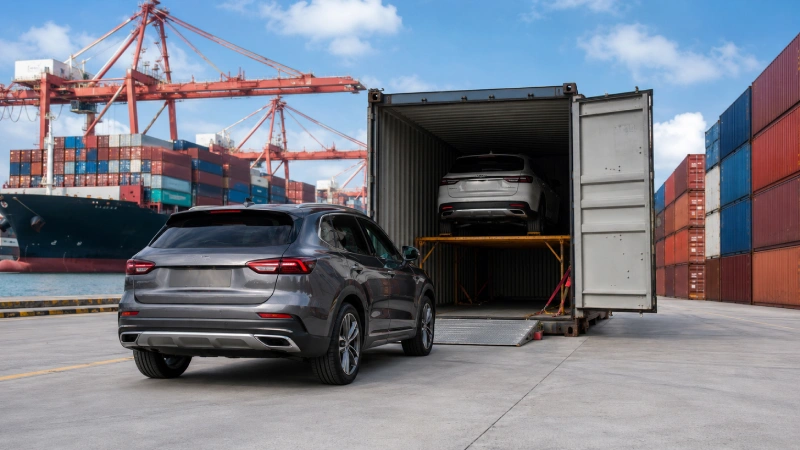
Cars can be exported from China in 20ft, 40ft and 40HQ containers. This method is particularly suitable for high-value vehicles, small batches, some used or non-running cars, and destinations with limited RoRo coverage.
However, placing a vehicle inside a container does not automatically make it acceptable for export, ocean carriage or destination import. Vehicle dimensions, condition, propulsion type, dangerous-goods classification, carrier approval and destination regulations must all be checked before loading.
For an overview of available transport methods, read Vehicle Shipping from China.
What Is Container Car Shipping from China?
Container car shipping involves loading one or more vehicles into an ocean freight container at a professional facility in China. The vehicles are inspected, positioned, blocked and secured before the container is sealed, declared to customs and delivered to the port.
The container then travels on a conventional container vessel. After arrival, it is cleared through customs and transported to an approved facility for unloading and empty-container return.
Most shipments use FCL, where one shipper controls the container. Specialist vehicle consolidation may combine several vehicles, but it is not the same as ordinary LCL cargo. Vehicle consolidation still requires a coordinated loading plan, compatible declarations, professional securing and approval from the ocean carrier.
When Should You Ship a Car by Container?
| Shipment situation | Container suitability | Main reason |
|---|---|---|
| One high-value, luxury or classic car | High | Enclosed transport and less terminal handling |
| Two or more standard passenger cars | Conditional | May reduce the complete cost per vehicle |
| Destination without stable RoRo services | High | Container services generally cover more ports |
| Used petrol or diesel vehicle | Usually workable | Subject to export, fuel and import checks |
| Used EV or hybrid vehicle | Conditional | Requires classification and carrier review |
| Accident- or battery-damaged EV | Low or prohibited | Elevated fire and acceptance risk |
| Oversized engineering vehicle | Low for standard containers | Flat rack, open-top or RoRo may be required |
Container shipping can also be useful when declared spare parts need to travel with the vehicles or when protection from weather and repeated port handling is important.
It does not remove export licensing, dangerous-goods documentation, carrier acceptance or destination import restrictions.
20ft vs 40ft Container for Cars
A 20ft dry container is commonly planned for one standard passenger car. A 40ft or 40HQ container is commonly planned for two cars loaded at floor level.
Loading three or four vehicles normally requires a professionally designed rack or tiered system. The result depends on vehicle length, height, ground clearance, weight distribution, rack certification, loading-yard capability and carrier approval.
A 40HQ provides additional internal height, but it does not automatically accommodate one more car. Door height and width can be more restrictive than the theoretical internal volume. ONE lists a typical dry-container door width of approximately 2,340 mm while warning that actual specifications can vary by equipment manufacturer and container series.
SUVs, pickups, vans and sports cars must therefore be calculated separately. For detailed vehicle combinations, read How Many Cars Fit in a Shipping Container.
Final capacity should always be based on the dimensions, kerb weight and wheelbase of every vehicle, together with the specifications of the container actually released for loading.
Which Vehicles Can Be Shipped in Containers?
| Vehicle type | Container transport | Main checks |
|---|---|---|
| New ICE vehicle | Usually possible | Fuel, leakage and SP961/SP962 |
| Used ICE vehicle | Usually possible | VIN, condition, ownership and import eligibility |
| New BEV | Conditional | Correct UN entry and DG approval |
| HEV or PHEV | Conditional | Fuel system and applicable UN3166 entry |
| Used BEV | Case-by-case | Age, battery condition, photographs and survey |
| Non-running ICE vehicle | Conditional | Steering, braking and safe handling plan |
| Accident- or flood-damaged EV | Commonly rejected | Possible battery or electrical damage |
| Oversized vehicle | Standard container may not work | Open-top, flat rack, RoRo or project cargo |
A vehicle that physically fits inside a container may still be rejected by the carrier. Modified vehicles, recalled units, flood-damaged cars, burned vehicles, damaged battery packs and vehicles that cannot be safely steered or braked must be disclosed before booking.
Some carriers may accept used EVs or hybrids after an independent inspection. Requirements must still be reconfirmed for the actual loading port, vessel and sailing date.
EV and Hybrid Car Container Shipping Requirements
Correct UN Classification in 2026
IMDG Code Amendment 42-24 became mandatory on January 1, 2026. The amendment introduced dedicated entries for complete battery-powered vehicles:
- Lithium-ion-battery-powered vehicles: UN3556, Class 9
- Lithium-metal-battery-powered vehicles: UN3557, Class 9
- Sodium-ion-battery-powered vehicles: UN3558, Class 9
- Hybrid and plug-in hybrid vehicles with an internal combustion engine: generally assessed under the applicable UN3166 entry
- Vehicles powered by wet batteries, metallic sodium or sodium alloys: UN3171, where applicable
The formal IMO amendment makes clear that UN3171 no longer covers ordinary lithium-ion or sodium-ion battery electric vehicles. The Dangerous Goods List assigns packing instruction P912 to UN3556, UN3557 and UN3558. Special Provisions 961 and 962 then determine whether a vehicle qualifies for an exemption or must be transported under the applicable Class 9 requirements.
Therefore, the following statements are inaccurate:
- All electric vehicles should still be declared as UN3171.
- Every new-energy vehicle should be declared as UN3556.
- A hybrid vehicle can automatically be treated as a pure battery electric vehicle.
- A vehicle becomes ordinary cargo simply because it is loaded inside a container.
SP961 vs SP962
SP961 may exempt a qualifying vehicle from certain IMDG requirements, but every condition must be evaluated carefully.
One SP961 provision applies to vehicles stowed in designated vehicle spaces on RoRo vessels. An ordinary freight container is not automatically treated as an approved RoRo vehicle space.
SP961 also contains fuel-related conditions. A vehicle using fuel with a flashpoint of 38°C or above may qualify when there is no leakage, the permitted fuel quantity is not exceeded and the battery is protected against short circuit.
For fuel with a flashpoint below 38°C, such as petrol, the fuel tank generally needs to be emptied and drained so that the vehicle cannot operate because it contains no fuel. Vehicles that do not meet SP961 are handled under SP962 and the applicable UN entry.
Diesel, petrol, LPG, LNG and hybrid vehicles should not be placed under one generic “fuel vehicle” rule. Classification must reflect the actual fuel system, fuel condition and vehicle configuration.
Carrier Approval Comes After Classification
Correct IMO classification does not guarantee carrier acceptance. The carrier may request:
- Dangerous Goods Declaration
- Container Packing Certificate
- Battery type and capacity information
- SDS or UN38.3 battery documentation
- Current SOC declaration
- Vehicle and battery photographs
- Third-party inspection report
- Letter of Indemnity
- Confirmation of vehicle age or first-use date
- Container placarding details
There is no single SOC percentage that should be presented as a universal IMO rule for every complete electric vehicle shipment. The applicable SOC limit may depend on the carrier, terminal, vessel, transshipment port, vehicle condition and OEM procedures. Confirm the required state of charge in writing with the actual ocean carrier before loading.
For more detailed EV guidance, read How to Ship Electric Cars from China by Sea.
China’s export licensing rules are a separate issue. From January 1, 2026, export licence administration applies to the specified category of pure-electric passenger vehicles with a VIN, using reference customs code 8703801090. This does not cover every vehicle, every new-energy vehicle or every HS code. A freight forwarder may coordinate documentation but cannot issue or replace the exporter’s licence.
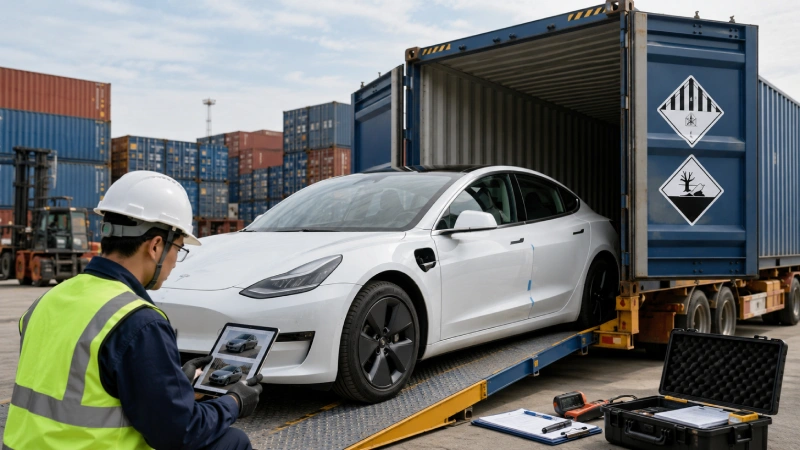
Container Car Shipping Process from China
A professional shipment normally follows these steps:
- Confirm that the vehicle meets destination-country import rules.
- Verify the Chinese exporter, HS code, VIN and applicable licensing requirements.
- Collect the model, dimensions, weight, powertrain, battery, SOC and condition information.
- Select a 20ft, 40ft or 40HQ container and prepare the loading layout.
- Submit the vehicle and dangerous-goods information to the actual carrier.
- Arrange domestic pickup, VIN verification and condition photographs.
- Inspect the empty container and professionally load, block, brace and lash the vehicles.
- Record the seal, calculate VGM, complete customs clearance and finalize dangerous-goods documents.
- Deliver the container before customs, DG and terminal cut-off times.
- Arrange destination clearance, container pickup, unloading, empty return and final vehicle delivery.
The shipper is responsible for providing the verified gross mass, and a container generally cannot be loaded without a valid VGM. VGM acceptance does not replace customs, dangerous-goods or carrier approval.
It is also important to separate three milestones:
- Booking confirmation
- Dangerous-goods or vehicle pre-approval
- Final permission to load the container
A booking confirmation does not always mean the vehicle has received final loading approval. A container can still be rejected if its declaration, placards, vehicle condition or gate-in inspection differs from the approved file.
How Cars Are Loaded and Secured Inside a Container
Before loading, the team should inspect the container structure, floor, doors, locking bars, seals and any old dangerous-goods marks. Each VIN and the vehicle’s external condition should be photographed and recorded.
The loading method must suit the vehicle’s weight and ground clearance. The layout must maintain appropriate weight distribution, door clearance, access to securing points and separation from the container walls and other vehicles.
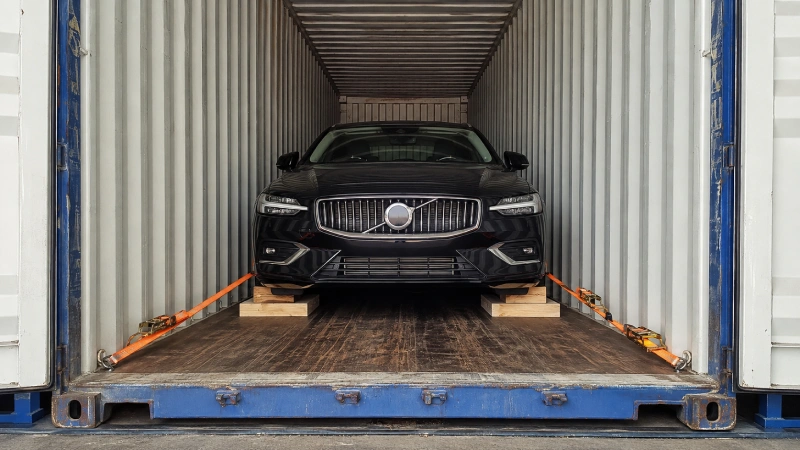
Professional securing may use wheel chocks, timber blocking, structural supports and rated lashing equipment attached to suitable points. The handbrake or “Park” position is not sufficient by itself.
The securing system must prevent longitudinal and lateral movement without damaging the tyres, suspension, bodywork or EV battery enclosure. Spare parts must be separately declared, packed and secured.
After loading, photographs should record the vehicle positions, restraints, container number and seal number.
The IMO, ILO and UNECE CTU Code provides international guidance for packing and securing cargo throughout the intermodal transport chain. It addresses risks including insufficient securing, poor weight distribution and incorrect cargo information, but carriers and local authorities may impose additional requirements.
Documents Required for Container Car Shipping
Vehicle and Export Documents
- Commercial invoice
- Packing list
- Sales contract
- VIN list and vehicle specifications
- Export customs documents
- Export licence or exporter qualification documents, when applicable
- Certificate of origin, when required
- Manufacturer documents for new vehicles
- Ownership or transfer documents for used vehicles
Shipping Documents
- Booking confirmation
- Shipping Instructions
- Bill of Lading
- Verified Gross Mass
- Container seal record
- Loading photographs
- Lashing record or survey report
Dangerous Goods Documents
- Dangerous Goods Declaration
- Container or Vehicle Packing Certificate
- SDS, UN38.3 report or battery data requested by the carrier
- SOC declaration
- Letter of Indemnity
- Vehicle or battery inspection report
Not every shipment requires every document. The final checklist depends on the vehicle type, classification, carrier, loading port, transshipment ports and destination-country requirements.
Main Container Ports for Vehicle Exports from China
Common options include Shanghai, Ningbo-Zhoushan, Shenzhen, Guangzhou Nansha, Qingdao, Tianjin, Xiamen and Taicang.
The port should not be chosen by size alone. Important factors include:
- Vehicle location and domestic transportation cost
- Container availability
- Vehicle loading-yard capability
- New-energy-vehicle dangerous-goods procedures
- Actual carrier acceptance policy
- Direct or transshipment routing
- DG and terminal cut-off times
- Destination-port coverage
China also has rail-sea movements under which vehicles are packed inland and exported without opening or changing the container. One reported example involved vehicles packed in Wuhan and transported through Xiamen under a “one-container-through” arrangement.
How Much Does Container Car Shipping from China Cost?
A complete quotation should follow this structure:
Total logistics cost = China inland transport + loading and securing + export and DG charges + ocean freight + insurance + destination charges + customs and taxes + final delivery
The total varies according to:
- Port of loading and port of discharge
- 20ft, 40ft or 40HQ equipment
- Number and dimensions of vehicles
- Floor loading or rack loading
- ICE, BEV, HEV or PHEV classification
- New, used or non-running condition
- Direct or transshipment service
- Current ocean freight market
- Dangerous-goods surcharges
- Destination unloading and empty-return arrangements
Origin costs may include pickup, empty-container collection, loading-yard charges, inspection, securing materials, customs filing, VGM, terminal handling and seal charges.
Destination costs may include THC, DG handling, inspection, unpacking, storage, demurrage, detention, customs duties, VAT and delivery.
When comparing a 20ft and a 40ft container, compare the complete logistics cost per vehicle—not only the ocean-freight rate.
Transit Time and Booking Lead Time
The complete lead time includes vehicle or dangerous-goods review, pickup, inspection, loading, customs clearance, origin-port waiting, ocean transit, transshipment, destination clearance, unloading and delivery.
A carrier’s published port-to-port transit time should not be presented as a door-to-door estimate. EV review, DG cut-offs, transshipment approval and destination inspections may add several days or more to the total schedule.
Destination Customs and Container Unloading
Import eligibility should be confirmed before booking. The consignee should appoint a customs broker and arrange a facility where the container doors can be opened safely and the vehicles can be unloaded without damage.
The destination plan should confirm:
- Whether unpacking inside the port is permitted
- Available free time
- Demurrage and detention conditions
- Required unloading equipment
- Safe removal of the lashing system
- Empty-container return location and deadline
Saudi Arabia applies controls relating to vehicle age, energy efficiency, condition and supporting documentation. For many light vehicles, the permitted model age is generally limited, while the import process uses chassis or VIN information and ownership or shipping documents.
Kenya generally requires imported used vehicles to be less than eight years old from the year of first registration, to be right-hand drive and to undergo pre-shipment roadworthiness inspection by an appointed inspection agent.
A shipping service to a particular port does not prove that the vehicle can be legally imported, registered or operated in that country.
Main Risks and How to Reduce Them
The main risks include:
- Carrier rejection or unsuccessful DG approval
- Incorrect UN number or propulsion-type declaration
- Inconsistent VIN, invoice, packing list or Bill of Lading information
- Vehicle movement inside the container
- Damage caused by racks or lashings
- Abnormal battery condition
- Condensation and corrosion
- Inadequate destination unloading equipment
- Customs delays and demurrage
- Destination rejection of damaged or non-compliant vehicles
- Insufficient marine insurance
A sealed container can reduce repeated handling, weather exposure and unauthorized access. It does not eliminate fire, water ingress, container loss overboard, collision, general average or damage caused by inadequate internal securing.
Risk should be reduced through early destination checks, written carrier acceptance, professional loading, complete condition records and insurance suited to the actual shipment.
Container Shipping vs RoRo: Which Is Better?
Container shipping offers enclosed transport, broad liner-network coverage and greater control for high-value vehicles or small batches. However, professional loading and destination unpacking make the operation more complex.
RoRo allows operational vehicles to be driven onto and off the vessel and may be efficient for larger volumes. It depends on dedicated routes, vehicle operability and the RoRo operator’s acceptance policy.
Compare both methods in Container vs RoRo Shipping.
How Winsail Supports Container Vehicle Shipments
Winsail can coordinate:
- Vehicle pickup within China
- Vehicle and battery information review
- Container type and loading-plan communication
- Enquiries with the actual carrier
- Booking and shipment coordination
- Vehicle loading and professional securing
- Loading photographs and seal records
- Export customs and transport-document coordination
- Destination-agent and delivery handover
Winsail does not issue export licences, approve dangerous goods, guarantee carrier acceptance or replace the importer’s responsibility for destination customs clearance and vehicle registration.
FAQ
Can I ship a car from China in a container?
Yes. The shipment can proceed when the vehicle satisfies Chinese export requirements, carrier acceptance criteria, container-loading limitations and destination import regulations.
How many cars fit in a 20ft or 40ft container?
A 20ft container commonly carries one standard passenger car. A 40ft or 40HQ commonly carries two cars at floor level. Three or four vehicles require compatible dimensions, a professional rack system and approval.
Is a 20ft or 40ft container better for one car?
A 20ft is usually the starting option for one standard car. A 40ft may be more economical when another approved vehicle or declared spare parts are included, but the complete landed cost should be compared.
Can electric cars be shipped from China in containers?
Yes, subject to correct UN classification, battery disclosure, dangerous-goods review, SOC instructions, container placarding and written carrier acceptance.
Can used or non-running cars be shipped in containers?
Sometimes. Used vehicles require condition and eligibility checks. Non-running vehicles need a safe loading and unloading plan. Accident-damaged, flood-damaged or battery-damaged EVs face much stricter restrictions and may be rejected.
Can spare parts or personal items be loaded with the car?
Only when permitted by the carrier, customs authorities and destination country. Every item must be declared, appropriately packed and independently secured. Some carriers and destinations prohibit personal effects inside vehicle containers.
How much does container car shipping from China cost?
There is no reliable universal price per vehicle. The route, container type, number of vehicles, loading system, dangerous-goods status, market freight rate and destination charges determine the final cost.
How long does it take to ship a car from China by container?
The schedule includes document and carrier review, pickup, loading, customs clearance, port waiting, ocean transit, transshipment, destination clearance, unloading and delivery. Port-to-port transit is only one part of the total lead time.
