
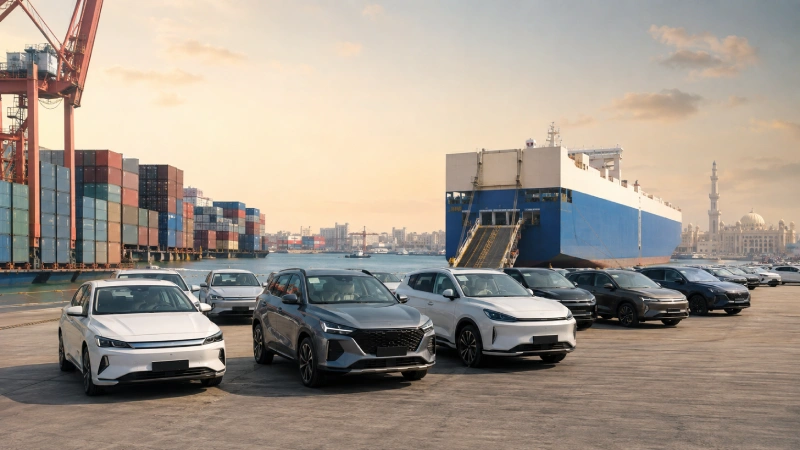
Shipping cars from China to Iraq is possible for private buyers, vehicle dealers, fleet operators and commercial importers, but the process has become more compliance-driven in 2026. Umm Qasr remains the main maritime gateway for Federal Iraq, while container and RoRo options may both be considered depending on the vehicle and sailing schedule.
Before requesting freight rates, however, importers should determine whether the vehicle will enter Federal Iraq or the Kurdistan Region. Import licensing, vehicle eligibility, technical conformity, customs treatment and registration requirements may differ between the two jurisdictions.
For a broader overview of export methods, see Vehicle Shipping from China.
Quick Answer: Can You Ship a Car from China to Iraq?
Yes. Cars can be shipped from China to Iraq, provided both the Chinese export requirements and Iraqi import requirements are satisfied.
The Iraqi importer may need a valid vehicle import licence, while the vehicle itself must meet applicable rules covering model year, left-hand-drive configuration, vehicle history and technical conformity. Fuel vehicles, hybrids and battery electric vehicles may also follow different approval paths.
Most importantly, carrier acceptance is not the same as customs or registration approval.
Import eligibility and vehicle conformity should be checked before comparing freight rates.
Federal Iraq or the Kurdistan Region?
One of the first questions for any China-to-Iraq vehicle shipment should be:
Is the vehicle being imported into Federal Iraq or the Kurdistan Region?
These should not be treated as identical import markets.
| Item | Federal Iraq | Kurdistan Region |
|---|---|---|
| Common entry routes | Umm Qasr, Khor Al-Zubair | Turkey or Iran borders; some cargo via Umm Qasr |
| Main authorities | Federal Customs, COSQC, Ministry of Trade | KRG Customs, Ministry of Interior and regional authorities |
| Model-year rules | Confirm under federal rules and 2026 vehicle standards | Confirm current KRG rules by vehicle category |
| Customs | Imported vehicles currently generally subject to 15% federal customs duty | Do not automatically apply federal rates |
| Registration | Federal traffic registration system | KRG vehicle registration system |
A vehicle’s final destination does not necessarily determine its customs jurisdiction. For example, a vehicle destined for Erbil could enter through different corridors, each creating different customs, transport and registration implications.
The route should therefore be agreed with the Iraqi importer and local clearing agent before purchasing the vehicle.
Who Can Import a Car into Iraq?
Iraq provides different vehicle-import procedures for individuals, companies and certain special categories.
Personal Import
An Iraqi individual may be able to import a vehicle using the personal import procedure. Typical requirements include an Iraqi National Card, Residence Card and an approved vehicle import licence submitted through the relevant electronic system.
The importer name should remain consistent across the import licence, commercial documents and customs declaration.
Commercial Import
Companies importing vehicles commercially generally need valid company registration, importer status and the appropriate business activities.
Applications may include information such as:
- Number of vehicles
- Country of origin
- HS code
- Intended customs entry point
- Vehicle category
- Importer details
The licensing mechanism is administered through the relevant Iraqi Ministry of Trade system. Importers should confirm the latest procedure directly with the Iraq Ministry of Trade or their licensed local agent.
Diplomatic, disability-related, government and project imports may use separate procedures and should not be treated as standard commercial shipments.
Which Cars Are Eligible for Import into Iraq?
Vehicle eligibility cannot be determined from model year alone.
| Vehicle category | Main risks | Check before shipment |
|---|---|---|
| New gasoline/diesel passenger car | Model year, TR 167, conformity | VIN, production date, model documents |
| Used passenger car | Age, history, damage | First registration, VIN history, accident records |
| Battery electric vehicle | Technical approval, China licence, carrier review | Battery, charging system, model acceptance |
| Hybrid vehicle | Vehicle classification and technical requirements | HEV, PHEV, REEV or MHEV type |
| Pickup/light commercial vehicle | Weight and vehicle category | GVW, seats, chassis information |
| Truck or bus | Category-specific restrictions | Actual weight, GVWR, purpose |
| Special vehicle | Equipment or project classification | Dimensions, function, chassis and certification |
A common mistake is assuming that every vehicle within a certain two- or three-year age range is automatically permitted.
Iraq’s 2026 vehicle standards apply to relevant 2025-model-year and later vehicles, but this does not create a universal nationwide rule stating that every 2025 or 2026 vehicle is automatically importable.
Before purchase, confirm the model year, manufacture date, first-registration date, vehicle category, new or used status, customs jurisdiction and intended entry point.
2026 Iraqi Vehicle Standard and COSQC Compliance
Technical Requirement No. 167 has become an important part of vehicle compliance in Iraq.
The standard focuses on safety and technical areas such as braking, airbags, lighting, emissions, fuel economy, noise and suitability for Iraqi operating conditions. Vehicle identification, make, model and specification should also correspond with the submitted conformity documents.
Depending on the vehicle, importers may need supporting documents such as GSO-related vehicle information, test reports, a whole-vehicle Certificate of Conformity, model approval documentation or additional COSQC assessment.
The Iraq Ministry of Planning has confirmed the mandatory introduction of the new vehicle specification framework.
This is particularly important for Chinese domestic-market vehicles. A vehicle may be legally exportable from China without automatically having the exact whole-vehicle conformity documentation required in Iraq.
A generic export certificate is not necessarily the same as Iraqi whole-vehicle conformity approval.
Electric and hybrid vehicles should be checked separately because their technical requirements may follow dedicated or transitional procedures.
Damaged Cars, Salvage Titles and Right-Hand-Drive Vehicles
Buying a heavily damaged vehicle because it is cheaper can create major import problems.
Vehicles presenting particularly high risk include:
- Major-accident vehicles
- Flood-damaged vehicles
- Fire-damaged vehicles
- Seriously damaged or unsafe vehicles
- Right-hand-drive vehicles
- Steering-converted vehicles
- Vehicles with inconsistent VIN or ownership documents
- EVs with damaged or water-exposed battery systems
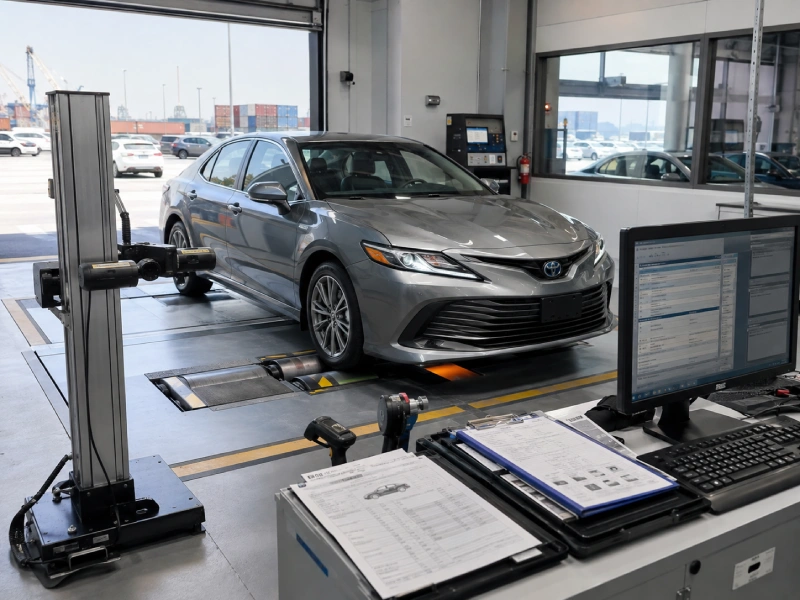
Before shipment, obtain VIN history, accident records, photographs, title or registration documents and information about airbag, structural and battery condition.
A low purchase price does not make a salvage vehicle legally importable into Iraq.
Iraq is a right-side-driving market. Factory-built left-hand-drive vehicles are the appropriate choice. Converting a right-hand-drive vehicle after production can create inconsistencies involving steering systems, lights, airbags, VIN specifications and conformity documents.
China-Side Export Requirements in 2026
Chinese export compliance must be completed independently from Iraqi import approval.
Depending on whether the vehicle is new, used, gasoline-powered, hybrid or electric, the exporter may need specific qualifications and export licensing.
From January 1, 2026, China’s export-licence regime also applies to qualifying pure electric passenger vehicles under the relevant commodity classification.
Used vehicles exported through China’s used-car process require the appropriate exporter qualifications and vehicle documentation. For vehicles registered for less than 180 days, additional after-sales service confirmation from the manufacturer may also be required.
The VIN, make, model and registration information should be consistent throughout the Chinese export documents.
A completed Chinese export declaration does not mean that Iraqi customs, COSQC or the vehicle-registration authority has approved the car.
Iraq Import Licence, ASYCUDA and Required Documents
A vehicle shipment normally involves documents from both China and Iraq.
China Export Documents
Common documents may include:
- Commercial invoice
- Packing list
- Sales contract
- Export customs declaration
- Vehicle registration or title
- Export licence, where applicable
- VIN and vehicle specifications
- Battery and dangerous-goods documents for applicable EV shipments
Iraq Import Documents
Depending on the shipment, documentation may include:
- Vehicle import licence
- Importer identification
- Bill of lading
- Certificate of origin
- Certificate of Conformity or model documentation
- Insurance documents
- ASYCUDA declaration
- Electronically verified supporting documents
- Customs-clearance authorization
Iraq is progressively digitizing customs procedures through ASYCUDA. The system supports electronic declaration, manifest information, pre-arrival risk review, licence and certificate verification and other customs processes. Further information is available from the Iraq Ministry of Finance ASYCUDA portal.
The importer name, exporter name, VIN, make and model, HS code, invoice value, origin, bill of lading, import licence and conformity information should match.
Document inconsistencies can delay customs clearance even when the vehicle itself is otherwise acceptable.
Best Ports and Routes for Shipping Cars to Iraq
Umm Qasr
Umm Qasr is the principal maritime gateway for vehicles entering Federal Iraq and is commonly used for shipments serving Basra, Baghdad, Najaf, Karbala and other central or southern markets.
Importers should confirm the exact terminal and customs center shown in the shipping documentation.
Khor Al-Zubair
Khor Al-Zubair may be evaluated for certain commercial vehicles, heavy units, project cargo or specialized vessels depending on the carrier and terminal arrangement.
Routes to the Kurdistan Region
For Erbil, Duhok or Sulaymaniyah, possible logistics structures include:
- Umm Qasr plus long-distance trucking
- A Turkish port plus cross-border road transport
- Sea-land routing through Iran
The lowest ocean freight is not always the lowest landed cost. Customs jurisdiction, internal border procedures, registration rules, inland distance and transport security should all be considered.
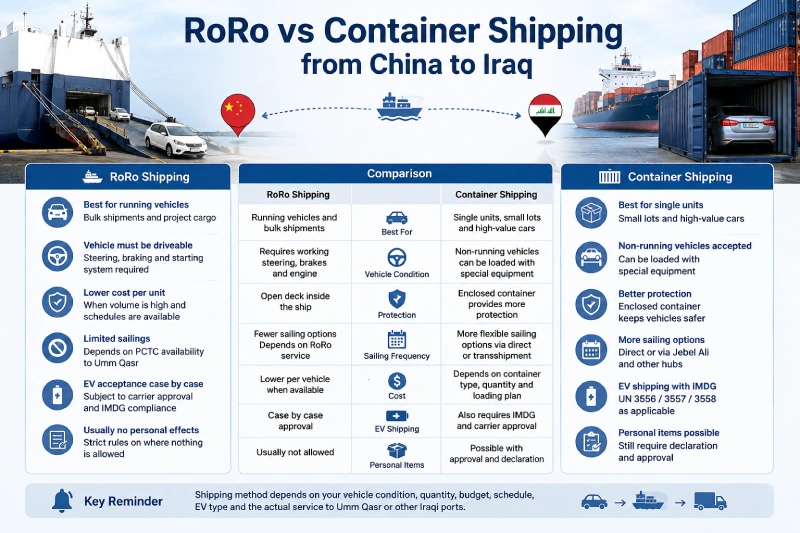
RoRo vs Container Shipping from China to Iraq
Both methods can work, but availability depends on the actual carrier network.
| Factor | RoRo | Container |
|---|---|---|
| Best for | Running vehicles and larger batches | Single units, small batches, higher-value cars |
| Sailing availability | Depends on actual PCTC schedules | Usually broader and more flexible |
| Vehicle condition | Usually must start, steer and brake | Non-running units may be evaluated |
| Protection | Vehicle deck inside vessel | Enclosed container |
| Personal items | Usually prohibited | Still subject to declaration and approval |
| EV acceptance | Carrier approval required | IMDG and carrier approval also required |
| Cost | Can be economical per vehicle | Depends on container and loading plan |
China-to-Iraq RoRo should not be advertised as a guaranteed direct service from every Chinese port. A port’s ability to handle RoRo vessels does not mean a suitable PCTC sailing is always available.
See RoRo Car Shipping from China and Container Car Shipping from China for detailed method comparisons.
Electric and Hybrid Vehicle Shipping Requirements
EV projects require additional checks at the export, transport and import stages.
First identify the actual powertrain: BEV, HEV, PHEV, REEV or MHEV. They should not automatically be treated as the same regulatory or dangerous-goods category.
For Federal Iraq, EVs and hybrid vehicles should no longer be assumed to be customs-duty-free in 2026. Their Iraqi technical conformity path should also be confirmed for the exact model.
China-side export licensing may apply to pure electric passenger vehicles, while vehicles registered for less than 180 days can require additional manufacturer documentation.
Under IMDG Code Amendment 42-24, relevant vehicle classifications include UN3556 for lithium-ion-battery-powered vehicles, UN3557 for lithium-metal-battery-powered vehicles and UN3558 for sodium-ion-battery-powered vehicles. Hybrid configurations may require different classification depending on the fuel and battery system.
Carriers may request battery chemistry, capacity, SOC, VIN, photographs, recall status and declarations confirming that the battery is not damaged.
Importers should also examine charging compatibility, high-temperature battery management, diagnostic support, software, spare parts and warranty arrangements in Iraq.
See Electric Vehicle Shipping from China for more information.
Car Shipping Cost and Iraq Import Duty
There is no single reliable “China to Iraq car shipping cost” without vehicle and route details.
Freight-related costs can include:
- Vehicle pickup in China
- Vehicle inspection
- Export licensing and documentation
- Chinese port and customs charges
- Container loading or RoRo handling
- Ocean freight
- EV or dangerous-goods surcharges
- Insurance
- Transshipment costs
- Iraq destination charges
- Inland delivery
For Federal Iraq, imported vehicles are currently generally assessed at a 15% customs duty, including EVs and hybrid vehicles that previously benefited from preferential treatment.
The final assessment should still be confirmed against the VIN, HS code, customs value, vehicle category, origin and customs entry point. Kurdistan Region treatment should be checked separately.
A practical landed-cost formula is:
Vehicle price + China inland transport + export compliance + loading and port charges + ocean freight + insurance + Iraq customs duty + conformity and inspection + port and broker fees + storage + registration + inland delivery
Customs valuation should not be based on an assumption that an unusually low invoice value will automatically be accepted.
Step-by-Step Car Shipping Process
A safer shipping process is:
- Determine Federal Iraq or Kurdistan Region.
- Confirm the personal or commercial importer.
- Obtain written guidance from the local clearing agent.
- Check model year and manufacture date.
- Verify VIN, left-hand drive and vehicle history.
- Confirm TR 167, GSO or model documentation.
- Estimate HS code, customs value and taxes.
- Make import-licence approval a purchase condition.
- Complete Chinese exporter eligibility and licensing.
- Prepare vehicle conformity documentation.
- Prepare ASYCUDA and document verification.
- Select Umm Qasr or an alternative route.
- Obtain carrier approval, including EV review.
- Complete inspection, loading, securing and insurance.
- Issue and check the bill of lading.
- Complete arrival clearance, inspection, duty payment and vehicle registration.
Treating these steps as separate approvals helps prevent the common situation where a vehicle can leave China but cannot legally clear or register in Iraq.
Transit Time from China to Iraq
For planning purposes, a complete project may take approximately 45–70 days or longer.
Typical ranges may include:
- China pickup and export preparation: 7–20 days
- Container shipping to Umm Qasr: about 25–40 days
- Routes requiring less convenient connections: about 35–50 days
- RoRo: commonly 30–50 days or longer depending on PCTC schedules
- Iraq clearance and release: around 7–21 days or more
Delays may result from import licensing, COSQC review, document verification, customs valuation, EV carrier approval, transshipment connections, Umm Qasr congestion or inland checkpoints.
Pre-Purchase Checklist
Before paying the Chinese seller, confirm:
- [ ] Federal Iraq or Kurdistan Region
- [ ] Personal or commercial importer
- [ ] Vehicle import-licence status
- [ ] Exact model year
- [ ] Manufacture and first-registration dates
- [ ] Factory-built left-hand drive
- [ ] VIN and title history
- [ ] No major accident, flood or fire history
- [ ] Iraqi or GSO conformity documentation
- [ ] Chinese export eligibility
- [ ] BEV, HEV, PHEV or other powertrain type
- [ ] Battery condition and charging compatibility
- [ ] Correct HS code
- [ ] Federal or KRG customs estimate
- [ ] ASYCUDA readiness
- [ ] Carrier acceptance
- [ ] Registration eligibility
- [ ] Full landed-cost estimate
Common Mistakes to Avoid
Import problems often begin before the vehicle reaches the port.
Avoid:
- Checking only the model year
- Treating Federal Iraq and Kurdistan as one system
- Paying before confirming import licensing
- Buying steering-converted vehicles
- Buying serious accident, flood or fire vehicles
- Treating a generic CoC as whole-vehicle approval
- Using the old 5% customs assumption
- Assuming EVs remain automatically duty-free
- Ignoring ASYCUDA and electronic document requirements
- Assuming direct China–Umm Qasr RoRo is always available
- Comparing only ocean freight instead of total landed cost
How Winsail Coordinates Car Shipping to Iraq
Winsail can coordinate the logistics side of vehicle shipping from China to Iraq by collecting vehicle information, arranging China pickup, checking export documentation and comparing container, RoRo or special-vehicle solutions.
We can also coordinate loading, securing, export customs clearance, insurance, carrier acceptance requests for EVs, documentation with the Iraqi importer and destination-agent arrangements around Umm Qasr and inland delivery.
However, the Iraqi importer and relevant authorities remain responsible for import licensing, COSQC approval, customs valuation and final vehicle-registration decisions.
Frequently Asked Questions
Can I ship a used car from China to Iraq?
Yes, but used-car eligibility depends on more than age. The model year, manufacture and first-registration dates, vehicle history, technical conformity, customs jurisdiction and condition should all be checked before purchase.
What model year can be imported into Iraq in 2026?
Iraq's 2026 vehicle-standard framework applies to relevant 2025-model-year and later vehicles, but it should not be interpreted as a complete nationwide model-year rule. Confirm the vehicle category, entry point and Federal or KRG requirements with the clearing agent.
Can an individual import a car into Iraq?
Yes. Personal vehicle imports are possible, but the importer normally needs the applicable Iraqi identification documents and vehicle import licence and must follow the relevant electronic application procedure.
Can damaged or salvage cars be imported?
Major-accident, flood-damaged, fire-damaged and seriously unsafe vehicles face import prohibitions or rejection risk. Even minor damage should be checked against VIN history and the applicable inspection requirements.
Can a right-hand-drive car be imported into Iraq?
Right-hand-drive vehicles should not be treated as a normal import option. Buyers should source factory-built left-hand-drive vehicles rather than rely on steering conversions.
Is an electric car duty-free in Iraq?
Not under the current Federal Iraq treatment. Imported EVs and hybrid vehicles are currently generally subject to the 15% federal vehicle customs duty. KRG treatment should be checked separately.
Do vehicles need a Certificate of Conformity?
They may require COSQC conformity assessment, GSO-related documentation, model approval, a whole-vehicle CoC or other vehicle-specific evidence. The exact requirement depends on the model, category and powertrain.
Is RoRo or container shipping better for Iraq?
RoRo can be efficient for running vehicles when a suitable PCTC service exists. Container shipping generally offers broader scheduling flexibility and can be preferable for single vehicles, small batches, higher-value cars or some non-running units.
