
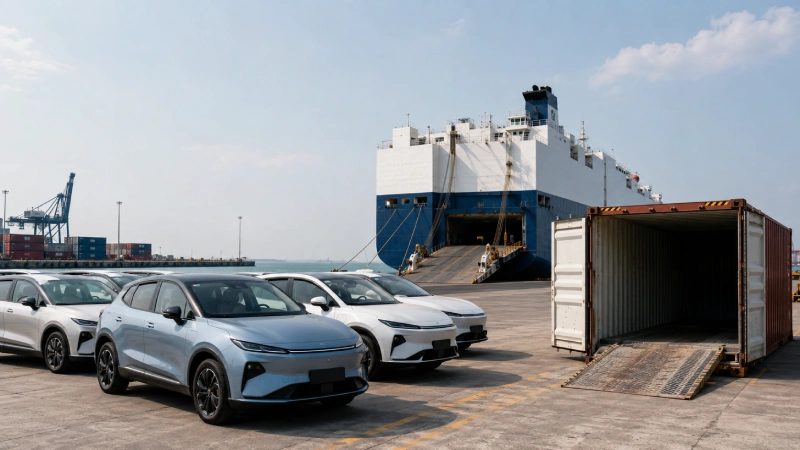
Electric vehicles can be exported from China, but an ocean booking does not prove that a vehicle may enter the destination, be registered locally, or be accepted by a carrier and every terminal on the route.
Before paying the balance or sending a vehicle to port, complete four checks in order:
Destination eligibility → China export eligibility → IMDG classification → Carrier and terminal acceptance
This guide covers BEVs, hybrids, plug-in hybrids, extended-range vehicles, and new and used units. It also corrects common assumptions about UN numbers, SOC, MSDS and UN38.3.
First Identify What Type of Electric Vehicle You Are Shipping
“New energy vehicle” is a policy and sales term, not an IMDG classification. Classification starts with the propulsion system, battery chemistry, fuel system and whether the battery remains installed.
| Vehicle type | Powertrain or battery | Initial sea-classification direction |
|---|---|---|
| BEV | Installed lithium-ion traction battery | UN3556 |
| BEV | Installed lithium-metal battery | UN3557 |
| Sodium-ion vehicle | Installed sodium-ion battery | UN3558 |
| HEV, PHEV or EREV | Battery plus fuel- or gas-powered engine | Usually UN3166 |
| Wet-battery vehicle | Wet-battery propulsion | Within UN3171’s retained scope |
| Spare or removed battery | Shipped separately | Classify as a battery, not a complete vehicle |
Do not classify from a sales name alone. Confirm the actual powertrain, chemistry, fuel system and condition. The shipper should make the final declaration with qualified dangerous-goods support and carrier confirmation.
Check Whether the Vehicle Can Be Imported Before You Buy It
Regulatory checks
Confirm whether the destination allows the brand, model, category and model year. Check new-versus-used rules, age limits, steering side, type approval, conformity certification, import permits, pre-shipment inspection, insurance and registration eligibility.
There is no single Middle East or Africa EV import standard. Saudi Arabia applies conformity requirements to covered electric vehicles exceeding 25 km/h under the SASO electric vehicle technical regulation. Kenya’s PVoC system can require pre-shipment inspection and a Certificate of Conformity. South Africa generally requires an NRCS Letter of Authority. Check taxes and incentives under rules expected at arrival.
EV usability checks
Verify the charging connector, AC and DC standards, voltage, infotainment language, connected services, updates and diagnostic access. Also confirm local parts, battery repair, workshops and overseas warranty validity.
Buyer concerns about fraud, hidden history, landed cost, charging access, range and after-sales support are useful demand signals, but not regulatory sources.
Can the Vehicle Be Legally Exported from China?
Pure electric passenger vehicle export licensing
From January 1, 2026, China’s export-license measure applies specifically to other passenger vehicles equipped solely with a driving electric motor and carrying a VIN, with reference to customs code 8703801090. It does not cover every product marketed as a new energy vehicle.
Verify both the vehicle and the actual Chinese exporter. Manufacturers, traders, approved used-vehicle exporters and freight forwarders have different roles. See the Ministry of Commerce pure electric passenger vehicle export licensing announcement. Winsail coordinates transport and document handover but does not issue export licenses.
New EV versus used EV
For a used vehicle, the VIN, registration, ownership, invoice and license data must match. Applicable vehicles first registered for 180 days or less may require a manufacturer-stamped After-Sales Maintenance Service Confirmation; this is not a blanket export ban.
Review How to Export Used Cars from China and the used-car export documents checklist.
How Electric Vehicles Are Classified Under IMDG 42-24
IMDG Amendment 42-24 became mandatory on January 1, 2026. Complete vehicles must be assessed by their actual battery and propulsion system rather than being placed broadly under UN3171.
UN3556, UN3557, UN3558 and UN3166
A vehicle with an installed lithium-ion traction battery is generally UN3556. Lithium-metal vehicles are UN3557 and sodium-ion vehicles are UN3558. HEVs, PHEVs and EREVs with a fuel- or gas-powered engine usually follow the relevant UN3166 entry.
UN3171 remains for vehicles or equipment powered by wet batteries, metallic-sodium batteries or sodium-alloy batteries. See the China MSA material implementing IMDG 42-24.
What SP961 means for RoRo shipments
SP961 can exempt a qualifying vehicle from most IMDG provisions when stowed in an approved vehicle, special-category or RoRo space, with no evidence of leakage. SP388 and P912 may still matter.
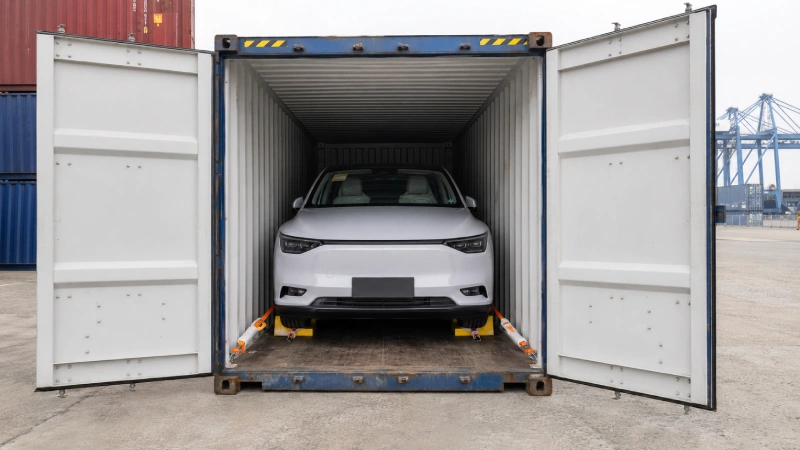
A vehicle in a freight container does not gain SP961 status merely because the container travels on a RoRo vessel.
What SP962 means for other shipments
When SP961 does not apply, the vehicle is generally handled under Class 9 and SP962. Protect the battery from damage and short circuit and prevent accidental activation. Marking and placarding depend on the configuration; carriers and terminals may impose stricter instructions.
P912 loading and securing
P912 addresses movement, overturning, unintended operation and battery damage. A vehicle of at least 30 kg net mass may travel unpackaged under specified conditions when upright and adequately protecting its battery. A wooden crate is not universally required.
Myth: Every complete EV shipped by sea must be below 30% SOC.
Fact: IMDG sets no universal SOC limit for all complete vehicles. Follow the written carrier, terminal, route or insurer requirement.Myth: Every shipment needs a full UN38.3 report and MSDS.
Fact: The battery must meet applicable tests, and the UN38.3 test summary should be available. Upload requirements vary, and an MSDS is not universally required.
Do not make blanket claims about China’s dangerous-goods packaging certificate. Confirm the requirement with the loading port and relevant authority for the exact vehicle and packing method.
RoRo or Container—Which Method Should You Choose?
| Decision factor | RoRo | Container |
|---|---|---|
| Typical volume | One unit or vehicle batches | One unit, small batches or enclosed transport |
| Vehicle condition | Usually drivable or towable | More non-standard cases may be possible, subject to approval |
| Loading | Driven or towed on and off | Ramp or lifting plus professional securing |
| IMDG treatment | SP961 may apply in an approved space | Usually needs fuller classification and pre-approval |
| Extra cargo | Normally delivered without loose cargo | No undeclared parts, batteries or oils inside |
| Coverage | Limited by RoRo services | Wider network, but acceptance varies |
RoRo is not always cheaper, and a container is not automatically safer. Compare condition, quantity, routing, schedule, handling, insurance and total cost.
Choose the origin port according to vehicle location, carrier acceptance, destination and transshipment plan rather than naming one port as universally best. See RoRo ocean freight from China for a broader comparison. Air freight is mainly for urgent, high-value or special projects and follows separate IATA and airline rules.
Documents Required to Ship an Electric Vehicle from China
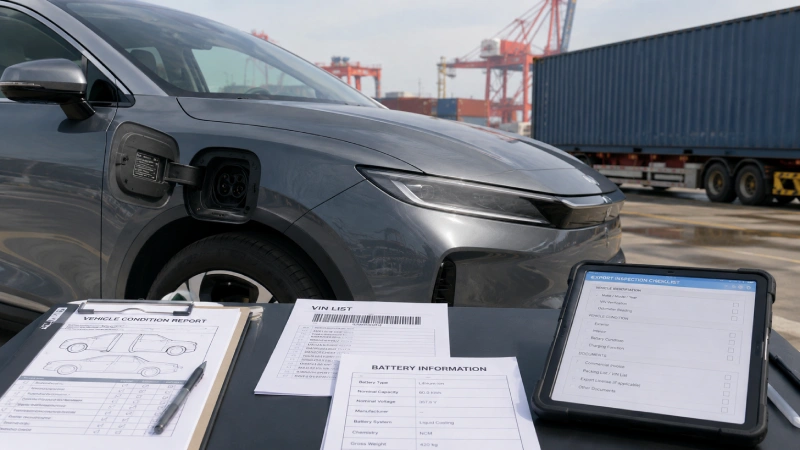
The final package depends on the vehicle, method, carrier, every terminal and the destination. Treat these as document groups, not a universal mandatory checklist.
China export and commercial documents
- Commercial invoice
- Packing list or VIN list
- Sales contract
- Export license where applicable
- Customs declaration information
- Used-vehicle registration and ownership records where applicable
Vehicle and battery information for carrier review
- Make, model, year and VIN
- BEV, PHEV, HEV or EREV identification
- Battery chemistry, capacity and manufacturer
- Dimensions and gross weight
- UN38.3 test summary or manufacturer evidence when requested
- Photographs, condition declaration and damage history
- Dangerous-goods declaration or packing certificate where applicable
Destination documents
- Import license
- Type approval or conformity certificate
- Pre-shipment inspection certificate
- Customs valuation, tax and registration documents
An MSDS or battery report alone does not prove that the carrier, terminals or destination authority will accept the shipment.
Step-by-Step Electric Vehicle Shipping Process
- Confirm destination import and registration eligibility.
- Check charging, software, diagnostics, parts, warranty and local service suitability.
- Identify new or used status and verify China export eligibility.
- Collect the VIN list, specifications, battery data and condition history.
- Assess the likely UN number, SP961 or SP962 status and transport method.
- Pre-check the carrier and every origin, transshipment and destination terminal.
- Compare feasible RoRo and container schedules, risks and total costs.
- Obtain written acceptance before arranging terminal delivery.
- Complete inspection, photographs, PDI, loading and professional lashing.
- Process customs, dangerous-goods formalities and transport documents.
- Check every VIN and party detail on the draft bill of lading.
- Prepare destination clearance, collection and local registration before arrival.
Do not deliver the vehicle to the terminal before carrier and terminal acceptance is confirmed. A rejected unit can create storage, inspection, return-transport and rebooking charges before sailing.
How Much Does EV Shipping from China Cost and How Long Does It Take?
A complete quotation can be structured as:
Vehicle pickup + export and document costs + origin handling and PDI + ocean freight + DG or approval charges + loading and lashing + insurance + destination charges
The total depends on quantity, dimensions, weight, running condition, powertrain, new or used status, transport method, pickup city, ports, carrier policy and battery or accident history.
Lead time should be divided into:
Export licensing and document preparation → carrier and terminal review → booking and gate-in waiting → ocean transit and transshipment → destination clearance and registration
Ocean transit time is not the complete door-to-port lead time. Document review, booking approval, terminal cut-off and destination clearance add separate time.
What Can Delay or Stop an EV Shipment?
Booking Rejection Checklist
- A PHEV or EREV is declared as UN3556
- A lithium-ion BEV is still declared under UN3171
- VIN, invoice, registration or license data does not match
- Collision, flood, fire or battery-repair history is hidden
- The battery is damaged or warning codes remain active
- Destination approval or import permission is missing
- The vehicle arrives before written acceptance
- SOC or MSDS rules are copied from another route
- Lashing does not meet P912 or carrier instructions
- Undeclared batteries, oils, parts or cargo are inside
- A transshipment or destination terminal was not checked
A damaged or defective lithium battery should generally be removed from the vehicle and transported under SP376 unless the competent authority approves another arrangement. Flooded, burned or battery-abnormal vehicles require disclosure and specialist review.
How Winsail Coordinates EV Shipping from China
Winsail can compare options based on vehicle location, quantity, condition and destination; coordinate pickup, inspection photographs and condition records; arrange RoRo or container booking; and connect loading, lashing, customs and dangerous-goods information.
Winsail does not issue Chinese automobile export licenses, replace the importer’s destination-market review, guarantee customs release or guarantee local registration. Final transport acceptance remains subject to carriers, terminals and competent authorities.
FAQ
Is an electric car classified as dangerous goods for sea shipping?
Battery-powered vehicles have Class 9 entries, but treatment depends on the battery, vehicle and stowage. SP961 may apply to a qualifying RoRo unit; other configurations generally require SP962 handling.
Should a lithium-ion electric car be declared under UN3556 or UN3171?
From January 1, 2026, a complete vehicle with an installed lithium-ion traction battery is generally UN3556. UN3171 remains for specified wet-battery, metallic-sodium or sodium-alloy battery vehicles.
Are hybrid and plug-in hybrid vehicles classified as UN3556?
Usually not when they also contain a fuel- or gas-powered engine. HEVs, PHEVs and EREVs generally require assessment under the applicable UN3166 entry.
Must an EV battery be below 30% state of charge for sea freight?
No universal 30% limit applies to every complete EV. Follow the written SOC condition for the selected carrier, terminals, route and insurer.
Do I need an MSDS and UN38.3 report to ship an electric car?
The battery must meet applicable tests, and the UN38.3 test summary should be available. Carrier uploads vary, and an MSDS is not universally required.
Is RoRo or container shipping better for electric vehicles?
RoRo may suit operational vehicles on supported routes. Containers offer enclosed handling and broader coverage but usually need more approval and lashing. Compare the exact vehicle, route and cost.
Can a damaged, flooded or non-running EV be shipped from China?
Possibly, but only after disclosure and technical review. Damaged or defective batteries may require removal and separate SP376 handling, while carriers may reject the vehicle.
How much does it cost to ship an electric vehicle from China to the Middle East or Africa?
There is no reliable flat price. Include pickup, documents, handling, approvals, freight, lashing, insurance and destination charges. Size, route, condition and carrier acceptance change the total.
