
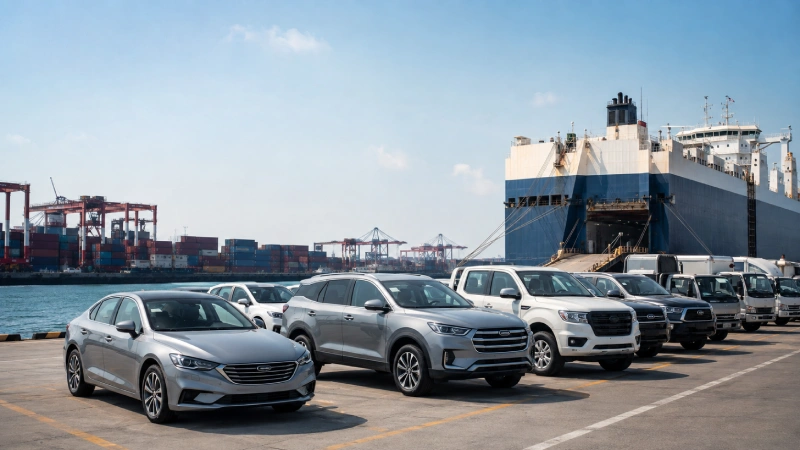
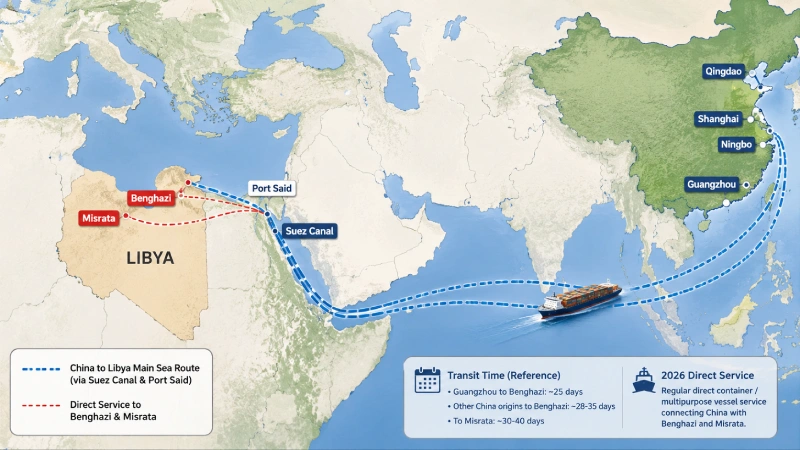
China has become an important sourcing market for passenger cars, SUVs, pickups, trucks and electric vehicles purchased by Libyan importers. In 2026, the launch of a regular direct China–Libya shipping service calling at Benghazi and Misrata also gives buyers more routing options.
However, successful car shipping from China to Libya involves much more than booking ocean freight. Before purchasing a vehicle, importers should confirm the Libyan importer route, manufacture date, original steering position, China export eligibility, ACI requirements, carrier acceptance, customs valuation and local registration conditions.
For a broader overview of vehicle export logistics, see Vehicle Shipping from China.
Quick Answer: Can You Ship a Car from China to Libya?
Yes. New and eligible used vehicles can be shipped from China to Libya, but the vehicle and transaction must pass several separate checks before loading.
These include:
- A legally eligible Libyan importer
- Correct new or used vehicle classification
- Eligible manufacture date and vehicle age
- Factory-built left-hand-drive configuration
- China export eligibility
- ACI and applicable payment documentation
- Shipping-line acceptance
- Libyan customs clearance and registration
Important: Do not pay for the vehicle until its manufacture date, original steering position, Libyan importer route and China export eligibility have been verified.
Libya’s Used-Car Age Limits Depend on the Importer and Vehicle
One of the most common mistakes in online guides is stating that all used vehicles entering Libya must be less than five years old.
That is not an accurate description of the current framework.
Libyan Customs continues to list Decision No. 148 of 2019 among its relevant government decisions. Under this framework, age limits depend on both the type of importer and the vehicle category. Buyers should therefore verify eligibility before purchasing rather than applying one age limit to every vehicle.
Personal-Use Imports
For personal use, an individual may generally import one used vehicle every three years, provided the vehicle is intended for personal use rather than commercial resale.
Passenger cars, family vehicles and light vehicles of up to four tonnes are generally subject to an age limit of approximately ten years.
Commercial Vehicle Imports
Commercial vehicle importers should have the appropriate automobile-import business scope and be registered through the applicable Libyan importer system.
Passenger cars, buses with up to 30 seats and light vehicles of up to four tonnes are generally limited to approximately eight years.
Larger buses, trucks, tractor units, trailers and vehicles above four tonnes are generally subject to an approximately seven-year limit.
| Import Route | Vehicle Category | General Age Limit |
|---|---|---|
| Personal use | Passenger cars, family vehicles, light vehicles ≤4 tonnes | Up to about 10 years |
| Commercial import | Passenger cars, buses ≤30 seats, light vehicles ≤4 tonnes | Up to about 8 years |
| Commercial import | Buses >30 seats, trucks, tractors, trailers and vehicles >4 tonnes | Up to about 7 years |
| Company operational use | Vehicles related to business activities | Confirm by vehicle type and actual project need |
How Vehicle Age Is Calculated
The manufacture date is the critical reference. Buyers should not rely only on the model year, first-registration year, Chinese invoice date, transfer date or shipment date.
For vehicles close to an age-limit boundary, provide the VIN, manufacturer plate photograph and expected arrival date to the clearing agent at the selected Libyan port and obtain written confirmation before purchase.
The relevant government decisions can be checked through the Libyan Customs cabinet decree directory.
Left-Hand Drive and Vehicle Checks Before Purchase
Right-Hand-Drive Vehicles Are Prohibited
Libya drives on the right side of the road, and Decision No. 148 prohibits the importation of right-hand-drive motor vehicles.
For importing Chinese cars to Libya, buyers should therefore select factory-built left-hand-drive vehicles.
A vehicle that was originally manufactured as right-hand drive and later converted should not automatically be treated as compliant. Its specific VIN and conversion history should be reviewed by the Libyan clearing and registration agent before purchase.
Vehicle Identity Checklist
Verify the VIN, exact manufacture date, first-registration date, original steering position, new or used status, engine or powertrain type, accident history, flood or fire damage, recall status, dimensions and weight.
For long-term operation in Libya, also consider spare-parts availability, diagnostic support, dashboard language, software support and whether the original manufacturer configuration matches the export documents.
China Export Requirements for New and Used Cars
China export approval and Libya import approval are separate processes.
Exporting New Cars
A new vehicle should be exported by an eligible manufacturer or authorized export entity. The invoice, VIN, brand, model and customs information must be consistent throughout the export documentation.
Destination-market after-sales arrangements should also be reviewed where required.
Exporting Used Cars
Used-car exports require legitimate ownership and vehicle-source records, the appropriate transfer or deregistration procedures for export, and the applicable automobile export licence.
For used vehicles that have been registered for less than 180 days, a manufacturer-issued after-sales maintenance service confirmation may also be required. Failure to obtain it can affect China export-licence eligibility.
Pure Electric Passenger Cars
From January 1, 2026, certain pure electric passenger vehicles equipped only with traction electric motors and carrying a VIN, including vehicles under the relevant HS 8703801090 classification, are subject to China’s export-licence administration.
The applicable requirements should be checked against the latest MOFCOM automobile export licensing rules.
China export approval does not replace Libya’s ACI, import, customs or vehicle-registration requirements.
Which Libyan Port Should You Use?
The best Libyan port depends on the final destination, current sailing schedule, customs arrangements and total landed logistics cost.
Misrata
Misrata is now one of the ports served by the 2026 China–Libya direct service. It can be suitable for vehicle traders and buyers serving central and western Libya and has established container-handling capabilities.
Benghazi
Benghazi is particularly relevant for buyers in eastern Libya and is also included in the current direct China service.
A published Guangzhou-to-Benghazi direct-service example indicates a sailing time of approximately 25 days. This should be treated as a route example rather than a guaranteed transit time for every Chinese origin.
Tripoli, Al Khoms and Tobruk
Tripoli may remain suitable for cargo destined for the capital and surrounding areas, while Al Khoms can be evaluated for some western projects. Tobruk may be relevant for selected eastern cargoes and special services.
Do not choose a port based only on ocean freight. Compare sailing availability, ACI execution, terminal charges, clearing-agent experience, vehicle-handling capability, storage, inland distance and final-delivery conditions.
RoRo or Container Shipping from China to Libya?
Both methods can work, but actual availability should be confirmed for each shipment.
RoRo Shipping
RoRo Car Shipping from China is normally suitable for vehicles that can start, move, steer and brake under their own power.
It can be cost-effective for standard passenger cars and some commercial vehicles when suitable RoRo or PCTC space is available.
However, China–Libya RoRo sailings are not necessarily available on a fixed schedule from every Chinese port. Non-running vehicles and some EVs may be rejected, and undeclared personal goods or cargo should not be stored inside the vehicle.
Container Shipping
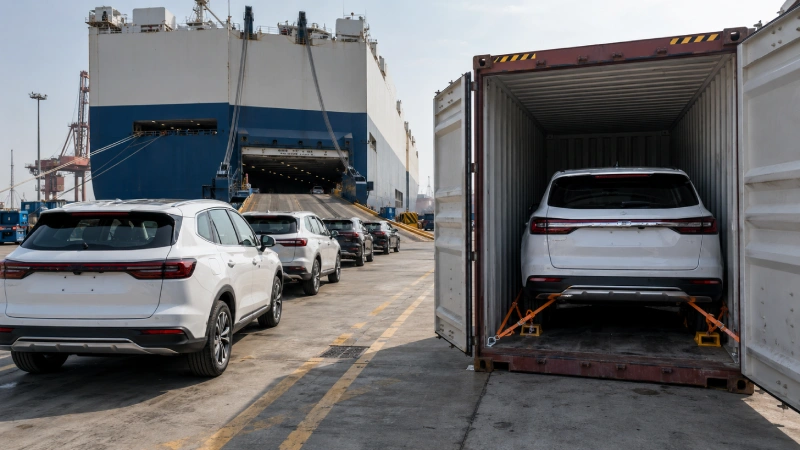
Container Car Shipping from China provides greater physical protection and can be attractive for higher-value vehicles, multi-car shipments and projects using the current direct services to Benghazi or Misrata.
Accurate dimensions and weight are required. Vehicles must be professionally secured with wheel chocks, lashing equipment and an appropriate loading plan. Verified Gross Mass requirements also apply to container shipments.
A 40HQ should not be advertised as carrying a fixed number of cars without checking vehicle dimensions and the proposed loading arrangement.
| Factor | RoRo | Container |
|---|---|---|
| Vehicle condition | Usually running vehicle required | Running or approved non-running vehicles possible |
| Protection | Vehicle exposed to terminal and vessel handling | Enclosed transport |
| Schedule | Depends heavily on actual RoRo service | Broader container-service options |
| Loading | Vehicle driven aboard | Professional blocking and lashing |
| Cost structure | Often based on vehicle size/volume | Container, loading and securing costs |
| EV acceptance | Carrier-specific | Carrier and DG approval required |
ACI, Inspection Certificates and Import Compliance
Complete ACI Before Loading
Libya operates an Advance Cargo Information system, or ACI, for advance submission of cargo and trade information.
Required information can include importer and exporter details, commercial invoices, certificate of origin information, cargo descriptions, HS codes, bill of lading information and loading and destination ports.
ACI should be dealt with before loading, not after arrival in Libya. Commercial container shipments should treat it as a key pre-shipment compliance item.
Current requirements can be checked through the Libyan Customs ACI service.
ACI should not be described as an ECTN certificate. The two concepts should not be used interchangeably.
For RoRo vehicles, personal-use shipments and special projects, the exact ACI execution method should be confirmed with the consignee, clearing agent and carrier.
When a Certificate of Inspection Is Required
Where imports are financed through a documentary letter of credit, an inspection certificate issued by an approved inspection company may be required under the applicable banking and trade-finance arrangement.
Confirm the payment method, issuing bank and inspection provider before loading.
What the Certificate Does Not Replace
An L/C Certificate of Inspection does not automatically confirm vehicle-age eligibility, left-hand-drive compliance, customs clearance, post-arrival technical inspection or registration.
These are separate checks.
Shipping Electric and Hybrid Cars to Libya
There is currently no reliable basis for stating that all electric vehicles imported into Libya are automatically exempt from customs charges.
EV buyers should confirm the vehicle HS code, customs value and current treatment with the clearing agent at the selected port.
For ocean transport, IMDG Code Amendment 42-24 became mandatory from January 1, 2026. Depending on battery chemistry and powertrain, vehicle classifications can include:
- BEV with lithium-ion battery: UN 3556
- Lithium-metal battery vehicle: UN 3557
- Sodium-ion battery vehicle: UN 3558
- Some hybrid or plug-in hybrid vehicles with fuel systems: UN 3166
Final dangerous-goods classification and acceptance remain subject to the shipping line and qualified DG personnel.
For more detail, see Electric Vehicle Shipping from China.
Before booking, prepare battery chemistry and capacity, state of health, carrier-required SOC information, battery technical sheets, accident and fire history, recall information and emergency-response data.
Libyan buyers should also check charging-interface compatibility, local charging equipment, software-region restrictions, remote-app availability, spare parts and repair support.
Documents Required
China-side documentation may include the commercial invoice, packing list, sales contract, export customs declaration, automobile export licence, vehicle export or registration records, VIN and chassis details, certificate of origin and applicable EV or dangerous-goods documents.
Where required by the payment structure, an inspection certificate may also be needed.
Libya-side documentation can include the ACI record, bill of lading, importer-registration documents, original invoice, packing list, certificate of origin, bank-transfer or L/C documents, customs declaration, insurance evidence and clearing-agent authorization.
Most importantly, the VIN, manufacture date, model and powertrain information must remain consistent across all documents.
Car Shipping Cost and Libya Landing Charges
A realistic landed-cost calculation should include more than the ocean freight quotation:
Vehicle price + China pickup + vehicle inspection + export documents and licence + ACI and CoI where applicable + port delivery + container loading or RoRo handling + ocean freight + marine insurance + Libyan customs value + applicable tariff or service fee + shipping-line charges + terminal handling + customs broker + examination + storage + registration + inland delivery.
Customs and Tax Points
Libya does not currently operate a general VAT system.
A 5% customs or import-fee layer is commonly referenced for general imports, but specific goods can be subject to different treatment depending on tariff classification. Vehicles should therefore be assessed according to the applicable HS code rather than assuming that every car is charged exactly 5% of the supplier’s invoice value.
Customs may also review the declared vehicle value rather than automatically accepting an unusually low invoice.
Another important 2026 change concerns foreign-exchange conversion for customs valuation. Foreign-currency cargo is now converted using the official Central Bank of Libya exchange rate applicable on the date the customs declaration is registered.
As a result, even where the USD vehicle price remains unchanged, the customs value expressed in Libyan dinars can change according to the declaration date.
Why Fixed Dollar Prices Are Misleading
Car shipping rates vary according to vehicle dimensions, Chinese origin port, Libyan destination port, container or RoRo method, available sailing, EV status, loading configuration and destination charges.
Storage costs can also rise quickly when customs clearance or original documentation is delayed.
Step-by-Step Shipping Process
A practical shipping workflow is:
- Decide whether the shipment is personal-use, commercial import or company operational use.
- Confirm the legally eligible Libyan importer and clearing agent.
- Obtain the VIN, manufacture date, original steering position and vehicle-condition details.
- Verify the applicable age limit and vehicle category.
- Confirm the China exporter and automobile export-licence route.
- Determine the payment method and whether an L/C inspection certificate is required.
- Compare Benghazi, Misrata and other viable Libyan ports.
- Compare actual RoRo availability with container shipping.
- Apply to the carrier for vehicle or EV acceptance where required.
- Complete ACI procedures and confirm how the information must appear on shipping documents.
- Arrange pickup, inspection, container loading or RoRo delivery, lashing and China customs declaration.
- Issue and carefully check the bill of lading.
- Complete Libyan customs valuation using the applicable exchange rate on the declaration-registration date.
- Pay assessed duties, port and carrier charges.
- Complete release, technical inspection, local registration and inland delivery.
The key is to complete eligibility checks before the vehicle enters the shipping process rather than trying to solve compliance problems after arrival.
Transit Time from China to Libya
Typical planning ranges can be:
- China pickup and export preparation: approximately 5–15 days or longer
- Guangzhou to Benghazi direct-service example: approximately 25 days
- Other Chinese origins or Misrata: approximately 28–40 days
- Transshipment services: approximately 35–55 days or longer
- Libya customs clearance and release: approximately 5–15 working days or longer
- Complete project: often 40–65 days or more
The 25-day figure should not be presented as a guaranteed China-to-Libya transit time.
Delays can result from age-limit problems, steering-position discrepancies, export-licence processing, ACI mismatches, L/C inspection delays, carrier rejection, EV approval, sailing changes, valuation disputes, missing originals or port storage.
What to Check Before Buying a Chinese Car for Libya
Before paying the final balance, confirm:
- Legal Libyan importer
- Personal or commercial import route
- Exact manufacture date
- Factory-built left-hand drive
- VIN and WMI
- New or used classification
- China export eligibility
- Original registration records
- Accident, flood and fire history
- Destination port
- Shipping method
- Carrier acceptance
- ACI procedure
- Payment and inspection route
- Estimated customs treatment
- Local registration requirements
- Spare-parts availability
- Diagnostic support
- EV charging compatibility
- Warranty validity
Do not pay the vehicle balance until the manufacture date, original left-hand-drive configuration, importer eligibility, China export licence and selected-port clearance route have all been checked.
How Winsail Coordinates Car Shipping to Libya
Winsail can coordinate the logistics steps between the vehicle supplier in China and the Libyan consignee.
Our team can collect vehicle and importer information, check the VIN, manufacture date, steering position, dimensions and powertrain, coordinate pickup in China, review available export documentation, compare Benghazi, Misrata and other routing options, evaluate RoRo versus container shipping, provide export-side information needed for ACI, request carrier and EV acceptance, and arrange loading, lashing, customs declaration and ocean freight.
Where required, we can also coordinate shipment information with the consignee’s Libyan customs broker and inland-delivery provider.
FAQ
How much does it cost to ship a car from China to Libya?
The cost depends on the vehicle's dimensions, pickup location, Chinese port, Libyan destination port, RoRo or container method, EV status, number of vehicles and destination charges. Request a shipment-specific quotation rather than relying on a fixed published USD rate.
What is the maximum age for a used car imported into Libya?
There is no single five-year limit for all vehicles. Personal-use passenger cars are generally allowed up to about ten years, commercial passenger cars about eight years, and larger commercial vehicles about seven years. Eligibility should be checked using the manufacture date.
Can a right-hand-drive car be imported into Libya?
Generally no. Libya prohibits the importation of right-hand-drive vehicles. Buyers sourcing vehicles in China should select factory-built left-hand-drive models and should not assume that a vehicle converted from right-hand drive will be accepted.
Can an individual import a car into Libya?
Yes, subject to the applicable personal-import rules. Under the 2019 used-vehicle framework, an individual can generally import one qualifying used vehicle every three years for personal use rather than commercial resale.
Is there direct car shipping from China to Libya?
Yes. In 2026, a regular direct China–Libya service began calling at Benghazi and Misrata from Chinese ports including Qingdao, Shanghai, Ningbo and Guangzhou. It should not, however, automatically be described as a fixed direct RoRo service.
Is RoRo or container shipping better for Libya?
RoRo can be efficient for running vehicles when suitable vessel space is available. Container shipping offers more protection and can use current direct container or multipurpose services to Benghazi and Misrata. The better option depends on vehicle type, schedule and total landed cost.
Do cars shipped to Libya need ACI and a Certificate of Inspection?
ACI should be confirmed and completed before loading where applicable. A separate Certificate of Inspection may be required for transactions financed through a documentary letter of credit. Neither document replaces vehicle-age checks, technical inspection, customs clearance or registration.
Are electric cars imported into Libya tax-free?
Do not assume so. There is no verified blanket exemption covering every EV imported into Libya. The importer should confirm the HS code and customs treatment while also checking China's export-licence requirements, IMDG classification and carrier acceptance.
