
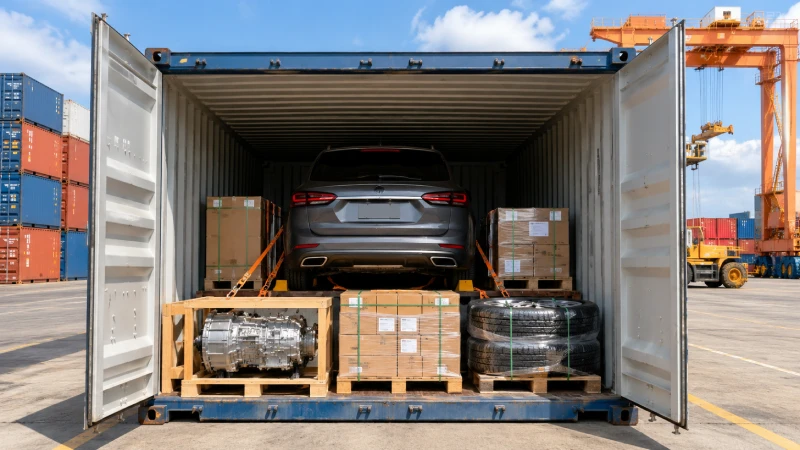
Yes, cars and spare parts can often be shipped in the same full container. But this does not mean you can simply load a vehicle, fill the remaining space with parts, close the doors, and send it overseas.
For containerized vehicle shipping from China, the real question is whether the exact combination of vehicle and spare parts is acceptable to the ocean carrier, correctly declared for customs, compliant with dangerous-goods rules, safely secured inside the container, and permitted at the destination.
Some carriers clearly recognize vehicle-and-parts combinations. For example, Atlantic Container Line’s containerized vehicle declaration includes a “Vehicle(s) & Spare Parts” option. However, this shows that mixed loading can be operationally possible; it does not mean every carrier, route, port, or country will accept the same arrangement.
The safest principle is:
Same container, separate compliance.
The vehicle and spare parts may share one transport unit, but each cargo type must still satisfy its own classification, documentation, packing, customs, safety, and import requirements.
Quick Answer: When Can a Car and Spare Parts Share One Container?
Mixed loading is usually possible when:
- The shipment moves as an FCL controlled by the same shipper.
- The carrier knows that the container contains both a vehicle and spare parts.
- Every commercial item appears on the invoice, packing list, and shipping instructions.
- Dangerous goods have been identified and approved before loading.
- The vehicle and spare-part packages are secured independently.
- The destination permits the vehicle and the specific parts being imported.
It may become unacceptable when:
- Batteries, liquids, airbags, or other regulated goods are undeclared.
- Spare parts are loosely placed in the cabin or trunk.
- Engines, fuel tanks, or components contain fuel or are leaking.
- Container payload, gross mass, axle-load, or inland transport limits are exceeded.
- The destination prohibits used parts, used tires, waste batteries, or certain second-hand components.
Available space is therefore only one consideration. Regulatory and operational acceptance matter more.
Six Approvals That Determine Whether Mixed Loading Is Allowed
Before booking a mixed vehicle-and-parts container, six separate issues should be checked.
1. Export and Customs Eligibility
The vehicle must be eligible for export from China and supported by the required export documentation.
The spare parts should also be reviewed separately. Depending on the product, questions may arise around licenses, used-goods requirements, controlled technologies, trademark issues, or other export formalities.
2. Ocean Carrier Acceptance
Provide the carrier or freight forwarder with the actual cargo list before confirming the booking.
Do not assume that because one shipping line accepted a similar container previously, another carrier—or even the same carrier on another route—will accept it now. Carrier acceptance should ideally be obtained in writing for the specific shipment.
3. Dangerous-Goods Approval
The vehicle, batteries, airbags, engines, paints, chemicals, aerosols, and fluids must be evaluated individually.
A vehicle qualifying for a particular IMDG exemption does not automatically make everything else inside the container non-dangerous.
4. Port and Terminal Acceptance
Origin terminals, transshipment ports, and destination terminals may impose their own restrictions. A booking accepted by the ocean carrier may still face operational limitations at a particular terminal.
5. Destination Import Permission
Check whether the destination allows the vehicle and the spare parts.
This is particularly important for used engines, used tires, second-hand components, batteries, oily machinery parts, and accident-damaged parts.
6. Insurance Acceptance
Cargo insurance should describe and value both the vehicle and the spare parts. A policy covering only the car may create problems if separate commercial parts inside the container are damaged.
One Container Does Not Mean One Commodity
One of the most common mistakes is declaring the shipment simply as “1 car with accessories.”
That description may be far too vague.
Information Required for the Vehicle
The vehicle should normally be identified by information such as:
- Make and model.
- Model year.
- VIN or chassis number.
- Fuel or propulsion type.
- New or used status.
- Quantity.
- Declared value.
Information Required for the Spare Parts
Spare parts should be described separately using information such as:
- Accurate product name and function.
- Brand, model, or part number where applicable.
- Quantity.
- Net and gross weight.
- New, used, or remanufactured status.
- Unit price and total value.
- Country of origin.
- Applicable HS classification.
This level of detail is increasingly important in international shipping. Hapag-Lloyd, for example, has highlighted the need for clear cargo descriptions and gives specific examples such as “Toyota Corolla 2021 engine oil filter” and “aluminum piston” rather than vague terms.
Another important point is that not every automotive component belongs under HS heading 8708.
Depending on its construction and function, a product such as an engine, tire, battery, glass panel, lighting product, lubricant, or electronic component may fall under a different tariff heading.
Similar parts may sometimes be grouped where customs rules allow, but unrelated products should not all be declared simply as “auto parts.”
Which Spare Parts Are Usually Acceptable—and Which Need Special Approval?
The following matrix provides a practical starting point:
| Spare part type | General assessment | Main controls |
|---|---|---|
| Lamps, bumpers, doors, mirrors, filters | Usually manageable | Accurate declaration and separate packing |
| Tires and wheels | Often acceptable | New/used status and destination restrictions |
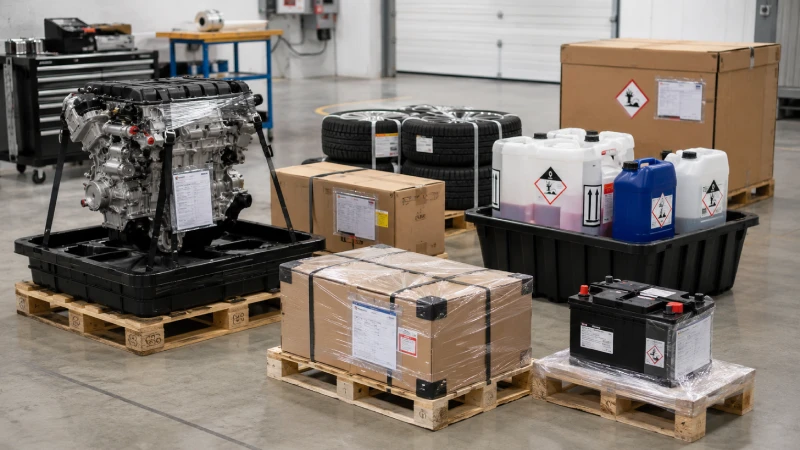
| Engines, gearboxes, fuel tanks | Conditional | Drained, cleaned, leak-free and DG review |
| Lubricants, coolant, brake fluid | Product-specific | SDS, flash point, packaging and UN classification |
| Paint, thinner, adhesive, aerosols | Often DG | Carrier DG approval and compliant packaging |
| Lead-acid, lithium or sodium-ion spare batteries | Special review | Independent classification, packaging and technical data |
| Airbags and seat-belt pretensioners | Potential DG | Classification, often including consideration of UN3268 |
| Damaged, recalled or swollen batteries | High risk | Should not be treated as ordinary spare parts |
| Waste or oil-contaminated parts | High risk | Waste and controlled-used-goods rules may apply |
A particularly important distinction concerns EV batteries.
The traction battery installed in an electric vehicle and a separate spare propulsion battery placed elsewhere in the container are not automatically the same declaration item.
A spare battery must be assessed according to its own classification, condition, packaging, documentation, and carrier requirements.
Dangerous-Goods Rules for the Vehicle Itself
Dangerous-goods classification is one of the most important parts of vehicle container shipping.
Internal-Combustion Vehicles
Fuel-powered vehicles transported inside freight containers may fall under UN3166, Class 9.
Under the IMDG Code, certain vehicles may qualify for treatment outside the normal dangerous-goods provisions when relevant conditions, including those associated with Special Provision 961, are satisfied.
However, the exact preparation requirement must be confirmed with the carrier.
Do not rely on a universal rule stating that every vehicle may retain a certain fraction of fuel. Requirements can differ between container shipping, RoRo services, exemptions, carriers, and ports. Some carriers may require much stricter fuel preparation.
Battery terminals, ignition sources, leakage, and vehicle condition may also need to be addressed.
Electric and Hybrid Vehicles
From 2026, the mandatory IMDG Code 2024 Edition, Amendment 42-24 applies to international maritime dangerous-goods transport.
For battery-powered vehicles, important classifications include:
- UN3556 — Vehicle, lithium ion battery powered.
- UN3557 — Vehicle, lithium metal battery powered.
- UN3558 — Vehicle, sodium ion battery powered.
Older online guidance may still refer generally to UN3171 for battery-powered vehicles. That should not automatically be copied into 2026 shipping documentation for lithium-ion, lithium-metal, or sodium-ion powered vehicles.
When arranging electric vehicle shipping from China, the carrier may also require information concerning battery condition, damage history, state of charge, vehicle status, labels, placards, or additional technical documents.
When the Entire Container Is Handled as Dangerous Goods
Depending on the cargo combination, the shipment may require:
- Dangerous Goods Declaration.
- Container/Vehicle Packing Certificate.
- Correct UN Number.
- Proper Shipping Name.
- Hazard labels.
- Container placards.
- Carrier DG approval.
- Transshipment-port DG approval where applicable.
Every regulated article in the container must therefore be identified before loading begins.
Can Spare Parts Be Placed Inside the Car?
Putting spare parts in the same container as the vehicle is different from putting them inside the vehicle itself.
Do not assume that commercial cargo may simply be loaded into the trunk, passenger compartment, or onto the seats.
Some carriers prohibit personal or commercial goods inside vehicles. Others may accept certain contents only when they are declared in advance and included in the freight calculation.
Cargo placed inside a car is also more difficult to inspect, count, identify, and secure. It may damage seats, windows, trim, or electronics during transit and can complicate customs inspections and insurance claims.
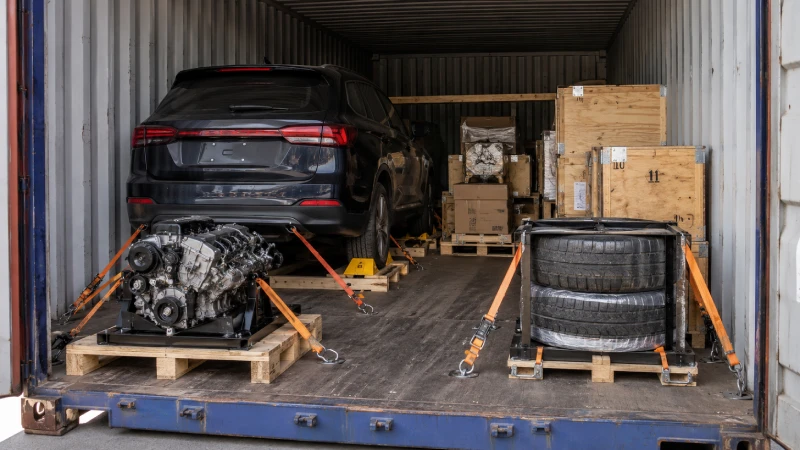
A safer arrangement is generally to pack the parts into separately numbered cartons, pallets, crates, or engineered supports and secure those packages directly to the container.
How to Pack and Secure a Car and Spare Parts Safely
The IMO/ILO/UNECE CTU Code provides internationally recognized guidance for safe packing of cargo transport units.
Inspect the Empty Container
Before loading:
- Inspect the structural condition.
- Check the floor.
- Look for water ingress.
- Check for contamination or strong odors.
- Verify the CSC safety plate.
- Confirm maximum gross mass and payload.
Secure the Vehicle Independently
The vehicle should have its own professional restraint arrangement.
Depending on the loading plan, this may include suitable wheel chocks, lashings, or other approved securing methods.
The vehicle should not become a storage platform for spare parts. Heavy components should never be placed on the roof, hood, trunk lid, seats, or other vulnerable surfaces merely to save floor space.
Pack Spare Parts as Independent Cargo Units
Heavy engines and transmissions may require purpose-built frames, pallets, or crates.
Metal components must be prevented from sliding or striking the vehicle or container walls.
Each package should correspond to the packing list so that customs officers and destination agents can identify the contents without unnecessary confusion.
Control Weight Distribution and Empty Space
Heavy cargo should remain low and be distributed appropriately along the container floor.
Avoid concentrating excessive weight near the container doors.
Large voids should be blocked or filled so that packages cannot gain momentum at sea.
Where dangerous goods and general cargo share a container, additional packing rules may apply. Maersk, for example, recommends careful weight distribution, filling substantial void spaces, and considering accessibility when dangerous goods are packed with other cargo.
Use Compliant Wood Packaging
Solid-wood pallets, crates, blocking, or dunnage used in international trade generally need to comply with ISPM 15 and carry the appropriate IPPC mark.
Processed wood products such as plywood may fall outside the same treatment requirements depending on their construction.
Documents Required for a Mixed Vehicle-and-Parts Container
A well-prepared shipment usually requires documentation in three groups.
Commercial and Customs Documents
These may include:
- Sales contract.
- Commercial invoice.
- Detailed packing list.
- Vehicle purchase, title, or registration documents.
- VIN information.
- Chinese export declaration documents.
- Certificate of origin where required.
- Destination compliance documents.
- Applicable used car export documents from China.
Shipping Documents
Typical documents and records include:
- Carrier booking confirmation.
- Shipping Instructions.
- Bill of Lading.
- Container loading plan.
- Verified Gross Mass.
- Loading photographs.
- Container number.
- Seal number.
- Handover records.
Under SOLAS, the shipper named on the Bill of Lading is responsible for providing the verified gross mass of a packed container. Without VGM, the container is not eligible to be loaded aboard the vessel under the SOLAS VGM requirements.
Documents for Dangerous or Controlled Parts
Depending on the cargo, these may include:
- Safety Data Sheet.
- UN38.3 Test Summary or battery documentation.
- Dangerous Goods Declaration.
- Container Packing Certificate.
- Battery-condition declaration.
- Import permit.
- Used or remanufactured-part documentation.
- Inspection certificates.
One Bill of Lading can describe multiple commodities. That does not mean every item should be merged into one generic cargo description or one HS code.
Destination-Country and Port Restrictions
Destination checks should be completed before booking, not after arrival.
Used automotive components can be treated as controlled second-hand goods, environmentally sensitive products, or even waste in some jurisdictions.
Particular attention should be given to:
- Used tires.
- Waste batteries.
- Damaged batteries.
- Oily engines.
- Accident-damaged components.
- Heavily contaminated mechanical parts.
Restrictions may originate from customs authorities, environmental agencies, standards organizations, ports, container terminals, or local carrier offices.
A good example is Egypt. From February 2026, Hapag-Lloyd advised that Port Said East’s Suez Canal Container Terminal would not handle customs clearance for certain second-hand cars, trucks, and equipment spare parts. Relevant containers may need to move through Port Said West instead, potentially creating additional costs.
This illustrates why “the country allows it” is not always enough. Terminal-level rules can still affect routing.
A destination customs broker should therefore review the cargo list before shipment and provide written feedback where possible.
Is Shipping Them Together Actually Cheaper?
Sometimes.
Using spare space around a vehicle may:
- Eliminate a separate LCL shipment.
- Avoid another full container.
- Allow vehicles and after-sales parts to arrive together.
- Reduce coordination between multiple shipments.
But mixed loading can also create new costs:
- Crates and engineered supports.
- Professional lashing.
- DG surcharges.
- Inspection fees.
- Container opening and rehandling.
- Higher inland transport cost due to weight.
- Terminal-transfer charges.
- Storage and demurrage caused by documentation problems.
A useful way to evaluate the decision is:
Net saving = avoided separate-shipment cost − additional packing, DG, handling, customs and risk costs.
Container selection should also consider vehicle dimensions and securing space rather than theoretical cubic capacity alone. See how many cars fit in a shipping container for additional planning considerations.
Insurance and Evidence Requirements
The insurance declaration should list both the vehicle and the spare parts, including their respective values.
Confirm whether the policy covers the required transport stages and mixed cargo.
Do not assume cargo insurance will compensate for poor packing. Packaging and securing deficiencies are commonly excluded or restricted under cargo-protection arrangements.
Before closing the doors, keep a complete photo record:
- All sides of the vehicle.
- VIN.
- Odometer.
- Each spare-part package.
- Internal packing.
- Chocking and lashing.
- Final container overview.
- Container number.
- Seal number.
These records can be important during customs inspections, delivery disputes, or insurance claims.
Step-by-Step Booking and Loading Workflow
A practical workflow is:
- Prepare a complete list of the vehicle and every spare part.
- Record new/used status, weight, dimensions, value, batteries, liquids, and other sensitive characteristics.
- Have the vehicle and potentially dangerous components reviewed for DG classification.
- Ask the destination broker to confirm import and terminal restrictions.
- Submit accurate cargo details to the carrier and obtain acceptance.
- Prepare invoice, packing list, export declaration, and DG documents where applicable.
- Create separate securing plans for the vehicle and spare-part packages.
- Photograph the loading process, determine container weight, and submit VGM.
- Check the Bill of Lading draft, commodity descriptions, UN details, quantities, and weights.
- Send the complete document package to the destination agent for pre-arrival review.
Red Flags: When the Cargo Should Be Split
Separate shipments may be safer when:
- Batteries are damaged, swollen, recalled, or of uncertain condition.
- Several incompatible dangerous goods are involved.
- Engines, gearboxes, or tanks cannot be confirmed leak-free.
- Used-parts import rules remain unclear.
- Spare parts interfere with safe vehicle securing.
- The carrier accepts the vehicle but rejects additional cargo.
- Insurance will not cover mixed loading.
- The only way to fit everything is to place heavy cargo on the vehicle.
The cheapest loading plan is not necessarily the lowest-risk shipping plan.
How Winsail Can Support the Shipment
Winsail can help coordinate mixed vehicle-and-spare-parts shipments from China by:
- Reviewing cargo information before booking.
- Checking route-specific carrier acceptance.
- Assisting with booking, customs, and DG documentation preparation.
- Coordinating crating, supports, loading, lashing, photography, and VGM.
- Working with destination agents for document pre-review.
Final cargo classification, licensing, carrier acceptance, customs clearance, and government approvals remain subject to the shipper, carrier, destination authorities, and other responsible parties.
FAQ
Can I put spare parts inside the car?
Possibly, but only where the carrier permits it, the goods are completely declared, and they can be secured safely. Packing commercial spare parts separately inside the container is generally the safer approach.
Can a spare engine or gearbox be shipped with the car?
Potentially. The component should be properly drained or prepared, clean, leak-free, securely packed, and reviewed for both dangerous-goods and destination import requirements.
Can batteries be shipped in the same container?
Possibly, depending on battery chemistry, condition, capacity, packaging, documentation, and carrier acceptance. A spare battery requires its own classification and cannot simply be treated as part of the vehicle's UN3556, UN3557, or UN3558 classification.
Can airbags and seat-belt pretensioners be included?
They may qualify as regulated safety devices, potentially involving UN3268, Class 9. Obtain a proper dangerous-goods assessment before loading them.
Do the car and spare parts need separate HS codes?
Usually, goods should be classified according to their individual characteristics. Not every automotive product belongs under HS 8708.
Can everything be listed on one Bill of Lading?
Often yes, subject to carrier and customs-system requirements. However, the Bill of Lading, invoice, packing list, and customs declaration should still clearly identify the different commodities.
Is a 20-foot container enough?
It depends on the vehicle dimensions, spare-part packaging, total weight, door clearance, working space, and lashing plan. Cubic capacity alone cannot determine whether the loading arrangement is safe.
Will customs open the container?
They can. Customs, port, security, or other authorities may order an inspection. Accurate declarations, numbered packages, and clear loading photographs make inspections easier, but they cannot guarantee that a container will not be opened.
Conclusion: Same Container, Separate Compliance
Cars and spare parts can often travel together in one FCL container, but they should be treated as separate cargo inside one transport unit.
Before requesting a quotation, prepare the vehicle make and model, VIN, propulsion type, new or used status, complete spare-parts list, package dimensions and weights, and details of any batteries, liquids, airbags, engines, or other sensitive components.
Also provide the origin port, destination port, and final importing country.
With this information available from the beginning, Winsail can help evaluate the proposed loading arrangement and coordinate the appropriate carrier, documentation, packing, and shipping process before the container is loaded.
