
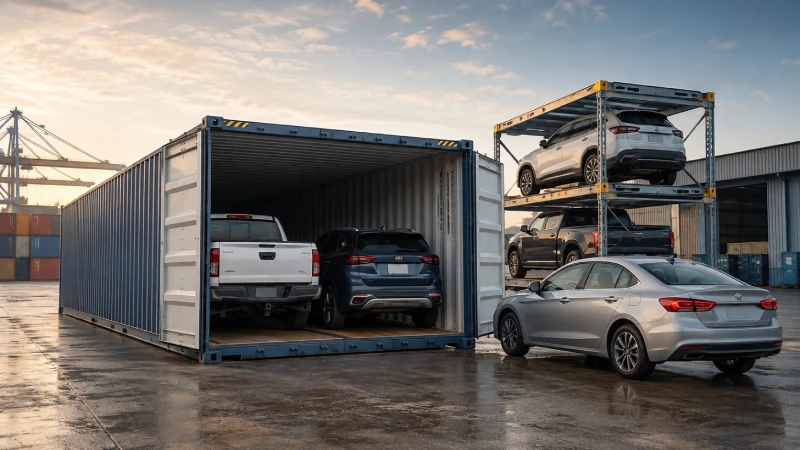
A 40HQ does not have one fixed vehicle capacity. With normal single-level floor loading, two full-size vehicles is the safest planning assumption. With a certified multi-level vehicle racking system, the same container may carry three to four sedans, two to four SUVs, or two pickups. A third pickup should be treated as a model-specific engineered load, not standard capacity.
Real capacity depends on vehicle dimensions, weight, ground clearance, accessories, loading angle, rack design, lashing space and carrier acceptance. If you are arranging vehicle shipping from China, confirm the exact model list before putting a quantity into the booking or sales contract.
Quick Answer—How Many Vehicles Fit in a 40HQ?
| Vehicle type | Floor loading | Certified racking |
|---|---|---|
| Compact/midsize sedans | 2 | Usually 3–4 |
| Small hatchbacks / microcars | 2–3 | Up to 4–6 in specialized systems |
| Compact SUVs / crossovers | 2 | Usually 3; 4 may be possible |
| Midsize and large SUVs | 2 | Usually 2–3 |
| Midsize pickups | 2 | Usually 2; 3 requires engineering |
| Full-size pickups | 1–2 | Usually 1–2 |
These are quotation-stage ranges, not loading guarantees. “Fit” means every vehicle must pass through the door, remain within safe clearances, be independently supported and secured, stay within weight limits and meet the carrier’s conditions.
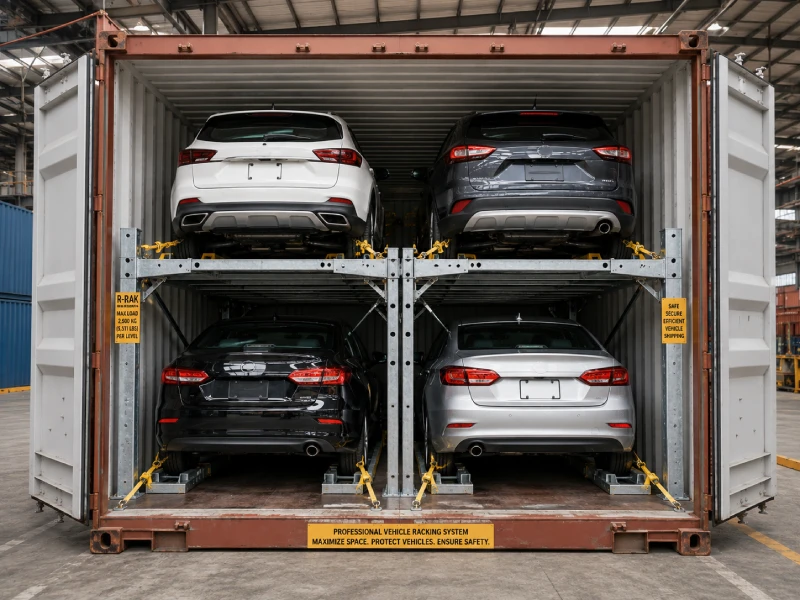
Trans-Rak states that a 40ft container without racks typically carries two cars, while its R-RAK system can load four standard passenger vehicles. Other configurations may hold three medium-sized vehicles or up to six very small cars. These are system-specific capabilities, not universal 40HQ limits.
For 20ft, 40ft and 40HQ comparisons, see how many cars fit in a shipping container.
What Are the Actual Internal Dimensions of a 40HQ?
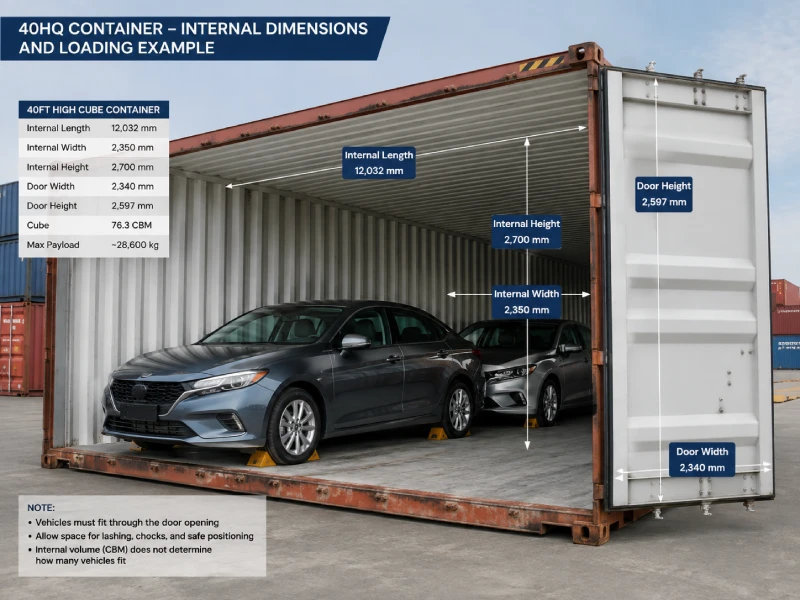
A representative Hapag-Lloyd 40HQ provides about 12,032 mm of internal length, 2,350 mm of width and 2,700 mm of height. The door opening is approximately 2,340 mm wide and 2,597 mm high, internal volume is about 76.3 m³, and maximum payload is around 28,600 kg.
Why the Door Opening Matters
The door opening is lower than the internal roof. Roof racks, antennas, light bars, snorkels or pickup bed frames may prevent entry even when the vehicle’s final position would fit inside.
A vehicle must also pass through the door at the angle required by the loading method. A car that fits comfortably once positioned inside may still fail to clear the door during loading.
Why Container Specifications Vary
Specifications can vary slightly among container manufacturers. Carrier data is suitable for preliminary planning, but final stuffing should use the actual unit released for loading.
Before loading, check the container number, CSC safety plate, door opening and usable internal dimensions rather than relying only on a generic 40HQ specification sheet.
Why Cubic Metres Cannot Tell You the Vehicle Count
A formula such as:
76.3 CBM ÷ vehicle CBM = number of vehicles
does not work for vehicle loading.
Cars are irregular three-dimensional objects, not stackable cartons. Racks, wheel chocks, supports, lashings and safe working clearances all consume space. A vehicle may also need a different angle while entering the box than in its final position, and one vehicle cannot simply rest on another.
CBM describes total volume. It does not replace a vehicle-specific loading drawing.
How Many Sedans Fit in a 40HQ?
Without a Vehicle Rack
Compact and midsize sedans normally load two per 40HQ on the floor.
A representative 2026 Toyota Corolla is about 4.64 m long. Two cars total roughly 9.27 m before bumper clearance and securing space. Three total about 13.91 m, already longer than the 12.03 m internal floor.
Only unusually short microcars may allow three on one level, and the lashing plan still needs verification.
With a Certified Rack
A multi-level rack uses vertical separation and controlled overlap. Three midsize sedans is a conservative arrangement, while four compact or standard passenger cars is a common target for purpose-built systems.
Five or six vehicles should not be described as “six sedans.” Those figures apply to very short cars and specialized rack combinations.
Before confirming four sedans, check overall length, height, ground clearance, wheelbase, track width, overhangs, roof accessories and the vehicle’s highest point when tilted.
How Many SUVs Fit in a 40HQ?
Compact Crossovers
Compact SUVs normally load two on the floor. With professional racking, three is a realistic planning figure, while four may be possible for selected short, relatively low models.
Trans-Rak has published a case showing four SsangYong Tivoli compact crossovers in one 40HQ. This proves that four-SUV loading can be engineered, but it does not mean all SUVs can be shipped four per container.
Midsize and Large SUVs
Midsize SUVs are usually planned at two to three units with racks. Large three-row SUVs and traditional 4×4 vehicles are safer to quote at two unless a loading simulation confirms more.
Height is often the limiting factor because taller vehicles reduce the amount of vertical overlap available between upper and lower rack positions.
SUV-Specific Restrictions
Roof rails, rear spare wheels, lifted suspension, off-road tires, steel bumpers, snorkels and roof lights can reduce usable clearance.
Mixed SUV loads also require rack settings that match each vehicle’s wheelbase, track width, body profile and highest point when tilted.
How Many Pickups Fit in a 40HQ?
Midsize Double-Cab Pickups
Two midsize double-cab pickups is the normal floor-loading figure.
A 2026 Ford Ranger is about 5.35 m long. Two units total about 10.70 m before clearance; three total more than 16 m. A third pickup therefore cannot be achieved by ordinary nose-to-tail floor loading.
Even with racks, two remains the safer quotation basis for many pickups. Three may be possible for selected models, but only after a model-specific loading study.
Full-Size Pickups
Full-size pickups are usually limited to one or two depending on cab style, bed length, bumpers, tow hitches and accessories.
A pickup can be narrower than the container door and still be unsuitable for a higher-density loading plan because length, height and working clearance may become the real restrictions.
Why Pickups Are Harder to Rack
Pickups are longer, often taller, and have different weight distribution from standard passenger cars. Rack support points must match wheelbase, tire size and track width.
Passing through the container door is not enough. Side clearance is still required for positioning, securing equipment and safe lashing operations.
Three Vehicle Loading Methods Compared
1. Single-Level Floor Loading
Single-level loading usually carries two vehicles. It is comparatively simple and avoids rack rental, purchase or return logistics.
This method suits large, high-value or rack-sensitive vehicles, but ocean freight cost per vehicle is higher because much of the container’s vertical space remains unused.
2. Angled Loading With Temporary Supports
Tilting one vehicle can create longitudinal overlap and may allow three vehicles in selected cases.
However, temporary timber supports are not equivalent to a certified steel rack. The stuffing company, carrier and insurer should accept the proposed method. If solid-wood bracing or dunnage is used, applicable ISPM 15 requirements should also be considered.
3. Certified Multi-Level Steel Racking
Purpose-built racks are the normal method for carrying three to four passenger vehicles. Rather than allowing vehicles to rest directly on one another, the system uses defined wheel trays or structural supports.
The rack should have documented load ratings, operating procedures and compatible vehicle ranges. Its own weight, maximum raised height and support positions must be included in the calculation.
Final quantity should be confirmed only after the exact vehicle mix has been simulated.
How to Calculate the Real Capacity Before Booking
Step 1—Collect Vehicle Data
For each unit, provide:
- Make, model, year and exact trim;
- VIN where available;
- Overall length, width and height;
- Folded-mirror width;
- Curb weight;
- Wheelbase and track width;
- Ground clearance;
- Powertrain type;
- Roof, rear and other aftermarket accessories;
- Whether the vehicle can drive, steer and brake normally.
Current photos are useful because modified bumpers, racks, spoilers or off-road equipment may not appear in manufacturer specifications.
Step 2—Confirm the Loading System
Decide whether the shipment will use floor loading, angled loading or a steel rack.
If a rack is proposed, confirm its model, tare weight, support points, maximum load and compatibility with the vehicle’s wheelbase, track width and tire dimensions.
Step 3—Build a Three-Dimensional Loading Plan
A proper loading drawing should show:
- Side and top views;
- Final angle of each vehicle;
- Roof-to-container clearance;
- Bumper spacing;
- Minimum clearance at the container door;
- Wheel-chock or wheel-tray positions;
- Lashing points;
- Approximate floor-load distribution.
This is the step that turns “four cars may fit” into an operational loading plan.
Step 4—Verify the Plan
Review the proposed arrangement with the stuffing warehouse, rack supplier, ocean carrier and cargo insurer. Where relevant, the destination agent should also confirm unloading requirements.
The maximum theoretical quantity should not be written into a sales contract or treated as guaranteed capacity before these checks are completed.
Weight, Lashing and Safety Limits
For normal passenger vehicles, geometry usually limits capacity before a 40HQ reaches its theoretical payload. However, EVs, large SUVs, armored vehicles or other special vehicles can increase total weight quickly. Inland container and road limits at origin, transshipment points and destination must also be checked.
The IMO/ILO/UNECE CTU Code provides international guidance for safe packing and securing of cargo transport units.
Every Vehicle Must Be Independently Secured
Each vehicle should be independently secured. Vehicles should not rely on one another for structural support, while the parking brake or transmission position should not be treated as the primary restraint.
Wheel chocks, wheel trays and lashings must suit the vehicle and loading system. Unverified body or suspension points should not be used as primary tie-down locations.
VGM Remains Mandatory
Verified Gross Mass is mandatory under SOLAS. VGM includes the vehicles, rack, dunnage, securing equipment and container tare weight.
The shipper must submit it before the carrier’s deadline. See the IMO’s VGM guidance.
Electric Vehicles May Change the Loading Plan
EVs are often heavier than comparable combustion vehicles, and the battery pack can affect approved support and lashing positions. Damaged or battery-compromised vehicles should not be treated as ordinary intact cars.
After physical loading capacity is confirmed, EV shipments still need a separate review covering dangerous-goods classification, battery condition, state of charge, carrier booking requirements and applicable documentation or marking.
In 2026, lithium-ion battery-powered vehicles are handled under the current IMDG framework, including UN3556 where applicable.
See electric vehicle shipping from China for the shipping-specific requirements.
Does Loading More Vehicles Always Reduce the Cost?
Higher loading density can reduce ocean freight, terminal and documentation cost per vehicle, which is attractive for dealers and fleet importers.
Potential savings may include:
- Sharing the container ocean freight across more vehicles;
- Lowering terminal and document cost per vehicle;
- Improving container utilization for dealer or fleet shipments.
However, higher-density loading may also require:
- Rack rental or purchase;
- Specialist stuffing and lashing;
- Additional warehouse time;
- Loading equipment;
- Rack return logistics;
- More complicated unloading procedures.
An incorrect plan can also create container changes, re-stuffing, storage charges or demurrage.
The highest vehicle count is not always the lowest-risk or lowest-total-cost loading plan.
For some shipments, three vehicles with comfortable clearances can be commercially better than forcing a fourth vehicle into an unsuitable configuration.
Pre-Booking Checklist
Before confirming the number of vehicles in a 40HQ:
- Verify the exact model, year and trim—not simply “four sedans.”
- Obtain manufacturer dimensions and curb weight.
- Collect current photos and check aftermarket accessories.
- Confirm each vehicle can drive, steer and brake.
- Verify the actual 40HQ internal and door dimensions.
- Obtain the rack model, load rating and loading drawing.
- Calculate vehicle, rack, dunnage and lashing weight.
- Confirm carrier acceptance of the vehicle and loading method.
- Complete loading, lashing, photo, VGM and seal records.
If spare parts will also be loaded, see cars and spare parts in the same container before using the remaining space.
FAQ
Can four sedans fit in a 40HQ?
Yes, but usually with a professional multi-level rack. All four vehicles still need a loading simulation before the quantity is confirmed because length, height and rack compatibility vary by model.
Can four SUVs fit in a 40HQ?
Some compact crossovers can, but midsize and large SUVs are more commonly limited to two or three. Four should not be treated as the default SUV capacity.
Can three pickups fit in a 40HQ?
Possibly for selected midsize pickups with a custom engineered rack. For normal quotation purposes, two is the safer starting point.
Can vehicles be loaded side by side?
Usually no. A 40HQ is only about 2.35 m wide internally, so higher vehicle counts mainly come from longitudinal overlap and vertical separation rather than side-by-side loading.
Does a 40HQ carry more cars than a standard 40ft container?
Potentially, when a suitable rack is used. The main advantage is roughly 30 cm of additional internal height, not extra floor length.
Can six cars fit in a 40HQ?
Specialized systems may carry up to six very small cars or microcars. This figure should not be applied to normal sedans, SUVs or pickups.
Can spare parts be added after the vehicle count is confirmed?
Yes, if remaining space, total weight, declaration and securing requirements allow it. Spare parts should be separately listed and securely restrained.
What information is needed for an accurate loading plan?
Provide the exact make, model, year and trim of every vehicle, together with dimensions, curb weight, wheelbase, track width, ground clearance, photos, powertrain type, accessories and operating condition.
Confirm the Models Before Confirming the Number
A 40HQ normally fits two full-size vehicles on the floor. Certified racking may raise capacity to three or four sedans, two to four SUVs, or two pickups, but the exact result depends on the models and loading system.
Do not confirm capacity from the words “sedan,” “SUV” or “pickup” alone. Send Winsail Logistics the vehicle list, dimensions, weights, photos, powertrain type, origin port and destination port so the practical 40HQ loading layout can be evaluated before booking.
