
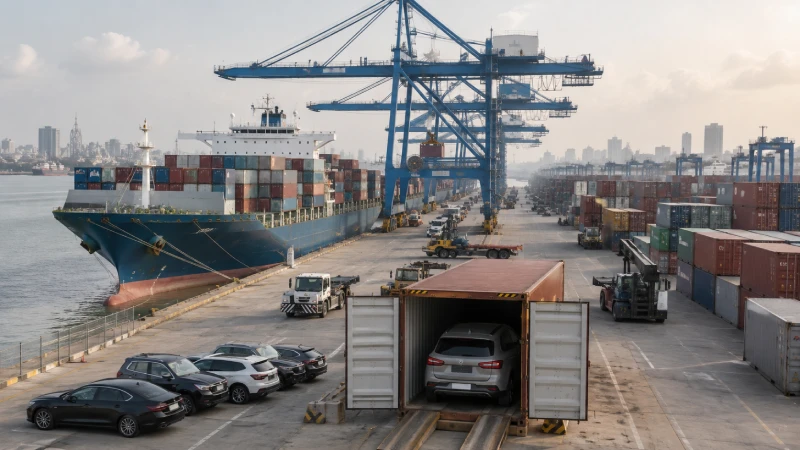
Shipping a car to Lagos involves more than paying ocean freight. A port-to-port quotation usually covers only part of the amount required before the vehicle can leave the destination terminal.
“Freight prepaid” does not mean all Nigerian destination charges are paid. CIF also generally covers the goods, insurance and freight to the named destination, not Nigerian customs duties, terminal release, clearance or inland delivery.
For importers arranging vehicle shipping from China, the final amount depends on the actual Lagos terminal, shipping method, vehicle specifications, customs valuation and clearance time.
Quick Answer — What Destination Charges Should You Budget For?
There is no single fixed “Apapa clearing charge” for every imported vehicle.
| Charge Category | Typical Cost Items |
|---|---|
| Customs | Import duty, vehicle-related adjustment tax or levy, VAT and Green Tax |
| Shipping line | Documentation, release, container-related fees and demurrage |
| Port and terminal | Handling, delivery, gate-out, examination and storage |
| Clearance | Clearing-agent service and examination coordination |
| Inland operations | Haulage, towing, stripping and warehouse handling |
| Container return | Empty return and possible detention |
| Final delivery | Transport from Lagos to the buyer’s destination |
Before booking, confirm which items are included, excluded, prepaid or collect. A low ocean freight rate can still result in a high landed cost.
First Confirm Where the Car Will Actually Be Discharged
“Apapa,” “Lagos,” “Tin Can Island” and “PTML” are not interchangeable terminal names.
Apapa Port and APM Terminals Apapa
The Lagos Port Complex at Apapa is a major container gateway. Vehicles inside 20GP, 40GP or 40HQ containers may be handled through a container terminal such as APM Terminals Apapa, depending on the booking.
Container shipments can involve handling, container deposits, demurrage, detention and empty-container return.
Tin Can Island and PTML
Tin Can Island Port Complex is a separate port area. PTML Terminal, located in the Tin Can Island area, is an important Nigerian RoRo and multipurpose vehicle terminal. A RoRo vehicle may therefore discharge at PTML rather than an Apapa container terminal.
Why “Lagos” on a Quotation Is Not Specific Enough
Before calculating charges, confirm:
- Port of Discharge
- Port code or UN/LOCODE where applicable
- Exact terminal name
- Shipping line
- RoRo, ConRo or container service
- Direct or transshipment routing
- Whether a shared container will be stripped off-port
Do not calculate destination costs only from a salesperson saying the vehicle “arrives in Apapa.”
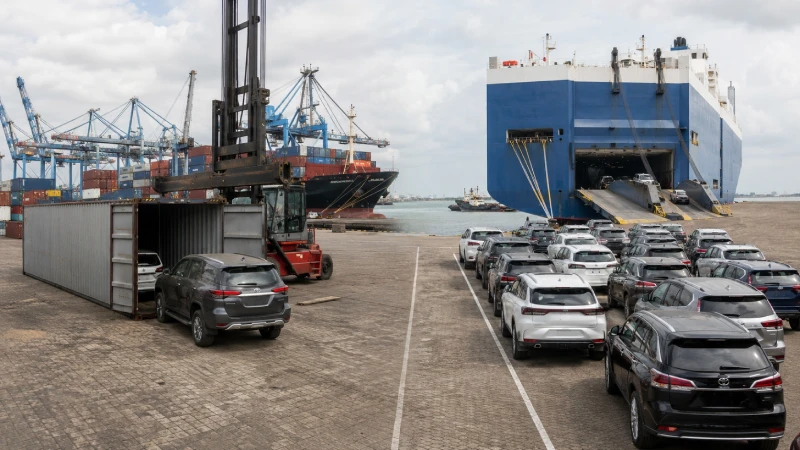
Customs Duties and Taxes on Imported Vehicles
Customs assessment can be one of the largest destination costs, but it cannot be reduced to one universal percentage.
Customs Valuation Is Separate from the Purchase Price
A low purchase price does not necessarily create an equally low customs assessment. Nigeria Customs Service may consider the VIN, make, model, year, condition and applicable valuation framework when determining the assessable value.
Importers should therefore request a preliminary estimate using the actual vehicle details before shipment.
Main Statutory Charge Categories
Depending on the vehicle and assessment, charges may include:
- Import duty
- Import Adjustment Tax or another applicable vehicle-related levy
- VAT
- Green Tax
- Other items appearing on the official customs assessment
2026 Vehicle Tax Changes
According to the Nigeria Customs Service, the Import Adjustment Tax for new vehicles was reduced from 20% to 10%, while the relevant used-vehicle rate was reduced from 15% to 5%.
From July 1, 2026, Green Tax applies at 2% for 2,000–3,999cc vehicles and 4% for vehicles of 4,000cc and above. Vehicles below 2,000cc, electric vehicles, qualifying public-transport vehicles and locally produced vehicles are exempt under the announced policy.
The 5% used-vehicle rate is not the total customs charge. Import duty, VAT and other statutory items may still apply. The 4% FOB levy introduced in 2025 was later suspended and should not be automatically added unless it appears in the current official assessment.
Shipping-Line Local Charges at Destination
The carrier or its Nigerian agent may invoice local charges separately from ocean freight, including:
- Destination documentation or release fee
- Shipping agency or port additional charge
- Container protection, maintenance or cleaning fee
- Manifest amendment or late-payment fee
- Telex or express-release related charges
- Container deposit
- Carrier demurrage
Some charges are per Bill of Lading and others per container. Always request a tariff showing the carrier, charging basis and effective date, and confirm whether VAT is additional.
A container deposit should be listed separately from non-refundable charges because it may be refundable when the empty unit is returned on time, in acceptable condition and to the correct depot.
NPA and Terminal Operator Charges
The Nigerian Ports Authority tariff database publishes official port tariff information. Actual bills may be collected directly or through terminals and other service providers.
Importers should verify the charging entity, billing unit and supporting invoice, especially when a quotation uses a broad label such as “port fee.”
Container terminal charges may include handling, delivery, examination positioning, scanning, shifting, extra lifts and special handling. RoRo terminals may charge for vehicle discharge, delivery, gate release, parking, storage and towing for non-running units.
Where Apapa is the actual terminal, check the applicable APM Terminals Apapa tariffs and terms. Also verify that the same port-related item is not being charged by both the carrier and terminal.
Storage, Demurrage and Detention Explained
These charges are often grouped together informally, but they are different.
| Charge | Usually Charged By | When It Arises |
|---|---|---|
| Terminal storage | Terminal | Vehicle or container remains at the terminal beyond free time |
| Demurrage | Shipping line | Carrier container remains in port beyond carrier free time |
| Detention | Shipping line | Container leaves port but the empty unit is returned late |
| Vehicle storage | RoRo terminal | RoRo vehicle is collected after the allowed period |
Free-time rules should be confirmed from the applicable tariff or service contract. The start date may be tied to vessel arrival, discharge or free-time expiry, and terminal and carrier free periods may differ.
Check whether weekends and public holidays count and whether later day bands become more expensive. Customs release does not automatically stop every charging clock because cargo must still complete terminal delivery and, for container shipments, empty-equipment return.
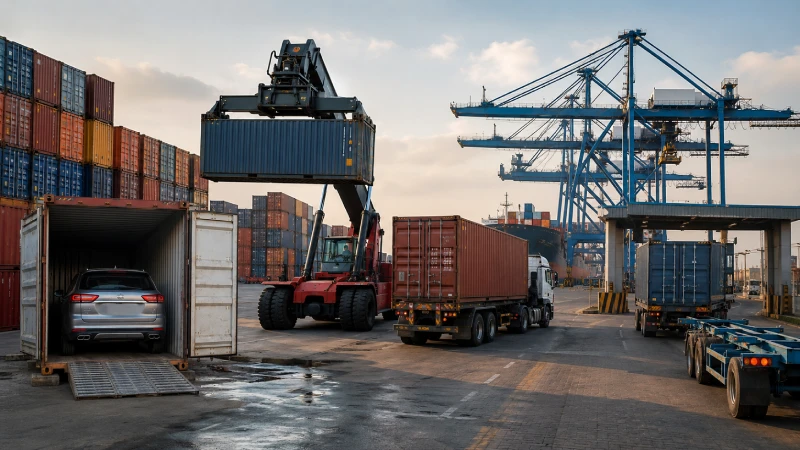
RoRo vs Container Destination Charges
Destination costs vary significantly by transport method.
| Cost Factor | RoRo Vehicle | FCL Container Vehicle |
|---|---|---|
| Billing basis | Per vehicle, dimensions or CBM | Per container, TEU or Bill of Lading |
| Typical terminal | RoRo/vehicle terminal such as PTML | Container terminal |
| Container deposit | Normally no | May apply |
| Empty return | Not required | Required |
| Detention risk | No container detention | Yes |
| Port storage | Vehicle storage | Container storage |
| Non-running vehicle | May need towing or special acceptance | Can be secured inside the container |
| Multi-car sharing | Many charges remain per vehicle | Fixed container charges may be shared |
RoRo is not automatically cheaper. It may simplify destination operations for one running vehicle because there is no empty-container return. A 40HQ carrying several vehicles, however, can spread some container-based fixed costs across multiple units.
See RoRo vs container shipping for cars to Africa for a broader comparison.
Additional Charges for Shared or Consolidated Containers
A shared 40HQ can reduce ocean freight per vehicle, but destination charges cannot always be divided evenly by the number of cars.
Possible additional costs include:
- Deconsolidation and container stripping
- Warehouse or CFS handling
- Vehicle separation
- Per-unit documentation
- Cargo-release fees
- Off-port transfer
- Towing after unloading
The consolidator may charge per vehicle, CBM or individual delivery operation. Before planning the load, see how many sedans, SUVs or pickups fit in a 40HQ.
Clearing-Agent, Examination and Port-Exit Costs
A licensed Nigerian clearing agent may coordinate customs declaration, assessment, PAAR-related documentation, physical examination, scanning, terminal release and port-exit procedures.
Government duties and official disbursements should be separated from the agent’s professional service fee. An undocumented “facilitation fee” should not be presented as an official Customs or NPA charge.
WINSail can assist with logistics coordination and communication with destination partners, but it does not issue Nigerian customs assessments, PAAR or customs release documents and cannot guarantee clearance outcomes.
Haulage, Vehicle Recovery and Empty-Container Return
Container Shipments
Container shipments may require port haulage, truck call-up, driver waiting, warehouse delivery, stripping and empty-container return. Keep the EIR as proof of equipment handover.
Late return, a wrong depot, missing EIR or container damage can cause detention, additional transport or delays in deposit refunds.
RoRo Shipments
RoRo vehicles may require authorized collection, flatbed transport, towing for non-running vehicles, temporary parking or inland transport.
“Apapa destination charges” normally do not include delivery to Abuja, Kano or another state unless final delivery is specifically quoted.
How to Calculate the Total Destination Cost
Use this planning formula:
Total amount required before delivery = Customs assessment + Carrier charges + NPA/terminal charges + Storage or delay charges + Clearing-agent fee + Port-exit transport + Optional warehouse or final delivery
For several cars in one container:
Operational destination cost per vehicle = Shared container-based costs ÷ Number of vehicles + Vehicle-specific customs charges + Vehicle-specific handling
Before requesting an estimate, collect the VIN, new or used status, production year, invoice and estimated CIF value, engine displacement or EV information, container size, number of vehicles, shipping line, exact terminal, estimated arrival date, free time and final Nigerian delivery address.
Avoid relying on a permanent “standard Apapa clearing price.”
How to Prevent Unexpected Apapa Charges
Before the vehicle sails:
- Verify the discharge terminal on the booking and draft Bill of Lading.
- Request a destination charge sheet with its effective date.
- Obtain a preliminary VIN-based customs estimate.
- Prepare Form M, PAAR-related information and other applicable documents.
- Appoint a licensed clearing agent before vessel arrival.
- Confirm carrier and terminal free time separately.
- Keep a contingency allowance for valuation and exchange-rate changes.
- Budget for possible examination, scanning and delays.
- Confirm the empty-container return depot before delivery.
- Keep EIRs, receipts, release documents and vehicle handover photos.
If the shipment includes automotive components, review can cars and spare parts be shipped in the same container before loading.
FAQ
Are Apapa destination charges included in ocean freight?
Usually not all of them. Customs duties, destination release charges, terminal fees, clearance, storage and inland transport may remain payable by the consignee.
Is Apapa the same as Tin Can Island or PTML?
No. Lagos Port Complex at Apapa and Tin Can Island are different port areas, and PTML is a major RoRo and multipurpose terminal in the Tin Can Island area.
How much does it cost to clear one car at Apapa?
There is no universal price. The amount depends on the VIN, customs value, vehicle classification, engine capacity, terminal, shipping line, transport method and clearance time.
Are destination charges lower for RoRo than for a container?
Not necessarily. RoRo avoids container deposits and empty-container return, but vehicle handling, delivery and storage still apply.
Is the container deposit refundable?
It is commonly refundable subject to carrier conditions, including timely return of the empty container in acceptable condition to the designated depot.
What is the difference between storage, demurrage and detention?
Storage applies to cargo or containers remaining at the terminal. Demurrage generally applies to a carrier container staying in port beyond free time, while detention applies after the container leaves port and is returned late.
Does CIF include Nigerian customs duty and port clearance?
Normally no. CIF generally covers the goods, insurance and freight to the named destination, while Nigerian import duties, clearance, terminal release and inland delivery are separate.
Can the final charge be confirmed before the vehicle leaves China?
Some carrier, terminal and logistics charges can be estimated before shipment, but final customs valuation, exchange rates, examination requirements and delay costs may not be fully fixed.
Conclusion: Confirm the Terminal Before Comparing the Price
The first step in estimating destination charges when shipping cars to Apapa is confirming where the vehicle will actually be discharged.
Separate customs, carrier, NPA or terminal, clearing-agent and inland transport costs instead of accepting one unexplained “port charge.” Compare quotations using the same vehicle details, terminal, shipping method and cost boundaries.
The lowest ocean freight does not always produce the lowest delivered cost.
For a shipment-specific estimate, send WINSail the VIN, vehicle model, production year, new or used status, powertrain, dimensions, shipping method, carrier and final Nigerian delivery address.
