
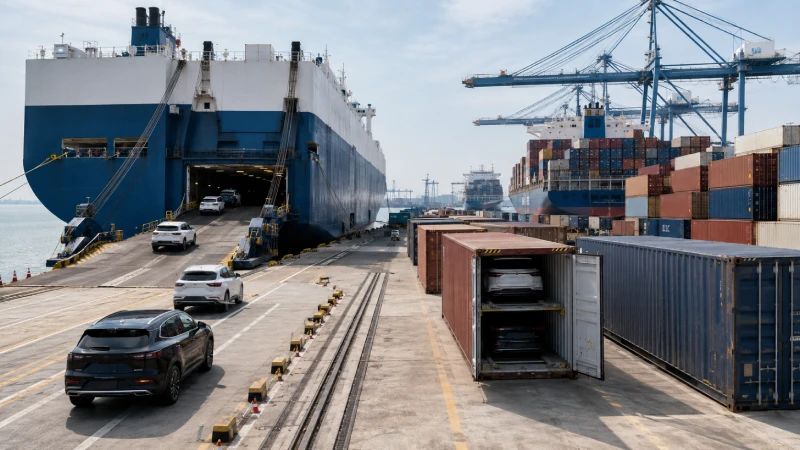
Choosing between RoRo and container shipping for cars to Africa is not simply a matter of comparing two ocean freight rates.
Africa is not a single vehicle-import market. Shipping the same car from China to Mombasa, Lagos, Tema, Alexandria or an inland destination such as Uganda can produce very different results because route availability, port charges, customs procedures, inland corridors and carrier acceptance rules vary significantly.
For importers arranging vehicle shipping from China, the more useful question is: which option gives the best total cost, transit time and risk profile from the vehicle’s origin in China to the final destination in Africa?
As a general starting point, RoRo is often suitable for one operable, standard-sized vehicle moving on a reliable direct route. Container shipping becomes more attractive for high-value cars, multiple vehicles, non-running units, shipments with approved spare parts, or destinations without stable RoRo coverage.
RoRo vs Container Shipping at a Glance
| Factor | RoRo | Container |
|---|---|---|
| Loading method | Vehicle is driven onto and off a specialized vessel | Vehicle is loaded and secured inside a container |
| Best suited for | Operable standard vehicles | High-value, multiple or special vehicles |
| Route availability | Depends on dedicated RoRo port calls | Usually supported by a wider liner network |
| Vehicle handling | Vehicle may be driven and handed over several times | Vehicle normally stays inside the sealed container after loading |
| Security control | No individual container seal | Container seal can be recorded |
| Personal cargo | Usually prohibited | May be accepted if declared and approved |
| Non-running vehicle | Standard RoRo acceptance can be difficult | Can be loaded with a winch or specialist equipment |
| Cost basis | Vehicle dimensions or carrier charging unit | Whole 20ft, 40ft or 40HQ container |
| Schedule | Dedicated services may be less frequent | More sailing and transshipment options are often available |
| EV requirements | Carrier-specific acceptance conditions | Dangerous goods rules may apply |
This table should be treated as a decision guide rather than an absolute rule.
How RoRo Shipping Works
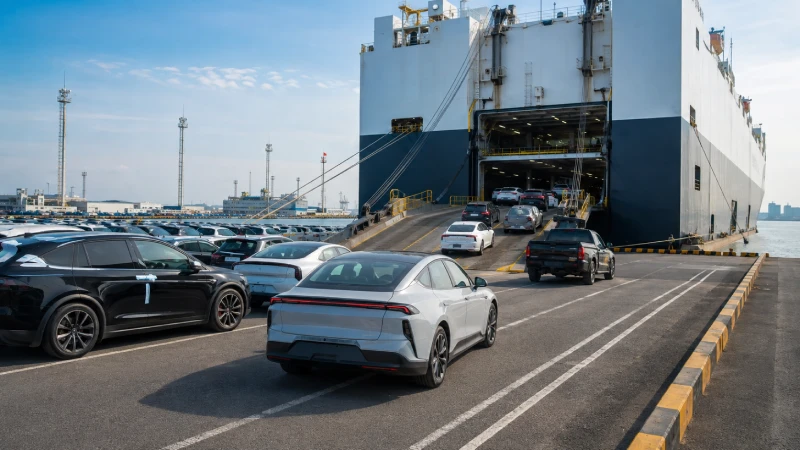
With RoRo shipping, the vehicle is delivered to a designated vehicle terminal, where booking details, VIN and vehicle condition may be checked before loading.
The vehicle is then driven onto a PCTC or other RoRo vessel and secured using approved wheel restraints or lashing systems. At the African discharge port, it is driven off the vessel and moved to the vehicle yard for customs clearance and collection.
Professional vehicle carriers normally transport cars on enclosed vehicle decks. RoRo should therefore not be described as continuous open-deck exposure to rain and seawater. The more relevant risk difference is that the vehicle is driven, handled and transferred more frequently.
Typical RoRo Acceptance Conditions
Carrier requirements vary, but vehicles will commonly need to:
- Start and move under their own power.
- Have functional steering and brakes.
- Have properly inflated tires.
- Be free from fuel, oil or other fluid leaks.
- Have no dangerous loose or sharp body parts.
- Be reasonably clean.
- Meet the carrier’s fuel-level requirements.
- Meet any applicable EV state-of-charge requirements.
- Be cleared of personal belongings and loose cargo.
For example, Höegh Autoliners publishes vehicle acceptance conditions covering fuel levels, electric vehicles and vehicle preparation. These are carrier-specific requirements, however, so the actual booking rules must always be reconfirmed.
Can RoRo Accept a Non-Running Car?
Standard used-vehicle RoRo services generally favor vehicles that can be driven normally.
Some carriers can move non-running units using towing equipment, Mafi trailers, roll trailers or other specialized solutions, but this normally requires advance approval.
An accident-damaged or non-running vehicle should never simply be delivered to the RoRo terminal without written carrier acceptance.
How Container Shipping Works
Container shipping involves moving the vehicle to a loading facility before it reaches the export terminal.
The usual process includes:
- Inspecting the vehicle and container.
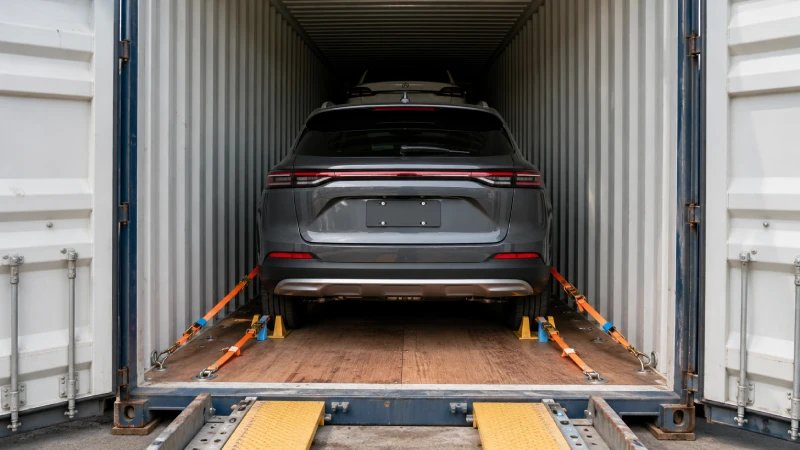
- Loading the car using ramps, a winch or professional equipment.
- Securing the wheels and vehicle using appropriate restraint systems.
- Photographing the VIN, vehicle condition and securing arrangement.
- Closing the container and recording the seal number.
- Delivering the loaded container to the Chinese export port.
- Clearing and unpacking it after arrival.
Vehicle securing is critical. The IMO/ILO/UNECE CTU Code provides internationally recognized guidance for packing and securing cargo transport units. A handbrake and a few ordinary ropes are not an adequate vehicle-securing plan.
20ft, 40ft or 40HQ?
A 20ft container is commonly considered for one standard car, while a 40ft or 40HQ may be used for two or more vehicles.
However, there is no guaranteed number.
Actual loading capacity depends on each vehicle’s length, width, height, weight and the loading system being used. SUVs, pickups and larger vehicles can reduce container utilization considerably.
For multi-vehicle shipments, the correct approach is to prepare a vehicle-specific loading plan rather than assume a fixed quantity. See how many cars fit in a shipping container for more detailed capacity planning.
Can Cargo Be Shipped With the Vehicle?
Container shipping may provide more flexibility for approved spare parts or other cargo, but it does not mean importers can simply fill the car or container with undeclared goods.
Additional cargo must be accepted by the carrier, correctly declared, included in the commercial documentation, independently secured and compliant with dangerous goods and destination-country requirements.
Undeclared batteries, fuel, gas cylinders and similar items can create serious compliance and safety problems.
RoRo Availability from China to African Ports
Route availability is one of the most important differences when comparing car shipping methods from China to Africa.
China-to-Africa RoRo services do exist, but they cannot be assumed for every Chinese origin and African destination.
East Africa
In 2025, Grimaldi announced an East Asia-East Africa service connecting Taicang in China with Mombasa and Dar es Salaam.
These ports are important not only for Kenya and Tanzania but also for regional inland corridors. Mombasa serves cargo moving toward markets including Uganda, Rwanda, Burundi and South Sudan, while Dar es Salaam supports several neighboring landlocked markets.
For importers, the inland corridor can be just as important as the ocean leg.
West Africa
Grimaldi also announced a China-West Africa RoRo service to Lagos in 2025.
Other important West African vehicle gateways can include Tema, Cotonou, Dakar and Lomé. However, service structures may involve direct calls, regional hubs or transshipment depending on the carrier and sailing.
Importers should verify the actual routing rather than assume that every major West African port has a direct Chinese RoRo service.
Southern and North Africa
Ports such as Durban, Maputo, Walvis Bay, Casablanca, Tangier and Alexandria may be relevant depending on the shipment.
That does not mean each port has a current direct RoRo connection from China.
Before booking, confirm the Chinese loading port, direct or transshipment routing, sailing frequency, vehicle type accepted, terminal cut-off and destination RoRo handling arrangements.
Which Method Is Actually Cheaper?
There is no reliable Africa-wide price table for RoRo versus container shipping.
A better comparison is to calculate the full route cost.
RoRo Total-Cost Components
A RoRo quotation may include or exclude:
- Vehicle pickup in China.
- Export documentation and customs declaration.
- Origin terminal vehicle handling.
- Ocean freight and carrier surcharges.
- Marine cargo insurance.
- Destination vehicle handling.
- Port storage.
- Customs broker charges.
- Inland vehicle delivery.
Container Total-Cost Components
Container shipping may involve:
- Vehicle pickup.
- Container trucking.
- Loading facility charges.
- Ramps, winches or other loading equipment.
- Wheel chocks, lashings or vehicle racks.
- Ocean freight and surcharges.
- Dangerous goods fees where applicable.
- Destination THC.
- Storage and container detention.
- Unpacking and removal of securing materials.
- Empty-container return.
- Inland delivery.
Compare Cost per Vehicle, Not Cost per Shipment
The correct comparison is cost per vehicle, not simply cost per shipment.
A single standard sedan on a direct RoRo route will often favor RoRo. Two cars sharing a 40ft or 40HQ container can produce a very different cost calculation. Larger SUVs and pickups should also be compared using their real dimensions.
For high-value vehicles, paying more for a container may also be commercially reasonable if the additional control reduces an important handling or security risk.
If the destination country calculates duties on a CIF or similar customs-value basis, freight and insurance costs may also affect the tax base. The lowest ocean rate therefore does not necessarily produce the lowest total landed cost.
Protection, Handling and Security Differences
RoRo and container shipping do not eliminate risk. They create different risk profiles.
RoRo Risk Profile
With RoRo, the vehicle is driven during terminal and vessel operations. This increases the number of handovers and creates exposure to minor scratches, contact damage, key handling and loss of unsecured accessories. Transshipment can add further vehicle movements.
Professional RoRo vessels normally carry vehicles on enclosed decks, so the main concern is handling rather than continuous exposure to weather.
Container Risk Profile
With container shipping, the vehicle remains inside an enclosed unit after loading, and the container seal can be recorded. During transshipment, the container rather than the individual vehicle is normally moved.
However, container shipping introduces another set of risks. Poor wheel restraint, incorrect weight distribution, inadequate clearance, loading damage or improper unpacking can all damage the vehicle.
Customs inspection may also require the container to be opened.
The correct conclusion is not that one method is always safer. The type and location of the risk are different.
Transit Time and Schedule Reliability
RoRo is not automatically faster than container shipping.
Total transit time can include:
- Waiting for booking space.
- Vehicle receiving or container loading.
- Vessel sailing frequency.
- Direct versus transshipment routing.
- Transshipment waiting time.
- Destination unloading.
- Customs and inspection.
- Container unpacking or vehicle collection.
- Inland transportation.
A direct RoRo service can be faster than a transshipment container route. But if the RoRo vessel sails only periodically, waiting for the next departure may offset its sea-transit advantage.
Container shipping may involve longer routing but offer more frequent departures.
Documentation delays at destination can erase the time advantage of either method.
RoRo vs Container for Electric Vehicles
Electric vehicles require a separate shipping review.
Carrier Approval Comes First
Before booking, provide the carrier or freight forwarder with:
- VIN.
- Make and model.
- BEV, PHEV or HEV type.
- Battery type and capacity.
- Accident history.
- Battery damage or recall status.
- Production date.
- Current SOC.
- New or used status.
RoRo Requirements
For RoRo, carrier conditions may cover vehicle operability, emergency instructions, SOC limits and confirmation that the battery is not damaged, leaking, overheating or subject to an unresolved safety issue.
Container Requirements
From January 1, 2026, IMDG Code Amendment 42-24 is mandatory. Battery-powered vehicles may fall under updated classifications including UN3556, UN3557 or UN3558, depending on battery chemistry.
The shipment may therefore require a Dangerous Goods Declaration, Container Packing Certificate, container marking or placarding, battery-condition information and carrier dangerous-goods approval.
Importers planning electric vehicle shipping from China should obtain written acceptance before loading rather than assume that a booking process used for a gasoline vehicle also applies to an EV.
Marine Insurance and Damage Evidence
Carrier liability should not be treated as full vehicle insurance.
Both RoRo and container shipments should be evaluated for separate marine cargo insurance. Importers should check insured value, deductible, transshipment coverage, theft and accessory coverage, loading and unloading risks, EV battery exclusions, general average and claim notification deadlines.
Before shipment, record:
- VIN.
- All four sides of the vehicle.
- Roof and underbody where practical.
- Interior.
- Odometer.
- Existing scratches and dents.
- Fuel level or SOC.
- Keys and accessories.
- Container seal or RoRo handover information.
If damage is discovered at destination, document it before the vehicle leaves the terminal or unpacking facility and record reservations on the relevant delivery documents.
Decision Matrix: Which Method Should You Choose?
| Shipment scenario | Recommended starting point |
|---|---|
| One operable standard car with direct RoRo service | Compare RoRo first |
| High-value, classic or luxury car | Consider dedicated container shipping |
| Two or more dealer vehicles | Compare 40ft/40HQ cost per vehicle |
| Non-running or accident vehicle | Evaluate container or specialist RoRo equipment |
| Large pickup, truck, bus or machinery | RoRo may be practical, subject to dimension approval |
| Shipment includes declared spare parts | Container may provide greater flexibility |
| Electric vehicle | Obtain written RoRo and container acceptance conditions |
| Destination lacks reliable RoRo service | Container is often more practical |
| Final destination is inland Africa | Compare port corridors and inland transit |
| Import approval is incomplete | Do not finalize the shipping method yet |
How to Compare Two Quotes Correctly
Ask freight forwarders to quote RoRo and container shipping on the same basis.
The origin, destination port, vehicle dimensions, VIN, insurance coverage and final inland delivery point should be identical.
Each quotation should clearly distinguish:
- Included.
- Excluded.
- Estimated.
- Payable at destination.
- Subject to carrier approval.
Also confirm whether export customs, vehicle terminal handling, container loading, securing, unpacking, dangerous goods charges and potential waiting costs are included.
A cheap headline ocean rate can become expensive when major destination expenses are excluded.
Pre-Booking Checklist
- Confirm destination-country vehicle eligibility.
- Provide VIN and accurate dimensions.
- Confirm whether the vehicle runs and drives normally.
- Verify the current RoRo route and sailing.
- Compare direct and transshipment options.
- Obtain destination-port charges.
- Confirm the container loading plan where applicable.
- Declare all additional cargo.
- Confirm fuel or EV SOC requirements.
- Obtain written EV acceptance where required.
- Arrange professional container securing.
- Purchase suitable marine insurance.
- Record pre-shipment vehicle condition.
- Arrange destination clearance and inland delivery.
What Winsail Can and Cannot Do
Winsail Can Assist With
Winsail can assist importers in comparing RoRo and container options based on the vehicle’s dimensions, condition and destination.
Support can include:
- China pickup.
- Current routing and space inquiries.
- Container loading coordination.
- Securing and seal records.
- Booking and transport documentation.
- EV carrier acceptance coordination.
- Destination-agent communication.
- Inland transportation planning.
- RoRo or container shipping quotations.
Winsail Cannot Replace or Guarantee
A freight forwarder cannot replace government import approval, issue a vehicle export license on behalf of the competent authority, guarantee destination customs clearance or registration, guarantee carrier acceptance of every vehicle, or guarantee that no transportation damage will occur.
Carrier liability should also not be represented as full cargo insurance.
FAQ
Is RoRo cheaper than container shipping to Africa?
For one operable standard-sized car moving on a suitable direct route, RoRo often has a cost advantage. For multiple vehicles sharing a container, high-value cars or routes with poor RoRo coverage, container shipping can become more competitive.
Is RoRo safe for shipping cars to Africa?
Professional RoRo vessels normally carry vehicles on enclosed decks and use appropriate securing systems. The main risks involve vehicle handling, terminal movements and handovers rather than continuous exposure to weather.
Can I put personal items inside a RoRo vehicle?
Normally not. Major vehicle carriers generally require personal belongings and loose items to be removed before acceptance. Always confirm the exact carrier rule before terminal delivery.
Can a non-running car be shipped by RoRo?
Possibly, but standard RoRo services often require the vehicle to operate normally. Non-running vehicles may require towing equipment, Mafi trailers, roll trailers or another approved solution.
How many cars fit in a 40ft container?
There is no guaranteed number. Capacity depends on vehicle dimensions, weight and the loading system. Standard sedans may allow better utilization than SUVs, pickups or tall vehicles, so a vehicle-specific loading plan is essential.
Is RoRo or container faster from China to Africa?
Neither method is always faster. A direct RoRo vessel may outperform a transshipment container route, while frequent container sailings may reduce waiting time compared with an infrequent RoRo schedule.
Can electric cars be shipped to Africa by RoRo?
Yes, subject to carrier approval and the relevant vehicle and battery conditions. SOC limits, vehicle operability and battery-condition requirements can vary by carrier and route.
Which African ports receive RoRo vehicles from China?
Published services have included China connections with ports such as Lagos, Mombasa and Dar es Salaam. Other African ports may be served directly or through regional networks. Current schedules, vehicle acceptance and transshipment arrangements must be reconfirmed at booking.
Conclusion: Compare the Whole Route, Not Just the Ocean Rate
RoRo and container shipping both have valid roles in moving cars from China to Africa.
RoRo is often a strong option for an operable standard vehicle when a suitable direct service exists. Container shipping may be more appropriate for high-value cars, multiple vehicles, non-running units, approved accompanying cargo or destinations where RoRo coverage is limited.
The final decision should consider the entire transportation chain: route availability, vehicle condition, port charges, customs requirements, insurance, inland corridors and destination handling.
To compare both methods accurately, send Winsail:
- Origin city in China.
- Destination country and port.
- Number of vehicles.
- Make and model.
- Length, width, height and weight of each vehicle.
- New or used status.
- Running or non-running condition.
- Gasoline, hybrid or electric powertrain.
- Any spare parts or additional cargo.
- Final inland delivery location.
With the same shipment information applied to both options, you can compare the real landed logistics cost and risk rather than choosing a shipping method based only on the lowest ocean freight rate.
