
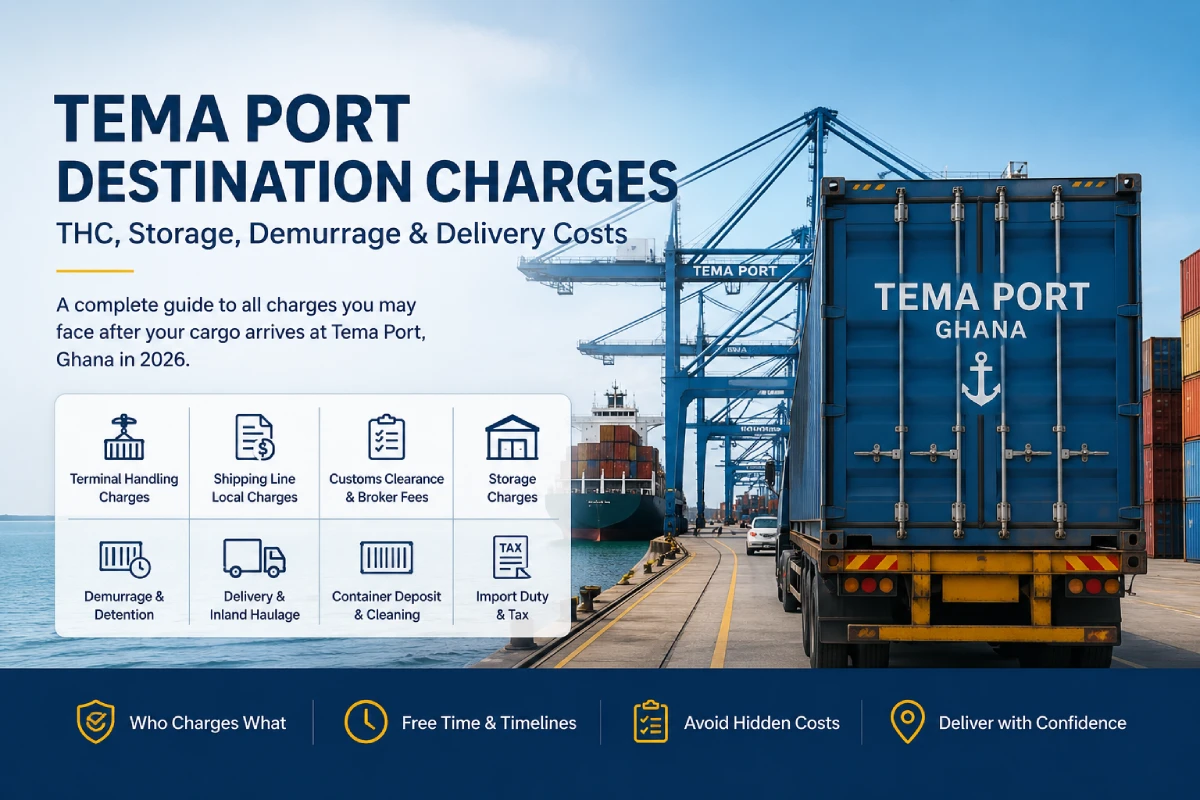
Tema Port destination charges are not one fee or one invoice. After a sea shipment arrives in Tema, separate amounts may be billed by the shipping line, terminal or inland clearance facility, clearing agent, Ghana Revenue Authority, CFS or warehouse, and trucker. Tema also has different operating facilities, so the party handling an FCL container may not be the same party handling an LCL shipment.
Ocean freight is not a Tema destination charge, and customs duties and taxes should be separated from terminal, carrier, broker, storage, and delivery costs. CIF also does not automatically mean every charge after arrival has already been paid. The written quotation, Incoterm, named place, carrier terms, and actual release process determine what is included.
For origin and international transport planning, see shipping cost from China to Ghana.
Last verified: August 28, 2026
Quick Answer: What Are Tema Port Destination Charges?
Tema Port destination charges are the post-arrival costs connected with releasing cargo, handling it at the destination facility, completing import formalities, moving it inland, and, for FCL shipments, returning the carrier-owned empty container.
Depending on the shipment, these can include:
- Terminal handling or receipt-and-delivery charges
- Shipping line import service or documentation charges
- Delivery order or cargo release charges
- Customs broker service fees
- Inspection, scanning, positioning, or examination-related handling
- Terminal, ICD, CFS, or warehouse storage
- Demurrage, detention, or combined demurrage and detention
- Container deposits
- Conditional cleaning or damage charges
- LCL deconsolidation and warehouse handling
- Inland haulage, waiting time, and empty-container return
There is no reliable universal “Tema Port rate” that applies to every importer. The final amount can change with the carrier, terminal or CFS, FCL or LCL status, container type, cargo, customs process, free-time terms, exchange rate, delivery address, and release timeline.
Any useful destination-charge quotation should therefore state the charging party, billing unit, currency, tax treatment, validity period, and included and excluded items.
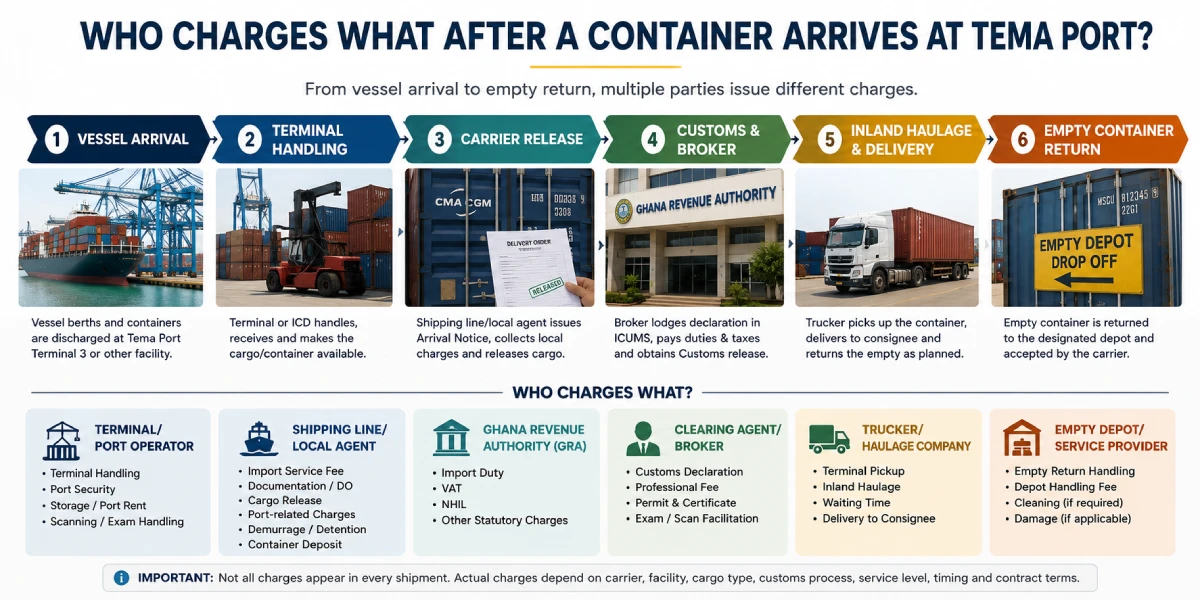
Tema Destination Charge Map: Who Charges What?
A destination charge should be identified by who issues it, what triggers it, and how it is billed. The name alone is not enough. For example, a shipping line may use a label containing the word “port” even when the amount is billed by the carrier rather than directly by the port authority or terminal operator.
| Charge | Charged By | Trigger | Billing Unit | Currency | Variable Factors | When It Starts | How to Reduce It | Source or Last Verified Date |
|---|---|---|---|---|---|---|---|---|
| Terminal handling or receipt/delivery | Terminal, ICD, or CFS; sometimes collected through another party | Cargo handling and release | Container, TEU, tonne, CBM, or shipment | GHS or USD, depending on issuer | Facility, cargo, equipment, service | Facility-defined handling or release event | Confirm facility, covered operations, and current tariff | Current terminal invoice or written quotation |
| Carrier local charges | Shipping line or local carrier agent | Import documentation and carrier release | Container, B/L, TEU, or shipment | GHS or USD | Carrier, trade, equipment, contract | Before cargo release | Request charge codes and current local schedule | Carrier invoice; verify for shipment ETA |
| Customs declaration and broker services | Clearing agent or broker | Import entry and clearance work | Declaration, shipment, or agreed service basis | Usually GHS; confirm quote | Commodity, permits, inspection, service scope | During pre-arrival or clearance work | Send accurate documents early | Broker quotation or invoice |
| Import duty and tax | Ghana Revenue Authority | Customs assessment | Statutory customs basis | GHS | HS code, customs value, origin, applicable taxes | During customs processing | Verify classification and valuation documents | GRA or ICUMS assessment |
| Storage or port rent | Terminal, ICD, CFS, or warehouse | Cargo remains after facility free period | Container/day, tonne/day, CBM/day, or other tariff unit | GHS or USD, depending on issuer | Facility, cargo, duration | Facility-defined date | Complete release before expiry | Current tariff or actual invoice |
| Demurrage, detention, or combined D&D | Shipping line | Carrier equipment exceeds agreed free time | Container/day, TEU/day, or carrier-defined basis | Often USD; confirm invoice | Carrier, equipment, contract, duration | Carrier-defined event | Confirm last free day and return empty promptly | Carrier terms and container record |
| Deposit, cleaning, or damage | Shipping line, depot, or equipment provider | Release security or container condition | Container or event | GHS or USD | Equipment, credit arrangement, condition | Before release or after inspection | Keep EIR, photos, and return records | Carrier or depot invoice |
| LCL deconsolidation and CFS handling | Consolidator, destination agent, or CFS | Unpacking and loose-cargo release | CBM, W/M, HBL, tonne, shipment, or minimum | GHS or USD | CFS, minimum charge, volume, weight | Deconsolidation or cargo release | Request units and minimums in writing | LCL quote and CFS invoice |
| Inland haulage and empty return | Trucker, forwarder, or depot | Pickup, delivery, waiting, and repositioning | Trip, container, hour, or day | Usually GHS; confirm quote | Address, weight, waiting, depot, timing | Dispatch or after free waiting | Plan unloading and return before pickup | Current haulage quotation |
Currency references above are not published rates. The actual invoice should also state whether VAT, NHIL, or other applicable taxes or levies are included.
Ghana Revenue Authority processes import declarations through ICUMS and lists documents such as the Bill of Lading, commercial invoice, packing list, Import Declaration Form, taxpayer identification information, and any cargo-specific permits among the documents that may be required for clearance. Customs duties and taxes should therefore remain a separate landed-cost category rather than being hidden inside a general “Tema Port charges” subtotal. See the Ghana Revenue Authority import procedures for the official clearance framework.
FCL Destination Charges at Tema Port
An FCL import normally passes through several distinct steps: carrier notification and release, terminal handling, customs clearance, terminal pickup, inland delivery, unloading, and empty-container return.
Carrier Import Service, Documentation, and Cargo Release
The shipping line or its Ghana agent may invoice items connected with the import file and release process. Depending on the carrier, these may include:
- Import service or administrative charges
- Destination documentation
- Arrival Notice-related administration
- Delivery order or cargo release charges
- Security or port-related carrier charges
- Container deposit
- Demurrage, detention, or combined D&D
The labels are not standardized across every line. Two carriers may charge for similar services under different names, or one carrier may combine items that another carrier separates.
For that reason, do not compare two local-charge quotations by line-item name alone. Compare the issuer, charge code, billing unit, equipment type, trigger, tax treatment, and service description.
Terminal and Conditional Handling
Terminal or facility-related charges can include normal receipt and delivery operations as well as conditional services such as:
- Storage or port rent
- Container positioning for customs examination
- Scanning or examination-related handling
- Unstuffing or restuffing
- Reefer plug-in, monitoring, or electricity
- Special-equipment handling
These items should not be treated as automatically applicable to every shipment. A reefer, open top, flat rack, or other special container may have a different fee structure from a standard dry container.
A 20ft, 40ft, and 40HQ may also be billed differently for some services even when another charge happens to use the same rate for 40ft and 40HQ. Always verify the exact equipment code.
Container Deposit, Cleaning, Damage, and Empty Return
A container deposit may be refundable, but the refund conditions should be confirmed before payment. Ask:
- What event qualifies the deposit for refund?
- Is an empty-return EIR required?
- Is a clean container condition required?
- What documents must be submitted for the refund?
- How long is the refund process expected to take?
- Which charges, if any, may be deducted?
Cleaning and damage charges should be treated as conditional. They should not appear as an unavoidable fixed cost unless the specific service is genuinely part of the agreed shipment arrangement.
For FCL and LCL mode planning before arrival, see sea freight from China to Ghana.
LCL Destination Charges in Ghana
LCL destination charges should be reviewed separately from FCL charges because the cargo is released from a shared master container rather than as a dedicated full container.
After arrival, the master container may be moved to a CFS or other approved handling facility for deconsolidation. The consignee may therefore deal with a consolidator, destination agent, CFS, warehouse, broker, and final-delivery provider.
Deconsolidation and CFS Handling
Possible LCL destination items include:
- Deconsolidation or unstuffing
- CFS handling
- Warehouse handling
- HBL documentation or cargo release
- LCL storage
- Forklift or pallet handling where required
- Loose-cargo pickup or final delivery
Tema’s Golden Jubilee Terminal is one facility that supports FCL and LCL-related services, but the actual Arrival Notice or destination agent should identify the facility handling the shipment. See the GPHA Golden Jubilee Terminal information.
Per-CBM, W/M, Minimum, and Per-HBL Billing
LCL charges are not always calculated only by CBM.
Depending on the destination agent and facility, the billing basis may be:
- Per CBM
- Weight/measurement
- Revenue tonne
- Per HBL
- Per shipment
- A minimum charge
This is why an importer should ask for both the unit rate and minimum charge. A low-looking per-CBM amount can still produce a higher final bill if a minimum applies.
| Cost Question | FCL | LCL |
|---|---|---|
| Common billing basis | Container, TEU, event, or day | CBM, W/M, HBL, shipment, or minimum |
| Main time-related exposure | Terminal storage plus carrier D&D | CFS or warehouse storage |
| Container deposit and empty return | May be important | Usually handled within the consolidation chain rather than by the individual consignee |
| Key evidence | Carrier invoice, terminal invoice, gate-out record, EIR | Destination quote, CFS invoice, HBL release terms |
| Delivery method | Container haulage | Loose cargo, pallet, or smaller-truck delivery |
Do not combine FCL per-container and LCL per-CBM charges into one “average Tema destination cost.”
Storage vs Demurrage vs Detention
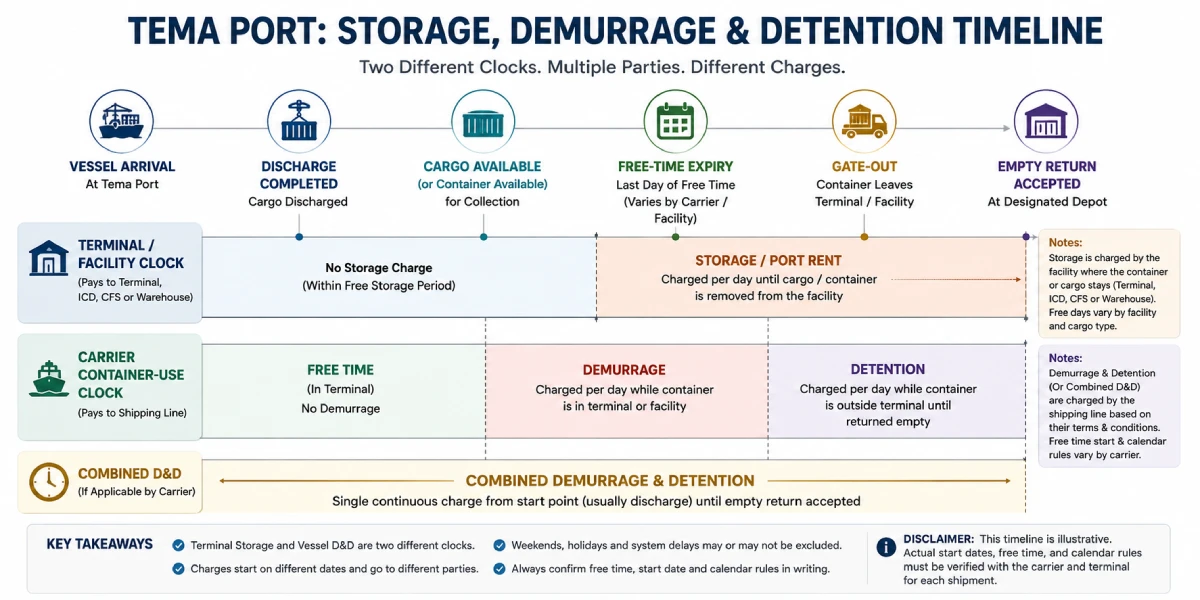
Storage, demurrage, and detention are frequently confused because they can all increase when cargo release is delayed. They are not the same charge.
Storage or Port Rent
Storage pays for the use of space at a terminal, ICD, CFS, or warehouse after the applicable free-storage period.
The facility determines:
- When the storage clock begins
- How many free days apply
- Whether the tariff escalates by time band
- Whether weekends and holidays count
- Whether different cargo or equipment types use different rules
Demurrage
Demurrage generally refers to the shipping line’s charge for continued use of its container while the equipment remains inside the terminal or another defined facility after the carrier’s free time has expired.
Detention
Detention generally applies after the container has left the terminal but has not yet been returned empty to the carrier’s designated depot or accepted return location within the allowed period.
This means that removing the container from Tema does not necessarily stop all time-related charges.
Combined Demurrage and Detention
Some carriers use a combined D&D structure rather than separate demurrage and detention clocks. In that model, one continuous carrier equipment clock may run from a carrier-defined starting event until the empty container is accepted back.
This carrier clock can still run separately from the terminal’s storage clock because the two charges compensate different parties for different resources.
Carrier terms also show why a universal Tema free-time rule is unsafe. For example, Maersk Ghana publishes its own import D&D terms, while OOCL Ghana publishes separate Ghana free-time and D&D information. The carrier’s current shipment-specific terms should control rather than a generic port assumption. See Maersk Ghana import information and OOCL Ghana free-time information.
Free-Time Countdown
Before cargo arrives, record these milestones separately:
- Vessel arrival
- Container discharge
- Cargo or container availability
- Terminal or CFS free-storage expiry
- Carrier free-time expiry
- Terminal gate-out
- Delivery and unloading
- Empty return accepted
Do not assume the carrier and terminal count from the same date.
Also do not assume weekends, public holidays, customs holds, or system delays are automatically excluded. Ghana Shippers’ Authority has publicly discussed demurrage pressure and operational delays, but any exemption or waiver still needs to be confirmed with the party issuing the charge.
Avoidable vs Usually Unavoidable Charges
Some destination charges are part of the normal import process. Others are triggered or increased by delay, rework, or failed coordination.
| Usually Part of the Import Chain | Often Triggered or Increased by Delay |
|---|---|
| Normal carrier documentation or release | Carrier demurrage or detention after free time |
| Normal terminal handling | Terminal, ICD, CFS, or warehouse storage |
| Customs declaration and broker services | Repositioning, amendments, or repeated examination handling |
| Import duty and tax | Truck waiting, failed pickup, or failed delivery |
| Planned inland haulage | Late unloading, late empty return, or after-hours operations |
“Usually unavoidable” does not mean every shipment must include the same line item. The correct test is whether the charge was required for that specific cargo movement under the agreed carrier, facility, customs, and delivery arrangements.
FOB, CIF, DAP and DDP: Who May Face the Destination Bill?
Incoterms allocate responsibilities between seller and buyer, but they do not replace a detailed logistics quotation.
| Incoterm | Main Carriage | Import Clearance | Tema Destination Cost Position |
|---|---|---|---|
| FOB | Buyer arranges main carriage | Buyer | Normally buyer-side after shipment |
| CIF | Seller arranges carriage and insurance to the named port | Buyer | Not automatically all destination charges included |
| DAP | Seller arranges delivery to the named place | Buyer normally handles import | Depends on named place and written quote scope |
| DDP | Seller-side obligation extends through import to named place | Seller-side import responsibility | Still requires an itemized operational quotation |
Under CIF, the seller contracts the main carriage and insurance, but the buyer normally remains responsible for import formalities. Under DAP, import clearance is normally for the buyer, while DDP shifts import responsibility to the seller side. The exact named place and unloading arrangement still matter. See the ICC explanation of C and D Incoterms rules.
A quotation marked “CIF Tema” should therefore state whether it includes:
- Carrier destination local charges
- Terminal handling
- Destination documentation
- Customs broker service
- Duty and tax
- Examination-related charges
- Terminal or CFS storage
- Demurrage or detention
- Inland delivery
A quotation marked “DDP Accra” should still identify the named delivery location and clarify unloading, waiting time, special handling, storage caused by consignee delay, and other exclusions.
Before Vessel Arrival Checklist
The most effective way to reduce storage and D&D exposure is to resolve documents, payment, transport, and release requirements before the free-time clocks become critical.
Documents That Affect Cargo Release
Depending on the shipment, prepare and verify:
- Bill of Lading or waybill
- Original B/L surrender, Sea Waybill, or Telex Release status
- Commercial invoice
- Packing list
- Import Declaration Form
- TIN or Ghana Card PIN details
- Commodity-specific permits and certificates
- HS classification information
- Customs valuation support
- Clearing-agent authorization where applicable
GRA’s import procedures explain the core document and ICUMS declaration framework. For a complete Ghana clearance workflow, see customs clearance in Ghana.
Pre-Arrival Clearance and Payment Readiness
Before ETA, confirm:
- The Arrival Notice recipient and local carrier agent
- Whether the broker has the full document set
- Whether the customs declaration can be prepared before arrival
- Whether duty and tax funds are ready
- Whether carrier local charges and deposit requirements are known
- The carrier’s free-time basis and last free date
- The terminal or CFS storage rule separately
- Any inspection, scan, or permit risk that could delay release
Truck, Unloading, and Empty Return Planning
For an FCL shipment, the operational plan should be ready before pickup:
- Terminal or ICD pickup point
- Truck availability
- Exact delivery address
- Unloading equipment
- Consignee receiving window
- Allowed truck waiting time
- Empty-container depot
- Depot opening hours
- Empty-return deadline
A container released from customs can still incur additional costs if no truck or unloading slot is available.
How to Review a Tema Destination-Charge Quotation
A useful destination quotation is itemized. It should not simply say “Tema local charges” or “all port charges.”
Included vs Excluded
Ask the forwarder or destination agent to state whether the quotation includes or excludes:
- Ocean freight
- Carrier destination local charges
- Terminal or CFS charges
- Customs broker service
- Import duty and tax
- Inspection or examination-related costs
- Storage
- Demurrage and detention
- Container deposit
- Inland delivery
- Truck waiting
- Empty-container return
- VAT, NHIL, or other applicable tax treatment
- Quote validity
How to Check Vague or Potentially Duplicate Charges
Review unclear labels such as:
- Terminal handling
- Local terminal recovery
- Port additional
- Port infrastructure charge
- Documentation
- Arrival Notice fee
- Delivery order
- Cargo release
- Carrier security
- Terminal security
Two similar names do not automatically mean duplicate billing. They may be issued by different parties for different services.
Likewise, different names do not guarantee that two fees are genuinely separate.
For each line, compare:
- Charging entity
- Charge code
- Billing unit
- Service description
- Trigger
- Container or cargo type
- Invoice reference
Currency, Exchange Rate, and Tax Treatment
The quotation should show the billing currency and how any conversion is handled.
Ghana Shippers’ Authority has also issued guidance aimed at greater transparency in exchange-rate application by shipping service providers. For invoice review, confirm:
- Billing currency
- Exchange rate used
- Exchange-rate date
- Final payable currency
- Whether VAT, NHIL, or other applicable levies are included or excluded
See the Ghana Shippers’ Authority foreign-exchange invoice guidance.
Verified Tema Import Case: What Should Be Recorded
A real shipment case is more useful than a generic “average clearing cost,” but one invoice should never be presented as the standard Tema rate.
When Winsail adds a verified case to this page, the case should include:
- 20GP or 40HQ equipment
- Shipping line
- Port of loading
- Tema terminal, ICD, or CFS
- Vessel arrival date
- Discharge or availability date
- Customs declaration date
- Customs release date
- Terminal gate-out date
- Empty-return date
- Carrier free-time terms
- Final delivery city
The cost breakdown should separately identify:
- Carrier local-charge invoice
- Terminal or facility invoice
- GRA assessment
- Clearing-agent invoice
- Haulage invoice
- Container deposit
- Deposit refund
- Storage, if any
- Demurrage, if any
- Detention, if any
Commercially sensitive consignee data, B/L numbers, account numbers, and cargo values can be anonymized. The actual invoice amount should remain case-specific and should not be converted into a universal “Tema average.”
Delivery Costs from Tema to Accra, Kumasi, Takoradi, or Other Cities
A reliable inland delivery quote requires more information than the destination city.
Provide:
- Pickup terminal, ICD, CFS, or warehouse
- Exact delivery address
- 20ft, 40ft, 40HQ, reefer, or LCL details
- Cargo gross weight
- Cargo type
- Required delivery date
- Unloading method
- Site access restrictions
- Allowed waiting time
- Empty-return depot
- Empty-return deadline
The final price can vary with distance, cargo weight, truck availability, fuel and road conditions, waiting time, unloading arrangements, weekend or after-hours work, and the location of the empty depot.
For this reason, avoid publishing a fixed “Tema to Kumasi” or “Tema to Accra” rate without a current quotation date, container type, gross weight, delivery district, waiting allowance, empty-return conditions, and quote validity.
Empty Container Return Checklist
For FCL shipments, empty return is part of destination-cost control.
Keep:
- Written empty-depot instruction
- Return deadline
- Return appointment reference
- Depot opening-hour confirmation
- Truck gate-in record
- Equipment Interchange Receipt
- Container-condition photos
- Cleaning remarks
- Damage remarks
- Depot refusal evidence, if applicable
- Return date and time
- Container-deposit refund reference
If the designated depot refuses the container, obtain written evidence immediately and notify the shipping line or local agent. Do not assume a rejected return automatically stops detention.
Destination Charge RFQ Template
When requesting a Tema destination-cost quotation, provide:
- Port of loading
- Shipping line, if already known
- MBL and HBL details, where available
- ETA
- Tema terminal or CFS, if known
- FCL or LCL
- Container type or LCL CBM and weight
- Commodity
- HS code
- Incoterm
- Known free-time terms
- Customs or permit status
- Exact final delivery address
- Required delivery date
Ask the forwarder or agent to itemize:
- Carrier local charges
- Terminal or CFS charges
- Clearing-agent service
- Duty and tax treatment
- Inspection or examination exclusions
- Storage rules
- Demurrage and detention free time
- Container deposit
- Inland haulage
- Waiting time
- Empty return
- VAT, NHIL, or other applicable levies
- Billing currency and exchange-rate basis
- Quote validity
FAQ
What are Tema Port destination charges?
They are post-arrival costs billed by parties such as the shipping line, terminal or CFS, clearing agent, customs authority, and trucker. Ocean freight and import duty should be identified separately rather than combined into one vague port-charge total.
Are Tema Port destination charges included in CIF shipping?
Not automatically. CIF covers the seller’s contracted carriage and insurance to the named port, but the buyer normally handles import formalities. Destination unloading and local charges should be checked against the freight contract and written quotation.
Who charges THC, storage, demurrage, and detention at Tema Port?
The charging party varies. Terminal handling and storage are linked to the terminal or facility arrangement, while demurrage and detention are normally carrier equipment charges. Always confirm the issuer shown on the actual invoice.
How many free days do import containers receive at Tema Port?
There is no universal free-time number for every Tema shipment. Carrier free time and terminal or facility free storage use separate terms, which may vary by carrier, equipment, facility, and commercial agreement.
When does container free time start at Tema Port?
It starts from the event defined by the relevant carrier or facility, such as discharge, the day after discharge, or cargo availability. Obtain the start date and last free date in writing for the specific shipment.
What is the difference between port storage, demurrage, and detention?
Storage pays for terminal, ICD, CFS, or warehouse space after the facility’s free period. Demurrage generally applies to carrier equipment inside the terminal after carrier free time, while detention generally applies after gate-out until accepted empty return.
Why are LCL destination charges in Ghana often billed per CBM?
LCL cargo shares a master container, so destination CFS and handling services may be billed by CBM, weight/measurement, revenue tonne, HBL, shipment, or a minimum charge rather than by a full container.
What information is needed to estimate delivery from Tema to Accra, Kumasi, or Takoradi?
Provide the pickup facility, exact delivery address, container or LCL details, gross weight, cargo type, delivery date, unloading method, waiting allowance, and empty-return requirement. A city name alone is not enough for a reliable quotation.
Control the Cost Before Arrival
The safest way to control Tema Port destination charges is to separate each invoice by charging party and timeline before the vessel arrives.
Confirm the shipping line’s destination local charges and free time, the terminal or CFS storage rules, customs and broker scope, inland delivery conditions, and empty-container return requirements. A price without a clear issuer, billing unit, currency, tax status, effective or verification date, and equipment scope should be treated as incomplete rather than as a reliable current rate.
