
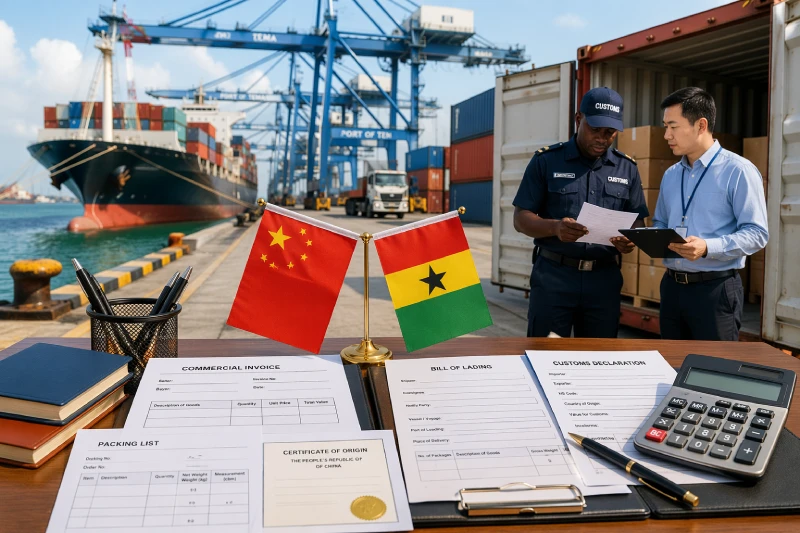
Importing goods from China to Ghana does not end when the cargo arrives at Tema Port or Kotoka International Airport. Before your shipment can be released, it must pass Ghana customs clearance.
For many importers, customs is the stage where delays, unexpected charges, and document problems happen. Missing paperwork, incorrect HS codes, or confusion about who is responsible under the agreed Incoterm can add days or even weeks to the process.
This guide explains how customs clearance works in Ghana, what documents you need, who is responsible under EXW, FOB, CIF, and DDP shipping terms, and how to avoid the most common problems.
If you are still planning your shipment, first read the related guide on shipping from China to Ghana to understand the full transport process before customs begins.
How Customs Clearance Works in Ghana
Most shipments from China enter Ghana through Tema Port, Takoradi Port, or Kotoka International Airport in Accra. Once the cargo arrives, customs clearance normally follows these seven steps:
- Cargo arrives at the port or airport.
- A customs declaration is submitted.
- Customs reviews the shipping documents.
- Duties and taxes are calculated.
- The shipment may be scanned or inspected.
- Import duty and VAT are paid.
- Customs releases the cargo for delivery.
In practice, most importers do not complete these procedures themselves. A licensed customs broker or clearing agent in Ghana usually files the declaration, communicates with customs officers, arranges payment, and collects the cargo.
Using a local broker is especially important for first-time importers because Ghana customs procedures can be complicated if you are unfamiliar with the required forms and local regulations.
Who Is Responsible for Customs Clearance?
The responsibility for customs clearance depends on the Incoterm agreed between the Chinese supplier and the Ghana buyer.
EXW (Ex Works)
Under EXW, the buyer is responsible for everything after collecting the goods from the supplier’s factory in China. This includes export clearance in China, international freight, customs clearance in Ghana, duty payment, and final delivery.
EXW gives the buyer maximum control, but it is usually not recommended unless you already have an experienced freight forwarder and customs broker.
FOB (Free on Board)
Under FOB, the Chinese supplier delivers the cargo to the port in China and handles export customs there. The buyer is responsible for sea or air freight, Ghana customs clearance, duties, and inland delivery.
FOB is one of the most common options for importers because it gives you control over shipping costs while leaving the supplier responsible for Chinese export procedures.
CIF (Cost, Insurance, and Freight)
Under CIF, the supplier pays for freight and insurance to Ghana. However, once the cargo arrives, the buyer still must arrange customs clearance, pay import duty and VAT, and organize delivery from the port.
Many importers mistakenly believe CIF includes customs clearance. It does not. You still need a Ghana clearing agent.
DDP (Delivered Duty Paid)
Under DDP, the seller or freight forwarder handles the entire process, including freight, Ghana customs clearance, duty payment, and delivery to your address.
DDP is often the easiest option for new importers because you do not need to find a separate customs broker or worry about duty calculations.
If you are unsure which shipping method is best, compare the options in the related guide on the best shipping methods from China to Ghana.
Documents Required for Customs Clearance in Ghana
Incomplete or inconsistent documents are one of the biggest reasons shipments are delayed in Ghana. Before the cargo leaves China, make sure you have the following documents ready.
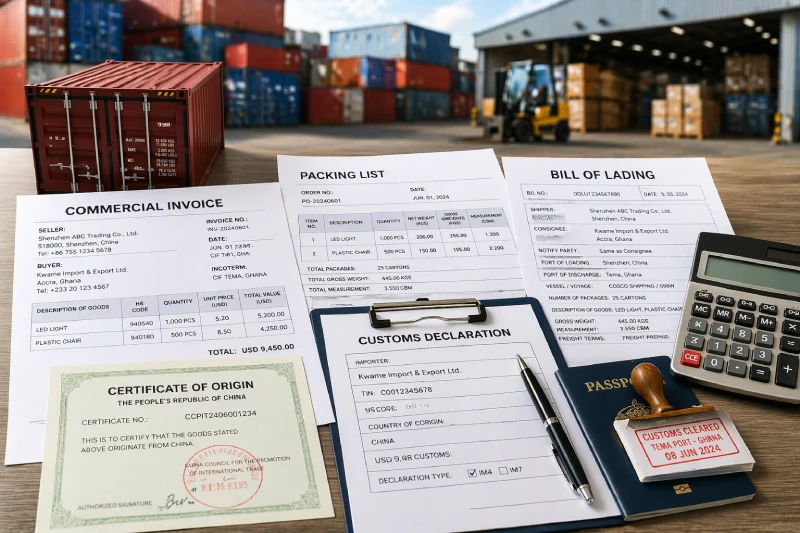
Commercial Invoice
The commercial invoice is the main document used by customs to determine the cargo value and calculate import duty.
It should include:
- Seller and buyer details
- Product description
- Quantity and unit price
- Total cargo value
- Currency used
- Agreed Incoterm
The description should match the actual goods exactly. Generic descriptions such as “general merchandise” can create delays.
Packing List
The packing list shows how the goods are packed and shipped. It normally includes:
- Number of cartons or pallets
- Weight and dimensions
- Quantity per package
- Marks and container details
Customs may compare the packing list with the invoice and inspect the cargo if the details do not match.
Bill of Lading or Air Waybill
For sea freight shipments, you need a Bill of Lading. For air freight, you need an Air Waybill.
This document proves ownership of the shipment and shows where the cargo was shipped from and who should receive it in Ghana.
Import Declaration and Customs Entry
The customs declaration is normally submitted by a licensed clearing agent in Ghana. The declaration includes the HS code, cargo value, importer details, and taxes payable.
Additional Certificates
Some products require extra documents, such as:
- Certificate of Origin
- Health certificate for food or cosmetics
- Product conformity certificate
- Import permits for chemicals, medicines, or regulated goods
Always confirm document requirements before shipping, especially for electronics, food, cosmetics, and medical products.
How Duties and Taxes Are Calculated in Ghana
Import charges in Ghana are usually based on the customs value of the goods. Customs uses the declared value plus freight and insurance costs to calculate the amount payable.
The final amount may include:
- Import duty
- VAT
- Processing fees
- Other port or inspection charges
The most important factor is the HS code. Every product has an HS code, and each code has a different duty rate.
For example, clothing, machinery, and electronics may all have different customs rates even if the shipment value is the same.
Using the wrong HS code can cause customs to recalculate the duty, delay the shipment, or even issue a penalty.
Some importers try to declare a lower value to reduce taxes. This is risky. Ghana customs may compare your declared value with market prices and ask for extra proof. If customs believes the value is too low, they can increase the amount and delay the cargo.
To understand the full landed cost of importing, combine customs charges with freight costs shown in the shipping cost from China to Ghana guide.
How Long Does Customs Clearance Take in Ghana?
If all documents are correct and there are no inspections, customs clearance in Ghana is usually quite fast.
- Air freight shipments: normally 1–3 working days
- Sea freight shipments: normally 3–7 working days after arrival
However, customs clearance can take longer if:
- The documents are incomplete
- The HS code is incorrect
- Duty payment is delayed
- The cargo is selected for physical inspection
- The shipment arrives during public holidays or busy port periods
Remember that customs clearance time is different from total shipping time. Even if your shipment reaches Ghana quickly, it cannot be delivered until customs releases it.
For a complete breakdown of transit time plus customs time, see the guide on how long shipping from China to Ghana takes.
Common Customs Problems and How to Avoid Them
Incorrect HS Codes
Wrong HS codes are one of the most common customs issues. If the code does not match the product, customs may stop the shipment and request a new declaration.
To avoid this, ask your supplier or freight forwarder to confirm the correct HS code before shipping.
Missing or Inconsistent Documents
If the invoice, packing list, and Bill of Lading contain different quantities, product names, or values, customs may hold the shipment.
Always check that every document uses the same information.
Under-Declared Cargo Value
Declaring a lower cargo value may seem like a way to save money, but it often creates bigger problems. Customs can request bank records, supplier invoices, or other proof of value.
If customs believes the declaration is inaccurate, the shipment may be delayed and additional duty may be charged.
Cargo Inspection Delays
Some shipments are selected for scanning or physical inspection. This is common for:
- High-value cargo
- Mixed cargo shipments
- Products with unclear descriptions
- Restricted or regulated items
You cannot completely avoid inspection, but accurate documents reduce the risk.
Restricted Goods
Certain goods need special approval before import into Ghana, including:
- Food products
- Cosmetics
- Medicines
- Chemicals
- Telecommunications equipment
If you ship these products without the required permit, customs may refuse release.
Customs Clearance Under DDP Shipping
With DDP shipping, the freight forwarder or seller takes care of customs clearance on your behalf.
A typical DDP service includes:
- Shipping from China to Ghana
- Customs declaration in Ghana
- Duty and VAT payment
- Cargo release
- Delivery to your address
DDP is often the best choice if:
- This is your first shipment to Ghana
- You do not have a local customs broker
- You want a predictable total cost
- You want to avoid handling customs paperwork yourself
However, DDP is not suitable for every shipment. Some regulated products may still require the importer in Ghana to provide licenses or company registration documents.
If you want a full explanation of this process, read the detailed guide on DDP shipping from China to Ghana.
Who Should Handle Customs Clearance?
The best option depends on your experience and the type of cargo.
- First shipment to Ghana: Use DDP or a local customs broker
- Small air shipment: DDP is usually easiest
- Large container shipment: Use a licensed Ghana clearing agent
- Experienced importer with local staff: Handle customs locally under FOB or CIF
- Regulated products: Use a specialist customs broker
In general, first-time importers should not try to manage customs alone. Working with an experienced forwarder or broker reduces the chance of delays and unexpected costs.
FAQs
How long does customs clearance take in Ghana?
Air freight normally clears within 1–3 working days, while sea freight usually takes 3–7 working days after arrival.
What documents are required?
You usually need a commercial invoice, packing list, Bill of Lading or Air Waybill, customs declaration, and any special certificates required for your product.
Who pays customs duty under CIF?
Under CIF, the buyer pays customs duty, VAT, and local clearance charges in Ghana.
Can I clear goods in Ghana without a customs broker?
Technically yes, but most importers use a licensed clearing agent because the process is more efficient and less risky.
Is DDP easier for first-time importers?
Yes. DDP is usually the easiest option because the freight forwarder handles customs, taxes, and delivery.
Conclusion
Successful customs clearance in Ghana depends on correct documents, accurate HS codes, proper duty payment, and a clear understanding of who is responsible under the shipping terms.
For experienced importers, FOB or CIF may provide more control. For new importers, DDP or a licensed Ghana customs broker is usually the safest option.
Before shipping, review your documents carefully and choose the customs method that matches your experience level and cargo type.
