
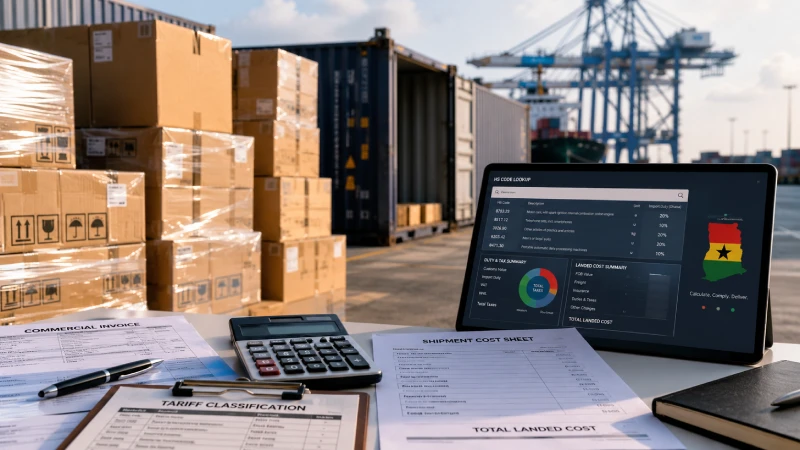
If you import commercial goods into Ghana, the import duty shown against an HS code is only one part of the final cost. A reliable budget normally starts with the product’s tariff classification, continues through customs valuation and the ICUMS duty assessment, and then adds destination charges, clearing costs and inland delivery.
For businesses buying from China, this means you should not judge profitability from the supplier price or freight quote alone. Before placing an order, build a product-specific estimate covering customs duty, VAT and applicable levies as well as logistics costs. For the broader transport side of the shipment, see our guide to shipping from China to Ghana.
Quick Answer
A practical Ghana import-cost calculation follows this sequence:
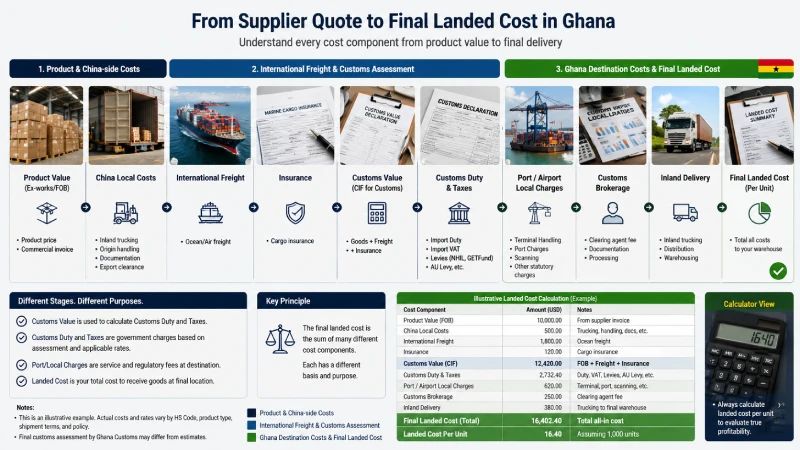
Product specification → HS classification → Customs value → Duty and taxes → Ghana local charges → Inland delivery → Landed cost per unit
The official ICUMS General Goods Duty Calculator is useful for budgeting, but its result should not be treated as a guaranteed final Customs Assessment.
Ghana Import Duty by HS Code: Why Classification Comes First
The Harmonized System, or HS, is the international system used to classify traded goods. Ghana applies its tariff treatment through HS classifications within the ECOWAS Common External Tariff framework.
The GRA Harmonized System Code search provides an official starting point for tariff research and displays information including the HS description and relevant import tax fields.
However, an importer should not choose an HS code simply because a product name looks similar.
Descriptions such as “machinery,” “phone accessories,” “textiles,” “auto parts” or “electrical equipment” are normally too broad to support reliable classification. Two products sold under the same commercial name can fall under different tariff headings because their materials, functions, technical characteristics or intended uses differ.
Product Information Needed for Classification
| Information | Why It Matters |
|---|---|
| Detailed product description | Identifies what the goods actually are |
| Material and composition | Can determine the relevant heading or subheading |
| Function and intended use | Important for machinery, equipment and components |
| Working principle | Helps distinguish technically similar products |
| Power, voltage or capacity | Often relevant to electrical equipment |
| Dimensions and specifications | May separate similar tariff categories |
| Model number | Connects the declaration to technical documentation |
| Packaging and presentation | Can affect treatment for certain products |
| Technical catalogue or drawings | Supports classification review |
| Product photos | Helps a broker or Customs understand the physical goods |
This is why tariff research should begin before the shipment departs China, not after the goods arrive in Ghana.
How to Find the Right Ghana HS Code
Start by creating a small classification file for the product. Ask the supplier for a specification sheet, catalogue, clear photos, material or composition details, model information and an explanation of the product’s function.
Then search the official GRA HS Code database using both the product description and possible tariff headings. Compare the tariff description with the actual specifications rather than choosing the first result containing a familiar keyword.
For goods with significant duty exposure, recurring imports or an ambiguous classification, consider seeking more formal confirmation.
GRA Customs provides advance-ruling mechanisms for tariff classification and rules of origin. An advance ruling can be useful before importation where classification is commercially important, especially for mixed-material goods, multifunction machines, components that may be classified differently from complete equipment, or products where competing classifications produce materially different tax treatment.
A freight forwarder can help organize product information and obtain a preliminary estimate, but that is not a substitute for GRA, the declaring customs agent or a formal classification decision.
Ghana Import Cost Formula: From Invoice Value to Customs Value
One of the most common budgeting mistakes is treating the supplier’s commercial invoice value as automatically identical to the customs value.
They are related, but they are not necessarily the same.
Invoice Value is the amount shown on the supplier’s commercial invoice.
Transaction Value generally refers to the price actually paid or payable for the imported goods, subject to applicable customs valuation rules and adjustments.
Customs Value is the value accepted for customs assessment purposes.
For preliminary budgeting, an importer can work from the applicable purchasing term.
From an FOB Quote
Estimated CIF Budget Value = FOB Value + International Freight + Insurance
From an EXW Quote
Estimated CIF Budget Value = EXW Product Value + Relevant China Origin Costs + International Freight + Insurance
From a CIF Quote
If the supplier or freight quotation already includes the agreed freight and insurance components, do not add the same costs again.
A CIF amount used for commercial budgeting should still not be treated as a guarantee that Customs will accept exactly the same customs value.
Most importantly:
CIF Value ≠ Customs Taxes ≠ Tema or Airport Charges ≠ Final Landed Cost
If you still need to estimate the international transport component, refer to our guide on shipping cost from China to Ghana.
What Import Duty, VAT and Levies May Apply in Ghana?
GRA describes Ghana’s ECOWAS tariff structure through five headline bands: 0%, 5%, 10%, 20% and 35%. The appropriate treatment depends on the tariff line and should not be selected from the product name alone. See the GRA Customs Tariffs and Levies guidance for the official framework.
Customs duty is also not the same as total import tax.
For taxable imports, Ghana’s VAT structure changed from January 1, 2026. The current standard rates are:
- VAT: 15%
- NHIL: 2.5%
- GETFund Levy: 2.5%
GRA states that VAT, NHIL and GETFund are now calculated using the same current base or value rather than the previous cascading method. The former COVID-19 Health Recovery Levy has been abolished. The current framework is summarized by GRA VAT guidance.
For imports, the VAT calculation base is not simply the supplier invoice value. Customs value, applicable import duties and other chargeable taxes may form part of the statutory tax build-up.
Possible Duty and Tax Components
| Charge | General Treatment | Rate / Method |
|---|---|---|
| Import Duty | Depends on HS classification | Tariff-line specific |
| VAT | Taxable imports unless exempt or relieved | 15% |
| NHIL | Follows applicable current VAT treatment | 2.5% |
| GETFund Levy | Follows applicable current VAT treatment | 2.5% |
| AU Import Levy | May apply to eligible goods from non-AU states | 0.2% of applicable value |
| ECOWAS Community Levy | Generally applies within its rules to goods from third countries | 0.5% |
| EXIM Levy | Applies to goods within its statutory scope | Currently documented at 0.75% |
| Special Import Levy | Applies only where goods fall within its statutory scope | Currently documented at 2% for covered goods |
| Import Excise | Only for excisable products | Product-specific |
| Inspection / Regulatory Charges | Only where applicable | Product- and regulator-specific |
Do not add every percentage in this table together and apply the total to CIF. Different charges can have different tax bases, exclusions and applicability rules. Some charges depend on HS classification, country of origin, customs procedure, product use or a specific statutory schedule.
Ghana also enacted major customs and excise legislation in August 2026. Because implementation details and administrative practice can change, the shipment-specific assessment in GRA and ICUMS should take precedence over formulas copied from older online articles.
How to Use the Official ICUMS General Goods Duty Calculator
Ghana’s ICUMS General Import Duties and Tax Form is the most relevant official tool for a pre-import general-goods duty estimate.
The current form requests information including:
- HS Code
- CPC
- Country
- Currency
- CIF value
- FOB value
- Net weight
- Quantity
- Package and supplementary units where applicable
Before using it, make sure the product specification and provisional HS classification are sufficiently detailed. Also remember that the HS Code and CPC are different inputs: the HS code identifies the product, while the CPC relates to the customs procedure under which the goods are declared.
A practical workflow is:
- Collect complete product specifications.
- Research the provisional HS code.
- Confirm the appropriate customs procedure with the Ghana clearing agent.
- Prepare the correct FOB, CIF, weight and quantity information.
- Enter the data into ICUMS.
- Review individual assessment lines, not just the total figure.
Treat the result as a budgeting reference.
The final declaration can still be affected by classification, customs valuation, origin, the applicable exchange rate, exemptions or reliefs, inspection findings and the documents submitted.
What Exchange Rate Should You Use?
Do not permanently hard-code a USD/GHS exchange rate into a landed-cost calculator.
The Bank of Ghana publishes market reference rates, but a commercial budgeting rate is not necessarily the same rate ultimately applied to the customs assessment. For a shipment-specific calculation, confirm the exchange rate reflected in ICUMS when the declaration is assessed.
From FOB, CIF or DDP to Final Landed Cost
Customs taxes are only one layer of the importer’s total cost.
A useful full formula is:
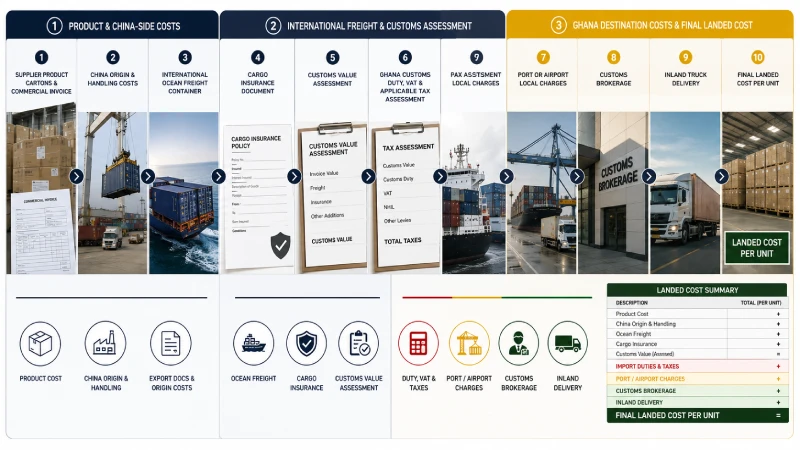
Gross Landed Cost = Product Purchase Price + China Local Charges + International Freight + Insurance + Customs Duties and Taxes + Port/Airport Charges + Brokerage + Regulatory Costs + Inland Delivery
From an FOB quotation, you still need to budget international freight, insurance where applicable, Ghana customs charges and destination costs.
From a CIF quotation, avoid adding freight and insurance twice. Continue the calculation from customs taxes through Ghana destination charges, broker fees and inland delivery.
With a DDP quotation, ask what the seller or forwarder has actually included rather than relying on the Incoterm label alone.
DDP Quote Verification Checklist
| Ask the Provider | Why It Matters |
|---|---|
| Who will act as importer of record? | Clarifies declaration responsibility |
| Are Customs duty and taxes included? | Confirms whether the quote covers assessment |
| Will I receive the Customs Assessment or Tax Bill? | Allows reconciliation |
| Are terminal or destination charges included? | These are separate from Customs duty |
| Is final inland delivery included? | Determines true door-delivered cost |
| Who bears an additional assessment? | Important if classification or value changes |
Worked Example: Landed Cost per Unit
The following example is illustrative only. It does not assign an official HS code to the product.
Illustrative Example
Product specification: A defined electrically powered consumer appliance, 220–240V, 1,200W, plastic and metal housing, individually retail packed.
Assumed HS Code: To be verified
Source date: August 30, 2026
FOB value: USD 10,000
International freight: USD 2,000
Insurance: USD 200
Estimated customs value: USD 12,200
Assumed import duty: 20% for mathematical illustration only
Assumed additional applicable levies: 1.45% of customs value for illustration
Special Import Levy / excise / regulatory charges: Excluded pending classification
Quantity: 1,000 units
First calculate the illustrative duty:
Import Duty = 12,200 × 20% = USD 2,440
Illustrative additional levies:
12,200 × 1.45% = USD 176.90
For this simplified example, assume the common VAT/NHIL/GETFund calculation base is:
12,200 + 2,440 + 176.90 = USD 14,816.90
Then:
VAT = 14,816.90 × 15% = USD 2,222.54
NHIL = 14,816.90 × 2.5% = USD 370.42
GETFund = 14,816.90 × 2.5% = USD 370.42
Estimated customs taxes and levies in this illustration:
USD 5,580.28
Now assume, purely for landed-cost budgeting:
- Ghana local charges: USD 450
- Customs broker: USD 250
- Inland delivery: USD 300
Landed Cost per Unit Worksheet
| Cost Component | Illustrative Amount |
|---|---|
| FOB Product Value | $10,000.00 |
| International Freight | $2,000.00 |
| Insurance | $200.00 |
| Customs Duties, Taxes & Assumed Levies | $5,580.28 |
| Local Charges | $450.00 |
| Brokerage | $250.00 |
| Inland Delivery | $300.00 |
| Gross Landed Cost | $18,780.28 |
| Quantity | 1,000 |
| Gross Landed Cost per Unit | $18.78 |
This is not a Ghana Customs quotation. A different HS classification, tax treatment, customs value, exchange rate or additional assessment line would change the result.
For VAT-registered businesses, certain import VAT and levies may also qualify for input-tax treatment where the legal requirements are met. Do not automatically subtract recoverable tax from your landed cost. Confirm the accounting treatment with a Ghana tax professional.
Why Your Final Customs Assessment May Differ
A pre-order estimate is useful for commercial decisions, but the Customs Assessment is declaration-specific.
Differences commonly arise from:
Tariff classification. Customs or the declaring agent may determine that the product belongs under a different tariff line.
Customs valuation. The accepted customs value may differ from the importer’s preliminary budget.
Freight or insurance adjustments. This is particularly relevant where an EXW or FOB buyer estimated the CIF component before final shipping costs were known.
Exchange-rate timing. The rate used in an early procurement budget may differ from the rate applied when the declaration is assessed.
Origin or customs procedure. Origin and CPC can affect the treatment of particular assessment lines.
Inspection or regulatory requirements. Certain products require additional approvals, inspections, testing or certification. Ghana Standards Authority, for example, applies import-inspection requirements to specified regulated and high-risk goods.
Ghana’s customs process includes classification, valuation and approval before the final tax bill is established. For the wider declaration and release process, see our guide to customs clearance in Ghana.
Pre-Order Duty Estimation Checklist
Before placing an order, request from your supplier:
- Detailed commercial invoice or quotation
- Exact product specifications
- Material or composition
- Model number
- Catalogue and product photos
- Packing list
- Quantity and package count
- Net and gross weight
- Carton dimensions
- Country of origin
- EXW, FOB or CIF cost breakdown
Provide your Ghana customs broker with the same technical information together with the provisional HS code, freight and insurance figures and any known permit or certification requirements.
Seek formal classification or specialist advice when the shipment is high-value, repeated frequently, potentially excisable or regulated, or where two competing HS codes would produce materially different tax treatment.
A better landed-cost estimate does not come from finding the lowest percentage online. It comes from improving the quality of the classification, valuation and shipment data used in the calculation.
FAQ
How do I check Ghana import duty by HS code?
Start with the official GRA Harmonized System Code search and compare the tariff description with the product's detailed specifications. For material classification uncertainty, consult a Ghana clearing agent or request formal guidance from GRA.
What is the official Ghana import duty calculator?
ICUMS provides a General Import Duties and Tax Form for general goods. It uses information including HS code, CPC, country, CIF, FOB, weight and quantity.
Is Ghana import duty calculated on FOB or CIF value?
For budgeting, importers commonly build the customs-value estimate from the goods value plus relevant freight and insurance components. The final customs value is the value accepted for the declaration, so an FOB or commercial CIF quotation should not be treated as a guaranteed Customs Assessment.
What are the current VAT, NHIL and GETFund rates on imports into Ghana?
As of August 30, 2026, the standard rates are VAT at 15%, NHIL at 2.5% and GETFund Levy at 2.5% for applicable taxable imports. The former COVID-19 Health Recovery Levy has been abolished.
Why can my ICUMS estimate differ from the final Customs Assessment?
Differences can result from HS classification, customs valuation, exchange rates, origin, customs procedure, exemptions, inspection findings or additional taxes and charges applicable to the specific shipment.
Does a CIF quote include Ghana port and clearing charges?
Not automatically. A commercial CIF price generally addresses the agreed cost, insurance and freight elements. Ghana customs taxes, destination terminal or shipping-line charges, customs brokerage and inland delivery must be checked separately.
How do I calculate landed cost per unit in Ghana?
Add the product cost, origin charges, freight, insurance, customs duties and taxes, destination charges, brokerage, regulatory costs and delivery, then divide the total by the saleable quantity. Landed Cost per Unit = Total Gross Landed Cost ÷ Saleable Quantity.
When should I request formal HS classification advice?
Consider formal advice when classification is ambiguous, the shipment has high tax exposure, the goods will be imported repeatedly, the product is regulated or excisable, or a classification difference would materially affect your margin.
Estimating Ghana import duty is most reliable when the calculation starts with the product itself rather than a generic tax percentage. Build the HS classification from technical information, check the current GRA and ICUMS treatment, separate customs taxes from freight and destination charges, and calculate the final cost down to the unit level before committing to the order.
Winsail Logistics can help organize the China-side shipping information, freight cost and shipment details needed for a preliminary landed-cost budget. Final HS classification, customs value, applicable taxes and assessment remain subject to GRA, ICUMS and the actual customs declaration.
