
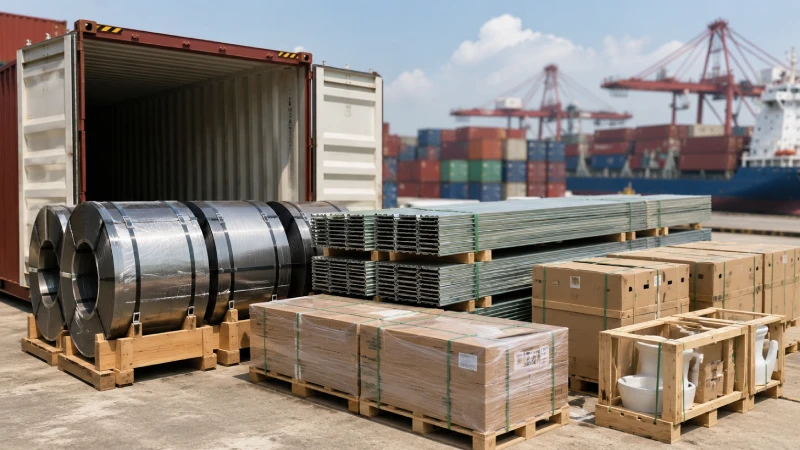
Shipping building materials from China to Ghana is not simply a matter of choosing a container and booking ocean freight. Steel coils, roofing sheets, tiles, sanitary ware and steel profiles have very different weight, shape, handling and damage risks.
A steel coil may occupy little space but place a very high concentrated load on the container floor. Roofing sheets may be relatively light for their volume but vulnerable to bending and edge damage. Tiles are dense and brittle, while sanitary ware is bulky, irregular and fragile.
For Ghana importers, contractors and building-material distributors, the safest approach is therefore to design the shipment around the actual cargo dimensions, gross weight, packing method, container specification, weight distribution, cargo securing and final delivery conditions.
For a broader overview of routes and shipping methods, see Winsail’s shipping from China to Ghana guide.
Quick Answer: There is no universal container loading weight for building materials. The practical allowable load depends on the container specification, road limits, port limits, carrier limits, weight distribution, VGM and whether the cargo can be secured safely.
What Building Materials Are Commonly Shipped from China to Ghana?
Ghanaian importers source a wide range of construction products from manufacturing centres such as Foshan, Guangzhou, Shanghai, Tianjin, Qingdao and other Chinese industrial regions.
Typical enquiries include steel coils, coated steel, roofing sheets, ceramic and porcelain tiles, sanitary ware, steel profiles, pipes, cables, hardware and other construction products. These should not be treated as one logistics category simply because they are all used in construction.
Building Material Shipping Matrix
| Material | Logistics Profile | Likely First Constraint | Main Risk | Main Shipping Focus |
|---|---|---|---|---|
| Steel coils | Very dense, concentrated footprint | Weight, floor loading, securing | Movement, floor stress, corrosion | Bedding, blocking, bracing, lashing |
| Roofing sheets | Long and relatively bulky | Length, cube, handling | Bending, crushed edges, scratching | Bundle support and edge protection |
| Tiles | Dense and brittle | Weight and pallet distribution | Cracking and chipping | Strong pallets and movement control |
| Sanitary ware | Bulky, irregular, fragile | Cube and handling | Impact and breakage | Cushioning and reinforced packing |
| Steel profiles or pipes | Long and dense | Length and weight distribution | Shifting or deformation | Bundling, blocking and load distribution |
This distinction should be made before asking how many containers are required. A container that works well for lightweight bathroom products may be completely unsuitable for a concentrated steel-coil loading plan.
The Ghana Standards Authority also distinguishes engineering product categories such as steel products, roofing sheets and building or road construction materials when conducting testing.
Dense vs Bulky Cargo: 20GP, 40GP or 40HQ?
One of the most common mistakes when planning construction materials freight to Ghana is choosing equipment based only on cubic capacity.
A 40HQ provides substantially more internal space than a 20GP, but this does not mean it can carry twice as much dense material. For steel, tiles and other high-density cargo, weight distribution or securing feasibility may become the limiting factor long before the container is physically full.
By contrast, sanitary ware and some roofing products may run out of usable cubic space before reaching a weight constraint.
Dense Cargo vs Bulky Cargo
Dense cargo tends to include:
- Steel coils
- Steel plates or profiles
- Ceramic and porcelain tiles
- Other compact metal products
Bulky cargo tends to include:
- Sanitary ware
- Lightweight construction components
- Some packaged roofing products
- Large but relatively light building fixtures
This is why steel coils often begin with a 20GP evaluation rather than automatically using a 40GP or 40HQ. The shorter container can be practical for dense cargo where additional cubic capacity provides little benefit.
That is not a rule that every steel shipment should use a 20GP. Coil diameter, coil width, individual gross weight, loading footprint, loading equipment, carrier acceptance and inland transport conditions must all be checked first.
20GP vs 40GP/40HQ Decision Table
| Decision Factor | 20GP | 40GP | 40HQ |
|---|---|---|---|
| Dense steel cargo | Often worth evaluating first | Use when loading plan supports it | Extra height may provide little benefit |
| High-volume cargo | Limited cube | More cubic capacity | Highest cube among these options |
| Long roofing bundles | Check dimensions carefully | Often more practical | Useful when extra volume is needed |
| Concentrated heavy loads | Load engineering required | Load engineering required | Load engineering required |
| Bulky fragile cargo | May fill quickly | Often suitable | Often suitable |
| Carrier and route limits | Verify | Verify | Verify |
For general FCL and LCL planning rather than cargo-specific loading engineering, refer to the sea freight from China to Ghana guide.
Container Weight Planning Table
Before confirming equipment for heavy building materials, the loading file should record:
| Check | Information Required |
|---|---|
| Container | Type, actual tare and equipment condition |
| Cargo | Individual package or coil gross weights |
| Dunnage | Pallets, cradles, timber and securing materials |
| Distribution | Position of each heavy cargo unit |
| Floor loading | Concentrated load and support arrangement |
| Carrier | Booking and equipment acceptance |
| Inland transport | China and Ghana road limitations |
| VGM | Final verified gross mass |
| Securing | Blocking, bracing and lashing feasibility |
A published container specification should therefore be treated as a reference, not as permission to load that theoretical payload on every China-Ghana shipment.
How Steel Coils Should Be Loaded and Secured
Steel coil container loading requires more planning than checking whether a coil physically fits through the doors.
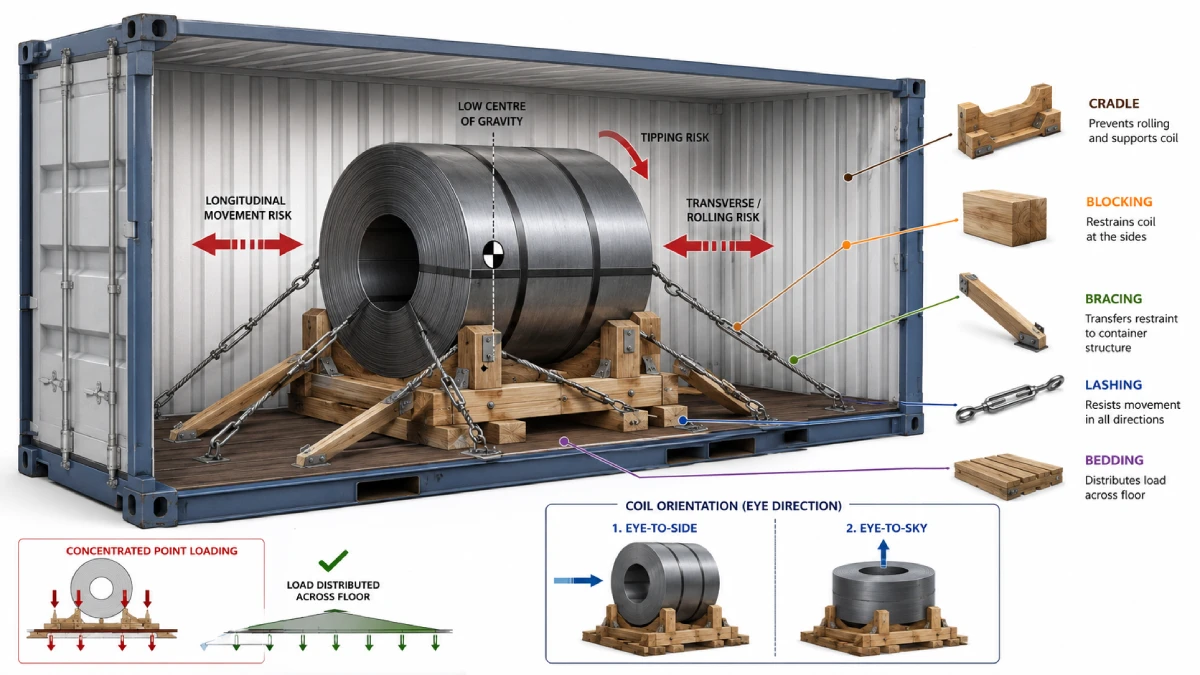
The major problem is that a steel coil combines high mass with a relatively small contact area and an unstable shape. CTU Code-based guidance highlighted by TT Club specifically identifies concentrated loading, weight distribution and coil stability as important risks.
Point Loading Comes Before Container Volume
A container may have enough total payload capacity on paper while still being unsuitable for the way a particular coil transfers weight into the floor.
Heavy coils therefore require an appropriate bedding or cradle arrangement. The objective is to distribute forces across suitable areas of the floor while also keeping the coil stable.
Simply placing a heavy coil directly on the container floor because the total shipment weight appears acceptable is not an adequate loading plan.
Control Weight Distribution
The combined cargo mass should be distributed according to a planned layout rather than concentrated randomly at one end of the container.
For multiple coils, the plan should consider:
- Individual coil weights
- Coil positions
- Longitudinal and transverse distribution
- Combined centre of gravity
- Space required for blocking and bracing
- Loading and unloading access
The total weight of the shipment alone is not enough to determine whether the loading arrangement is safe.
Eye-to-Side, Eye-to-Rear and Eye-to-Sky
Steel coil orientation is often described by the direction of the coil eye.
With Eye-to-Side or Eye-to-Rear, the coil is positioned on its curved surface and may have a tendency to roll if it is not properly restrained.
With Eye-to-Sky, the coil rests on its end and the primary stability concern may shift toward tipping.
There is no universal orientation that is correct for every containerized steel shipment. The choice depends on coil dimensions, weight, support arrangement, container type, handling method and the approved securing plan.
Bedding, Blocking, Bracing and Lashing Are Different
These functions should not be confused.
Bedding or a cradle supports the coil and helps distribute its weight.
Blocking restricts initial cargo movement.
Bracing provides structural restraint against expected forces.
Lashing supplements the system by controlling movement, rolling or tipping.
Adding more straps cannot compensate for an inadequate support structure or poor load distribution.
A typical preparation sequence is:
- Verify the mill packing list and individual coil weights.
- Inspect the empty container.
- Prepare the loading and securing plan.
- Install the required bedding or cradle.
- Load each coil into its planned position.
- Install blocking and bracing.
- Apply the specified lashings.
- Photograph the completed securing arrangement.
- Seal the container.
- Complete the VGM process.
How to Protect Roofing Sheets, Tiles and Sanitary Ware
Heavy does not always mean difficult in the same way. Roofing sheets and fragile building materials require a different damage-prevention strategy.
Roofing Sheets
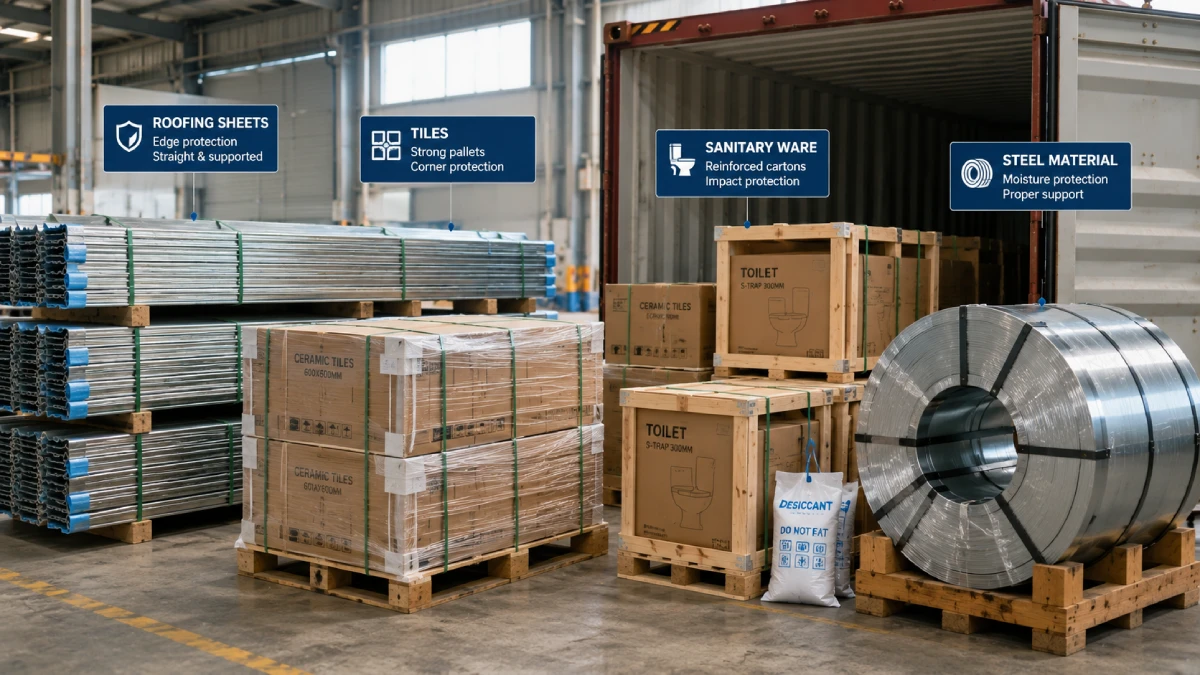
Roofing sheets should normally be prepared in rigid, manageable bundles with adequate support along their length.
Important checks include:
- Bundle length against container internal and door dimensions
- Support underneath long bundles
- No unsupported overhang
- Edge and corner protection
- Protection beneath straps
- Control of gaps that could allow movement
- Suitable forklift or crane handling
- Protection against inappropriate heavy top-loading
Long roofing bundles can be damaged before the vessel even sails if a forklift lifts them at poorly positioned points or if the bundle bends under its own weight.
Tiles
Tiles are compact and dense, but their brittleness creates a different problem.
A packing review should check pallet strength, carton condition, stack pattern, edge protection, strapping and void control. Pallets must also be restrained so they cannot move repeatedly during transport.
There is no reliable universal figure for how many tiles fit into a container because tile dimensions, carton configuration, pallet size and gross weight vary by product.
Sanitary Ware
Toilets, basins and similar products are irregular and vulnerable to impact.
Depending on the product and supplier packaging, protection may include individual cartons, cushioning, separation between pieces, reinforcement around projecting sections and stronger outer cases for particularly vulnerable cargo.
The supplier’s designed stacking limit should be respected rather than trying to maximize container utilization by placing excessive weight on lower cartons.
Fragile Building Material Packing Checklist
Before loading, confirm:
- Gross weight per pallet or crate
- Outer dimensions
- Pallet condition
- Edge and corner protection
- Banding or strapping
- Internal cushioning where required
- Void control
- Forklift entry points
- No unsupported overhang
- No incompatible heavy cargo above fragile packages
- Pre-loading photographs
How to Reduce Moisture and Corrosion Risk
Steel shipping from China to Ghana also requires moisture planning.
A closed container can experience temperature and humidity changes during a long sea voyage. Moisture already present in cargo, timber, packaging or container interiors can contribute to condensation, while water ingress or chloride contamination can significantly increase corrosion risk.
Moisture protection should start before loading:
- Use a container that is clean, dry and free from obvious water ingress.
- Avoid loading visibly wet steel.
- Avoid wet timber or dunnage.
- Maintain appropriate mill or factory protective wrapping.
- Protect exposed surfaces and edges where required.
- Photograph cargo condition before sealing.
Container desiccants can be useful where the risk assessment justifies them, particularly for corrosion-sensitive steel, long voyages, humid loading conditions or packaging containing moisture.
However, desiccant is not a substitute for loading dry cargo into a dry container, and there is no universal number of desiccant bags suitable for every shipment.
At destination, inspect packaging for water staining or other evidence before unpacking. Suspected damage should be documented before cargo condition changes during handling.
Can Several Foshan Suppliers Share One Container?
Yes, building materials from multiple Foshan or Guangzhou suppliers can sometimes be consolidated, but available space alone should not determine whether products are compatible.
Tiles, bathroom products, fittings and hardware may be suitable for consolidation when their cargo-ready dates, packaging and loading requirements are compatible.
The situation becomes more difficult when dense steel cargo is mixed with light or fragile products.
Heavy cargo generally needs low placement, strong support and tightly controlled weight distribution. Fragile goods need protection from compression and impact. Filling unused space around a steel coil with sanitary ware is therefore not automatically a good use of container capacity.
A practical decision sequence is:
Same origin region → Compatible cargo-ready dates → Suitable packaging → Safe weight distribution → Heavy cargo can be isolated → Loading sequence works → Destination unloading sequence works
If a critical stage fails, separate containers or shipments may be safer.
For the complete warehouse and multi-supplier process, see Winsail’s China to Ghana cargo consolidation guide.
Ghana Standards, HS Codes, Wood Packaging and VGM
Physical loading is only one part of a successful building materials import to Ghana.
Check the Exact Ghana Standard
Do not assume that every construction product has the same conformity requirement.
The Ghana Standards Authority maintains testing capabilities covering products including steel products, roofing sheets and other building or construction materials. Importers should therefore identify the exact product and applicable Ghana Standard before shipment.
An important 2026 clarification also distinguishes mandatory compliance with Ghana Standards from participation in the EasyPASS programme. GSA stated in July 2026 that EasyPASS does not represent a new blanket regulatory obligation for the entire Ghanaian business community.
Product-specific requirements should therefore be confirmed rather than assuming that every building material needs the same certificate.
“Building Materials” Is Not an HS Code
The Ghana Revenue Authority uses HS classification in customs assessment. Its import procedures also make clear that duties and taxes depend on factors including the type of goods and applicable rates.
This means a Ghana importer should not estimate tax simply from a commercial description such as “building materials.”
The exact classification may depend on the material, composition, coating, form, manufacturing process and intended function.
Wood Packaging and ISPM 15
Where solid-wood pallets, crates or dunnage are used, ISPM 15 requirements should be checked.
The IPPC standard covers wood packaging such as pallets, crates and dunnage that can carry pest risk. Processed wood materials such as plywood, particle board or OSB produced using glue, heat or pressure are among the listed exemptions.
Why VGM Matters for Heavy Cargo
VGM is particularly important when shipping steel or other heavy construction materials.
IMO states that the shipper is responsible for providing the verified gross mass of a packed container and that VGM must be available sufficiently in advance for vessel stowage planning. A packed container without the required verified mass cannot simply be treated as ready for loading.
The VGM is the packed container’s gross mass, not merely the weight shown for the products on the commercial invoice.
A shipment file should normally include the commercial invoice, detailed packing list, bill of lading, applicable Ghana import documents, product compliance documents where required, loading plan for heavy cargo, securing photographs and VGM information.
For a separate discussion of changing freight charges rather than physical loading, use Winsail’s shipping cost from China to Ghana guide.
Planning Tema Port and Final Project-Site Delivery
Arrival at Tema does not end the heavy-cargo planning process.
Ghana Ports and Harbours Authority lists containerized cargo and iron or steel among the cargo types handled at Tema. The importer still needs to coordinate customs and regulatory release, container availability, trucking and site delivery.
Before dispatching a heavy container from Tema, confirm:
- Clearing and document status
- Carrier or terminal release
- Truck configuration
- Applicable road and axle-weight restrictions
- Final delivery route
- Site gate and turning access
- Ground conditions
- Crane or forklift availability
- Safe unloading capacity
- Temporary storage location
- Empty-container return arrangements
For coils in particular, the project site should know how the cargo will be lifted before the truck departs the port area. A heavy coil arriving at a construction site without suitable lifting equipment can create both delay and safety risk.
China Factory to Tema to Project Site
A well-planned shipment should follow one connected process:
Chinese Supplier(s)
↓
Collect Packing Data
↓
Classify Cargo as Dense, Bulky, Fragile or Corrosion-Sensitive
↓
Choose Container and Prepare Loading Plan
↓
Factory Pickup or Consolidation
↓
Inspect Empty Container
↓
Load, Block, Brace, Lash and Apply Moisture Protection
↓
Photograph Cargo and Seal Container
↓
Complete VGM
↓
China Port
↓
Ocean Freight
↓
Tema Port
↓
Ghana Customs and Compliance Process
↓
Container Release
↓
Suitable Truck to Project Site
↓
Planned Offloading and Condition Check
The key is that decisions made at the Chinese factory should already take Tema delivery and project-site unloading into account.
What Information Is Needed for a Building Materials Shipping Quote?
For an accurate shipping plan, do not send only “20 tons of steel” or “one container of tiles.”
Provide the actual cargo data.
General Cargo Information
- Exact product name and specification
- Proposed HS code, if available
- Number of packages, pallets, crates or coils
- Gross weight of every packing unit
- Total gross weight
- Outer dimensions
- Packaging photographs
- Supplier address
- Cargo-ready date
- Incoterm
- Final Ghana delivery location
For Steel Coils
Provide:
- Individual coil weight
- Coil width
- Outer diameter
- Inner diameter
- Existing skid or cradle details
- Supplier’s normal loading orientation
- Available lifting method
For Roofing Sheets
Provide:
- Bundle length, width and height
- Gross weight per bundle
- Bundle support or skid design
- Number of bundles
For Tema-to-Site Delivery
Also confirm:
- Final project city or delivery area
- Whether a container truck can access the site
- Crane or forklift availability
- Any access or unloading restrictions
With these details, the forwarder can evaluate container type, weight distribution, loading method, securing requirements and inland delivery instead of relying on a theoretical container capacity.
FAQ
Is a 20GP or 40HQ better for shipping steel coils to Ghana?
Neither is universally better. Because steel coils are dense, a 20GP is often worth evaluating first. The final choice depends on actual coil dimensions, gross weight, loading footprint, container specification, weight distribution, road limits and carrier acceptance.
How much steel can I load into one container to Ghana?
There is no responsible universal figure. Depends on actual dimensions, gross weight, container specification, road limits and carrier acceptance. The loading plan must also consider point loading, weight distribution, VGM and cargo securing feasibility.
How are steel coils secured inside containers?
A proper system may use bedding or cradles to support and spread the load, blocking and bracing to restrict movement, and lashings to supplement the restraint system. The design should be based on the actual coil and container.
What do Eye-to-Side and Eye-to-Sky mean?
They describe the direction of the coil opening or "eye." Eye-to-Side and Eye-to-Rear arrangements can create rolling risk, while Eye-to-Sky can present tipping risk. The appropriate orientation must be selected as part of the complete loading and securing plan.
Can tiles and sanitary ware be loaded with roofing sheets?
Sometimes, but only when package strength, weight distribution, loading sequence and cargo compatibility allow it. Fragile goods should not simply be used to fill unused space around heavy cargo.
Do wooden pallets and crates need ISPM 15 treatment?
Solid-wood pallets, crates and dunnage used in international trade generally fall within ISPM 15 scope. Qualifying processed wood materials such as plywood are exempt under the standard. The actual packaging should still be checked before shipment.
Do all building materials need the same Ghana certification?
No. Requirements depend on the exact product and the applicable Ghana Standard or regulatory procedure. Importers should verify product-specific requirements before shipment rather than assuming one certificate applies to all construction materials.
What information should I provide before arranging building materials shipping to Ghana?
Provide the detailed packing list, individual unit weights and dimensions, packing photographs, supplier locations, cargo-ready dates and final Ghana delivery point. For steel coils, also include coil width, inner and outer diameter, individual gross weight and skid or cradle details.
