
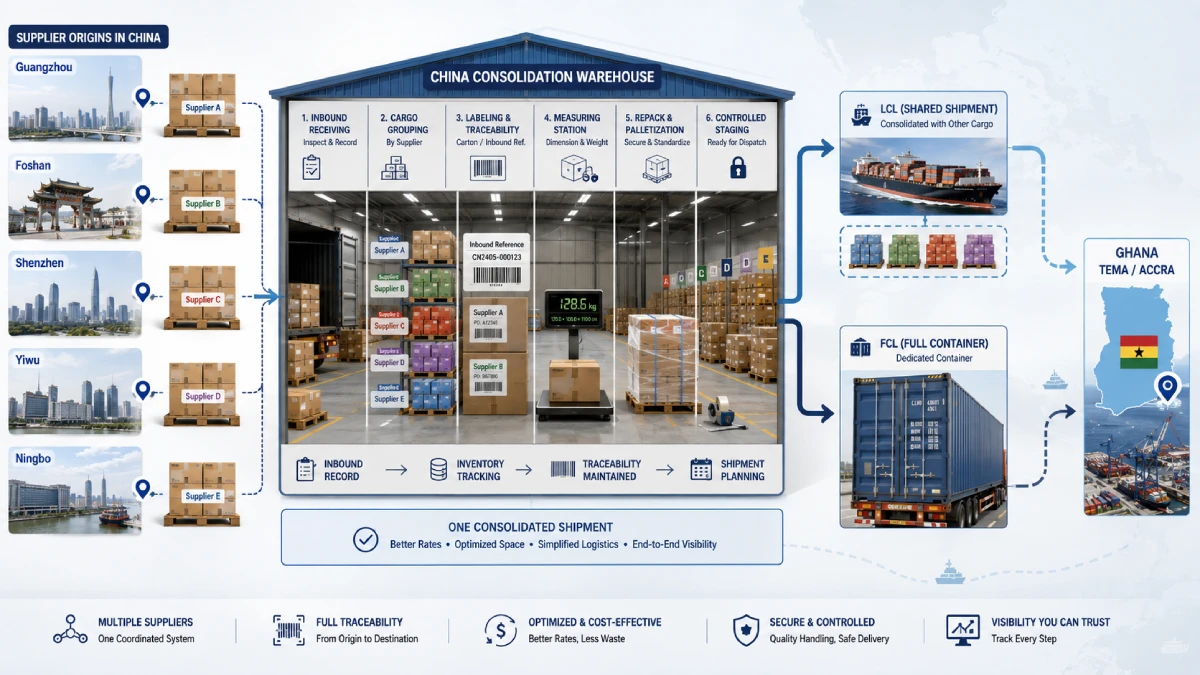
Buying from several Chinese suppliers can widen your product range, but it also creates coordination risks. Orders may have different cargo-ready dates, packaging standards, pickup locations, exporter arrangements, and supporting documents.
China to Ghana cargo consolidation puts those orders under one origin-control plan. Each batch can be delivered or collected into a designated China warehouse, identified by supplier and purchase order, recorded, measured, checked within an agreed scope, and prepared for LCL, FCL, or a split shipment.
This page focuses on the consolidation process itself. For the wider route, transit, and destination overview, see shipping from China to Ghana.
Quick Answer
Multiple supplier orders can be coordinated through one warehouse, but being stored in one place does not automatically mean the cargo can use one commercial invoice, one export declaration, or one regulatory approval.
A freight forwarder can coordinate supplier pickup, warehouse receiving, carton marks, measurements, repacking, shipment planning, booking, and document reconciliation. Supplier invoices, exporter responsibilities, product certificates, and customs declarations may still need to remain separate or clearly traceable.
The final cargo can move as LCL, fill a 20GP or 40HQ, or be divided between air and sea. Consolidation is useful only when the operational savings outweigh additional pickup, warehouse, handling, repacking, storage, and waiting costs.
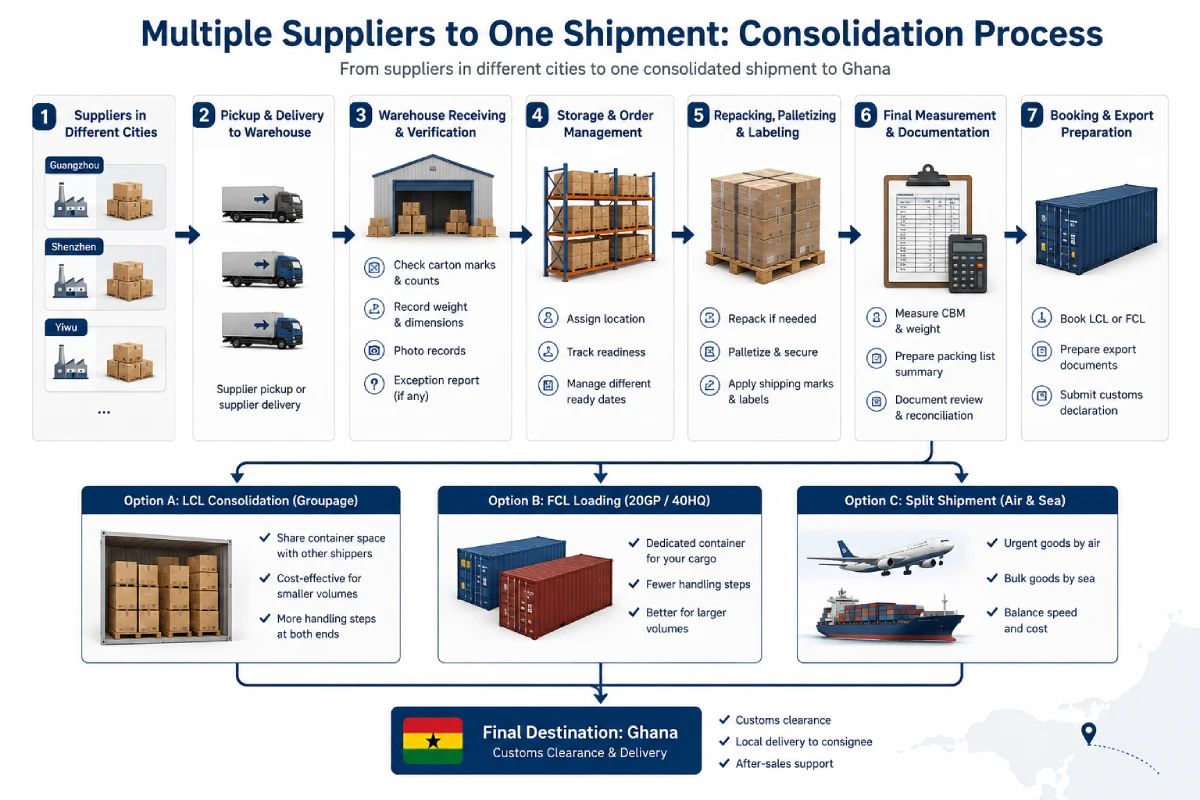
Typical flow: Suppliers → Delivery instructions → China warehouse → Receiving and exception control → Repacking and final measurement → Compatibility and document review → LCL, FCL, or split shipment → Ghana
Cargo Consolidation Is Not the Same as LCL Groupage
Several logistics terms are often used loosely, but they describe different parts of the process.
| Term | Practical meaning |
|---|---|
| Cargo or freight consolidation | A broad plan for combining smaller cargo lots into a more efficient movement |
| Buyer’s consolidation | Several supplier orders coordinated for the same buyer or consignee |
| Warehouse consolidation | Receiving, identifying, storing, measuring, and preparing orders at one warehouse |
| Order consolidation | Combining purchase or delivery planning at order-management level |
| LCL groupage | Cargo from different shippers sharing a consolidator’s container |
| FCL loading after consolidation | One buyer’s compatible cargo gathered before loading a dedicated container |
| Co-loading | A forwarder uses another consolidator’s LCL capacity |
| Physical consolidation | Cargo is in one place, but commercial and customs responsibilities are not automatically merged |
A Ghana buyer may consolidate orders from five factories and still ship as LCL because the final volume does not justify a dedicated container. Alternatively, compatible orders may be gathered and loaded into an FCL.
The important distinction is that physical consolidation, transport consolidation, commercial documentation, and customs declaration are separate control layers.
How Multi-Supplier Consolidation Works in China
1. Build a Supplier and Cargo Master
Before arranging pickup, create one master list covering every supplier and purchase order.
The file should include the supplier name, city, pickup address, Incoterm, product description, expected carton count, estimated dimensions, gross weight, cargo-ready date, exporter arrangement, and inspection requirement. It should also flag batteries, liquids, chemicals, food, cosmetics, branded goods, or raw-wood packaging.
This becomes the working reference for pickup planning, warehouse receiving, cut-off control, and preliminary LCL or FCL comparison.
2. Send Standard Delivery Instructions
Every supplier should receive supplier-specific delivery instructions before dispatching cargo.
The instructions should normally include:
- Confirmed warehouse address, contact, receiving hours, and appointment rules
- A unique inbound reference
- Buyer code, supplier code, and purchase-order number
- Expected package count
- Carton sequence, such as 1/10, 2/10, and 3/10
- Required carton marks and labels
- Cargo-ready date
- Documents required before delivery
- A requirement to disclose batteries, liquids, chemicals, food, or other controlled cargo
- Instructions not to add unapproved products to the shipment
The exact warehouse address, receiving schedule, and mark format should always come from the operating team for that shipment.
3. Coordinate Supplier Pickup or Delivery
Some suppliers deliver to the warehouse themselves. Others need factory pickup arranged by the forwarder. The correct arrangement depends on the agreed Incoterm and the supplier’s location.
Before dispatch, confirm the actual pickup address, cargo readiness, package count, loading access, vehicle requirements, and whether special equipment is needed.
Location matters. Combining small orders from Guangzhou, Foshan, and Shenzhen may be operationally efficient, while moving small Yiwu or Ningbo orders to a South China warehouse can add significant domestic transport cost. The warehouse location therefore needs to be selected around the supplier network and planned export gateway.
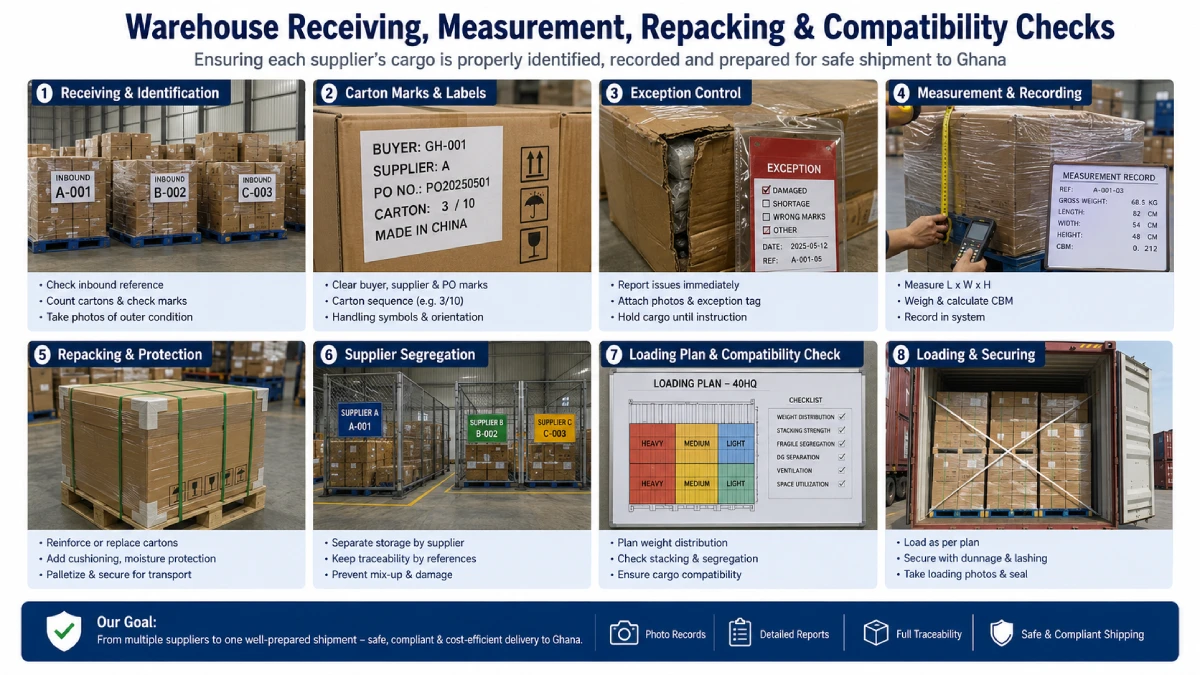
4. Receive, Identify, and Record Each Batch
When cargo arrives, the warehouse should match the inbound reference, identify the supplier and purchase order, count outer packages, check carton marks, photograph visible external damage, and record agreed measurements.
A receiving result should be clearly classified as accepted, held for clarification, or exception reported.
| Warehouse receiving may include | Normally requires a defined inspection scope |
|---|---|
| Outer-carton count and marks | Model, colour, accessories, and specifications |
| Visible crushing, opening, or wetting | Quantity inside sealed retail cartons |
| Package-condition photos | Functional or electrical testing |
| Gross weight and dimensions | Material or certification verification |
Warehouse receiving is not professional product inspection. If product quality, function, dimensions, materials, or specification compliance must be checked, arrange a defined third-party inspection or another qualified inspection process.
5. Close Exceptions Before Packing
Shortages, excess cartons, missing marks, damaged packaging, unexpected products, and document discrepancies should be reported before the affected cargo is mixed into the final shipment.
The buyer may need to decide whether to accept the cargo, request relabelling, arrange repacking, return it to the supplier, or order an inspection.
Closing these exceptions before final packing preserves traceability and reduces the risk of discovering a problem after the cargo has already entered an LCL warehouse or container.
6. Repack, Palletize, and Protect Cargo
Repacking can be useful when factory cartons are damaged, too weak for international transport, or unsuitable for stacking. Fragile cargo may require added cushioning or moisture protection, while small cartons may benefit from palletization.
Heavy cargo may need stronger support or a crate. Any change in packaging should preserve supplier, PO, and carton traceability.
Raw-wood pallets, crates, frames, and dunnage may fall under ISPM 15. Processed wood materials such as plywood are generally treated differently, so the actual packaging material should be checked against the IPPC ISPM 15 requirements before shipment.
7. Re-measure and Screen Cargo Compatibility
Booking decisions should use the final package count, dimensions, gross weight, and CBM after repacking or palletization, not only the supplier’s original estimates.
Compatibility needs both a physical and a regulatory review.
Physical compatibility includes:
- Stackability
- Crush risk
- Weight distribution
- Leakage or contamination risk
- Odour
- Moisture sensitivity
- Securing requirements
Regulatory compatibility includes:
- Dangerous-goods classification
- Battery or chemical documentation
- Carrier acceptance
- Export controls
- Ghana import permits or conformity requirements
- Product-specific restrictions
Batteries, chemicals, and other dangerous goods cannot be assessed as ordinary dry cargo. The IMO dangerous-goods framework covers packaging, stowage, and segregation requirements for dangerous goods transported by sea.
8. Confirm Documents, Book, and Load
Before booking, reconcile supplier records with the final cargo summary and confirm the exporter and declaration structure.
Chinese Customs requires declaration information and supporting documents to accurately reflect the actual cargo. Putting several suppliers’ goods into one warehouse does not automatically create one lawful export declaration. The declaration structure should be verified with the actual exporter and customs-declaration party using current China Customs guidance.
For LCL, the consolidated cargo is normally delivered to a CFS or consolidator that controls shared-container loading.
For FCL, loading requires additional attention to package strength, weight distribution, securing, void space, and container payload. The IMO/ILO/UNECE CTU Code provides authoritative guidance on packing and securing cargo in cargo transport units.
A packed export container also requires verified gross mass before loading onto a SOLAS-regulated vessel. The shipper and operating parties should confirm the VGM method and cut-off under the actual booking.
What Can Be Combined—and What May Stay Separate?
The most important rule in multi-supplier consolidation is that operational coordination does not erase the identity of the original transactions.
| Layer | Can be centrally coordinated | May need separate treatment |
|---|---|---|
| Warehouse | Receiving, storage, photos, measurement, marks, repacking | Supplier identity, PO records, inspection status |
| Transport | Pickups, booking, cut-offs, LCL or FCL movement | Incompatible, urgent, or separately controlled cargo |
| Commercial | Progress reports and cargo summaries | Supplier invoices, sellers, values, and contracts |
| Customs and regulatory | Document collection and consistency checks | Declarations, licences, certificates, and approvals |
Different HS codes alone do not determine whether products can travel together. The forwarder, exporter, carrier, and destination broker may need to consider product identity, exporter structure, declaration requirements, physical compatibility, dangerous-goods status, and Ghana-specific controls.
For this reason, “all goods are in the same warehouse” should never be treated as evidence that they can be freely mixed into one customs or regulatory file.
Does Consolidation Really Save Money?
Cargo consolidation can reduce repeated pickup, handling, origin minimum, document, freight, destination-handling, or local-delivery charges. It can also improve shipment visibility and, at larger volumes, make better use of a dedicated container.
But the comparison needs to include all additional costs created by the consolidation process.
| Cost area | Items to compare |
|---|---|
| China collection | Supplier cities, trucks, waiting, loading conditions |
| Warehouse | Receiving, unloading, storage, measurement, sorting, photos |
| Preparation | Labels, cartons, pallets, crates, labour |
| Export | Declaration structure, permits, CFS or stuffing |
| Main carriage | LCL chargeable volume or FCL rate |
| Ghana destination | Handling, brokerage, examination, storage, delivery |
| Delay exposure | Late suppliers, missed sailing, extra storage |
Consolidation usually makes more sense when suppliers serve the same buyer and consignee, cargo is physically and legally compatible, ready dates are reasonably close, and duplicate minimum charges can be reduced.
It may be less attractive when suppliers are far apart, repacking substantially increases CBM, regulated products need separate handling, or one late order holds the entire shipment.
For a wider explanation of rate components, see shipping cost from China to Ghana.
LCL, 20GP, 40HQ, or Split Shipment?
After warehouse consolidation, the shipment still needs the right transport mode.
| Option | Usually suitable when | Main risk |
|---|---|---|
| Separate shipments | Cargo is urgent, incompatible, or has different destinations | Repeated minimum charges |
| Consolidated LCL | Final cargo remains below an economical FCL level | More CFS handling and destination minimums |
| Consolidated 20GP | Dense or moderate-volume cargo supports a dedicated container | Payload or weight-distribution constraints |
| Consolidated 40HQ | Larger, mainly cubic cargo needs more space | Unused capacity or weak packages mixed with heavy cargo |
| Urgent air plus sea | Only part of the order is time-critical | Higher air cost and split-document control |
Do not choose a shipping mode by CBM alone. Review regulatory acceptance, cargo compatibility, urgency, final measured volume, gross weight, cargo density, handling exposure, container payload, and total origin-to-destination cost.
When the shipment is near the LCL/FCL crossover, compare both quotations for the same departure period and service scope.
For a broader explanation of these shipping modes, see sea freight from China to Ghana.
Managing Different Cargo-Ready Dates
Multi-supplier orders rarely become ready on exactly the same day.
Set the warehouse cut-off before the first supplier delivers. The shipment tracker should show each supplier’s planned ready date, actual arrival date, latest warehouse receiving date, documentation cut-off, booking or CFS cut-off, and exception status.
If one supplier is late, there are three main choices:
- Wait when the late cargo is essential and the additional delay and storage remain acceptable.
- Split when urgent goods cannot miss the planned departure.
- Roll the late supplier to the next shipment when waiting would remove the financial benefit or create regulatory risk.
A fixed free-storage period should not be assumed. Confirm the warehouse tariff, charging unit, and storage conditions for the actual shipment.
Export Documents and Ghana Clearance
Each supplier should provide accurate commercial and packing information that remains traceable throughout the consolidation process.
Typical supplier-level information includes:
- Legal supplier or seller name
- Purchase-order reference
- Product description
- Quantity and unit
- Package count and package type
- Gross and net weight
- Dimensions
- Commercial value and currency
- Incoterm
- Exporter arrangement
- Product-specific certificates or permits where applicable
A forwarder may compile a supplier-readiness tracker, warehouse receiving summary, exception report, final measurement sheet, compatibility status, loading list, booking instructions, and bill-of-lading draft data.
These coordination documents do not automatically replace supplier invoices, contracts, export permits, or statutory customs declarations.
For Ghana, the final product descriptions, quantities, values, package counts, weights, HS codes, consignee data, and transport documents need to remain consistent. Ghana Revenue Authority identifies documents such as the Bill of Lading or waybill, invoice, Packing List, Import Declaration Form, and product-dependent permits as part of the import process. Current requirements should be checked against the GRA import procedures and reviewed by the Ghana customs broker before arrival.
For the full destination process, see customs clearance in Ghana.
Responsibility Matrix
| Party | Main responsibility |
|---|---|
| Buyer | Provide supplier, cargo, value, timing, consignee, and approvals; decide whether to wait, split, inspect, or repack |
| Supplier | Prepare, mark, pack, disclose, and document the correct goods |
| Freight forwarder | Coordinate pickup, warehouse, progress, measurements, booking, and document reconciliation |
| Warehouse | Receive, count outer packages, photograph visible condition, measure, store, and perform approved packing work |
| Exporter or declarant | Confirm and take responsibility for the lawful China export declaration structure |
| Inspection company | Check quantity, specification, function, or quality under a defined scope |
| Ghana customs broker | Review Ghana requirements and process declaration and clearance |
The warehouse is not a product laboratory. The forwarder cannot guarantee customs acceptance. A customs broker’s pre-review can reduce avoidable discrepancies, but it cannot guarantee release.
Common Failure Points
Multi-supplier consolidation problems often begin with small origin-control failures.
Common examples include:
- Supplier delivers without an inbound reference
- Cartons have no supplier or PO marks
- Actual package count differs from the Packing List
- Damaged packaging is not reported before consolidation
- A warehouse check is mistaken for professional quality inspection
- Repacking occurs without updating measurements
- Batteries, liquids, or chemicals are not disclosed
- One supplier misses the warehouse cut-off
- Exporter or commercial-document structure remains unresolved
- China and Ghana documents use inconsistent product descriptions
Written delivery instructions, supplier-level traceability, exception closure, final measurements, compatibility review, and pre-departure document reconciliation are the main controls used to prevent these issues.
What to Send for a Consolidation Quote
To compare consolidation options accurately, prepare:
- Number of suppliers
- Supplier pickup or delivery addresses
- Incoterms
- Product descriptions and photos
- Battery, liquid, chemical, food, cosmetic, branded-goods, or raw-wood-packaging information
- Estimated package count for each supplier
- Estimated weight and dimensions
- Cargo-ready date for each supplier
- Required inspection, repacking, palletization, or crating
- Destination in Ghana
- Urgent items and latest acceptable departure date
- Exporter arrangement
- Insurance requirement
- LCL, FCL, or split-shipment options you want compared
The more accurate the supplier and cargo information is before warehouse receiving, the easier it is to build a realistic consolidation plan and avoid repeated handling or booking changes.
FAQ
Can I consolidate goods from different suppliers in China and ship them to Ghana?
Yes, when suppliers follow coordinated delivery instructions and the cargo passes the required physical, documentary, regulatory, and carrier checks. Some documents or declarations may still remain supplier- or product-specific.
Is China-to-Ghana cargo consolidation always cheaper?
No. Any reduction in duplicate transport or handling charges must be compared with pickup, warehouse, repacking, storage, documentation, and delay costs.
What is the difference between buyer’s consolidation and LCL groupage?
Buyer’s consolidation organizes several supplier orders for one buyer. LCL groupage places cargo from different shippers into a shared container. Buyer-consolidated cargo can still move by LCL or FCL.
Can multiple suppliers use one Commercial Invoice and Packing List?
Not automatically. Seller identity, transaction values, exporter arrangements, products, and regulatory requirements must remain accurate and traceable. Confirm the final document structure before booking.
Does warehouse receiving include product quality inspection?
Normally no. Warehouse receiving usually covers agreed external checks, carton marks, package count, weight, dimensions, and visible condition. Product specifications or function require a defined inspection scope.
Can batteries, liquids, chemicals, food, and general cargo be loaded together?
Do not assume they can. Review accurate product data, dangerous-goods classification, physical compatibility, carrier rules, export requirements, and Ghana import controls before combining them.
What happens if one supplier misses the warehouse cut-off?
The buyer may wait, split the shipment, or move the late order to the next departure after considering storage, urgency, booking changes, and compliance risks.
Should consolidated cargo move by LCL or FCL?
Compare final volume, gross weight, cargo density, compatibility, urgency, handling exposure, container limits, and total cost. Near the crossover, obtain both LCL and FCL quotations.
