
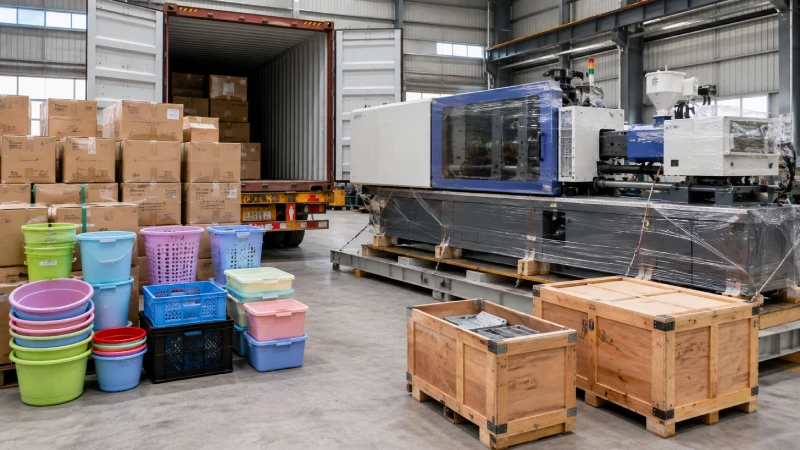
Shipping plastic products from China to Ghana can mean two very different things. A Ghanaian wholesaler may be importing plastic basins, buckets, storage boxes, household containers or packaging products for resale. Another buyer may be purchasing an injection molding machine, molds and auxiliary equipment to establish or expand local production.
Both belong to the same plastics supply chain, but their logistics are fundamentally different.
Finished plastic products are often light but bulky, so carton dimensions, nesting and total CBM can have a major influence on shipping cost. Injection molding machines and steel molds are heavy industrial cargo, where packed dimensions, gross weight, center of gravity, lifting points and load distribution become much more important.
For importers planning a broader supply chain, the main shipping from China to Ghana guide covers the overall route and freight options. For plastics, however, the first question should be more specific:
Are you importing finished inventory, or are you importing manufacturing capacity?
That decision determines how the shipment should be planned from China.
Import Finished Plastic Products or Build Local Manufacturing Capacity?
Importing finished plastic products and importing plastic manufacturing equipment serve different business models.
A distributor bringing household goods from China may want a broad range of SKUs, manageable inventory and the flexibility to change products between orders. A manufacturer investing in injection molding equipment is making a longer-term production decision involving machines, molds, utilities, raw materials, technicians, spare parts and factory startup planning.
| Decision Factor | Import Finished Products | Import Manufacturing Equipment |
|---|---|---|
| Main logistics issue | Carton volume and CBM | Weight, dimensions and handling |
| Typical cargo | Household goods, containers, packaging | Injection machines, molds, auxiliaries |
| Supplier coordination | Often many SKUs and factories | Machine, mold and equipment suppliers |
| Container planning | Carton and volume driven | Engineering and load-plan driven |
| Ghana delivery | Warehouse or distribution center | Factory or project site |
| Compliance focus | Product-specific standards | Machinery and project requirements |
Neither model is automatically cheaper or more profitable. The right choice depends on sales volume, SKU variety, expected production scale, access to molds and raw materials, factory utilities, technical capability, working capital and the required market-launch date.
From a shipping perspective, the two paths should always be calculated separately.
Part A: Shipping Finished Plastic Products from China to Ghana
Typical China plastics shipments to Ghana can include buckets, basins, baskets, plastic stools, organizers, storage boxes, kitchenware, bottles, containers, crates and packaging components.
One of the most important logistics characteristics of many household plastic products is that they occupy much more space than their weight might suggest.
Why Household Plastic Goods Can Be Light Bulky Cargo
Consider a hollow plastic basin or storage box. The individual item may not weigh very much, yet its external dimensions can consume substantial carton and container space.
This creates a low cargo-density problem.
For this type of shipment, freight planning may be driven less by the net weight of the merchandise and more by:
- carton dimensions;
- number of cartons;
- total CBM;
- nesting efficiency;
- palletization;
- empty space inside cartons; and
- overall container utilization.
This is very different from a steel mold or injection molding machine, where relatively compact cargo may still weigh several tonnes.
| Cargo Example | Main Logistics Constraint |
|---|---|
| Plastic basins | CBM and nesting |
| Storage boxes | Carton utilization |
| Plastic baskets | Volume |
| Packaging components | CBM and compliance |
| Injection molds | Concentrated weight |
| Injection molding machine | Dimensions, weight and COG |
Understanding this distinction before asking for freight prices prevents misleading comparisons between shipments that have completely different cargo profiles.
How CBM Affects Plastic Product Shipping Costs
For cartonized goods, calculate the packed volume rather than using the dimensions of an individual product.
The basic calculation is:
CBM = Carton Length × Carton Width × Carton Height × Number of Cartons
The information required from the supplier should therefore include:
- units per carton;
- master-carton dimensions;
- gross weight per carton;
- number of cartons;
- total CBM; and
- total gross weight.
For LCL shipping, both volume and weight can influence the chargeable freight according to the applicable carrier or consolidator tariff. There is no universal rule that should be applied to every China-Ghana LCL shipment.
For bulky plastic goods, however, CBM frequently becomes the more important commercial variable.
Carton Optimization Can Matter More Than a Small Freight-Rate Difference
Importers often focus first on finding a lower ocean freight rate. With lightweight plastic products, improving the packing method can sometimes be equally important.
Large amounts of unused space inside cartons effectively mean paying to transport air.
Before production is packed, review whether the supplier can improve:
- units per master carton;
- carton dimensions;
- internal arrangement;
- product orientation;
- carton strength; and
- container-loading pattern.
The objective is not simply to make cartons as small as possible. Excessive compression can deform thin-wall products, damage rims or create scratches.
Packing optimization must balance space efficiency and product protection.
Can Plastic Products Be Nested?
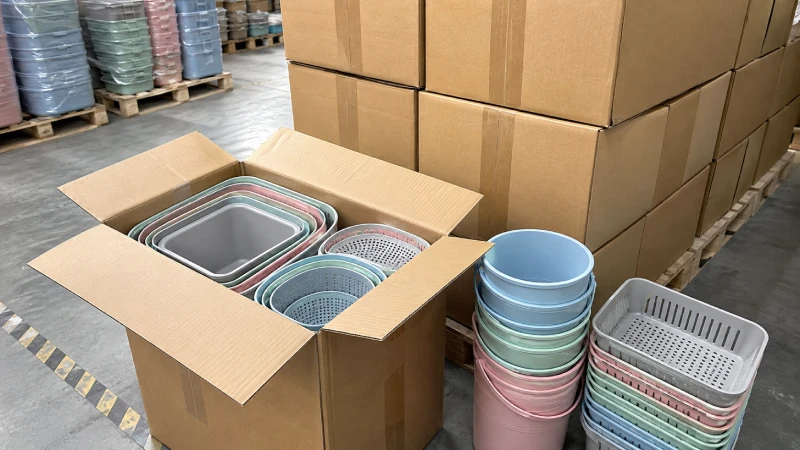
Many hollow plastic products can potentially be placed inside one another.
Common examples include:
- basin inside basin;
- bucket inside bucket;
- basket inside basket; and
- storage container inside storage container.
Nesting can reduce empty space significantly, but the method needs to be tested using the actual product.
Closely nested goods may scratch glossy surfaces, distort thin walls, become difficult to separate after a long voyage or place excessive pressure on handles and rims.
For higher-volume orders, ask the Chinese supplier for a packed sample showing:
- how many pieces fit into one carton;
- carton dimensions;
- carton gross weight; and
- photographs of the internal arrangement.
This gives the freight forwarder real data for container planning instead of estimates based on product dimensions alone.
Protecting Plastic Products from Deformation
Low weight does not mean low damage risk.
Plastic household products can be affected by carton crushing, excessive stacking pressure, surface abrasion and unsupported hollow areas.
Depending on the product, export packing may use:
- stronger outer cartons;
- PE bags;
- internal separators;
- corner or edge protection;
- controlled stacking;
- protective film; or
- pallets where handling conditions justify them.
The correct method depends on product shape and material. A thick plastic crate and a thin transparent food container should not automatically use the same packing specification.
Consolidating Multiple Plastic SKUs in China
Ghana wholesalers often buy different plastic products from several factories rather than placing one large order with a single supplier.
For example:
- Supplier A: buckets;
- Supplier B: storage boxes;
- Supplier C: kitchenware;
- Supplier D: packaging;
- Supplier E: accessories.
Instead of arranging five unrelated international shipments, the cargo can be brought into a China consolidation warehouse.
A typical China to Ghana cargo consolidation workflow may include:
Supplier pickup → warehouse receiving → carton count → SKU reconciliation → CBM measurement → consolidation → loading → export shipment.
Consolidation becomes particularly useful when purchase orders are spread across manufacturing regions such as Guangzhou, Foshan, Shenzhen, Yiwu or Ningbo.
However, cargo-ready dates should be coordinated carefully. Holding four completed suppliers’ goods for several weeks while waiting for one late factory can create unnecessary warehouse cost and delay.
LCL or FCL for Plastic Products?
There is no reliable universal threshold such as “use FCL above 12 CBM” or “15 CBM always needs a container.”
The correct comparison should include:
- actual packed CBM;
- gross weight;
- LCL freight;
- origin CFS charges;
- destination handling;
- number of suppliers;
- handling risk;
- FCL freight;
- container utilization; and
- delivery arrangements in Ghana.
Because plastic household goods can be bulky, a shipment may consume a significant percentage of a container long before it reaches a high gross weight.
The LCL-to-FCL decision should therefore be made using the completed packing data and current shipping cost from China to Ghana, not product weight alone.
Product Compliance Checks for Plastic Goods Entering Ghana
Before shipping, identify exactly what the plastic product is and how it will be used.
Useful questions include:
- What resin or material is used?
- Is it reusable or disposable?
- Is it a finished household product or packaging material?
- Will it come into contact with food?
- Does it contain expanded polystyrene?
- Which Ghana Standard applies?
- Are there labelling or conformity requirements?
- Does the product fall within a regulated tax or environmental category?
The Ghana Standards Authority maintains standards for plastic products and packaging, including standards relating to PET bottles and food-contact applications. Importers should therefore avoid treating every plastic article as one compliance category.
Food-contact applications deserve additional attention. The correct requirement depends on the specific article and its intended use rather than simply whether the product is described as “plastic.”
If a shipment also contains food or another FDA-regulated product, the importer should separately check the applicable Ghana Food and Drugs Authority requirements.
Ghana’s Plastic Regulations: Do Not Assume All Plastics Are Banned
As of August 31, 2026, Ghana should not be described as having a blanket nationwide ban on every plastic product.
A major specific change is approaching: Ghana’s Environmental Protection Authority has announced a nationwide prohibition on expanded polystyrene foam products, commonly called Styrofoam, effective January 1, 2027. Importers dealing in EPS food-service or packaging products should therefore verify the final implementation scope before placing new orders.
Ghana is also developing broader Extended Producer Responsibility measures for plastics and other waste streams. These evolving policies should not be presented as already-enforced blanket restrictions unless the final legal instrument confirms that position.
Ghana Revenue Authority states that the Excise Duty (Amendment) (No. 2) Act, 2023 reduced the relevant plastics excise duty from 10% to 5% and expanded coverage to imported plastic packaging. The actual application still depends on the product and tariff classification, so importers should verify whether the goods fall within the applicable scope rather than applying the rate automatically to all plastic products.
For current official guidance, review the Ghana Revenue Authority’s implementation notice and confirm the product classification before shipment.
Part B: Shipping Injection Molding Machines from China to Ghana
Shipping an injection molding machine to Ghana is not simply a larger version of shipping cartons.
It is an industrial machine shipping project.
The first task should be collecting engineering data, not selecting a container.
Why Injection Molding Machines Require Heavy-Cargo Planning
An injection molding machine can combine:
- substantial concentrated weight;
- a rigid machine frame;
- sensitive electrical cabinets;
- hydraulic systems;
- uneven weight distribution;
- restricted lifting points; and
- a center of gravity that may not be obvious from external appearance.
Machine weights and dimensions vary widely by model and configuration. A container should therefore never be selected only because a machine is described as “small,” “500-ton,” “large,” or another broad category.
For equipment that exceeds standard-container or normal handling conditions, Winsail’s project logistics for heavy and oversized cargo service provides the more relevant planning framework.
Injection Machine Shipping Data Sheet
Before booking freight, obtain a detailed shipping datasheet from the manufacturer.
Machine identification
- manufacturer;
- model;
- serial number;
- equipment description.
Packed cargo
- package quantity;
- length;
- width;
- height;
- gross weight per package;
- total gross weight.
Handling data
- center of gravity;
- lifting points;
- forklift pockets where applicable;
- machine footprint;
- lifting diagram;
- base or skid arrangement.
Transport preparation
- complete or dismantled shipment;
- removable components;
- hydraulic fluid status;
- electrical cabinet protection;
- waterproofing requirements.
Without this information, a freight quotation may look precise while the actual transportation plan remains uncertain.
Complete Machine or Partial Disassembly?
Some machines can be transported largely assembled. Others may need components removed to meet loading or transport constraints.
Potential detachable components can include guarding, hoppers, robots, auxiliary assemblies or other machine-specific sections.
Shipping more of the machine intact may reduce reassembly work in Ghana, but it can create a larger shipping envelope or heavier single lift.
Partial disassembly may improve container fit, but it introduces additional risks:
- more packages;
- disconnected cables and hoses;
- missing hardware;
- exposed surfaces;
- incorrect reconnection; and
- more complex commissioning.
Any dismantling should therefore be documented and approved by the machine manufacturer.
Component identification, photographs, connection markings and reassembly instructions should travel with the project documentation.
20GP, 40GP, Open Top or Flat Rack?
There is no universal container rule for injection molding machines.
A compact, dense machine may potentially suit a 20GP. A longer unit may require a 40GP or another suitable container. Over-height equipment may lead to an open-top evaluation, while machines that cannot fit safely within enclosed-container dimensions may require a flat rack or another project-cargo solution.
| Cargo Situation | Equipment to Evaluate | Critical Check |
|---|---|---|
| Compact heavy machine | 20GP | Weight and load distribution |
| Longer standard-size machine | 40GP | Length, door opening and floor loading |
| Machine plus auxiliary crates | 40GP/HQ where suitable | Complete load plan |
| Over-height cargo | Open Top | Dimensions and lifting method |
| Over-width or special loading | Flat Rack | OOG dimensions and securing |
| Extremely large equipment | Project or breakbulk solution | Full engineering review |
The final decision must use the specific carrier’s equipment data, packed machine dimensions, container payload, loading method and inland route.
The CTU Code emphasizes proper distribution of concentrated loads and appropriate positioning of cargo center of gravity. A heavy package with a small footprint may require load spreading into the container’s structural members rather than simply being placed on the floor wherever it fits.
Ship the Molds as High-Density Cargo
Injection molds create a different problem again.
A steel mold can have relatively small dimensions while carrying substantial weight. That makes it high-density cargo with potential concentrated floor loading.
For each mold, record:
- mold ID;
- dimensions;
- gross weight;
- crate size;
- lifting points;
- rust-protection method;
- moving-part locks;
- base construction; and
- center of gravity where necessary.
Machined or polished surfaces need protection against corrosion and physical damage.
Heavy molds should also not be positioned on top of lightweight cartons or against vulnerable goods. The CTU Code provides internationally recognized guidance on cargo packing, load distribution and securing in cargo transport units.
Plan the Machine, Mold and Auxiliary Equipment Together
A working injection molding cell may involve considerably more than the injection machine itself.
The project can include:
- mold;
- chiller;
- dryer;
- hopper loader;
- robot;
- compressor;
- temperature controller;
- conveyor;
- spare parts; and
- tooling.
These items should be managed under one master equipment list, even when they will not all travel in the same container.
The logistics team needs to compare supplier locations, cargo-ready dates, packed dimensions, gross weights and special conditions before deciding how to group the cargo.
A dense mold, fragile control cabinet and lightweight hopper should not be treated as interchangeable packages simply because they belong to the same production line.
What About Hydraulic Oil and Other Fluids?
Do not assume that every injection machine must be completely drained, and do not assume that oil remaining inside a machine is automatically acceptable for ocean transport.
Ask the manufacturer to identify:
- hydraulic oil;
- lubricants;
- refrigerants;
- fuel if any;
- cleaning liquids; and
- other potentially regulated substances.
Obtain the relevant Safety Data Sheets where needed and confirm the transport status with the carrier.
If fluids need to be drained or reduced, disconnected lines and hydraulic ports must be properly sealed and protected.
The current IMDG Code should be used for dangerous-goods classification rather than making assumptions based solely on the word “oil.”
Machine Base, Wooden Crates and Cargo Securing
Heavy machine packing has three separate functions.
The base or skid supports the machine, distributes load and creates suitable lifting or securing points.
Protective packing may include waterproof wrapping, moisture barriers, VCI corrosion protection and additional protection around electrical components.
Cargo securing prevents longitudinal, transverse and vertical movement during transport.
Depending on the machine, the securing system may involve blocking, bracing, direct lashing, anti-slip materials and load-spreading arrangements.
There is no safe generic rule such as “four straps are enough.” The arrangement should reflect machine weight, geometry, securing points, center of gravity and the selected transport unit.
If raw-wood crates, skids, pallets, blocking or dunnage are used, the wood packaging should also be checked for applicable ISPM 15 requirements.
Plan the Ghana Factory Unloading Before the Machine Leaves China
The logistics plan should not end at Tema Port.
Before departure, confirm how the machine will move from the port to its final installation location.
Check:
- package dimensions;
- package weight;
- trailer requirements;
- factory gate dimensions;
- road access;
- yard conditions;
- available forklift capacity;
- crane requirements;
- lifting radius if applicable; and
- final equipment position.
A crane is not automatically required for every injection molding machine. Some packages may be handled with suitable forklifts or other equipment.
But discovering after arrival that the factory cannot unload the machine safely can create avoidable delays and additional handling.
Should Spare Parts Ship with the Machine?
For a new production line, critical commissioning and startup spares are worth planning before the main shipment departs.
The actual list should come from the machine manufacturer, but it may include sensors, heaters, thermocouples, seals, hoses, filters, electrical components or machine-specific consumables.
The purpose is not to ship every possible spare part.
It is to avoid a situation where a large industrial machine reaches Ghana but cannot begin production because one small proprietary component is missing.
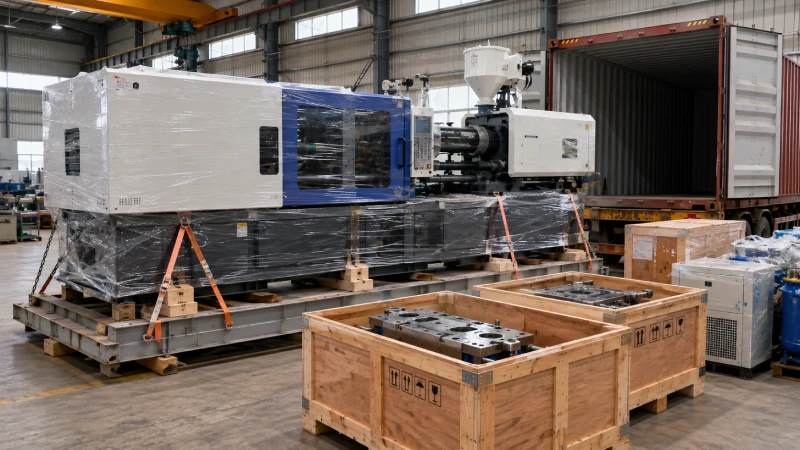
Complete Plastics Factory Shipment Planning
A factory project may involve several independent Chinese suppliers:
Injection machine manufacturer
+ Mold maker
+ Robot supplier
+ Chiller and dryer supplier
+ Compressor supplier
+ Spare-parts suppliers
These suppliers should feed into one project logistics schedule:
Supplier coordination
→ cargo data collection
→ heavy/light cargo segregation
→ packing
→ consolidation where suitable
→ container and OOG planning
→ blocking and lashing
→ China port
→ ocean freight
→ Tema Port
→ customs and conformity procedures
→ factory delivery
→ unloading
→ installation and commissioning.
The equipment does not necessarily have to move in one container. What matters is that it is managed as one production-startup project.
The shipment schedule should work backward from the intended production date:
Production start
← commissioning
← machine positioning
← factory delivery
← Ghana clearance
← vessel arrival
← ocean transit
← China loading
← equipment packing
← cargo readiness
Molds, auxiliaries, machine components, documentation and spare parts should each have their own milestones.
Ghana Compliance for Industrial Machinery
Industrial machinery should receive a compliance review before shipment.
The Ghana Standards Authority currently includes industrial machinery among its broad categories of High Risk Goods. Its published import inspection guidance states that importers of High Risk Goods should register with GSA, identify the applicable Ghana Standard and provide conformity documentation such as a Certificate of Analysis or Certificate of Conformance where applicable.
For an injection molding machine, the importer should therefore confirm the actual requirements using the machine specification before shipment.
Do not select an HS code simply from a generic web search. The exact machine function, configuration and accessories need to be reviewed by the importer or customs professional responsible for classification.
Shipping Cost Drivers: Plastic Goods vs Injection Machines
A single freight-rate table should not be used for both cargo groups.
Finished Plastic Products
Main cost drivers include:
- total CBM;
- carton dimensions;
- nesting efficiency;
- number of suppliers;
- LCL versus FCL;
- China origin location;
- destination charges; and
- final delivery location in Ghana.
Injection Molding Machines
Main cost drivers include:
- packed length, width and height;
- gross weight;
- center of gravity;
- number of packages;
- standard versus OOG cargo;
- container or flat-rack requirements;
- base and lashing design;
- lifting requirements;
- auxiliary equipment; and
- heavy inland delivery.
Freight rates change with sailing, carrier, equipment availability and market conditions. For machinery, cargo specifications can also change the required transport solution entirely.
That is why comparing current shipping options is more useful than relying on a generic historical rate.
Information Needed to Plan Your Shipment
For finished plastic goods, prepare:
- product description and photos;
- supplier locations;
- number of suppliers;
- carton quantity;
- carton dimensions;
- gross weight per carton;
- total CBM;
- total weight;
- nesting arrangement;
- intended product use; and
- delivery location in Ghana.
For an injection molding project, prepare:
- machine manufacturer and model;
- technical datasheet;
- packed dimensions;
- gross weight;
- package count;
- center of gravity;
- lifting points;
- packing details;
- molds and mold weights;
- auxiliary-equipment list;
- fluid information and SDS where relevant;
- loading drawings or photos; and
- Ghana factory address and unloading conditions.
Accurate cargo data allows the shipment to be designed before problems reach the port.
Final Takeaway
The most important difference in shipping plastics from China to Ghana is not simply whether the cargo is made of plastic.
It is the logistics profile of what is being imported.
Finished household plastic goods may be light, bulky and highly sensitive to carton and CBM optimization. Injection molding machines, molds and factory equipment require engineering data, heavy-cargo handling, load planning and coordinated site delivery.
For importers buying finished products, focus first on carton dimensions, nesting, SKU consolidation and the LCL-versus-FCL decision.
For manufacturers investing in local production, begin with machine dimensions, gross weight, center of gravity, lifting points, molds, auxiliaries and the factory startup schedule.
Keeping those two logistics models separate while managing them under one Ghana plastics supply-chain strategy produces more reliable freight planning, better container utilization and fewer surprises between the Chinese factory and the final destination in Ghana.
What is the best way to ship plastic products from China to Ghana?
It depends on total packed CBM, gross weight, supplier count and cargo-handling requirements. Smaller shipments can move by LCL, while larger or bulky plastic-product orders may be better suited to FCL after comparing the complete origin, ocean and destination costs.
Why can lightweight plastic household goods still be expensive to ship?
Many household plastic products have low cargo density. They consume significant container volume despite relatively low weight, making carton size, nesting and CBM important freight variables.
Can plastic buckets and basins be nested during shipping?
Often yes, if the product design permits it. The supplier should test the arrangement first to make sure nesting does not cause scratching, deformation or difficulty separating the goods after transit.
Can an injection molding machine fit into a 20ft container?
Some machines can, while others cannot. Packed dimensions, gross weight, center of gravity, container door dimensions, floor loading and loading method must be checked before selecting equipment.
When might a flat rack be needed?
A flat rack may be evaluated when cargo cannot fit safely within a standard enclosed container because of its dimensions, loading method or other heavy-cargo requirements. Final acceptance depends on actual measurements, securing design and carrier approval.
Can molds and auxiliary equipment ship with the main machine?
Potentially, yes. They should first be included in one load plan. Heavy molds, chillers, dryers, robots and other equipment may need separate crates or containers depending on their dimensions, weight and handling characteristics.
Does Ghana ban plastic products?
Ghana should not currently be described as having a blanket ban on every plastic product. However, a nationwide prohibition on expanded polystyrene foam products has been announced for January 1, 2027, while broader plastics-management measures continue to develop.
What documents are needed before shipping an injection molding machine to Ghana?
For freight planning, start with the commercial invoice, packing list, machine datasheet, packed dimensions, gross weights, package count, lifting information and packing drawings or photos. Additional conformity, customs or dangerous-goods documentation depends on the specific equipment and shipment.
