
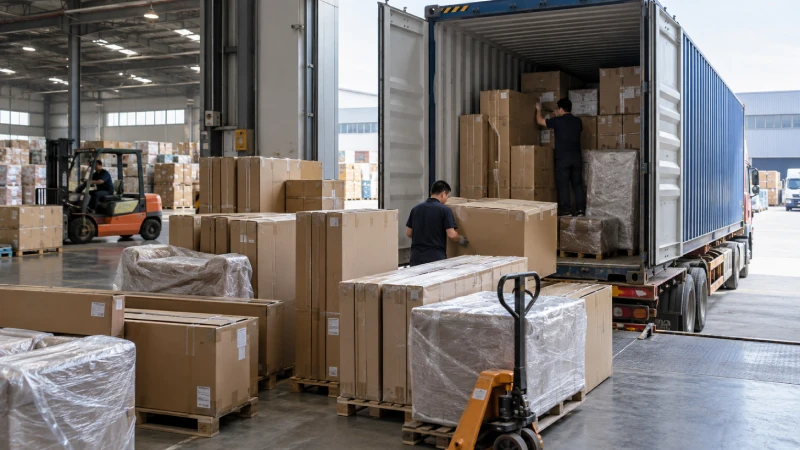
Shipping furniture from China to the UK is usually less about how heavy the products are and more about how much space they occupy after packing.
A shipment of tables, cabinets, sofas or hotel furniture can have a relatively modest gross weight but consume a large number of cubic metres. That makes packed CBM, stackability, carton dimensions and container utilisation central to the shipping decision.
For a small furniture order, LCL sea freight may be practical. As the order grows, however, it becomes increasingly important to compare the complete LCL cost with a dedicated container—often a 40HC for bulky furniture cargo. There is no reliable universal CBM threshold at which one automatically becomes cheaper than the other.
Furniture importers also need to think beyond ocean freight. Packaging quality, supplier consolidation, moisture protection, UK customs requirements and the ability of the destination warehouse to unload the cargo can all affect the final cost and risk.
For a broader overview of freight methods, routes, customs and delivery options, see the Shipping from China to the UK guide.
Quick Answer: What Is the Best Way to Ship Furniture from China to the UK?
For normal commercial furniture, sea freight is usually the practical starting point because furniture tends to occupy significant space relative to its weight.
Smaller orders may be shipped as LCL, where your cartons share container space with other cargo. Larger furniture orders should normally be compared against FCL, particularly a 40HC when the cargo is bulky.
A standard 40-foot high-cube container has a nominal internal capacity of approximately 76.3 m³, based on representative carrier equipment specifications. But this does not mean you can load 76.3 CBM of furniture into every container. Actual utilisation depends on carton dimensions, stacking restrictions, furniture shape, protection requirements and the container door opening. Container specifications can also vary slightly by manufacturer and equipment fleet.
Air freight is rarely economical for ordinary commercial furniture because chargeable weight can become very high for bulky cargo. It is more relevant for samples, prototypes, urgent replacement parts or small high-value pieces.
Before requesting a freight quotation, prepare the final packed dimensions, carton quantity, gross weight, supplier locations and UK delivery postcode.
Why Furniture Shipping from China to the UK Is Mainly a CBM Problem
Many furniture products are relatively low-density cargo.
A carton containing a flat-packed cabinet might occupy significant space while weighing far less than machinery occupying the same volume. For LCL shipping in particular, this means the freight calculation can be driven by measurement rather than physical weight.
This is why asking only:
“How many kilograms is the shipment?”
is not enough for furniture freight.
A forwarder normally also needs:
- the length, width and height of every packed carton;
- the number of cartons;
- total CBM;
- gross weight;
- whether the cartons can be stacked;
- whether some packages must remain upright;
- whether any items are fragile or non-stackable.
Product Dimensions Are Not Shipping Dimensions
One of the most common mistakes furniture buyers make is sending dimensions taken from a product catalogue.
For example, a cabinet may measure 1.0 × 0.5 × 0.8 metres when assembled, but that does not necessarily represent its shipping volume.
The final package could include:
- corrugated cartons;
- foam;
- edge guards;
- corner protection;
- pallets;
- wooden crates;
- internal spacers;
- protective wrapping.
Alternatively, the cabinet may be shipped flat-packed and occupy much less space than its assembled dimensions suggest.
For freight planning, final outer packed dimensions are what matter.
How to Calculate Furniture CBM Before Requesting a Freight Quote
The standard CBM calculation is:
Length × Width × Height × Quantity = Total CBM
Dimensions must use the same unit, normally metres.
For example, if one packed furniture carton measures:
1.20 m × 0.70 m × 0.50 m
its volume is:
1.20 × 0.70 × 0.50 = 0.42 CBM
If there are 10 identical cartons:
0.42 × 10 = 4.20 CBM
This example is purely illustrative.
Calculate CBM by SKU
For a furniture shipment containing several products, calculate the volume separately for each SKU.
| SKU | Qty | Packed L | Packed W | Packed H | CBM / Unit | Total CBM | Gross Weight | Stackable? |
|---|---|---|---|---|---|---|---|---|
| Dining table carton | 20 | — | — | — | — | — | — | Yes/No |
| Chair cartons | 60 | — | — | — | — | — | — | Yes/No |
| Cabinet cartons | 30 | — | — | — | — | — | — | Yes/No |
This gives your forwarder much more useful information than simply writing:
“Furniture shipment: approximately 30 CBM.”
It also makes later container-loading analysis easier.
Recalculate After Packaging Is Final
Do not finalise the freight plan too early.
If your supplier later adds:
- thicker cartons;
- pallets;
- crates;
- foam protection;
- larger corner protectors;
the final volume may increase.
For furniture orders where the shipping method depends heavily on CBM, ask the supplier to confirm final packed dimensions before the freight booking is locked in.
Pro Tip: Ask for outer carton dimensions from the production or packing team, not dimensions copied from the sales quotation.
LCL vs 40HC: Which Works Better for Furniture?
There is no single answer for every furniture shipment.
The correct comparison depends on:
- total packed CBM;
- origin charges;
- LCL handling charges;
- full-container rates;
- number of suppliers;
- fragility;
- stackability;
- UK destination charges;
- final delivery requirements.
When LCL Furniture Shipping Can Work Well
LCL can be useful when the shipment does not justify a dedicated container.
Typical situations include:
- smaller wholesale orders;
- product samples or first production runs;
- partial inventory replenishment;
- one small furniture collection;
- importers intentionally bringing stock in smaller batches.
With LCL, the furniture is delivered into a consolidation process and shares container space with other shipments.
One operational consideration is that LCL cargo normally goes through additional handling during consolidation and deconsolidation. That does not mean furniture shipped by LCL will necessarily be damaged, but packaging and handling resilience deserve extra attention for fragile finishes, glass, stone and irregular furniture.
When a 40HC Is Worth Comparing
As the packed volume increases, compare the total LCL cost against full-container shipping instead of continuing to assume LCL is cheaper.
A 40HC is particularly relevant for furniture because of its additional height and approximately 76.3 m³ nominal internal capacity. Representative carrier specifications put internal dimensions at roughly 12.03 × 2.35 × 2.70 metres, with a door opening around 2.34 × 2.60 metres. Actual equipment can vary.
The door opening matters as well as the internal volume.
A bulky assembled sofa, cabinet or decorative item might theoretically fit within the internal space but still create loading problems because of its orientation or packed external dimensions.
Why There Is No Universal LCL-to-FCL Break-Even Point
You may see statements online such as:
“Use LCL below 15 CBM and FCL above 15 CBM.”
That can be useful as a rough conversation starter, but it should not be treated as a shipping rule.
The economic break-even point changes with:
- current ocean rates;
- origin CFS charges;
- UK destination charges;
- collection costs;
- container rates;
- shipment density;
- port pairing;
- UK delivery location.
The better approach is to request both options when the cargo is approaching a meaningful container volume.
Compare the Complete Cost
Do not compare:
LCL ocean freight per CBM
against:
FCL ocean freight per container
and assume you have identified the cheaper shipment.
Compare the same service scope.
| Cost Area | LCL | FCL |
|---|---|---|
| China supplier pickup | Check | Check |
| Origin handling | Check | Check |
| Consolidation / CFS | Usually relevant | Different structure |
| Ocean freight | Check | Check |
| UK port/CFS charges | Check | Check |
| Customs clearance | Check | Check |
| Delivery to postcode | Check | Check |
| Unloading requirements | Check | Check |
For broader route pricing factors, use the China to UK shipping cost guide rather than relying on permanent rates inside a furniture-specific guide.

Consolidating Furniture from Multiple Suppliers in China
Furniture importers frequently source a project from more than one Chinese supplier.
For example, a hotel, retail collection or interior fit-out might involve separate factories producing:
Supplier A → tables
Supplier B → chairs
Supplier C → cabinets
Supplier D → decorative furniture
Booking each supplier independently is not always the most efficient approach.
Depending on the shipment plan, cargo can be coordinated through a consolidation point in China before export.
What Happens During Supplier Consolidation?
A typical workflow may involve:
Factories → China receiving/consolidation point → cargo checks → combined load planning → export shipment
Useful checks before final loading include:
- carton quantity;
- shipping marks;
- visible carton condition;
- packed dimensions;
- gross weight;
- SKU identification;
- fragile or non-stackable markings;
- oversized pieces;
- supplier paperwork.
Once all cargo information is available, the combined shipment can be assessed for LCL or container loading.
Consolidation Can Improve Loading Efficiency—but Not Automatically
The main advantage is not simply “fewer shipments.”
It can also make it possible to plan the container around the entire furniture mix.
For example, different carton shapes from different suppliers may fit together more efficiently than several separate partial shipments.
However, consolidation can create additional costs for:
- domestic transport in China;
- receiving;
- unloading and reloading;
- storage;
- repacking;
- waiting for late factories.
The correct question is therefore:
Does consolidation improve the total logistics plan enough to justify the additional handling?
Winsail can coordinate consolidation where applicable and subject to supplier locations, cargo condition and the agreed service scope.
Flat-Pack vs Assembled Furniture: How Packing Changes Freight Cost
Whether furniture is shipped flat-packed or assembled can materially affect the shipping plan.
Flat-Pack Furniture
Flat-pack designs can often create:
- smaller packages;
- more regular carton dimensions;
- improved stacking;
- fewer protruding parts;
- better container-space utilisation.
But flat-pack furniture introduces its own risks.
Panel corners can be damaged, finished surfaces can rub together and hardware can become separated from the correct carton.
Good packing planning may therefore include:
- edge and corner protection;
- protective layers between finished panels;
- securely packaged fittings;
- clear carton and SKU numbering;
- cartons strong enough for the intended stacking arrangement.
Assembled Furniture
Assembled furniture generally consumes more space and may create irregular voids inside the container.
Typical loading concerns include:
- projecting legs;
- arms and handles;
- large unsupported surfaces;
- upholstery;
- irregular shapes;
- non-stackable items.
This does not automatically mean furniture should be redesigned as flat-pack purely for shipping.
Product quality, assembly requirements, customer experience and manufacturing capability also matter.
From a freight perspective, however, the difference should be identified before the buyer compares LCL and FCL quotations.
| Factor | Flat-Pack | Assembled |
|---|---|---|
| CBM efficiency | Often better | Often lower |
| Carton shape | Usually more regular | Often irregular |
| Stackability | Often easier | Product-specific |
| Surface risk | Panel/edge damage | Impact/scratch risk |
| Loading planning | Relatively structured | More shipment-specific |
How to Protect Furniture During Sea Freight
Damage prevention should be planned around the characteristics of the furniture rather than using one packaging specification for every product.
Protect Corners and Edges
Corners are common impact points during warehouse movement and container loading.
Depending on the product, protection may involve:
- reinforced cartons;
- corner guards;
- foam;
- edge protectors;
- internal cushioning.
Heavy furniture should not rely on decorative retail packaging alone if that packaging cannot withstand the actual logistics chain.
Protect Finished Surfaces
Extra attention may be needed for:
- lacquered furniture;
- polished metal;
- high-gloss panels;
- veneer surfaces;
- painted components.
Protective layers should prevent adjacent surfaces from rubbing against each other during transport.
Treat Glass and Stone as Separate Risks
Glass doors, mirrors, tabletops and stone surfaces should not simply be treated as ordinary furniture cartons.
Depending on dimensions and value, they may require:
- stronger internal separation;
- cushioning;
- rigid protection;
- crates;
- specific handling or orientation instructions.
The appropriate solution depends on the actual product.
Plan for Moisture and Container Condensation
Furniture may spend several weeks in a marine environment, passing through significant changes in temperature and humidity.
For moisture-sensitive furniture, practical controls can include:
- ensuring products and cartons are dry before loading;
- checking that the container is clean and visibly dry;
- avoiding containers with evidence of water ingress;
- using suitable moisture protection where required;
- considering desiccants for appropriate cargo;
- preventing sensitive products from resting directly against potentially damp surfaces.
Desiccants can form part of a moisture-control plan, but they should not be treated as a guarantee against all condensation damage.
Does Furniture Packaging Need ISPM 15?
This is frequently misunderstood.
The UK Forestry Commission states that solid wood packaging material imported into Great Britain from any country must meet ISPM 15 requirements. Examples include packing cases, crates, pallets and dunnage. See the official GOV.UK wood packaging material guidance.
However:
Wooden furniture itself does not automatically require an ISPM 15 stamp merely because the product is made from wood.
The relevant issue in this context is the solid wood packaging material used to transport the furniture.
Processed non-solid wood packaging, such as plywood, is treated differently and is among the exemptions listed in UK guidance.
Therefore, if a Chinese furniture supplier uses:
- solid timber pallets;
- solid wood crates;
- wooden blocks;
- timber dunnage;
confirm that the applicable packaging complies before shipment.
Pro Tip: Ask the supplier whether pallets, crates and dunnage are solid timber. Do not use “the furniture is wooden” as the test for ISPM 15.
Planning 40HC Container Utilisation Without Guessing
A 40HC loading plan should begin with shipment data, not with a generic claim about how many sofas, tables or chairs fit in one container.
Prepare a loading matrix such as:
| SKU | Qty | Packed Dimensions | Total CBM | Stackable | Orientation | Fragile |
|---|---|---|---|---|---|---|
| SKU A | — | — | — | Yes/No | — | Yes/No |
| SKU B | — | — | — | Yes/No | — | Yes/No |
| SKU C | — | — | — | Yes/No | — | Yes/No |
The load planner then needs to consider whether those packages can actually be arranged inside the container.
Nominal Volume Is Not Usable Furniture Volume
The approximately 76.3 m³ equipment capacity is a physical specification, not a promise of practical furniture utilisation.
Unused space can result from:
- incompatible carton dimensions;
- curved or irregular products;
- non-stackable furniture;
- fragile top surfaces;
- loading orientation;
- aisle/loading constraints;
- pallets;
- protective spacing;
- container door dimensions.
This is why statements such as:
“One 40HC holds 80 sofas”
should be avoided unless the exact packed sofa dimensions and actual loading configuration are known.
A better question is:
Can this exact mix of packed furniture cartons be arranged safely inside the available container dimensions?
For larger furniture orders, that is much more useful than a generic furniture-per-container estimate.
China-to-UK Sea Freight Timing and When Air Freight Makes Sense
Sea freight transit time depends on the Chinese origin port, carrier service, routing and UK destination gateway.
As a 2026 planning reference, selected carrier schedules have shown roughly the high-30s to low-40s in days port-to-port between major Chinese ports such as Yantian or Ningbo and Felixstowe. Published schedules are indicative rather than guaranteed, and the current routing should be reconfirmed before booking.
Actual door-to-door furniture shipping takes longer because the total timeline may also include:
factory collection → consolidation → export handling → vessel departure → ocean transit → UK customs → LCL deconsolidation if applicable → final delivery
Carrier networks and rotations can change, so current sailing schedules should be checked for each booking.
Why Air Freight Is Rarely Economical for Normal Furniture
Air cargo pricing takes dimensional volume into account.
That makes bulky but relatively lightweight products particularly expensive compared with sea freight.
Air freight may still make sense for:
- showroom samples;
- prototypes;
- replacement parts;
- missing hardware;
- urgent small pieces;
- high-value products where speed outweighs freight cost.
For a normal commercial order of sofas, tables, cabinets or similar large furniture, sea freight will usually be the more realistic starting point.
UK Customs, VAT and Furniture Compliance Checks
Furniture shipping does not finish when the container reaches a UK port.
Importers also need the correct customs structure, product classification and any relevant product-compliance documentation.
EORI and Customs Declarations
Businesses importing goods into England, Scotland or Wales normally need an EORI number beginning with GB. Movements involving Northern Ireland may require an XI EORI instead or in addition.
A customs agent or freight forwarder may coordinate the import declaration where applicable, but the importer must still provide accurate shipment information. See GOV.UK guidance on importing goods.
Do Not Use One Commodity Code for All Furniture
The UK Trade Tariff determines commodity classification, Customs Duty, VAT treatment and any additional measures applying to imported goods.
The correct classification can depend on:
- product type;
- use;
- material;
- construction;
- packaging.
HMRC advises importers to use product information such as type, use, materials and production details when determining the commodity code. Check the current UK Trade Tariff for the actual product.
Therefore, do not assume every chair, table, cabinet or upholstered product uses the same code or duty rate.
Import VAT and Postponed VAT Accounting
UK VAT-registered businesses may be able to use Postponed VAT Accounting (PVA) to account for import VAT through their VAT Return rather than paying it upfront at import.
HMRC states that the business must be registered for VAT in the UK to use PVA, with normal input-tax recovery rules still applying. See the official GOV.UK PVA guidance.
This is an accounting and tax matter rather than a freight discount, so importers should confirm the appropriate treatment for their business.
Upholstered Furniture May Have Specific Fire-Safety Requirements
Importers of domestic upholstered furniture should check whether the Furniture and Furnishings (Fire) (Safety) Regulations apply to their products.
Amendments that took effect on 30 October 2025 changed parts of the regime, including removing certain baby and children’s products from scope and removing the previous display-label requirement. Permanent-labelling obligations remain for products within scope. See the current GOV.UK furniture fire-safety guidance.
Do not assume the same rules apply identically to every type of hotel, commercial, contract or domestic furniture. The actual product and intended market need to be checked.
Does All Furniture Need UKCA or CE Marking?
No generic rule says that every ordinary furniture item automatically requires UKCA or CE marking simply because it is furniture.
UK government guidance applies product-marking regimes to specified regulated product sectors and requires businesses to identify which legislation applies to the actual product.
This becomes particularly important when furniture includes regulated functions or components, such as:
- electrical systems;
- powered mechanisms;
- lighting;
- batteries;
- other regulated equipment.
Compliance should therefore be assessed against the actual product configuration.
Timber and CITES Checks
UK timber regulations can cover a broad range of timber products, including furniture. Businesses first placing timber products on the Great Britain market can have due-diligence obligations concerning legality and supply-chain information. See GOV.UK timber regulation guidance.
Separately, furniture containing timber from a CITES-controlled species may require permits. See the current GOV.UK CITES import and export guidance.
This does not mean every wooden furniture shipment requires a CITES permit.
The timber species must be checked.
Battery-Powered or Motorised Furniture
Electric recliners, adjustable beds, smart furniture or other products containing lithium batteries may introduce dangerous-goods considerations in addition to product-compliance requirements.
The classification and transport requirements depend on the battery configuration, mode of transport and applicable dangerous-goods rules.
These products should be identified when requesting the freight quotation rather than declared simply as “furniture.”
Great Britain and Northern Ireland Are Not Identical Import Markets
Do not assume a shipment to Belfast follows exactly the same customs and product-safety framework as a shipment to Birmingham.
For Northern Ireland, an XI EORI may be required in relevant circumstances, and some EU product rules continue to apply under the Northern Ireland framework.
If the final furniture destination is Northern Ireland, confirm the customs and product-compliance route separately before shipping.
Can Furniture Be Shipped DDP from China to the UK?
DDP may be possible for suitable furniture shipments, but it should not be treated as an automatic service label.
Before confirming a DDP structure, the parties need to establish:
- who is acting as importer/declarant;
- EORI arrangements;
- commodity codes;
- Customs Duty;
- Import VAT treatment;
- customs representation;
- required licences or compliance documents;
- final UK delivery arrangements;
- unloading conditions.
HMRC distinguishes direct and indirect customs representation and applies specific rules where an importer is not established in the UK. See the current GOV.UK customs representation guidance.
Winsail can review whether a door-to-door or DDP arrangement may be coordinated for a particular furniture shipment, subject to the importer structure, customs treatment, commodity and agreed service scope.
DDP should not be understood to mean that every tax, compliance or importer responsibility can simply be transferred to a freight forwarder.
Planning UK Warehouse Delivery and Container Unloading
For furniture, the final mile can become a major operational issue.
A container arriving at a warehouse full of bulky furniture cannot be treated like a few palletised cartons arriving by courier.
Before shipment, confirm:
- full delivery postcode;
- whether the destination is a warehouse, 3PL, retail facility or project site;
- whether container vehicles can access the property;
- whether a delivery appointment is required;
- whether there is a loading dock;
- whether a suitable forklift is available;
- whether manual unloading labour is required;
- whether any pieces are oversized;
- expected unloading time;
- whether specialist delivery equipment is required.
Dock-Level vs Ground-Level Delivery
A warehouse with a suitable loading dock and handling equipment has very different delivery requirements from a commercial premises where furniture must be removed manually at ground level.
Do not assume:
- a forklift is included;
- the driver will unload furniture;
- a tail lift is included;
- manual labour is included.
These need to be specifically discussed within the agreed transport scope.
Why Unloading Time Matters
With a full container, delays at the delivery site can result in additional haulage or waiting costs.
Depending on the arrangement, importers may also need to manage container-return deadlines and potential detention-related exposure.
The exact free-time and waiting rules vary by carrier, terminal and haulage agreement, so they should be checked on the actual booking rather than copied from a generic online guide.
Pro Tip: Confirm the UK unloading plan while the furniture is still in China. Discovering that the destination cannot accept a container after arrival can be far more expensive than solving the issue before booking.

Furniture Shipping Quote Checklist: What Your Forwarder Needs
The quality of the freight quotation depends heavily on the quality of the information provided.
For furniture, CBM should be one of the first items on the quote request—not an estimate added later.
Cargo Information
Provide:
- product description;
- SKU list;
- quantity per SKU;
- number of cartons/packages;
- final packed length × width × height;
- CBM per SKU;
- total CBM;
- gross weight per package;
- total gross weight;
- stackable or non-stackable status;
- required orientation;
- fragile pieces;
- pallet/crate dimensions;
- batteries or electrical functions;
- timber species or other controlled materials where relevant.
Supplier Information
Include:
- number of suppliers;
- factory addresses or collection cities;
- cargo-ready date for each supplier;
- whether suppliers can deliver to a consolidation point;
- agreed purchasing/collection arrangement where relevant.
UK Delivery Information
Provide:
- delivery postcode;
- warehouse / 3PL / project site / store;
- delivery appointment rules;
- vehicle-access restrictions;
- loading-dock availability;
- forklift availability;
- manual unloading requirement;
- any unusual handling requirements.
Shipping Requirements
Finally, explain:
- required delivery timeframe;
- whether you want LCL and FCL compared;
- whether cargo insurance should be reviewed;
- desired origin-to-destination service scope;
- whether customs-clearance coordination is required;
- whether a DDP structure needs to be assessed.
A Simple CBM Quote Template
| Information | What to Provide |
|---|---|
| Product | Furniture type / SKU |
| Quantity | Units and cartons |
| Packed dimensions | L × W × H per package |
| Total CBM | Calculated from packed dimensions |
| Weight | Gross kg |
| Supplier | City/address |
| Suppliers | Number of factories |
| Cargo ready | Date |
| UK destination | Full postcode |
| Unloading | Dock/forklift/labour information |
| Service | LCL / FCL comparison / door-to-door |
If these details are available, the forwarder can make a much more meaningful recommendation than simply responding to:
“How much to ship one container of furniture from China?”
Common Furniture Shipping Mistakes to Avoid
| Common Mistake | Better Approach |
|---|---|
| Using furniture catalogue dimensions | Use final packed dimensions |
| Estimating only total kilograms | Calculate total CBM |
| Assuming 76.3 m³ means 76.3 m³ usable furniture space | Build an SKU-based loading plan |
| Assuming a fixed number of sofas fits a 40HC | Use actual packed dimensions |
| Choosing LCL only because volume is below an online threshold | Compare actual all-in LCL and FCL costs |
| Shipping every Chinese supplier separately | Assess consolidation first |
| Finalising freight before packaging | Recalculate CBM after packaging is confirmed |
| Treating glass and stone like normal cartons | Plan separate protection/handling |
| Assuming all wooden furniture needs ISPM 15 | Check solid wood packaging, crates, pallets and dunnage |
| Using one commodity code for all furniture | Classify materially different products correctly |
| Ignoring UK warehouse unloading | Confirm destination conditions before booking |
| Treating DDP as automatically available | Review importer, VAT, customs and delivery structure |
FAQs
How much does it cost to ship furniture from China to the UK?
There is no universal rate. The cost depends on final packed CBM, gross weight, China collection location, LCL or FCL method, current ocean rates, UK destination charges, customs requirements and the final delivery postcode. Final packed dimensions are essential for a meaningful quotation.
Is LCL or FCL better for furniture shipping from China to the UK?
LCL can work well for smaller orders, while FCL becomes increasingly worth comparing as volume grows. There is no universal CBM threshold, so compare actual all-in LCL and FCL costs together with cargo handling, fragility and UK delivery requirements.
How do I calculate CBM for furniture?
Multiply the final packed length × width × height × quantity, using metres. Calculate from the outside dimensions of the shipping carton, pallet or crate rather than the assembled furniture dimensions.
How much furniture fits in a 40HC container?
There is no reliable furniture-piece count without packed dimensions and a loading plan. A representative 40HC has about 76.3 m³ nominal internal capacity, but usable space depends on carton geometry, stackability, pallets, fragile products, protection and door dimensions.
Does wooden furniture from China need ISPM 15?
Wooden furniture itself does not automatically need an ISPM 15 mark. The requirement applies to qualifying solid wood packaging material such as pallets, crates and dunnage entering Great Britain.
How long does furniture sea freight from China to the UK take?
As a planning reference, selected 2026 carrier schedules have shown roughly the high-30s to low-40s in days port-to-port from major Chinese ports to Felixstowe. Door-to-door lead time is longer and current schedules should always be reconfirmed before booking.
Can furniture be shipped from China to the UK by air?
Yes, but normal commercial furniture is rarely economical by air because bulky cargo can create high dimensional chargeable weight. Air freight is more suitable for samples, prototypes, urgent replacement parts or small high-value items.
Plan the Shipment Around Packed CBM, Not Furniture Piece Count
For furniture importers, the most useful freight question is rarely:
“How many items are in the order?”
It is:
“What is the final packed CBM, and how efficiently can those exact packages be transported?”
That information determines whether LCL remains practical, whether a 40HC should be compared, how suppliers can be consolidated and how the container should be loaded.
Before booking furniture shipping from China to the UK, prepare:
packed dimensions → CBM → weight → SKU quantities → supplier locations → packaging details → stackability → UK postcode → unloading requirements
With those details, Winsail Logistics can review suitable sea-freight options, coordinate supplier collections or consolidation where applicable, compare LCL and container arrangements, and plan final UK delivery according to the agreed service scope.
For broader China–UK route planning, including shipping methods, ports, customs and delivery options, refer to the Shipping from China to the UK guide.
Regulatory and carrier information reviewed in September 2026. Freight schedules, market rates and shipment-specific customs or compliance requirements should be reconfirmed before booking. This article provides logistics planning information and is not legal or tax advice.
