
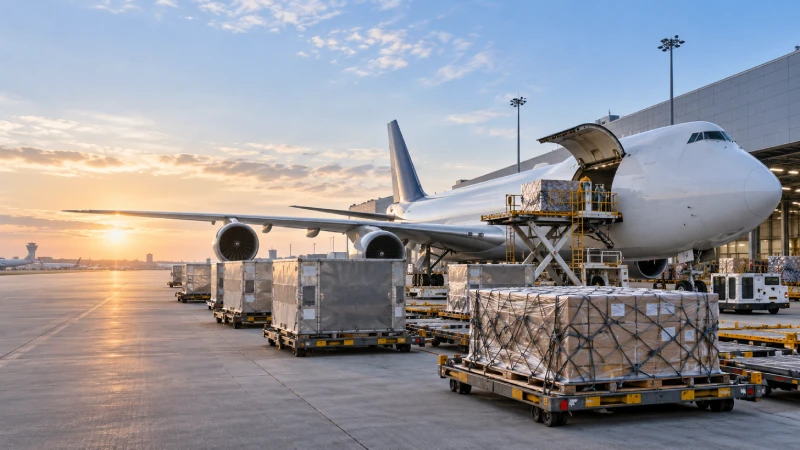
Air freight from China to Germany is usually chosen when delivery speed, inventory continuity or cargo value matters more than the lowest possible transport cost. It is commonly used for electronics, machinery parts, automotive components, samples, high-value equipment and urgent production materials.
However, choosing air freight involves more than finding the lowest rate per kilogram.
A shipment can be delayed before it reaches the aircraft because of chargeable-weight differences, cargo cut-off, security screening, export documentation or dangerous-goods checks. After arrival in Germany, customs clearance, terminal release and final truck delivery can add further time.
For most China-Germany shipments, the practical decision is:
Which China airport → which flight option → which German airport → which customs arrangement → which final delivery route?
Germany’s four most useful cargo gateways for this comparison are Frankfurt (FRA), Munich (MUC), Cologne/Bonn (CGN) and Leipzig/Halle (LEJ).
If you are still comparing air, sea, rail and express services, start with our main Shipping from China to Germany guide.
Quick Answer: How Does Air Freight from China to Germany Work?
A typical air freight shipment follows this route:
Supplier in China → Pickup → Export warehouse → Cargo acceptance and security screening → Export customs → Flight → German airport → Import customs → Cargo release → Final truck delivery
The best route depends on the cargo rather than on one airport or airline being universally better.
| Decision | Practical Rule |
|---|---|
| Best general German gateway | Frankfurt is usually the first airport to compare because of its large cargo network |
| Southern Germany | Compare Munich, especially for Bavaria and nearby industrial areas |
| North Rhine-Westphalia | Cologne/Bonn can be attractive for NRW and express-oriented cargo |
| Central/Eastern Germany | Leipzig/Halle is important for express and freighter operations |
| Urgent or high-value cargo | Prefer direct or low-transfer routing where practical |
| Lightweight but bulky cargo | Calculate volumetric weight before comparing rates |
| Batteries or dangerous goods | Confirm classification and airline acceptance before booking |
| Final airport choice | Compare the complete airport-to-postcode route, not the airfreight rate alone |
Pro Tip: A lower airfreight rate into Frankfurt does not automatically mean a lower delivered cost. For a consignee in Bavaria, flying into Munich may reduce destination trucking, handling and delivery time enough to make the total route more efficient.
When Does Air Freight from China to Germany Make Sense?
Air freight works best when the commercial cost of waiting is higher than the premium paid for faster transport.
Typical situations include:
- urgent stock replenishment;
- production-line shortages;
- replacement machinery parts;
- automotive components;
- electronics and high-value products;
- prototypes and samples;
- time-sensitive fashion or seasonal inventory;
- product launches with fixed delivery dates.
A useful question is not simply:
“Is air freight expensive?”
Instead, ask:
“What happens if these goods arrive one or two weeks later?”
If a delayed component stops a German production line, or a stockout causes lost sales, air freight may make commercial sense even when the freight rate is significantly higher than sea or rail transport.
Which Cargo Is Suitable for Air Freight?
| Cargo | Air Freight Suitability | Main Operational Check |
|---|---|---|
| Machinery spare parts | Excellent | Weight, dimensions and packing |
| Automotive components | Excellent | Deadline and final plant location |
| Consumer electronics | Excellent | Battery status and product compliance |
| High-value equipment | Excellent | Security, insurance and handling |
| Samples and prototypes | Excellent | Customs value and documentation |
| Fashion and urgent inventory | Good | Volumetric weight |
| Medical equipment | Good | Product-specific regulatory requirements |
| Electronics with lithium batteries | Conditional | Battery configuration and airline acceptance |
| Standalone lithium batteries | Restricted | DG classification and aircraft limitations |
| Chemicals or liquids | Conditional | SDS, UN classification and DG status |
| Large low-value bulky cargo | Often unsuitable | High volumetric weight |
| Oversized machinery | Case-by-case | Aircraft door, ULD and main-deck limitations |
For an accurate airfreight assessment, weight alone is not enough.
A forwarder should normally receive:
- commodity;
- number of cartons, crates or pallets;
- gross weight;
- dimensions of every package;
- cargo value;
- China pickup address;
- cargo-ready date;
- German delivery postcode;
- information about batteries, liquids, magnets or other potentially restricted contents.
Understand Chargeable Weight Before Booking
Air cargo is not always billed according to the weight shown on a factory scale.
Airlines need to account for both aircraft weight and aircraft space. A lightweight shipment occupying a large amount of space can therefore be charged according to its volumetric weight rather than its physical weight.
A commonly used airfreight formula is:
Volumetric Weight (kg) = Length × Width × Height in cm ÷ 6000
The chargeable weight is normally the higher of:
- actual gross weight; or
- volumetric weight.
Example
Suppose one crate measures:
100 × 80 × 60 cm
Its volumetric weight is:
100 × 80 × 60 ÷ 6000 = 80 kg
If the physical gross weight is only 55 kg, the shipment will normally be rated on:
80 kg chargeable weight
This is why two suppliers both saying “the cargo weighs 200 kg” can receive very different airfreight quotations.
Packaging design can directly affect freight cost. If unnecessary empty space can safely be removed before booking, the chargeable weight may decrease.
For detailed weight-break and rate examples, see our dedicated Air Freight Cost per KG from China to Germany guide.
What Makes Up the Air Freight Cost?
This page does not use a fixed China-Germany rate-per-kilogram table because air cargo pricing changes with capacity, routing, season, cargo type and weight break.
Instead, understand the cost structure.
A simplified calculation is:
Air freight based on chargeable weight
+ China pickup
+ origin handling
+ security / documentation
+ applicable surcharges
+ German terminal charges
+ customs clearance
+ duty and import VAT where applicable
+ final delivery
| Cost Component | Main Factors |
|---|---|
| China pickup | Factory location, vehicle and distance |
| Export handling | Departure airport and cargo type |
| Air freight | Chargeable weight, route, airline, capacity and weight break |
| Security screening | Cargo characteristics and screening requirement |
| DG handling | Classification, packing and airline requirements |
| Destination handling | German airport and ground handler |
| Customs brokerage | Entry complexity and shipment type |
| Duty | HS/TARIC classification and customs treatment |
| Import VAT | Import value and tax treatment |
| Storage | Delayed clearance or collection |
| Final delivery | German postcode, pallets, truck and appointment requirements |
The operational mistake to avoid is comparing two quotations only by the headline freight rate.
A cheaper airport-to-airport quotation can become more expensive after terminal handling, customs, storage and domestic delivery are added.
Which German Airport Should You Use?
There is no single German airport that is best for every shipment from China.
Airport selection should consider:
- flight availability;
- direct versus connecting routing;
- cargo restrictions;
- handling capabilities;
- customs arrangements;
- final German delivery postcode;
- total delivery time.
Main German Air Cargo Airports
| Airport | Code | Best Fit | Main Strength | What to Compare |
|---|---|---|---|---|
| Frankfurt | FRA | Broad general cargo | Large cargo ecosystem and specialist handling | FRA rate vs final trucking distance |
| Munich | MUC | Bavaria and Southern Germany | Strong industrial catchment and long-haul network | MUC vs FRA + trucking south |
| Cologne/Bonn | CGN | NRW and express cargo | Major express/integrator infrastructure | General cargo vs express routing |
| Leipzig/Halle | LEJ | Central/Eastern Germany and express cargo | Major freighter and DHL Express operations | Carrier availability and final postcode |
Frankfurt Airport (FRA)
Frankfurt is normally the first German airport to evaluate for conventional international air cargo.
Its advantages include:
- broad airline and cargo connectivity;
- large forwarding and handling ecosystem;
- general freight capability;
- dangerous-goods handling;
- valuable cargo handling;
- cold-storage capability;
- express and urgent freight handling.
Frankfurt Cargo Services states that its FRA operation handles import, export and transfer cargo as well as special freight including dangerous goods, valuable cargo, perishables and express shipments.
Frankfurt is particularly practical for:
- electronics;
- industrial components;
- machinery parts;
- high-value cargo;
- urgent general freight;
- special cargo accepted under the selected airline’s rules.
But its size does not mean every China shipment should automatically enter Germany through FRA.
A shipment ultimately going to southern Bavaria, for example, should also be compared against Munich.
Munich Airport (MUC)
Munich is particularly relevant for cargo destined for Bavaria and Southern Germany.
Potential destinations include:
- Munich;
- Augsburg;
- Ingolstadt;
- Regensburg;
- Nuremberg;
- surrounding automotive and industrial regions.
Munich Airport describes itself as Southern Germany’s largest cargo hub. It reported a total cargo volume of approximately 341,000 tonnes in 2025 and highlights its industrial catchment area, cargo network and expanding infrastructure.
For a Bavarian consignee, the correct comparison is often:
China → Frankfurt → long-distance truck to Bavaria
versus:
China → Munich → shorter German delivery
The Frankfurt flight might appear cheaper while the Munich route performs better after destination trucking and total transit are included.
Pro Tip: Choose the German gateway according to the consignee’s postcode and total route, not according to airport reputation alone.
Cologne/Bonn Airport (CGN)
Cologne/Bonn should be evaluated differently from Frankfurt and Munich.
Its strongest differentiation is its location in North Rhine-Westphalia and its major express logistics infrastructure.
Cologne Bonn Airport describes itself as the logistical heart of NRW and states that UPS, FedEx and DHL all operate hubs at the airport.
It can therefore be relevant for cargo linked to:
- Cologne;
- Bonn;
- Düsseldorf;
- the Ruhr region;
- western Germany;
- express distribution;
- time-critical parcel and e-commerce networks.
General air cargo is also handled at CGN, but importers should distinguish between integrator/express networks and conventional freight-forwarding services when comparing routes.
Leipzig/Halle Airport (LEJ)
Leipzig/Halle is particularly important for express and freighter networks serving Central and Eastern Germany.
Its position is useful for destinations around:
- Leipzig;
- Halle;
- Saxony;
- Saxony-Anhalt;
- Thuringia;
- parts of eastern and central Germany.
DHL describes its Leipzig operation as the largest hub in the DHL Express global network and says it operates 24/7, 365 days a year. See the DHL Hub Leipzig overview for operational details.
For conventional general cargo, however, the forwarder should still confirm whether the proposed airline and handling route are actually suitable.
The closest cargo airport is not necessarily the airport with the best available China uplift.
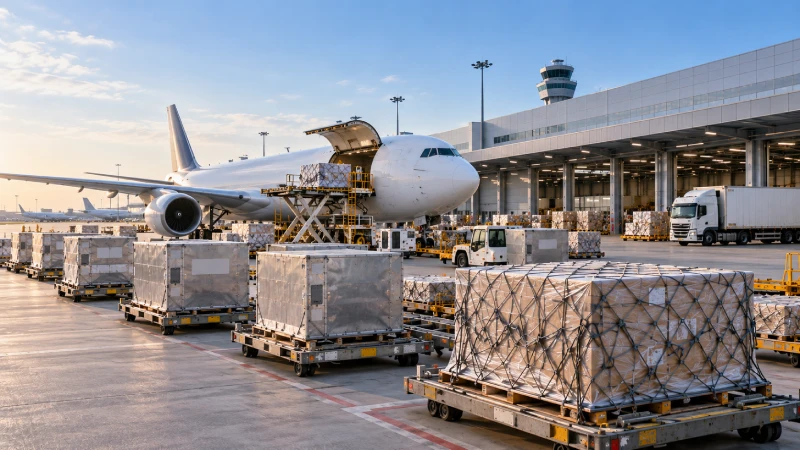
The China Departure Airport Matters Too
Airport selection should also start on the Chinese side.
Common gateways include:
| China Manufacturing Region | Airports Commonly Compared |
|---|---|
| Shanghai / Jiangsu / Zhejiang | Shanghai Pudong (PVG) |
| Shenzhen / Dongguan | Shenzhen (SZX) / Hong Kong (HKG) |
| Guangzhou / Foshan | Guangzhou (CAN) / Hong Kong (HKG) |
| South China multi-supplier cargo | CAN / SZX / HKG |
| Beijing / Tianjin / North China | Beijing-area gateways |
The cheapest flight rate is not always the best choice.
For example, moving cargo several hundred kilometres by truck merely to access a slightly lower airfreight rate can create:
- additional pickup cost;
- another warehouse transfer;
- missed cut-off risk;
- longer total transit.
The correct comparison is:
Factory → China airport → flight route → German airport → final delivery postcode
Direct vs Connecting Flights from China to Germany
One of the most important airfreight decisions is whether to use a direct/nonstop routing or a connecting service.
Direct vs Connecting Air Freight
| Factor | Direct / Nonstop | Connecting / Indirect |
|---|---|---|
| Number of flight sectors | Lower | Higher |
| Handling points | Fewer | More |
| Missed-connection risk | Lower | Higher |
| Transit predictability | Usually better | More variables |
| Freight rate | Can be higher | Can be more competitive |
| Capacity options | Depends on route | Often more alternatives |
| High-value cargo | Usually preferred | Assess transfer risk |
| Very urgent cargo | Usually preferred | Requires sufficient buffer |
| DG cargo | Potentially simpler | Transit restrictions must also be checked |
Choose a Direct Flight When Possible If:
- a production line is waiting for the goods;
- delivery deadline is fixed;
- shipment value is high;
- repeated handling should be minimized;
- a missed connection would have a serious commercial impact.
A Connecting Flight Can Make Sense When:
- direct capacity is unavailable;
- the next direct departure is too late;
- cargo has a flexible delivery deadline;
- the price difference is significant;
- the connecting service has reliable uplift and acceptable transfer time.
A key operational point is often missed:
A direct flight is not automatically the fastest commercial option.
Suppose the next direct service has available capacity in four days, while a connecting service can uplift tonight.
The connecting route may arrive first.
Pro Tip: Compare cargo-ready-to-delivery time, not simply airborne hours or the words “direct flight.”
How Long Does Air Freight from China to Germany Take?
Airfreight transit should not be measured only from aircraft departure to aircraft arrival.
A shipment goes through several operational stages.
| Stage | What Can Add Time |
|---|---|
| Supplier pickup | Distance and cargo readiness |
| Export warehouse | Weighing, measuring and packing checks |
| Security | Screening method and cargo characteristics |
| Export customs | Declaration and document accuracy |
| Waiting for uplift | Flight schedule and available capacity |
| Flight | Direct or connecting route |
| Transfer | Connection and terminal handling |
| German arrival handling | Breakdown and cargo availability |
| Import customs | Documentation, classification or inspection |
| Cargo release | Payment and consignee/broker readiness |
| Final delivery | Distance, truck and appointment |
Flight Time Is Not Transit Time
The aircraft may physically travel from China to Germany within a fraction of the complete logistics timeline.
For planning purposes, a well-prepared direct airfreight shipment can often move considerably faster than sea or rail freight, but there should never be a blanket promise such as:
“China to Germany always takes three days.”
Real transit depends on where the clock starts.
A forwarder quoting transit should clarify whether it means:
- airport to airport;
- warehouse acceptance to airport availability;
- pickup to airport;
- or full door-to-door delivery.
For a buyer, door-to-door elapsed time is normally the most useful measurement.
Cargo Cut-Off: “Cargo Ready” Is Not the Same as “Flight Ready”
A common misunderstanding is that a shipment can reach the cargo terminal shortly before aircraft departure.
Air cargo normally has several deadlines before departure.
1. Booking Deadline
Space first needs to be confirmed with the airline or service provider.
2. Forwarder Warehouse Cut-Off
Cargo may need to arrive early enough for:
- weighing;
- dimension verification;
- packaging inspection;
- labeling;
- documentation preparation;
- security screening;
- export customs procedures.
3. Airline Latest Acceptance Time
The shipment must then be accepted by the airline as ready for carriage before the relevant latest acceptance time.
The IATA Cargo Handling Manual includes Latest Acceptance Time (LAT) as part of standardized cargo handling processes. See the IATA Cargo Handling Manual for the current framework.
There is no universal “China to Germany air cargo cut-off.”
It varies with:
- airport;
- airline;
- flight;
- warehouse;
- commodity;
- security status;
- dangerous-goods status.
Why Cargo Misses Cut-Off
Typical reasons include:
- supplier arrives late;
- dimensions differ substantially from the booking;
- invoice does not match the physical cargo;
- cargo cannot pass the planned screening method;
- DG paperwork contains an error;
- battery configuration was declared incorrectly;
- packaging does not meet acceptance requirements;
- export customs is not completed in time.
Pro Tip: For urgent cargo, ask for both the forwarder warehouse cut-off and airline latest acceptance time, not just the scheduled flight departure.
Security Requirements for Germany-Bound Air Cargo
Air freight entering the European Union is subject to aviation security controls before loading.
The EU requires inbound cargo from non-EU countries to be physically screened to EU standards or to move through an EU aviation-security-validated secure supply chain under the ACC3 framework. The European Commission’s air cargo security guidance explains the requirements for carriers and secure supply chains.
For the shipper, the practical effect is that cargo may need to pass an approved screening process before it can fly.
Security screening can be more operationally complicated for:
- dense machinery;
- large metal assemblies;
- liquids;
- unusual shapes;
- tightly packed components;
- complex electrical equipment;
- batteries and other regulated commodities.
Standard X-ray screening is not necessarily suitable for every package.
The shipment may therefore need a different approved security process depending on its physical characteristics and supply-chain status.
This is another reason detailed dimensions and commodity descriptions should be provided before the cargo arrives at the airport warehouse.
ICS2 and Pre-Arrival Cargo Data
Germany is part of the EU’s Import Control System 2 (ICS2).
For goods entering or transiting the EU, a complete Entry Summary Declaration (ENS) must be provided before arrival. For air transport, a minimum set of information must also be filed before loading for pre-loading security risk analysis. The current requirements are published by the European Commission ICS2 portal.
The importer may not personally submit every ICS2 filing; responsibilities can vary across airlines, forwarders and other economic operators.
However, the quality of the shipper’s commercial data directly affects the filing.
Poor descriptions such as:
- “parts”;
- “accessories”;
- “samples”;
- “goods”;
- “electronics”;
provide weak customs and security information.
Use a commercially meaningful product description instead.
For example:
Weak:
“Machine parts”
Better:
“Stainless steel CNC-machined valve components for industrial pumps”
Accurate product descriptions, shipper/consignee data and shipment-level information should be prepared before departure rather than corrected after the cargo reaches Germany.
Customs Clearance for Air Freight in Germany
Air cargo entering through Frankfurt, Munich, Cologne/Bonn or Leipzig/Halle remains subject to German and EU customs requirements.
Choosing a different airport does not remove the importer’s responsibilities.
Common Customs Documents
| Document / Information | Main Purpose |
|---|---|
| Commercial Invoice | Customs value, parties, commodity and transaction information |
| Packing List | Packages, weights, dimensions and contents |
| Air Waybill | Air transport documentation |
| EORI | EU customs identification |
| HS / TARIC classification | Duty and regulatory treatment |
| Customs declaration | Entry into the appropriate customs procedure |
| Origin documentation | Where required or relevant |
| Licences / certificates | Product-dependent |
| Customs value information | Where required |
| DG documentation | Regulated air cargo where applicable |
The EU’s Access2Markets customs guidance identifies documents such as the commercial invoice, packing list and transport documentation among the records that may be needed for EU import clearance.
Commercial Invoice
The commercial invoice should normally provide information such as:
- exporter;
- importer;
- invoice number and date;
- accurate commodity description;
- quantity;
- unit and total value;
- currency;
- Incoterm;
- transport-related information.
Avoid creating one invoice for the customer and a substantially different description for freight/customs purposes.
Inconsistent documents are a common source of questions.
Packing List
The packing list should match the physical shipment and indicate:
- package count;
- packaging type;
- contents;
- marks and numbers;
- net and gross weight;
- dimensions where applicable.
EORI
Commercial importers in the EU commonly require an EORI number for customs operations.
This should be confirmed before departure from China rather than discovered only after arrival.
HS / TARIC Classification
Duty and product requirements depend on classification.
Do not select a code merely because a supplier has used it for another country.
EU TARIC treatment should be checked for the actual product being imported into Germany.
Pro Tip: Customs preparation should begin before the aircraft leaves China. Waiting for arrival to confirm EORI, product classification or importer details can turn a fast flight into a slow shipment.
For broader customs planning, see our Customs Clearance in Germany for Imports from China guide.
Airport-to-Airport vs Door-to-Door Air Freight
Airfreight quotations can cover very different scopes.
Airport-to-Airport Air Freight
Airport-to-airport service focuses primarily on moving cargo between the agreed origin and destination cargo airports.
The importer may still need to arrange:
- customs broker;
- import clearance;
- duty and VAT payment;
- terminal collection;
- German truck;
- delivery appointment.
This service can work well for importers with established logistics operations in Germany.
Door-to-Door Air Freight
A coordinated door-to-door shipment may include:
China supplier
→ Pickup
→ Export warehouse
→ Export customs
→ Security screening
→ Air transport
→ German cargo terminal
→ Import clearance
→ Cargo release
→ Truck delivery
→ Consignee
| Service | Best Suited To |
|---|---|
| Airport-to-airport | Importers with their own German logistics setup |
| Airport-to-door | Buyers who arrange customs separately |
| Door-to-door | Buyers wanting a coordinated logistics chain |
| DAP | Importer handles import duty/tax obligations |
| DDP | Case-by-case after tax, importer and product requirements are verified |
DDP should not be treated as a universal solution for every product.
Before agreeing to a DDP shipment, the parties should confirm:
- who acts as importer;
- EORI requirements;
- product compliance;
- customs valuation;
- duty;
- VAT;
- any licences or registrations.
For a broader view of delivery responsibilities, see DDP Shipping from China to Germany.
Final Delivery from the German Airport
For many importers, the shipment is not complete when customs releases it.
The airport-to-door leg can materially affect the best routing.
A final delivery quotation may need to consider:
- German postcode;
- pallet count;
- gross weight;
- pallet dimensions;
- oversized pieces;
- tail-lift requirement;
- forklift availability;
- loading dock;
- residential or commercial delivery;
- timed delivery;
- warehouse appointment;
- limited vehicle access.
Consider a shipment destined for Augsburg.
Option A might be:
Guangzhou → Frankfurt → truck to Augsburg
Option B:
Guangzhou → Munich → truck to Augsburg
Even if Option A has a lower air rate, Option B may provide a better total route.
That is why airport selection should always include final delivery geography.
Shipping High-Value Cargo from China to Germany
High-value cargo should not be routed purely according to the lowest freight rate.
Examples include:
- precision equipment;
- electronics;
- semiconductor-related products;
- specialized machine components;
- prototypes;
- instruments;
- premium finished products.
Operational priorities should include:
Reduce Unnecessary Handovers
Every transfer adds another handling point.
A direct or simpler route can therefore be preferable even when its freight rate is higher.
Confirm Secure Handling
Check whether the selected warehouse, handler and airline can support the cargo’s security requirements.
Frankfurt Cargo Services, for example, lists valuable freight among its special-cargo handling capabilities.
Use Appropriate Packaging
Packaging should protect against:
- impact;
- compression;
- moisture;
- tampering;
- electrostatic risks where applicable.
Consider Cargo Insurance
Carrier liability and cargo value are not the same thing.
High-value shippers should consider appropriate cargo insurance rather than assume that loss or damage would automatically be reimbursed at full invoice value.
Avoid Unnecessary Storage
For high-value cargo, arrival timing matters.
If a shipment reaches Germany before a weekend but customs or the consignee is not ready, it may remain at the cargo terminal longer than necessary.
Pro Tip: For high-value air freight, optimize risk-adjusted routing, not only cost per kilogram.
Shipping Electronics from China to Germany by Air
Electronics are among the most suitable products for air freight because they often combine:
- relatively high value;
- compact dimensions;
- short product cycles;
- inventory urgency.
But “electronics” is too broad a description for operational planning.
Before booking, determine:
- What exactly is the product?
- Does it contain batteries?
- Are batteries installed in the equipment or packed separately?
- What is the battery chemistry and capacity?
- Is the cargo unusually high-value?
- Does it require anti-static packaging?
- Is moisture protection necessary?
- Are EU product compliance requirements already addressed?
Logistics compliance and market compliance are related but separate.
Successful air transport does not automatically mean the product meets all requirements for placement on the EU market.
For a detailed product-specific workflow, use our Shipping Electronics from China to Germany guide.
Lithium Batteries and Dangerous Goods
Battery cargo should be classified before the shipment is booked.
Do not simply tell a forwarder:
“This is electronics with batteries.”
The correct transport treatment depends on whether the battery is:
- lithium ion;
- lithium metal;
- sodium ion;
- shipped alone;
- packed with equipment;
- contained in equipment;
- damaged or defective;
- a prototype.
Relevant information can include:
- UN number;
- Watt-hour rating;
- battery configuration;
- UN 38.3 test summary;
- packing instruction;
- packaging;
- marks and labels;
- shipper’s declaration where required;
- airline/operator restrictions.
Standalone Lithium-Ion Batteries
Under IATA’s 2026 guidance, lithium-ion batteries shipped by themselves under PI 965 must normally be offered at a state of charge not exceeding 30% of rated capacity. They cannot normally be carried as cargo on passenger aircraft without the relevant approvals.
Lithium-Ion Batteries Packed with Equipment
An important change applies from 1 January 2026.
For lithium-ion batteries packed with equipment under PI 966, IATA’s 2026 guidance applies reduced state-of-charge requirements. Section I batteries must be offered at no more than 30% rated capacity unless the relevant approvals are obtained. For Section II, lithium-ion cells and batteries above 2.7 Wh must also be offered at no more than 30% rated capacity under the stated conditions.
See the official IATA 2026 Lithium Battery Guidance Document for the current requirements.
Batteries Contained in Equipment
Battery configurations contained in equipment are treated differently from standalone batteries or batteries packed with equipment.
This distinction matters.
A laptop with an installed battery, spare batteries packed next to equipment, and cartons of standalone batteries may all require different treatment.
Airline Restrictions Still Matter
Meeting the general dangerous-goods rules does not guarantee that every airline or route will accept the shipment.
Operators can impose additional limitations.
Connecting routes may also require checking the rules and handling capability at transit points.
Therefore, battery cargo should be accepted only after reviewing the specific product + battery configuration + route + airline.
Do not rely on statements such as:
“This battery cargo has flown before, so it will be accepted again.”
Rules, operator policies and routing can change.
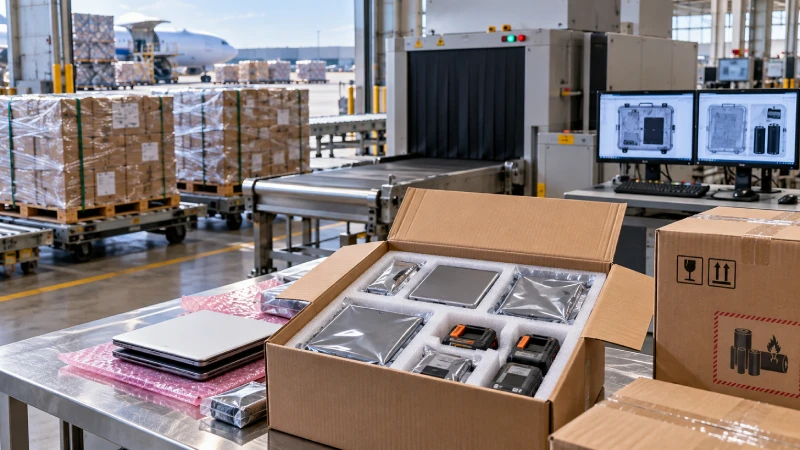
Practical Air Freight Booking Checklist
Before requesting a China-Germany airfreight booking, prepare as much of the following information as possible.
Cargo Information
- exact commodity;
- number of cartons, pallets or crates;
- gross weight;
- package dimensions;
- total cargo value;
- HS code if confirmed.
Origin Information
- supplier address;
- pickup requirements;
- cargo-ready date;
- export documentation status.
Destination Information
- German delivery postcode;
- consignee company details;
- EORI status;
- customs broker if applicable;
- unloading requirements;
- delivery appointment requirements.
Special Cargo Information
Confirm whether the goods contain:
- lithium batteries;
- sodium-ion batteries;
- liquids;
- chemicals;
- aerosols;
- magnets;
- compressed gas;
- temperature-sensitive goods;
- other regulated materials.
For battery/DG cargo, provide the applicable technical documentation before space is confirmed.
How to Choose the Best Air Freight Route
A practical China-Germany airfreight decision can be made in six steps.
Step 1 — Identify the Cargo
Determine whether it is:
- general cargo;
- high-value cargo;
- electronics;
- battery cargo;
- dangerous goods;
- oversized cargo;
- temperature-sensitive cargo.
This determines which airlines and routes can realistically be considered.
Step 2 — Calculate Chargeable Weight
Compare actual and volumetric weight.
Do this before comparing rates.
Step 3 — Confirm the Cargo-Ready Date
A good flight next week may be useless if the customer needs delivery this week.
Match the actual cargo-ready date against:
- warehouse cut-off;
- export processing;
- security screening;
- airline LAT;
- available uplift.
Step 4 — Compare Direct and Connecting Flights
Evaluate:
- departure date;
- arrival date;
- number of transfers;
- capacity reliability;
- cargo handling;
- restrictions;
- total cost.
Step 5 — Compare German Airports
Do not automatically choose Frankfurt.
Compare:
FRA vs MUC vs CGN vs LEJ
against the cargo type and final destination.
Step 6 — Build the Full Door-to-Door Route
Add:
- German handling;
- customs;
- cargo release;
- domestic trucking;
- appointment delivery.
The final decision should balance:
total cost + realistic transit time + cargo risk
rather than simply selecting the lowest airport-to-airport rate.
Planning Air Freight from China to Germany?
If you are deciding between Frankfurt, Munich, Cologne/Bonn or Leipzig/Halle, send the shipment details before choosing the route.
Useful information includes:
- commodity;
- number of packages;
- weight;
- dimensions;
- battery/DG status;
- pickup city in China;
- cargo-ready date;
- German delivery postcode.
We can then compare the suitable departure airport, flight routing, German gateway, customs arrangement and final delivery plan.
CTA Button: Check My Air Freight Route
FAQ
How long does air freight from China to Germany take?
There is no single transit time for every shipment. Actual door-to-door transit includes China pickup, export handling, security screening, customs, flight availability, German import clearance and final delivery. Always confirm whether a quoted transit time is airport-to-airport or door-to-door.
Which airport is best for air freight from China to Germany?
Frankfurt is normally the broadest general-cargo option, but Munich can be more practical for Southern Germany, Cologne/Bonn is strong for NRW and express networks, and Leipzig/Halle is important for express and freighter operations serving central and eastern Germany.
How is chargeable weight calculated for China-Germany air freight?
Airfreight normally compares actual gross weight with volumetric weight. A commonly used formula is Length × Width × Height in cm ÷ 6000, and the higher result normally becomes the chargeable weight.
Is a direct flight from China to Germany always faster?
No. A direct flight usually reduces transfers and operational risk, but a connecting service may depart earlier when direct capacity is unavailable. Compare cargo-ready-to-final-delivery time rather than flight duration alone.
Can electronics and lithium batteries be shipped by air from China to Germany?
Many electronics and battery-powered products can be shipped by air, but battery configuration must be identified first. Standalone batteries, batteries packed with equipment and batteries contained in equipment can have different packing, state-of-charge, documentation and airline acceptance requirements.
What documents are required for air freight customs clearance in Germany?
Typical documents and information include the commercial invoice, packing list, Air Waybill, EORI, HS/TARIC classification, import declaration, applicable origin documentation or licences, and dangerous-goods documents where required.
Official Sources
- IATA Cargo Handling Manual
- IATA 2026 Lithium Battery Guidance Document
- European Commission — Import Control System 2 (ICS2)
- European Commission — Air Cargo and Mail Security
- EU Access2Markets — Customs Clearance Documents and Procedures
- Frankfurt Cargo Services
- Munich Airport Cargo
- Cologne Bonn Airport
- DHL Hub Leipzig
