
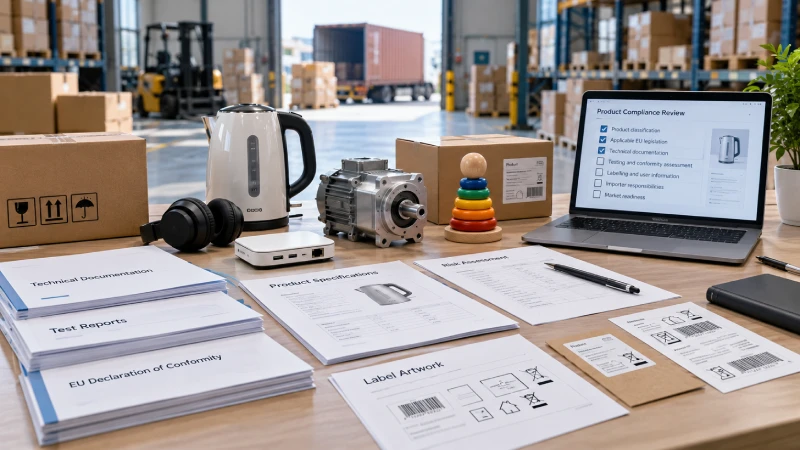
Importing products from China to Germany involves more than choosing a freight method, preparing a commercial invoice and clearing customs.
For many products, the importer must also determine whether EU product-safety, conformity-assessment, documentation, labelling or traceability rules apply before the goods are placed on the German or wider EU market.
One of the most common mistakes is to begin with the question:
“Does this product have CE?”
A better starting point is:
What exactly is the product? → Which EU legislation applies? → What conformity assessment, documentation and marking are required? → Who carries the manufacturer, importer or responsible-person obligations?
This distinction matters because not every product imported from China to Germany requires CE marking. The European Commission states that CE marking is compulsory only for products covered by EU legislation that requires it, and that CE marking must not be affixed to products where the relevant legislation does not provide for it. Germany’s Product Safety Act, the Produktsicherheitsgesetz (ProdSG), also prohibits making a product available with CE marking where no applicable legal provision requires or permits that marking. See the European Commission guidance on CE marking.
At the same time, a product that does not require CE marking is not automatically free from EU product-compliance obligations. Depending on the product, rules such as the General Product Safety Regulation (GPSR), REACH, sector-specific legislation, labelling requirements or other German and EU rules may still apply.
This guide explains how importers sourcing from China can approach product compliance before shipping goods to Germany.
Important: This guide provides a practical overview of EU and German product-compliance requirements. The applicable rules depend on the exact product, its design, intended use, users, configuration and sales model. It does not replace advice from qualified product-compliance specialists, conformity-assessment bodies or legal professionals.
For logistics planning after the compliance route has been established, see our guide to shipping from China to Germany.
Quick Answer: Does Every Product Imported From China to Germany Need CE Marking?
No.
CE marking is not a universal German import requirement and it is not a general certificate issued by German Customs or an EU authority.
CE marking applies when the product falls within EU legislation that specifically requires CE marking.
The manufacturer normally uses the CE mark to declare that the product complies with the applicable requirements of the relevant EU harmonisation legislation. The European Commission also makes clear that the CE mark does not mean an EU institution has individually tested or approved the product. See the European Commission CE marking overview.
In practice, an imported product may fall into one of three broad situations.
1. The Product Is Covered by Legislation Requiring CE Marking
Depending on its characteristics, examples can include certain:
- electrical equipment;
- electronic apparatus;
- radio equipment;
- machinery;
- toys;
- personal protective equipment;
- medical devices;
- pressure equipment.
Even within these categories, the conformity-assessment procedure is not identical.
Some products may be assessed by the manufacturer under the applicable legislation, while others may require involvement of a notified body.
Needs confirmation before publishing for the specific product.
2. The Product Is Not Subject to CE Marking
Many ordinary consumer products are not covered by CE-marking legislation.
They may nevertheless need to comply with the GPSR and other applicable EU or German product requirements.
Putting a CE mark on a product simply because it is being exported to Europe can itself create a compliance problem.
3. Several EU Laws Apply to the Same Product
A single electrical or electronic product may potentially need to be evaluated against several different legal regimes.
For example, depending on its design, voltage and functionality, a device could potentially involve:
- electromagnetic compatibility requirements;
- electrical safety requirements;
- RoHS requirements;
- radio-equipment requirements;
- ecodesign or energy-related rules;
- general product-safety provisions.
There is no safe rule that says:
“All electronics need LVD + EMC + RoHS.”
The legislation must be checked against the actual product.
Needs confirmation before publishing.
Start With the Product, Not With the CE Mark
Before asking your Chinese supplier for certificates, define exactly what is being imported.
A description such as:
- “electronic accessory”;
- “household appliance”;
- “machine”;
- “LED product”;
- “spare part”;
is usually not detailed enough to determine EU product-compliance requirements.
At minimum, the compliance review should identify:
- the exact product and model;
- intended use;
- intended users;
- whether it is intended for consumers, professionals or both;
- rated voltage;
- power supply;
- whether it contains electrical or electronic functions;
- whether it transmits or receives radio signals;
- whether it contains motors or moving parts;
- whether it is a complete machine, component or partly completed machinery;
- whether it is intended for children;
- whether it performs a protective function;
- whether batteries are included;
- relevant materials or chemical composition;
- whether the German importer will sell it under its own brand.
These characteristics can completely change the applicable regulatory route.
For example, two products that look almost identical externally may fall under different EU legislation because one contains a Wi-Fi module while the other does not.
Likewise, an electrical device powered directly from 230 V mains can have a different legal analysis from a similar product powered only at 5 V DC.
That is why compliance should begin with the question:
“What product are we legally placing on the EU market?”
—not simply—
“Does the supplier have CE?”
The Four-Step EU Product Compliance Decision Process
A practical compliance review for goods imported from China can be organised around four decisions.
| Step | Main Question | What You Need to Determine |
|---|---|---|
| 1 | What product is it? | Intended use, users, design, voltage, functions and configuration |
| 2 | Which EU legislation applies? | CE legislation, GPSR and any sector-specific requirements |
| 3 | What documentation and marking are required? | Assessment, standards, tests, technical documentation, DoC, CE and labels |
| 4 | Who has the legal obligations? | Manufacturer, importer, authorised representative or responsible economic operator |
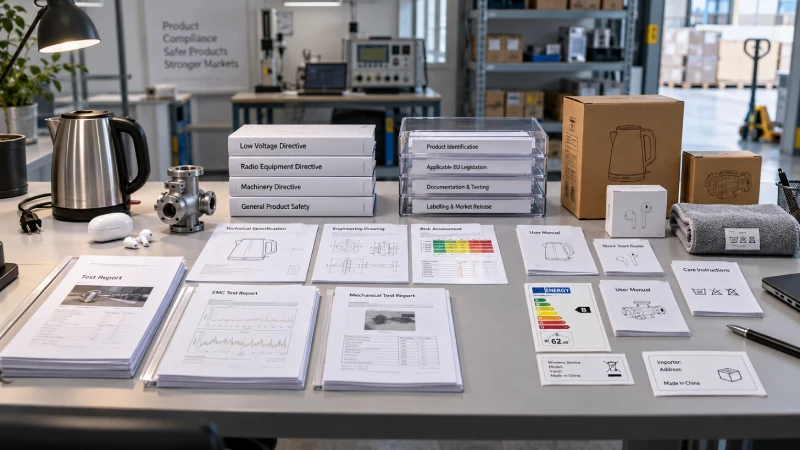
Step 1: What Product Is It?
Product classification for compliance purposes involves more than finding a customs HS code.
The HS or CN classification is important for customs, tariff measures and trade controls, but product-safety legislation uses its own scopes, definitions and exclusions.
You should therefore document:
Product → intended purpose → intended users → technical characteristics → market channel
One particularly important distinction is whether the product is a consumer product.
Under the GPSR, the definition of a product includes items intended for consumers or items that are likely, under reasonably foreseeable conditions, to be used by consumers even where they were not originally intended for them. See Regulation (EU) 2023/988.
This means a product labelled “professional” does not automatically fall outside consumer-product safety rules if consumers could reasonably be expected to use it.
Conversely, equipment genuinely intended exclusively for professional industrial use and not reasonably likely to be used by consumers should not automatically be treated as a GPSR consumer product.
Needs confirmation before publishing for the specific product and use case.
Step 2: Which EU Legislation Applies?
Once the product has been defined, identify which EU legislation actually covers it.
Do not work backwards from whatever certificates the Chinese supplier happens to have.
For CE-related products, this may involve one or several pieces of Union harmonisation legislation.
For consumer products, GPSR may also be relevant.
For some products, other regimes may apply in addition to or instead of those discussed in this guide.
The European Commission’s New Legislative Framework provides the general structure used by much of EU product legislation, including the roles of manufacturers, importers, distributors and conformity-assessment bodies.
The exact legal scope must always be checked against the legislation applicable to the specific product.
Step 3: What Documentation, Testing and Marking Are Required?
Once the applicable legislation has been identified, determine what it actually requires.
Depending on the product, the compliance route may involve:
- essential safety or performance requirements;
- risk assessment;
- harmonised standards;
- laboratory testing or other technical evidence;
- conformity assessment;
- technical documentation;
- an EU Declaration of Conformity;
- notified-body involvement;
- CE marking;
- product or model identification;
- manufacturer details;
- importer details;
- responsible-person details;
- warnings;
- user instructions;
- German-language safety information.
Not every item on this list applies to every product.
The relevant legislation controls the answer.
Step 4: Who Has the Legal Obligations?
When the manufacturer is located in China, the EU-based party cannot automatically assume that compliance remains entirely the supplier’s responsibility.
Depending on the legislation and commercial structure, obligations can fall on:
- the manufacturer;
- an authorised representative;
- the importer;
- the distributor;
- an EU responsible economic operator;
- a qualifying fulfilment service provider.
The European Commission specifically states that importers bringing products from outside the EU must verify that the non-EU manufacturer has taken the necessary steps, that required documentation is available and that the manufacturer can be contacted. See the European Commission guidance for importers and distributors.
The legal role therefore needs to be established before the product enters the market.
Product Category Compliance Overview
The following table shows why there is no universal CE rule for China–Germany imports.
| Product Example | CE Marking? | Main Rules to Investigate | Important Questions |
|---|---|---|---|
| Ordinary non-electrical consumer accessory | Often not CE-marked | GPSR and possibly REACH or sector-specific rules | Consumer safety, traceability, labels and warnings |
| Mains-powered electrical equipment | Often CE where LVD applies | LVD, EMC and potentially RoHS or other legislation | Voltage, safety, EMC, technical file, DoC |
| Low-voltage USB electronic device | LVD may not apply | EMC, RoHS, RED or other rules depending on product | Do not assume “outside LVD = no CE” |
| Bluetooth/Wi-Fi device | CE commonly relevant | Radio Equipment Directive and potentially other legislation | Radio functionality, safety, spectrum and documentation |
| Electrical/electronic equipment | RoHS may apply | RoHS / German ElektroStoffV | Product scope, restricted substances and exemptions |
| Machinery | CE commonly relevant where within scope | Machinery Directive during 2026 transition; Machinery Regulation from 2027 | Machinery definition, risks and conformity route |
| Partly completed machinery | Different regime | Machinery legislation | Do not treat it automatically as completed machinery |
| Toy, PPE or medical device | CE commonly applies | Product-specific legislation | Classification and conformity route vary significantly |
The product name alone is not enough.
Features such as voltage, intended users, radio functionality, installation method or integration into other equipment can alter the compliance analysis.
Needs confirmation before publishing for every product-specific determination.
What CE Marking Actually Means
CE marking is often misunderstood as a certificate that can simply be purchased from a laboratory.
That is not how the EU system works.
For products that require CE marking, the manufacturer must first determine which EU legislation applies and complete the required conformity process.
The European Commission summarises the process as including identifying the applicable EU requirements, determining the conformity-assessment route, preparing technical documentation, drawing up the EU Declaration of Conformity and affixing the CE mark where required. See the Your Europe CE marking guidance.
The manufacturer is normally responsible for ensuring that this process has been completed.
There Is No Universal “CE Certificate”
A Chinese supplier may send a PDF titled:
CE Certificate
That document should not automatically be treated as proof that the finished product is legally compliant.
The EU does not operate one central authority that issues a universal certificate giving manufacturers permission to use the CE mark.
For some products, the manufacturer may be able to carry out the applicable conformity assessment without a notified body.
For other products or conformity modules, an independent notified body may be required.
The correct route is determined by the applicable legislation—not by whether a supplier already has a document labelled “certificate.”
Pro Tip
Instead of asking:
“Do you have CE?”
ask the supplier:
“Which EU legislation applies to this exact model, which conformity-assessment procedure was used, and which standards and technical evidence support the declaration?”
That question usually produces much more useful information.
What Is the EU Declaration of Conformity?
For many products subject to CE-marking legislation, the EU Declaration of Conformity, commonly called the DoC, is a central compliance document.
By signing it, the manufacturer formally declares that the identified product complies with the applicable EU legislation.
A DoC normally needs to identify information such as:
- the manufacturer;
- the product or model;
- applicable EU legislation;
- relevant standards or technical specifications;
- notified-body information where relevant;
- the responsible signatory;
- date and place of issue.
The exact format and contents depend on the applicable legislation. See the European Commission guidance on signing an EU Declaration of Conformity.
One Product May Be Covered by Several EU Acts
If several EU harmonisation acts apply to the same product, the declaration needs to address the relevant applicable requirements.
For example, a particular electrical device could potentially involve several legal regimes.
However, it would be incorrect to publish a fixed rule saying every electrical product always needs the same combination of directives.
Needs confirmation before publishing.
Check That the Documents Match the Actual Product
A common sourcing problem is document mismatch.
For example:
- imported model: AB-520;
- DoC model: AB-500;
- test report: AB-480;
- rating label: AB-520 Pro.
These documents may or may not legitimately cover the same product family.
The importer should not assume that they do.
A practical review should trace:
physical product → model number → label → DoC → test reports → technical documentation
If the link between them is unclear, ask the supplier to explain it before shipment.
What Should Be in the Technical Documentation?
Technical documentation is the evidence package used to demonstrate why a regulated product meets the applicable EU requirements.
It is more than a folder containing laboratory reports.
European Commission guidance explains that technical documentation should demonstrate compliance and can include information on the product’s design, manufacture and operation, applicable requirements, standards, conformity assessment, risk analysis and supporting evidence. See Your Europe guidance on preparing technical documentation.
Depending on the legislation, typical contents can include:
- manufacturer details;
- product description;
- model and serial identification;
- drawings and schematics;
- design information;
- production information;
- applicable legislation;
- applicable essential requirements;
- risk assessment;
- standards used;
- component information;
- material information;
- test reports;
- conformity-assessment records;
- labels;
- instructions;
- safety information.
For complex products that fall under several EU regimes, the technical file should make clear which requirements and technical evidence relate to each part of the compliance assessment.
How Long Should Technical Documents Be Retained?
European Commission guidance states that technical documentation is generally retained for 10 years after the product is placed on the market, unless the applicable sector legislation specifies otherwise.
The exact retention period should therefore still be checked under the legislation applying to the product.
Needs confirmation before publishing for the specific product regime.
Harmonised Standards: Important, but Not the Law Itself
EU legislation normally sets the legally binding essential requirements.
Harmonised standards provide recognised technical methods for demonstrating compliance with requirements they cover.
Where the reference to a harmonised standard has been published in the Official Journal of the European Union, applying the relevant provisions can provide a presumption of conformity for the covered legal requirements. See the Your Europe conformity-assessment guidance.
However, harmonised standards generally remain voluntary.
A manufacturer may use another technical solution, but it still has to demonstrate that the product satisfies the legally binding requirements.
In practice, using an appropriate harmonised standard can make the technical case more straightforward, while departing from it can require a stronger technical justification.
Pro Tip
Do not automatically copy a standard number from an old supplier report.
Before relying on it, check:
- whether it applies to the exact product;
- whether it covers the relevant risk;
- whether the cited version is appropriate;
- whether its reference has the necessary OJEU status;
- whether additional standards or requirements also apply.
Importer Responsibilities When Buying From a Chinese Manufacturer
For many China–Germany transactions, the German or EU buyer is not simply a passive consignee.
If the business legally acts as the importer, EU product legislation can impose independent obligations on it.
The Commission’s CE guidance says importers must check that the manufacturer outside the EU has taken the necessary steps, that required documentation is available upon request and that communication with the manufacturer is possible. See the European Commission guidance for importers and distributors.
Individual directives and German implementing legislation can go further.
Before the Product Is Placed on the Market
Depending on the applicable legislation, the importer may need to verify that:
- the manufacturer completed the required conformity assessment;
- technical documentation was prepared;
- CE marking is present where legally required;
- the required declaration is available;
- manufacturer identification requirements are met;
- product identification requirements are met;
- instructions and safety information are provided;
- importer identification is present;
- a responsible economic operator exists where required.
For example, under the Low Voltage Directive, importers must ensure that the manufacturer has completed the conformity-assessment procedure, created the technical documentation, applied CE marking and supplied the required documentation before the electrical equipment is placed on the market. See Directive 2014/35/EU.
Germany’s EMVG imposes similar obligations for apparatus within its EMC scope. An importer may only place compliant apparatus on the market and must ensure that conformity assessment, CE marking and required information requirements have been addressed. See the German EMVG.
Germany’s ElektroStoffV similarly implements importer obligations relating to electrical and electronic equipment under RoHS.
While the Product Is Under the Importer’s Control
Importer responsibilities do not necessarily end once documents have been reviewed.
For example, German EMC law requires an importer to ensure that storage and transport conditions under its responsibility do not compromise compliance with the applicable essential requirements.
This is relevant when goods are exposed to inappropriate storage, moisture, physical damage or repacking that could affect the regulated product.
After the Product Has Been Placed on the Market
Depending on the applicable legislation, post-market obligations may include:
- keeping required records;
- cooperating with market-surveillance authorities;
- investigating compliance problems;
- taking corrective measures;
- withdrawing products;
- recalling products;
- notifying authorities about dangerous products.
Under the GPSR, importers who believe a product is dangerous must take the prescribed action and ensure relevant authorities are informed through the appropriate EU mechanism. See Regulation (EU) 2023/988.
The key point is simple:
The importer should not wait until German Customs or a market-surveillance authority asks questions before checking product compliance.
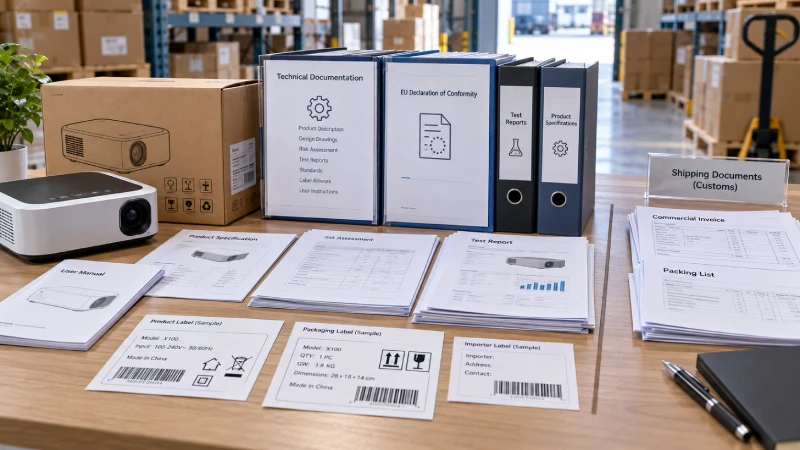
Private Label and OEM Imports: When the Importer Can Become the Manufacturer
Private-label sourcing from China requires particular care.
Imagine a Chinese factory manufactures a coffee machine, tool, electrical accessory or consumer product, but the German buyer:
- places its own brand on it;
- markets it under its own company name;
- changes the design;
- modifies components;
- changes safety-relevant functions.
Under relevant EU legislation, this can change the buyer’s legal role.
The European Commission warns that an importer or distributor that markets a product under its own name may take over the manufacturer’s responsibilities. See the European Commission guidance for importers and distributors.
RoHS also provides that an importer or distributor may be treated as a manufacturer where it places electrical and electronic equipment on the market under its own name or trademark or modifies it in a way that may affect compliance. See Directive 2011/65/EU.
That can mean responsibility for matters such as:
- conformity assessment;
- technical documentation;
- declarations;
- labels;
- traceability;
- corrective action.
Pro Tip
Clarify the legal manufacturer and brand-owner structure before approving product artwork and packaging.
Do not wait until the containers have already been loaded in China.
GPSR: What Importers Need to Know
Regulation (EU) 2023/988, the General Product Safety Regulation or GPSR, has applied since 13 December 2024.
It establishes general product-safety rules for consumer products and also addresses issues such as traceability, online sales, responsible economic operators and post-market action.
GPSR defines a product as an item intended for consumers or likely, under reasonably foreseeable conditions, to be used by consumers even if it was not originally intended for them. See Regulation (EU) 2023/988.
This means GPSR should not be described simply as:
“the new CE rule.”
It is not.
Nor should an article claim:
“Every B2B industrial product is subject to GPSR.”
The consumer-product definition and the relationship with sector-specific Union legislation need to be considered.
GPSR and CE-Marked Products Can Interact
A CE-marked product is not automatically outside GPSR.
At the same time, GPSR does not simply duplicate product-specific harmonisation legislation.
Article 2 provides rules governing how GPSR applies where specific Union legislation already regulates particular safety risks.
For an actual product, the analysis therefore needs to determine:
- what sector-specific legislation applies;
- which risks are already regulated there;
- which GPSR provisions remain relevant.
Needs confirmation before publishing for the specific product.
GPSR Technical Documentation
Under GPSR, manufacturers have product-safety assessment and technical-documentation obligations for products within its scope.
The documentation should support the assessment that the product is safe and address the relevant risks associated with the product.
The level of detail should be proportionate to the product and its risks.
For a simple low-risk household item, the technical justification may look very different from the file for a complex electrical product.
That does not mean the simple product requires no safety assessment.
It means the documentation should correspond to the actual risk profile.
GPSR Importer Responsibilities
Article 11 of GPSR places direct obligations on importers.
Before placing a covered product on the market, the importer must ensure that the product meets the general safety requirement and verify relevant manufacturer obligations. If the importer believes the product is not compliant or is dangerous, it must not simply continue placing the product on the market. See Regulation (EU) 2023/988.
Depending on the situation, importer duties can include matters such as:
- checking manufacturer compliance;
- ensuring traceability information;
- providing importer contact details;
- ensuring required instructions and safety information are available;
- maintaining access to documentation;
- cooperating with market-surveillance authorities;
- taking corrective action when a dangerous product is identified.
For German-market products, the language requirements also need to be reviewed.
EU Responsible Person and Responsible Economic Operator
The phrase “EU Responsible Person” is widely used in e-commerce, but it can cause confusion because EU legislation uses several related legal concepts.
Two important frameworks are Regulation (EU) 2019/1020 and GPSR.
Article 4 of Regulation (EU) 2019/1020
For products covered by specified Union harmonisation legislation, Article 4 requires an economic operator established in the EU to be responsible for particular tasks.
Depending on the supply-chain structure, that operator may be:
- an EU-established manufacturer;
- the importer;
- an authorised representative with the appropriate mandate;
- a qualifying fulfilment service provider where no other listed operator is established in the EU.
See Regulation (EU) 2019/1020.
This requirement should not be described as applying identically to every product sold in Europe. Article 4 applies to products within the legislation specified by that regulation.
GPSR Article 16
For products covered by GPSR, Article 16 provides that a product cannot be placed on the EU market unless an economic operator established in the Union is responsible for the relevant tasks. See Regulation (EU) 2023/988.
This means non-EU manufacturers selling consumer products into Germany need to establish who performs the relevant EU-side role.
Importer, Authorised Representative and Responsible Person Are Not Automatically the Same Thing
These terms should not be used interchangeably.
An importer can be the responsible EU economic operator in many circumstances.
An authorised representative acts under a written mandate for specified responsibilities.
A fulfilment service provider is another defined category subject to specific conditions.
The actual role depends on the supply chain and applicable legislation.
Does a Freight Forwarder Automatically Become the EU Responsible Person?
No.
Simply transporting a shipment from China to Germany does not automatically turn a freight forwarder or carrier into the product’s EU responsible person.
GPSR defines a fulfilment service provider around combinations of activities such as warehousing, packaging, addressing and dispatching, and expressly excludes freight transport services from that definition.
A logistics company may perform different services under a separate commercial arrangement, but ordinary carriage or forwarding alone should not be confused with taking legal responsibility for product conformity.
This distinction is important when arranging shipping from China to Germany.
Freight support and product-compliance responsibility are separate issues.
Product Labelling and Identification Requirements
There is no single universal EU label template for all products imported from China.
Depending on the legislation, a product or its packaging may need information such as:
- manufacturer name;
- manufacturer contact address;
- importer details;
- EU responsible-person details;
- model, type, batch or serial number;
- CE marking;
- electrical ratings;
- warnings;
- safety information;
- other sector-specific symbols or information.
Where that information needs to appear—product, rating plate, packaging or accompanying documentation—also varies by legislation.
This is another reason why importers should avoid using one standard “EU label” for every product category.
GPSR Requirements for Online Product Listings
GPSR also matters before a physical product reaches the customer.
Article 19 addresses products made available online or through other forms of distance selling.
Where it applies, the product offer must clearly and visibly provide information including:
- manufacturer name or trade name;
- manufacturer’s postal and electronic contact details;
- where the manufacturer is outside the EU, the responsible person’s name and postal/electronic address;
- product-identification information, including an image and product identifier;
- required warnings or safety information.
This is especially relevant for businesses selling through:
- Amazon;
- their own e-commerce websites;
- online marketplaces;
- other distance-sales channels.
An importer should therefore review not only the physical label but also the online listing.
Do Instructions and Warnings Need to Be in German?
For products sold in Germany, German-language requirements can be important.
Germany’s ProdSG specifically requires the GPSR instructions, safety information and warnings referred to in its implementing provisions to be provided in German. See the German Product Safety Act.
Certain sector-specific German regulations also contain their own language requirements.
For example, under Germany’s 1. ProdSV implementing the Low Voltage Directive, covered electrical equipment must be accompanied by operating instructions and safety information in German. See the German 1. ProdSV.
However, this should not be simplified into:
“Every item imported into Germany must have a full German manual.”
The exact obligation depends on the product and applicable legislation.
For some products, warnings or safety instructions may be required.
For others, extensive instructions may be unnecessary.
Needs confirmation before publishing for the specific product.
EMC Compliance for Electrical and Electronic Products
The Electromagnetic Compatibility Directive 2014/30/EU addresses electromagnetic compatibility for equipment within its scope.
In practical terms, the rules are intended to control problems such as equipment generating unacceptable electromagnetic disturbance or failing to operate appropriately in its electromagnetic environment.
For covered apparatus, requirements can include:
- conformity assessment;
- technical documentation;
- an EU Declaration of Conformity;
- CE marking;
- identification and importer information.
Under Article 9 of the EMC Directive, importers must ensure that the manufacturer has completed the appropriate conformity assessment, prepared the technical documentation, applied CE marking and provided the required documents before the apparatus is placed on the market. See Directive 2014/30/EU.
Germany implements these requirements through the Gesetz über die elektromagnetische Verträglichkeit von Betriebsmitteln (EMVG).
German law likewise requires importers to ensure relevant conformity steps have been completed and provides for corrective action where non-compliance or risk is identified. See the German EMVG.
Do not assume every item containing an electronic component automatically follows exactly the same EMC route.
Scope, exclusions, apparatus type and fixed-installation rules can matter.
Needs confirmation before publishing.
Low Voltage Directive: Not Every Electrical Product Falls Within It
One common mistake is to assume that every electrically powered product is covered by the Low Voltage Directive.
Directive 2014/35/EU applies to electrical equipment designed for use with a voltage rating generally between:
50 and 1,000 V AC
or
75 and 1,500 V DC
subject to the directive’s exclusions and scope rules. See Directive 2014/35/EU.
This distinction can be important for low-voltage electronic devices.
For example, a 5 V USB-powered product may fall outside the LVD voltage range.
But that does not automatically mean:
“No LVD = no CE.”
Other legislation such as EMC, radio-equipment rules or RoHS could still be relevant depending on the product.
Needs confirmation before publishing.
German Importer Obligations Under the LVD Framework
Germany’s 1. ProdSV requires an importer of covered electrical equipment to ensure that:
- the manufacturer carried out the required conformity assessment;
- technical documentation was prepared;
- the equipment carries CE marking;
- required operating instructions and safety information are supplied in German;
- other manufacturer obligations have been satisfied.
See the German 1. ProdSV.
This demonstrates why an importer cannot safely rely on the statement:
“Our Chinese factory has exported to Europe before.”
The actual product documents still need to be checked.
RoHS for Electrical and Electronic Equipment
RoHS—Directive 2011/65/EU—restricts the use of specified hazardous substances in electrical and electronic equipment within its scope.
Germany implements the requirements through the Elektro- und Elektronikgeräte-Stoff-Verordnung (ElektroStoffV).
RoHS should not be interpreted as applying identically to every item that contains a wire, circuit or electrical component.
The scope includes defined categories, exclusions and exemptions.
Needs confirmation before publishing for the specific product.
For electrical and electronic equipment within scope, RoHS includes requirements connected with:
- conformity assessment;
- technical documentation;
- an EU Declaration of Conformity;
- CE marking;
- traceability;
- importer obligations.
The directive requires importers to ensure that the manufacturer’s conformity procedure has been carried out, technical documentation exists, the electrical and electronic equipment carries CE marking and the required documents are present. See Directive 2011/65/EU.
It also provides that an importer or distributor can assume manufacturer obligations where it places equipment on the market under its own name or trademark or makes a modification that could affect compliance.
Pro Tip
Do not treat a single component RoHS report as automatic proof that every finished product manufactured with that component is compliant.
For an OEM product, review the finished product, materials, relevant components and supporting documentation as a complete compliance package.
Machinery Imported From China: Important 2026–2027 Transition
Machinery requires special attention because the EU is approaching a major regulatory transition.
Rules Applicable During 2026
As of September 2026, the existing machinery framework remains relevant.
Germany’s 9. ProdSV (Maschinenverordnung) implements the current Machinery Directive framework and remains in force through 19 January 2027. Germany’s official legislation database confirms that the 9. ProdSV expires at the end of that date. See the German 9. ProdSV.
For machinery being placed on the market under this current framework, issues may include:
- machinery classification;
- essential health and safety requirements;
- risk assessment;
- technical documentation;
- conformity assessment;
- declarations;
- instructions;
- CE marking.
The exact route depends on the machine.
From 20 January 2027
Regulation (EU) 2023/1230 on machinery becomes generally applicable from 20 January 2027. See Regulation (EU) 2023/1230.
Importers planning machinery purchases now for delivery or placing on the market around the transition period should therefore check which legal framework applies to the relevant transaction.
Compliance Update — September 2026: If machinery will be placed on the EU market on or after 20 January 2027, verify the requirements of Regulation (EU) 2023/1230 before approving production, documentation or shipment.
Do not assume a conformity file prepared for an old machine model several years ago will automatically satisfy the requirements applicable to a new production batch or a materially changed product.
Partly Completed Machinery
Partly completed machinery follows a different compliance concept from finished machinery.
Do not automatically demand the same final CE documentation package used for completed machinery without first establishing the product’s legal classification.
Needs confirmation before publishing.
Pre-Shipment Product Compliance Workflow for China–Germany Imports
Product compliance should ideally be completed before cargo leaves the factory.
The following workflow helps separate the legal compliance process from the physical logistics process.
| Step | Action | Main Question |
|---|---|---|
| 01 | Define the product | What exactly are we importing? |
| 02 | Confirm intended use | Consumer, professional or both? |
| 03 | Identify legislation | Which EU and German rules apply? |
| 04 | Determine CE requirement | Does applicable legislation require CE? |
| 05 | Identify essential requirements | What safety or environmental requirements must be met? |
| 06 | Determine conformity route | Self-assessment, harmonised standards or notified body? |
| 07 | Review technical evidence | Are risk assessment and supporting reports available? |
| 08 | Review declaration and labels | Do documents and labels match the exact product? |
| 09 | Check German-market requirements | Are German instructions or warnings required? |
| 10 | Release the cargo for shipment | Have unresolved compliance gaps been closed? |
The order matters.
If a product needs new label artwork, German warnings, additional testing or a corrected DoC, resolving the issue while the goods are still in the Chinese factory is normally much easier than trying to modify thousands of units after arrival in Germany.
Pro Tip
Do not make “the container has already sailed” the trigger for product-compliance review.
For regulated goods, compliance should be part of the purchasing and pre-production process.
Pre-Shipment Compliance Checklist
Before approving shipment from China, the importer or responsible business can use the following practical review.
Product Identity
Confirm that the:
- product model matches the purchase order;
- product label matches the actual product;
- photographs match the purchased configuration;
- technical ratings are consistent across the documents.
Applicable Legislation
Confirm:
- which EU legislation applies;
- whether CE marking is legally required;
- which essential requirements apply;
- which standards or technical specifications were used.
Technical Evidence
Check whether the required:
- technical documentation;
- risk assessment;
- test evidence;
- conformity-assessment records;
are available and relevant to the exact product.
Declaration
Where an EU Declaration of Conformity is required, check that:
- the exact product is identifiable;
- the manufacturer is correctly identified;
- relevant legislation is listed;
- relevant standards are listed appropriately;
- the declaration is signed and dated.
Labels and Traceability
Check, where required:
- CE marking;
- model/type information;
- manufacturer details;
- importer details;
- EU responsible-person details;
- warnings;
- electrical or other technical ratings.
German Market Information
Confirm whether the product needs:
- German-language instructions;
- German safety information;
- German warnings;
- online-sales information.
Needs confirmation before publishing for the exact product category.
Common Product Compliance Mistakes When Importing From China
“The Factory Says It Has CE”
A supplier’s statement is not the end of the compliance review.
Ask which legal act applies, what conformity-assessment route was used and what technical evidence supports the declaration.
Treating a CE Certificate as the Complete Compliance File
A laboratory certificate cannot automatically replace the manufacturer’s technical documentation, legal assessment and EU Declaration of Conformity.
Documents Refer to Different Models
Check whether the model on the:
product + packaging + label + DoC + reports
actually matches.
Checking Only One Directive
A product may fall under several legal regimes.
An EMC report, for example, does not automatically demonstrate electrical safety, radio compliance or RoHS compliance.
Forgetting Importer Information
Many EU product regimes impose identification obligations on EU importers.
Do not design packaging solely around the Chinese manufacturer’s information without checking importer requirements.
English-Only Safety Information
For products sold in Germany, applicable instructions and warnings may need to be in German.
Review this before mass production.
Assuming the Freight Forwarder Handles Product Conformity
A freight forwarder can coordinate transportation, export documents, customs processes and delivery.
That does not automatically make it the legal manufacturer, importer or responsible person for the product.
Applying CE to a Product That Should Not Carry It
More markings do not mean more compliance.
Germany’s ProdSG prohibits CE marking where legislation does not provide for it. See §7 ProdSG.
Pro Tips for Importers Sourcing From China
Pro Tip 1 — Ask legislation-specific questions.
Instead of asking “Does it have CE?”, ask which EU legislation applies to the exact product model.
Pro Tip 2 — Review documents before final payment.
Where commercially possible, make final compliance-document review part of the pre-shipment process.
Pro Tip 3 — Keep model numbers consistent.
The product, packaging, DoC, test reports and purchase documents should be traceable to the same model or clearly documented product family.
Pro Tip 4 — Review private-label responsibility early.
Your company logo or trademark can affect your legal role.
Pro Tip 5 — Do not rely on another buyer’s shipment.
“The factory sells this to Germany already” does not prove that your exact model, configuration and documentation are compliant.
Pro Tip 6 — Maintain a compliance file separate from freight documents.
Your forwarding documents and product-compliance evidence serve different purposes. Both need to be retrievable when required.
Pro Tip 7 — Check Safety Gate.
The EU Safety Gate can help importers identify recalls and safety alerts involving similar consumer products. It is useful as a due-diligence tool, although it does not replace product-specific conformity assessment.
Shipping Documents and Product Compliance Documents Are Different
One of the easiest ways to understand the process is to separate transport/customs documents from product-compliance documents.
| Shipping & Customs Documents | Product Compliance Documents |
|---|---|
| Commercial invoice | EU Declaration of Conformity, where required |
| Packing list | Technical documentation |
| Bill of lading / air waybill | Risk assessment |
| Customs declaration information | Test reports or other technical evidence |
| Origin documents where relevant | Conformity-assessment records |
| Transport documents | Product labels and safety instructions |
A complete commercial invoice and packing list do not prove that a product meets EU product law.
Likewise, an excellent technical file does not replace the documentation required for customs clearance.
For the border and customs side of the shipment, see our guides to Germany customs clearance for imports from China, Germany import duty and VAT from China, and EORI numbers for importing from China to Germany.
For freight budgeting, see shipping cost from China to Germany.
Product Compliance Should Be Resolved Before Freight Booking
Product-compliance problems can affect the logistics schedule even though conformity assessment and freight forwarding are legally different activities.
If goods arrive in Germany with:
- inconsistent model information;
- missing labels;
- missing German safety information;
- incomplete importer information;
- questionable CE marking;
- missing compliance documentation;
the shipment can face additional enquiries, inspection, corrective work, storage or delays.
The logistics lesson is therefore straightforward:
Confirm product compliance first, then build the transport plan around compliant cargo.
For physical transportation, your options may include:
- sea freight from China to Germany for larger volumes;
- air freight from China to Germany for urgent or high-value cargo;
- rail freight from China to Germany where schedule, cargo type and routing make it appropriate;
- express or door-to-door solutions for qualifying shipments.
The freight method does not change the underlying product-compliance obligations.
Shipping the product by air instead of sea does not remove CE, GPSR, labelling or responsible-person requirements that otherwise apply.
Confirm Your Product Requirements Before Shipping From China
Before arranging freight to Germany, establish:
What is the product?
Which EU rules apply?
Does it legally require CE marking?
What technical documentation, declaration and labels are required?
Who is the manufacturer, importer and responsible EU economic operator?
Once those questions have been addressed, Winsail Logistics can help plan the physical movement of compliant cargo from China to Germany.
We can coordinate transport requirements such as:
- supplier pickup in China;
- FCL or LCL sea freight;
- air freight;
- rail freight;
- shipping-document coordination;
- customs-clearance coordination;
- German destination delivery.
To plan the shipment, provide the product description, pickup city, carton or pallet quantity, dimensions, weight and German destination postcode.
Plan My China–Germany Shipment
Compliance Note: Winsail Logistics provides freight and logistics support. Product classification, CE conformity, legal manufacturer/importer status and product-compliance decisions should be confirmed by the responsible economic operator and, where necessary, qualified compliance professionals.
FAQ
Does every product imported from China to Germany need CE marking?
No. CE marking is required only where applicable EU legislation requires it. Products outside CE-marking legislation may still be subject to GPSR or other product-safety, chemical, environmental or labelling requirements.
Is a CE certificate from my Chinese supplier enough?
Not necessarily. There is no universal EU CE certificate issued by one central authority. Compliance can require identifying the applicable legislation, completing the correct conformity assessment, preparing technical documentation and issuing an EU Declaration of Conformity where required.
Who is responsible for CE compliance: the Chinese manufacturer or the German importer?
The manufacturer generally carries the manufacturer obligations, but an EU importer also has independent duties. Depending on the legislation, the importer may need to verify conformity assessment, CE marking, documentation, product identification and manufacturer information before placing the product on the EU market.
Does GPSR apply to products that already have CE marking?
It can, but GPSR and sector-specific EU legislation interact according to the product and risk concerned. The exact combination must be assessed for the specific product. Needs confirmation before publishing.
Do product instructions need to be in German?
For many regulated products sold in Germany, applicable instructions, safety information or warnings need to be in German. The exact requirement depends on the product and applicable legislation.
Can my freight forwarder be the EU responsible person?
A freight forwarder does not automatically become the product's EU responsible person simply because it transports or clears the shipment. Ordinary freight transport and product-compliance responsibility are separate legal roles.
What is an EU Declaration of Conformity?
It is the manufacturer's formal declaration that the identified product complies with the applicable EU legislation listed in the declaration. The required contents depend on the relevant product legislation.
Does a German importer need to put its address on the product?
Many EU product regimes impose importer-identification requirements, although the required information and permitted placement can vary. Needs confirmation before publishing for the specific product.
Which machinery rules apply in Germany in 2026?
As of September 2026, the existing Machinery Directive framework remains relevant. Regulation (EU) 2023/1230 becomes generally applicable from 20 January 2027, so machinery placed on the market around the transition should be reviewed against the applicable date and legal framework.
