

Importing goods from China into Germany involves more than checking a single “China tariff rate.” The amount you pay at import depends on what the product is, how it is classified under the EU tariff system, its customs value, its customs origin, and whether any additional EU trade measures apply.
For most commercial imports, the calculation involves two separate charges: customs duty and German import VAT (Einfuhrumsatzsteuer). These charges use different calculation rules, so treating them as one percentage of the supplier invoice can produce a significantly inaccurate landed-cost estimate.
If you are planning shipping from China to Germany, the safest approach is to determine the product classification first, establish the correct customs value, check the current TARIC measures, and then calculate import VAT on the appropriate German VAT base.
Quick Answer: Germany Import Duty and VAT from China
There is no universal German customs-duty rate for goods from China.
The European Commission identifies three fundamental factors when calculating customs duty:
- the customs tariff applicable to the product;
- the customs value of the goods; and
- the customs origin of the goods.
Germany uses the EU Common Customs Tariff, so the applicable duty depends mainly on the product’s CN/TARIC classification and origin, not simply on the fact that the shipment was dispatched from China.
German import VAT is generally charged at 19%. A reduced 7% rate applies to qualifying goods covered by German VAT legislation.
| Question | Short Answer |
|---|---|
| Is there one customs-duty rate for Chinese goods? | No |
| What determines customs duty? | Classification, customs value, origin and applicable TARIC measures |
| Standard German import VAT | 19% |
| Reduced German import VAT | 7% for qualifying goods |
| Can freight affect customs value? | Yes |
| Is customs duty normally included in the VAT base? | Yes |
| Does FOB, CIF or DDP determine the tariff rate? | No |
| Where should duty be checked? | EU TARIC / German EZT |
Pro Tip: Never calculate duty from descriptions such as “electronics,” “machinery,” “furniture” or “auto parts.” These categories are too broad. Determine the correct tariff classification first.
Is There a Standard Import Duty from China to Germany?
No.
A common mistake is to search for questions such as:
- “What is Germany’s tariff on Chinese products?”
- “What percentage tax do I pay importing from China?”
- “Is import duty from China 5%, 10% or 12%?”
These questions assume that goods imported from China share one customs-duty rate. They do not.
Germany is part of the EU Customs Union and applies the EU Common Customs Tariff (CCT) to imports from outside the European Union.
The European Commission states that the tariff is common across EU countries, but duty rates vary according to the type and origin of the goods.
The Three Main Inputs Behind Customs Duty
| Factor | What Must Be Determined | Why It Matters |
|---|---|---|
| Tariff classification | CN/TARIC code | Determines tariff treatment and other applicable measures |
| Customs value | Value calculated under EU customs rules | Usually forms the monetary basis for ad-valorem duty |
| Customs origin | Economic nationality of the goods | May affect duty and trade-policy measures |
This is why two shipments with the same invoice value can produce very different customs results.
For example, two products may both be described commercially as “electronic equipment,” but differences in their function, construction, components or intended use may place them under different tariff classifications.
One may have one duty treatment, while another may be subject to a different rate or an additional trade measure.
Country of Shipment Is Not Always Country of Origin
Another important distinction is:
Shipping from China does not automatically mean the goods have Chinese customs origin.
EU customs rules describe origin as the goods’ “economic nationality”—where the product is considered to have been produced or manufactured under the relevant origin rules, rather than simply where it was shipped from.
This matters because origin can affect:
- normal customs-duty treatment;
- anti-dumping duties;
- countervailing duties;
- safeguard measures;
- tariff quotas; and
- other commercial-policy measures.
What Is TARIC and Why Does It Matter?
TARIC is the Integrated Tariff of the European Union.
It is one of the most important databases for determining the customs treatment of a product imported into Germany or another EU member state.
According to the European Commission, TARIC integrates measures relating to the EU Common Customs Tariff as well as commercial and agricultural legislation. Its data is transmitted regularly to national customs administrations.
TARIC is therefore much more than a simple table of percentage duty rates.
HS Code, CN Code and TARIC: What Is the Difference?
Importers often use the terms HS code, customs code, CN code and TARIC code interchangeably. They are related, but they are not identical.
The international Harmonized System (HS) forms the global basis for customs classification.
The EU then develops this system into the Combined Nomenclature (CN).
The EU CN is an 8-digit classification system, and CN subheadings help determine customs-duty treatment and EU statistical treatment.
TARIC builds on that structure to apply more detailed EU measures.
This distinction is particularly important when buying from China.
A Chinese supplier may provide a Chinese customs code on the commercial invoice, but that code should not automatically be treated as the final EU import classification.
The international HS structure provides a common foundation, but country- or region-specific extensions can differ.
What Can TARIC Show?
Depending on the product and origin, TARIC may identify measures such as:
- third-country customs duty;
- tariff preferences;
- tariff quotas;
- duty suspensions;
- anti-dumping duties;
- countervailing duties;
- safeguard duties;
- import restrictions;
- additional codes;
- documentary requirements; and
- other EU trade-policy measures.
TARIC itself does not provide national VAT rates, which is why German import VAT should also be checked through German rules or tools such as EZT-Online.
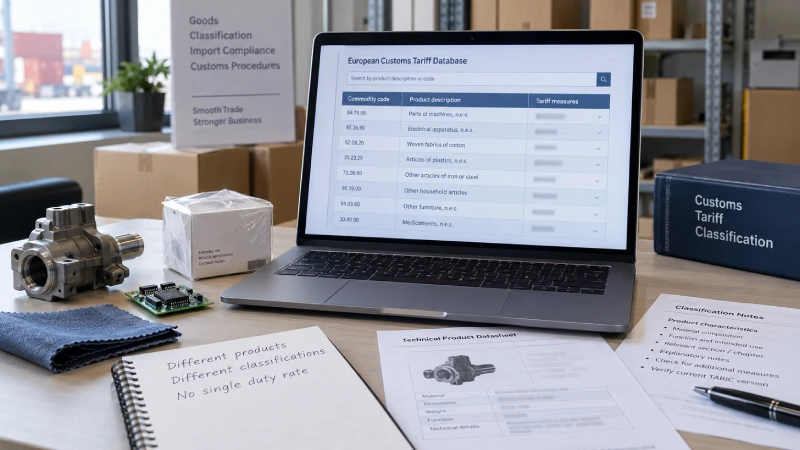
Why Similar Products Can Have Different Tariff Classifications
Classification can depend on characteristics such as:
- material;
- composition;
- principal function;
- technical design;
- power source;
- processing level;
- intended use;
- dimensions or capacity;
- whether the item is complete or unfinished;
- whether it is a finished product or a part.
For difficult cases, a product photo and supplier invoice alone may not be enough.
Technical specifications, material breakdowns, catalogues, drawings or product samples may be necessary.
Pro Tip: If classification uncertainty could create a significant tax or compliance risk, consider obtaining Binding Tariff Information rather than relying only on a supplier’s proposed HS code.
How to Find the Correct German Import Duty Rate
A more reliable process is to determine the tariff treatment step by step.
Step 1: Define the Product Precisely
Before searching TARIC, collect enough information to describe the product accurately.
Useful information includes:
- exact commercial name;
- function;
- material or composition;
- technical specifications;
- model;
- power source;
- manufacturing process where relevant;
- intended use;
- photos;
- product catalogue;
- datasheet.
“Machine part” is usually not enough.
“Stainless-steel replacement impeller specifically designed for an industrial centrifugal pump” gives far more useful classification information.
Step 2: Determine the CN/TARIC Classification
Use official tools such as:
- EU TARIC;
- EU CLASS;
- Germany’s EZT-Online;
- Binding Tariff Information where appropriate.
The European Commission’s CLASS system brings together classification information including CN material, TARIC information, classification regulations and other relevant sources.
German EZT-Online is particularly useful because it is based on TARIC data and supplements it with German national information, including import VAT and excise information.
Step 3: Determine Customs Origin
Confirm where the goods acquire customs origin.
Do not automatically use the country of export, supplier address or port of loading as proof of origin.
Step 4: Review All Relevant TARIC Measures
Do not stop when you find the basic “third-country duty.”
Check whether the classification and origin trigger:
- anti-dumping duty;
- countervailing duty;
- tariff quota;
- suspension;
- additional code;
- import licence;
- restriction;
- certificate requirement.
Step 5: Check the Information for the Actual Import Date
Tariff and trade-policy measures can change.
The European Commission notes that TARIC information is transmitted to EU national administrations on an ongoing basis.
For this reason, an old blog article or spreadsheet should not replace a current TARIC check.
What Is Customs Value?
Once the tariff classification has been established, the next major question is:
What value should the duty percentage be applied to?
It is not necessarily just the supplier’s invoice amount.
Under EU customs rules, the primary valuation method is normally the transaction value.
Broadly, this begins with the price actually paid or payable for the goods sold for export to the EU, with adjustments required under EU customs law.
Costs That May Affect Customs Value
Depending on the transaction, adjustments can include items such as:
- packing costs;
- certain commissions;
- assists supplied by the buyer;
- royalties or licence fees under qualifying circumstances;
- transport to the EU customs-entry point;
- insurance;
- loading; and
- handling associated with transportation.
Under Article 71 of the Union Customs Code, transport and insurance costs and associated loading and handling costs up to the place where the goods are brought into the customs territory of the Union are included when required and when they are not already reflected in the price paid or payable.
Transport after entry into the EU customs territory is treated differently and can be excluded from customs value when the conditions for exclusion are met.
Simplified Customs-Value Structure
| Cost Element | General Customs-Value Treatment |
|---|---|
| Transaction price of goods | Starting point |
| Packing | May need inclusion |
| Certain commissions | May need inclusion |
| Qualifying assists | May need inclusion |
| Certain royalties/licence fees | May need inclusion |
| Freight to EU customs-entry point | Included where required |
| Insurance to EU customs-entry point | Included where required |
| Loading/handling connected to pre-entry transport | Included where required |
| Separately identifiable post-entry EU freight | Generally treated differently |
This is why a freight quotation can matter even though customs duty is often described as a percentage of the “value of the goods.”
Are Freight and Insurance Included in German Customs Value?
They can be.
The key question is not simply:
“Did I pay the freight separately?”
The better question is:
“Is the relevant freight already included in the transaction price, and where does that transportation occur relative to the EU customs-entry point?”
Consider a direct shipment:
Shanghai → Hamburg → Munich
Assume Hamburg is where the goods enter the EU customs territory.
Transportation and insurance attributable to bringing the goods from China to Hamburg can be relevant to customs value.
Separately identifiable transportation after EU entry is treated differently for customs valuation.
Example: EXW Purchase
Assume:
- EXW goods price: €10,000
- China pickup/export logistics: €300
- international freight and insurance: €1,200
Using only the €10,000 supplier invoice as the customs value could omit costs that may need to be considered under the EU valuation rules.
Example: Freight Already Included
Now assume the seller charges €11,500 and the agreed price already includes qualifying transportation and insurance to Hamburg.
You should not automatically add another €1,500 simply because your customs-value calculation normally includes freight.
That would double-count the same cost.
For a broader transport-budget view, see our guide to shipping cost from China to Germany.
Pro Tip: Ask your supplier and freight forwarder for a clear cost breakdown. Separating pre-entry and post-entry transport makes customs valuation and import-VAT calculations easier to verify.
German Import VAT: Is It 19% or 7%?
Import VAT is separate from customs duty.
Germany generally applies a 19% standard VAT rate.
Section 12 of the German VAT Act states that the standard tax rate is 19% of the taxable amount.
A 7% reduced rate applies to qualifying transactions and imports covered by the relevant provisions, including qualifying goods listed under German VAT legislation.
German VAT Rates at Import
| VAT Treatment | General Position |
|---|---|
| 19% | Standard rate for most taxable imports |
| 7% | Reduced rate for qualifying goods |
| Other special treatment | Only where specific statutory rules apply |
The reduced rate should never be treated as an option that an importer can simply choose.
The product must independently qualify.
Classification can also matter here. The European Commission notes that tariff classification can be relevant when determining whether a reduced VAT rate applies where the CN is used as the reference.
How Is German Import VAT Calculated?
This is where import calculations often go wrong.
Import VAT is generally not calculated only on the supplier invoice value.
German VAT law starts from the customs value and requires certain additional amounts to be included where they are not already present.
These may include:
- customs duty;
- other import charges;
- transport;
- brokerage or related services;
- certain incidental costs to the first destination in the EU;
- and qualifying costs to a further EU destination where that destination is already known when the import VAT becomes chargeable.
The EU VAT rules follow the same basic principle: the VAT base for imports includes the customs value plus applicable duties and qualifying incidental expenses not already included.
Simplified Calculation Framework
| Stage | Simplified Formula |
|---|---|
| Customs value | Transaction value + required customs-value additions − permitted exclusions |
| Customs duty | Customs value × applicable tariff rate |
| Import VAT base | Customs value + duty + qualifying additional costs |
| Import VAT | Import VAT base × applicable German VAT rate |
Notice the distinction:
Customs value and import-VAT taxable amount are not necessarily the same number.
That distinction is particularly important when a shipment continues inland after entering the EU.
Customs Duty vs Import VAT
Although both may be collected during customs clearance, they are different charges.
| Customs Duty | Import VAT | |
|---|---|---|
| Main basis | EU customs tariff | German VAT law / EU VAT framework |
| Rate determined mainly by | Classification, origin and tariff measures | VAT treatment of the imported product |
| Calculation base | Customs value | Broader import-VAT taxable amount |
| One universal German rate? | No | 19% standard |
| Reduced treatment possible? | Depends on tariff measures | 7% for qualifying goods |
| Can affect VAT calculation? | Yes | — |
| Commercial accounting effect | Normally part of landed import cost | May be recoverable as input VAT where legal requirements are met |
For qualifying businesses, import VAT may be deductible as input VAT if the statutory requirements are met.
Customs duty normally does not function in the same way.
This is why importers should not simply group both under a single heading such as “customs tax.”
Pro Tip: A product with a 0% customs-duty rate can still be subject to German import VAT.
How Incoterms Affect Customs Value and Import Taxes
Incoterms are highly relevant to import-cost calculations, but not because they determine the customs-duty rate.
An Incoterm helps define:
- who arranges transport;
- who bears certain costs;
- where risk transfers;
- who is responsible for specified export/import obligations.
It does not determine the product’s CN/TARIC classification or replace EU customs-valuation rules.
EXW
Under an EXW transaction, the supplier’s invoice price may contain relatively few logistics costs.
The buyer may separately pay for:
- factory pickup;
- China inland transportation;
- export handling;
- international freight;
- insurance.
When calculating customs value, relevant additions must therefore be identified instead of assuming that the EXW invoice amount is the final customs value.
FOB
With FOB shipments, the commercial value normally includes costs through the agreed port-loading stage, while the buyer usually contracts the main ocean freight.
Relevant international transport and insurance therefore need to be reviewed when establishing customs value.
CFR and CIF
Under CFR or CIF pricing, some international transportation costs are already embedded in the seller’s commercial price.
With CIF, insurance is also included within the seller’s contractual responsibilities to the named destination port.
The customs calculation should identify what is already included before making adjustments.
Do not add the same freight or insurance twice.
For high-volume shipments moving by sea, our ocean freight from China guide explains the main FCL and LCL service structures.
CIP
CIP follows a similar principle from a valuation perspective: determine what transportation and insurance have already been included in the commercial price, then apply EU customs rules to the actual cost structure.
DAP
DAP prices can contain substantial transportation after the shipment has entered the EU.
For example:
Shenzhen → Hamburg → Stuttgart, DAP Stuttgart
The commercial DAP price may include the entire journey to Stuttgart.
That does not mean the entire DAP amount must automatically be treated as customs value without analysis.
Separately identifiable post-entry transport may require different treatment under customs valuation rules.
DDP
With DDP, the seller takes on extensive delivery and import-related contractual responsibilities.
However:
DDP does not change the applicable TARIC classification, tariff rate or German VAT law.
The import still needs:
- correct classification;
- correct valuation;
- correct origin;
- correct customs declaration;
- an appropriate importer structure; and
- compliant VAT/customs treatment.
A DDP quotation should therefore not be treated as evidence that customs duty and VAT have been calculated correctly.
For the service structure itself, see DDP shipping from China.
Pro Tip: Use Incoterms to understand which party pays each cost and where those costs appear. Use EU customs legislation, not the Incoterm itself, to determine the customs value.

Worked Example 1: Standard 19% German Import VAT
The following calculation uses a deliberately hypothetical customs-duty percentage.
The 4.00% rate below is not the TARIC rate for any specific product. It exists only to demonstrate the calculation method.
Assume:
- the goods arrive directly from China at Hamburg;
- Hamburg is the EU customs-entry point;
- the final German destination is Munich;
- the Munich destination is already known when import VAT becomes chargeable.
Shipment Details
| Item | Amount |
|---|---|
| Goods invoice | €10,000 |
| Freight + insurance to Hamburg | €1,500 |
| Hamburg → Munich transport | €400 |
| Hypothetical customs-duty rate | 4.00% |
| German import VAT rate | 19% |
Step 1: Customs Value
For this simplified example:
€10,000 + €1,500 = €11,500
| Component | Amount |
|---|---|
| Goods | €10,000 |
| Freight + insurance to EU entry | €1,500 |
| Customs value | €11,500 |
Step 2: Customs Duty
€11,500 × 4.00% = €460
Again, the 4.00% rate is hypothetical. A real shipment must use the actual tariff treatment identified from the correct TARIC classification.
Step 3: Import VAT Base
For this example, the known qualifying inland transportation is also included in the import-VAT base.
€11,500 + €460 + €400 = €12,360
| Component | Amount |
|---|---|
| Customs value | €11,500 |
| Customs duty | €460 |
| Qualifying inland transport | €400 |
| Import VAT base | €12,360 |
Step 4: Import VAT
€12,360 × 19% = €2,348.40
Import Charges
| Charge | Amount |
|---|---|
| Hypothetical customs duty | €460.00 |
| Import VAT | €2,348.40 |
| Total duty + import VAT | €2,808.40 |
This does not mean the shipment’s total landed cost is €12,808.40.
Other costs can still exist, including:
- customs-broker fees;
- terminal charges;
- storage;
- inspection;
- documentation;
- delivery;
- compliance costs.
Worked Example 2: Product Qualifying for the 7% Reduced VAT Rate
This second example demonstrates how the arithmetic changes if a product independently qualifies for Germany’s reduced VAT rate.
Again, the customs-duty percentage is entirely hypothetical.
Assumptions
| Item | Amount |
|---|---|
| Customs value | €20,000 |
| Hypothetical customs-duty rate | 4.00% |
| Customs duty | €800 |
| Other qualifying VAT-base costs | €500 |
| Hypothetical applicable VAT rate | 7% |
Step 1: VAT Base
€20,000 + €800 + €500 = €21,300
Step 2: Import VAT
€21,300 × 7% = €1,491
Result
| Charge | Amount |
|---|---|
| Hypothetical customs duty | €800 |
| Import VAT | €1,491 |
| Total duty + VAT | €2,291 |
This example does not mean a particular Chinese product qualifies for 7%.
Whether the reduced VAT rate applies must be established separately under German VAT rules.
Worked Example 3: EXW vs Freight-Included Pricing
This example shows why Incoterms and invoice structure can change the calculation process without changing the product’s tariff classification.
Assume the same goods can be purchased under two different commercial arrangements.
Option A: EXW-Style Purchase
- Goods invoice: €10,000
- Relevant transport/insurance to EU entry: €1,500
Simplified customs value:
€11,500
Option B: Freight-Included Purchase
- Supplier invoice including the same qualifying freight/insurance: €11,500
- Separate qualifying pre-entry freight: €0
Simplified customs value:
€11,500
| EXW-Style Structure | Freight-Included Structure | |
|---|---|---|
| Supplier invoice | €10,000 | €11,500 |
| Separate qualifying freight/insurance | €1,500 | €0 |
| Simplified customs value | €11,500 | €11,500 |
The commercial arrangement changed.
The underlying value for this simplified customs example did not.
The product also did not become subject to a different tariff rate simply because the Incoterm changed.
Import Duty and VAT Are Not the Same as Total Landed Cost
A landed-cost calculation should go further than customs duty and import VAT.
For a shipment from China to Germany, the final cost may include:
| Cost Category | Typical Example |
|---|---|
| Product cost | Supplier invoice |
| China inland logistics | Factory pickup |
| Export handling | Origin terminal / export documentation |
| International freight | Sea, air, rail or express |
| Cargo insurance | Transport insurance |
| Customs duty | TARIC-based |
| Additional trade measures | Where applicable |
| Import VAT | German import VAT |
| Customs clearance | Customs broker |
| Terminal charges | Port / airport handling |
| Storage | If clearance or pickup is delayed |
| German inland delivery | Port/airport → warehouse |
| Compliance costs | Testing, documentation or certification where applicable |
For budgeting, calculate shipping cost from China to Germany separately from customs taxes and then combine them into a landed-cost model.
If delivery timing is also part of your purchasing decision, compare the typical ranges in how long shipping from China to Germany takes.
Common Import Duty and VAT Calculation Mistakes
Using the Supplier’s HS Code Without Verification
The supplier’s code is useful information, but it should not automatically be copied into an EU customs declaration.
The EU classification should be verified independently.
Searching for a Generic “China Import Duty Rate”
There is no single percentage that applies to every product imported from China.
Start with product classification.
Confusing Shipping Country with Origin
A shipment leaving Shanghai does not, by itself, prove Chinese origin.
Origin follows customs-origin rules.
Assuming Invoice Value Equals Customs Value
The supplier invoice may exclude costs that EU customs rules require to be added.
Adding Freight Twice
This often happens when freight is already included under CFR, CIF, CIP, DAP or another freight-inclusive commercial arrangement.
Using 19% VAT for Every Possible Product
19% is the German standard rate, but qualifying imports can be subject to reduced or other specific statutory treatment.
Calculating Import VAT Only on the Product Value
German import VAT can include customs duty and qualifying ancillary costs in the taxable amount.
Ignoring Trade-Defence Measures
Finding a normal customs-duty rate does not necessarily complete the TARIC review.
Depending on classification and origin, anti-dumping, countervailing or safeguard measures may also need to be checked.
What Information Is Needed to Estimate German Import Taxes?
Before calculating a shipment from China to Germany, prepare:
- detailed product description;
- material/composition;
- technical function;
- model;
- product photos;
- technical datasheet;
- proposed HS code, if available;
- country of origin;
- quantity;
- commercial value;
- currency;
- Incoterm;
- factory/pickup location in China;
- shipping method;
- freight amount;
- insurance amount;
- EU entry port or airport;
- final German delivery postcode;
- gross weight;
- dimensions;
- total CBM.
For more complex products, also prepare:
- component breakdown;
- drawings;
- intended use;
- manufacturing information;
- previous classification documentation.
The more precise the product information is, the more reliable the tariff analysis can be.
How to Reduce Customs and Tax Risk Before Shipping
A good import-cost calculation should happen before the cargo leaves China.
Use this sequence:
- Identify the exact product.
- Verify the EU CN/TARIC classification.
- Confirm customs origin.
- Check current TARIC measures.
- Review the commercial invoice and Incoterm.
- Build the customs value from the real cost structure.
- Determine the applicable German import VAT rate.
- Calculate the import-VAT base separately from customs value.
- Add customs clearance and logistics costs to estimate landed cost.
- Recheck the tariff when the planned import date approaches.
For high-value or recurring imports, resolving classification uncertainty before the first shipment is usually cheaper than correcting repeated customs declarations later.
Need to Estimate Your China-to-Germany Landed Cost?
If you are preparing a shipment from China to Germany, send us:
- product description;
- product photos or datasheet;
- quantity;
- cargo value;
- proposed HS code if available;
- Incoterm;
- pickup city in China;
- shipment weight and volume;
- German delivery postcode.
Winsail Logistics can help you identify the logistics cost components required for your landed-cost estimate and coordinate transportation from China to Germany.
Check My Shipping & Import Costs
Official Sources and Further Reading
- European Commission — Tariff Classification of Goods
- European Commission — Calculation of Customs Duties
- European Commission — EU TARIC
- European Commission — Rules of Origin
- Union Customs Code — Regulation (EU) No 952/2013
- European Commission — VAT Taxable Amount
- German VAT Act §11 — Import Taxable Amount
- German VAT Act §12 — VAT Rates
- German Customs — EZT-Online Information
FAQ
How much import duty do I pay from China to Germany?
There is no universal customs-duty percentage for imports from China. The applicable duty depends on the productu0026#x27;s EU CN/TARIC classification, customs origin, customs value and any applicable tariff or trade-policy measures.
Is German import VAT always 19%?
No. Germanyu0026#x27;s standard VAT rate is 19%, while qualifying goods can be subject to the reduced 7% rate under German VAT legislation. The reduced rate must be supported by the applicable statutory treatment of the product.
Is freight included when calculating customs duty in Germany?
Freight can be included in customs value. Under EU customs rules, qualifying transport, insurance, loading and handling costs up to the place where goods enter the EU customs territory are included where required and where they are not already included in the transaction price.
Is German import VAT charged on customs duty?
Customs duty normally forms part of the import-VAT taxable amount. German VAT law starts from customs value and adds specified import duties and qualifying ancillary costs where they are not already included.
Does FOB, CIF, DAP or DDP change the German customs-duty rate?
No. Incoterms affect contractual cost, risk and responsibility allocation. They do not determine the productu0026#x27;s tariff classification or create a different customs-duty rate.
Where can I check the official German import duty rate?
Use the official EU TARIC database and Germanyu0026#x27;s EZT-Online system. For difficult classification cases, EU CLASS and Binding Tariff Information can also be useful. Check the applicable information for the actual planned import date rather than relying on an old tariff table.
