
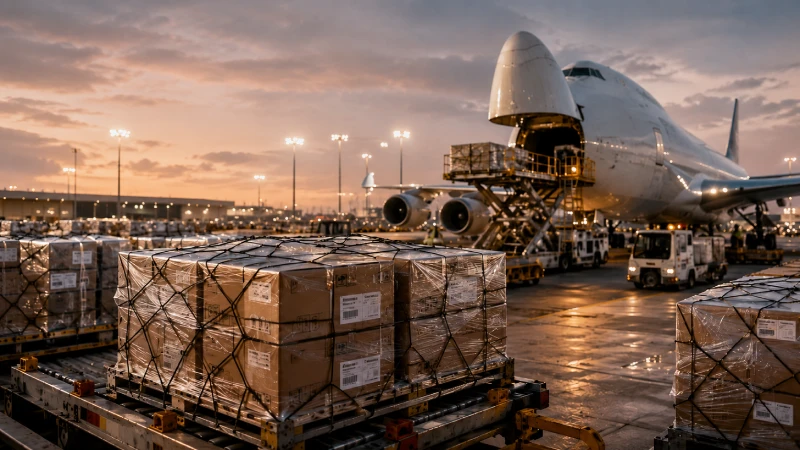
When your shipment cannot wait for sea freight, air freight from China to Qatar becomes a decision about urgency, risk control, and business continuity—not just transportation. For importers comparing options within the wider Shipping from China to Qatar route, air freight is usually the right choice when delivery speed protects revenue, avoids project delays, or prevents stockouts.
But air freight is not always the best answer. It can save time, but it can also waste budget if the cargo is too heavy, too low-value, poorly prepared, or not genuinely urgent. The real question is not “Is air freight fast?” The real question is:
Is the cost of delay higher than the cost of air freight?
If the answer is yes, air freight may be the most practical shipping solution from China to Qatar. If the answer is no, sea freight, LCL, FCL, or planned DDP shipping may protect your margin better.
Quick Decision Summary
Choose air freight from China to Qatar if your shipment is urgent, high-value, lightweight, compact, or business-critical. It is especially suitable for spare parts, electronics, samples, replacement components, medical-related supplies, seasonal goods, and stock replenishment orders where delay creates a direct business loss.
Do not choose air freight simply because it feels convenient. If your cargo is bulky, low-margin, non-urgent, or heavy enough to make air charges unreasonable, sea freight or a hybrid logistics plan may be better.
| Situation | Is Air Freight a Good Choice? | Why |
|---|---|---|
| Urgent stock replenishment | Yes | Prevents sales interruption |
| Production spare parts | Yes | Reduces downtime risk |
| High-value electronics | Yes | Faster movement and tighter handling control |
| Large furniture shipment | Usually no | Volume weight may be too expensive |
| Full container cargo | Usually no | FCL is normally more economical |
| Samples before bulk order | Yes | Supports faster buyer approval |
| Low-value heavy goods | Usually no | Freight cost may exceed commercial benefit |
Clear recommendation: use air freight when speed protects profit, operations, or customer commitments. Avoid it when speed is only a preference, not a business necessity.
What Air Freight from China to Qatar Is Best For
Air freight works best when the cargo has one or more of these characteristics.
Urgent commercial deadlines
If your Qatar customer, project team, retailer, or distributor needs goods by a fixed date, air freight can reduce the risk of losing the order. This applies to promotional goods, seasonal products, exhibition materials, replacement inventory, and urgent B2B deliveries.
In these cases, the freight cost should be measured against the cost of missing the deadline.
High-value, compact cargo
Air freight is often suitable for goods with a higher value per kilogram or per carton. Examples include electronics, precision components, branded products, industrial parts, testing devices, medical-related equipment, and premium samples.
The higher the cargo value density, the easier it is to justify air freight.
Production-critical spare parts
For factories, contractors, and maintenance teams in Qatar, one missing component can delay an entire operation. If a machine, production line, installation site, or service team is waiting for parts from China, air freight is often the safest decision.
In this scenario, freight cost is not the main issue. Downtime is.
Samples and pre-order approval cargo
Before placing a bulk order, many importers need samples delivered quickly for inspection, testing, client approval, or market presentation. Air freight allows the buyer to make decisions faster and move the project forward.
For samples, the shipment size is usually small enough that air freight is practical.
Emergency replenishment before planned sea shipments arrive
Some importers use air freight as a temporary bridge. They send a small urgent batch by air while the main order moves by sea. This avoids stockouts without converting the full order into an expensive air shipment.
This is often the smartest balance between speed and cost.
When NOT to Use Air Freight
Air freight is powerful, but it is not always the right solution. A good freight forwarder should tell you when not to use it.
Do not use air freight if the cargo is too bulky
Air freight is affected by chargeable weight, not only actual weight. Large but lightweight cargo may be charged based on volume. This can make goods like furniture, foam products, packaging materials, display racks, and oversized items expensive by air.
If the shipment takes up a lot of space but has low commercial value, sea freight is usually more logical.
Do not use air freight for low-margin heavy cargo
For products such as stone, tiles, hardware, machinery parts, low-value building materials, or dense industrial goods, air freight can quickly damage profit margins. Unless there is an emergency, sea freight is usually the better decision.
Do not use air freight if customs documents are not ready
Urgent shipping does not fix poor documentation. If invoices, packing lists, HS codes, product descriptions, certificates, or consignee details are incomplete, the cargo may still be delayed at origin or destination.
Speed only works when the shipment is prepared correctly.
Do not use air freight if the delivery date is flexible
If your Qatar buyer does not need the goods urgently, paying for air freight may not create real business value. A planned sea freight or LCL shipment may produce better landed cost control.
Do not use standard air freight for restricted or sensitive cargo without checking first
Batteries, liquids, chemicals, magnets, powders, cosmetics, certain electronics, and dangerous goods may require special review. Some cargo may need airline approval, special packaging, MSDS, UN38.3, or other supporting documents.
For sensitive goods, the first question should not be price. It should be: Can this cargo be accepted by the airline and cleared correctly?
Decision Framework: Should You Choose Air Freight?
Use this framework before requesting a quote.
What happens if the shipment is delayed?
If delay causes lost sales, project penalties, customer complaints, production downtime, or missed market timing, air freight becomes more attractive.
If delay only creates inconvenience, sea freight may be enough.
Is the shipment urgent or just poorly planned?
Air freight is often used to solve urgent problems, but repeated emergency shipments may signal weak inventory planning. If you are constantly using air freight, you may need a better replenishment schedule, not just faster transport.
A good logistics partner can help you separate true emergency shipments from planning problems.
Is the cargo value high enough to absorb air freight cost?
Air freight works better when the product value is high compared with its weight and volume. If freight cost becomes a large percentage of the selling price, your margin may suffer.
Is the cargo ready for immediate movement?
Urgency only matters if the supplier can release the goods quickly. Before choosing air freight, confirm:
- Cargo ready date
- Exact carton quantity
- Gross weight and dimensions
- Pickup address in China
- Commercial invoice and packing list
- Product name and HS code
- Qatar consignee information
- Delivery address or airport pickup requirement
Missing details slow down quoting and execution.
Is full air shipment necessary?
Sometimes the answer is not “air or sea.” The best answer may be split shipping.
For example, send 10% of urgent stock by air and 90% by sea. This keeps your business moving while protecting overall landed cost.
Cost vs Risk vs Convenience Analysis

Air freight is usually more expensive than sea freight, but lower risk in time-sensitive situations. The decision should be based on total business impact.
Cost
Air freight has a higher freight rate and may be affected by chargeable weight, airline capacity, fuel adjustments, cargo type, and destination service requirements. It is rarely the cheapest method.
However, the cheapest freight method is not always the lowest-cost business decision. If slow shipping causes lost revenue, air freight may be financially reasonable.
Risk
Air freight reduces transit-time risk, but it does not eliminate operational risk. Common risks include:
- Incorrect chargeable weight estimation
- Airline space shortage during peak periods
- Cargo rejected due to restricted items
- Customs delay from unclear product descriptions
- Supplier delays before pickup
- Incomplete consignee or import documents
- Unexpected destination handling or delivery costs
The biggest mistake is assuming air freight automatically means “no problems.” Speed only works when cargo, documents, routing, and delivery planning are controlled together.
Convenience
Air freight can be highly convenient when managed by a forwarder who coordinates pickup in China, export handling, air booking, customs documents, and Qatar-side delivery options.
For busy importers, the value is not only faster transit. The value is fewer moving parts, faster communication, and clearer accountability.
Air Freight Compared with Alternatives
Air Freight vs Sea Freight
Sea freight is better for planned, heavy, bulky, or full-container shipments. Air freight is better when urgency is real and the cargo size allows it.
Choose sea freight when cost control matters most. Choose air freight when delay costs more than freight.
Air Freight vs Express Courier
Express courier can be convenient for small parcels, samples, and documents. But for larger commercial shipments, air freight may offer better control over customs documents, pickup planning, cargo details, and delivery coordination.
Courier is often simple. Air freight is more flexible for B2B shipments.
Air Freight vs DDP Air Shipping
DDP air shipping may be useful when the importer wants a more all-inclusive solution with customs and delivery support. However, DDP suitability depends on cargo type, product compliance, declared value, and destination requirements.
For importers who want fewer operational responsibilities, DDP shipping from China to Qatar may be worth comparing. For importers who already manage import records and customs clearance, standard air freight may be more transparent.
Air Freight vs Split Shipment
Split shipment is often the best solution when the order is large but only part of it is urgent. Send critical items by air and move the balance by sea.
This strategy helps importers protect sales while avoiding unnecessary air freight cost on non-urgent goods.
Real Importer Scenarios
Electronics distributor facing stockout
A Qatar electronics distributor has fast-moving SKUs running out before the next sea shipment arrives. Shipping the entire order by air would be too expensive.
Best decision: send the urgent SKUs by air and keep the rest moving by sea.
Why it works: the importer protects sales without sacrificing the full order margin.
Contractor waiting for replacement parts
A construction or industrial project in Qatar is delayed because a key replacement part must come from China. Waiting for sea freight may stop installation or maintenance work.
Best decision: use air freight for the critical part.
Why it works: the freight premium is smaller than the cost of project delay.
Buyer needs samples before approving bulk order
A Qatar importer needs product samples from a Chinese supplier before confirming a large purchase. Sea freight is too slow for the approval cycle.
Best decision: ship samples by air or courier, then plan the bulk order by sea.
Why it works: fast sample delivery accelerates the sales decision without increasing bulk shipment cost.
Retailer preparing for a seasonal campaign
A retailer in Qatar is preparing for a promotion, but production in China finishes later than expected. Missing the campaign date would reduce sales.
Best decision: air freight only the launch quantity, then ship replenishment stock by sea.
Why it works: the campaign can start on time while the importer controls total logistics cost.
Sensitive cargo requiring document review
An importer wants to ship battery-powered devices by air. The cargo may require extra documents and airline acceptance.
Best decision: check cargo classification, MSDS, battery documents, packaging, and airline restrictions before confirming the shipment.
Why it works: urgent cargo is only useful if it is accepted and cleared correctly.
Common Mistakes Importers Make
Asking only for the cheapest air freight rate
The cheapest rate may come with poor routing, weak communication, unclear destination charges, or limited problem-solving support. For urgent cargo, reliability matters more than a small price difference.
A delayed “cheap” air shipment can become more expensive than a properly managed one.
Not providing carton dimensions
Air freight quotations depend heavily on chargeable weight. If you only provide actual weight, the quote may change later once dimensions are confirmed.
Always provide quantity, gross weight, and carton or pallet dimensions.
Treating all urgent cargo the same
A sample shipment, spare part shipment, retail stock shipment, and restricted cargo shipment do not require the same handling logic. The right solution depends on urgency, cargo type, documentation, and delivery responsibility.
Ignoring Qatar-side delivery planning
Getting cargo to the airport is not the same as getting cargo to your warehouse, project site, shop, or customer location. Destination handling, customs clearance, and local delivery should be discussed before shipment.
Choosing air freight after it is already too late
Air freight is fast, but it still requires supplier coordination, cargo pickup, airline space, document preparation, and customs handling. Waiting until the last possible moment increases risk.
The earlier you involve your forwarder, the more options you have.
Selection Criteria Checklist
Before choosing an air freight provider from China to Qatar, check whether they can answer these questions clearly:
- Can they advise whether air freight is actually the right choice?
- Can they compare air freight with sea freight, courier, DDP, or split shipment?
- Can they calculate chargeable weight correctly before booking?
- Can they check restricted cargo before accepting the shipment?
- Can they coordinate pickup from your Chinese supplier?
- Can they support document review before export?
- Can they explain origin and destination cost items clearly?
- Can they provide realistic timing instead of vague promises?
- Can they support Qatar delivery requirements?
- Can they respond quickly when the shipment is urgent?
A reliable freight forwarder should not simply quote a number. They should help you make the right shipping decision.
Final Recommendation
Choose air freight from China to Qatar if your shipment is urgent, commercially important, compact enough to justify air cost, and ready with proper documents.
Do not choose air freight if the cargo is bulky, low-value, non-urgent, or better suited to planned sea freight.
The smartest importers do not use air freight for everything. They use it selectively—for the cargo that protects revenue, prevents operational disruption, or keeps a project moving.
For many shipments, the best decision may be:
Air freight for urgent items. Sea freight for planned stock. DDP or managed delivery when convenience matters.
That is how you control both speed and cost.
Get an Air Freight Quote from China to Qatar
If you are deciding whether air freight is the right solution, Winsail Logistics can help you compare the practical options before you commit.
Send us your shipment details and we will help you evaluate:
- Whether air freight is suitable
- Whether sea freight or DDP is better
- Estimated chargeable weight
- Urgency and delivery feasibility
- Cargo risk and document requirements
- Pickup and delivery options
- A practical quote based on your real shipment details
To get a faster quote, please provide:
- Product name
- Cargo ready date
- Supplier city in China
- Destination in Qatar
- Number of cartons or pallets
- Gross weight
- Dimensions
- Commercial invoice and packing list if available
- Any special requirements, such as battery, fragile cargo, high-value cargo, or door delivery
Need urgent shipping from China to Qatar? Contact Winsail Logistics today and get a practical air freight solution based on your cargo, timeline, and delivery requirements.
FAQ
Is air freight from China to Qatar the best option for urgent cargo?
Yes, air freight is usually the best option when the shipment is urgent, compact, high-value, or business-critical. It is not always suitable for bulky, low-value, or non-urgent cargo.
When should I avoid air freight from China to Qatar?
Avoid air freight when the cargo is very bulky, heavy, low-margin, or when the delivery date is flexible. Sea freight or split shipment may offer better cost control.
What information is needed for an air freight quote?
You should provide product name, cargo ready date, supplier city, destination in Qatar, carton or pallet quantity, gross weight, dimensions, and any special cargo requirements.
Is air freight better than express courier for Qatar shipments?
Express courier can be convenient for small parcels and samples, while air freight is often better for larger B2B shipments that need clearer customs, pickup, and delivery coordination.
Can I ship only part of my order by air?
Yes. Many importers ship urgent items by air and send the remaining stock by sea. This helps protect delivery deadlines while controlling total logistics cost.
Are batteries allowed by air freight from China to Qatar?
Some battery or battery-powered products may be accepted, but they usually require document review, proper packaging, and airline approval. The cargo should be checked before booking.
Does air freight include delivery to my address in Qatar?
It depends on the service arrangement. Airport-to-airport, airport-to-door, and door-to-door options may be available, so Qatar-side delivery should be confirmed before shipment.
How do I know if air freight cost is worth it?
Compare the freight cost with the cost of delay. If delay may cause lost sales, project penalties, customer complaints, or production downtime, air freight may be worth the premium.
