
Introduction
Shipping oversized, overweight, or non-containerized cargo from China requires far more than a standard ocean freight booking. Breakbulk cargo—items that cannot fit safely inside a standard 20GP/40GP, open-top, or flat-rack container—demands specialized handling, engineering support, and coordination across ports, carriers, surveyors, and on-site lifting teams.
As global infrastructure, construction, and energy projects continue to rely on Chinese manufacturing, the demand for China breakbulk shipping services has grown sharply. Whether you are moving transformers, mining machinery, steel structures, vehicles, modular units, or power-plant components, working with the right breakbulk freight forwarder in China ensures your cargo is shipped safely, efficiently, and in full compliance with port and vessel requirements.
This guide explains what breakbulk cargo is, how it differs from other ocean freight modes, when to choose breakbulk, and how the end-to-end process works. It also outlines the technical, cost, and risk considerations every importer, EPC contractor, and project manager should understand before shipping breakbulk cargo from China.
What Is Breakbulk Cargo in Ocean Freight?
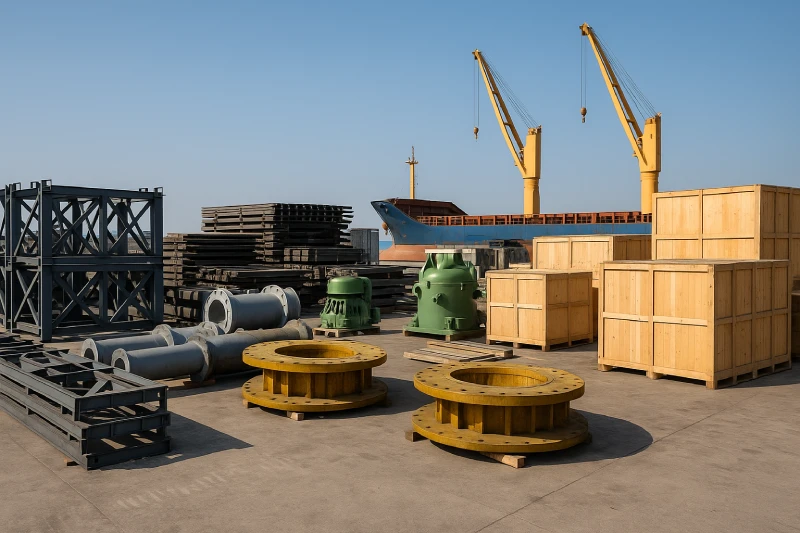
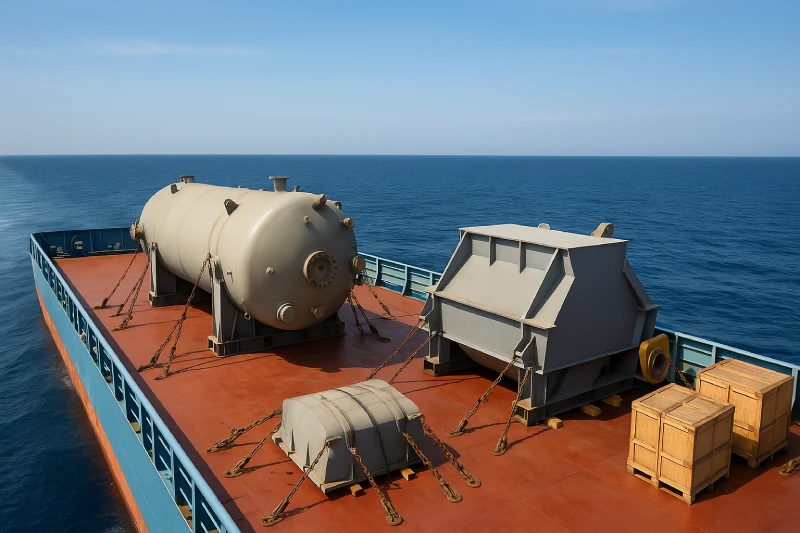
Breakbulk cargo refers to goods that are moved individually—piece by piece—rather than loaded into containers or shipped in bulk. Each unit is lifted, stowed, and secured directly on the vessel or inside the hold. This mode is common for large, heavy, long, or irregularly shaped cargo that cannot be safely stuffed into a container or would be too costly to dismantle.
Typical examples include:
- Heavy machinery and industrial equipment
- Power-plant components such as generators and turbines
- Transformers, boilers, tanks, pressure vessels
- Steel structures, pipes, beams, and fabrication modules
- Construction materials and prefabricated units
- Vehicles, trucks, buses, and wheeled equipment
- Wind tower sections, blades, nacelles, and energy cargo
- Oversized crates, skids, and custom-built packaging
Breakbulk is often grouped under the broader category of project cargo or OOG (Out-of-Gauge) cargo, but it specifically refers to non-containerized freight that must be handled individually.
1. Breakbulk vs. Container Shipping vs. Bulk Cargo
Understanding the differences is essential for selecting the correct transport mode.
Breakbulk Cargo
- Shipped as separate pieces
- Loaded using cranes, lifting frames, or heavy-lift gear
- Requires customized stowage and lashing plans
- Ideal for oversized, overweight, or irregular cargo
Containerized Cargo (FCL/LCL)
- Loaded inside standard containers (20’, 40’, HQ)
- Efficient, fast, and widely available
- Best for general cargo, packaged goods, and anything within container limits
- Limited by height, width, length, and weight restrictions
Bulk Cargo
- Unpackaged goods loaded loose into a vessel’s hold
- Examples: grain, coal, ores, cement
- Not suitable for machinery or equipment
Key distinction: Breakbulk is used when cargo cannot go in a container and should not be treated as bulk material. It is a specialized solution with higher operational complexity but often the safest and most practical option for large industrial shipments.
2. Typical Breakbulk & Project Cargo Exported From China
China is a global manufacturing hub for large industrial equipment, making it one of the world’s busiest origins for breakbulk and project cargo. Common categories include:
- Power & Energy Equipment
Turbines, generators, transformers, substations, wind tower sections, solar plant components. - Construction & Infrastructure Materials
Steel beams, pipes, modules, prefabricated structures, bridge components. - Industrial Machinery
Crushers, milling machines, cement plant equipment, mining machinery. - Vehicles & Rolling Equipment
Trucks, semi-trailers, mixers, dumpers, buses, engineering vehicles. - Oil & Gas / Petrochemical Equipment
Pressure vessels, separators, reactors, skid-mounted units. - Large Crates and OOG Packages
Custom-fabricated wooden crates exceeding standard dimensions.
Because these items often have extreme dimensions or weight, breakbulk shipping becomes the most efficient—and sometimes the only—feasible solution.
When to Choose China Breakbulk Shipping Instead of Containers or Ro-Ro?
Choosing between breakbulk, container shipping, and Ro-Ro (Roll-on/Roll-off) depends on cargo characteristics, route conditions, port capabilities, and overall project requirements. Breakbulk is not always the cheapest or fastest option, but for certain cargo profiles, it is the safest and most practical method.
1. Cargo-Related Triggers: When Breakbulk Becomes the Best Fit
Breakbulk shipping from China is recommended when your cargo meets any of the following conditions:
① Cargo exceeds container dimensions or weight limits
Even open-top (OT) and flat-rack (FR) containers have practical constraints:
- Height limit: ~2.3–2.6 m (OT slightly higher)
- Width limit: 2.44 m
- Max payload: 26–28 tons for standard containers
- FR can accommodate heavier cargo, but lifting/stacking restrictions often apply
If your cargo exceeds these limits—especially large industrial equipment—it’s usually safer to ship as breakbulk.
② Cargo cannot be dismantled or is too costly to disassemble
Many industrial machines can theoretically be taken apart, but:
- Disassembly increases labor and engineering cost
- Reassembly requires specialized technicians
- Warranty may be voided if equipment is not transported as a whole
- Misalignment risks or installation delays may occur
Breakbulk allows the unit to move fully assembled, minimizing technical risk.
③ Cargo has irregular shape or uneven weight distribution
Examples:
- Heavy castings with unusual geometry
- Machinery with protruding arms/frames
- Asymmetrical equipment that cannot sit flat inside a container
Breakbulk vessels have flexible deck arrangements that can accommodate odd shapes safely.
④ Extremely heavy single pieces
Heavy-lift cargo—sometimes 50 MT, 150 MT, or even 400+ MT—requires specialized shipboard cranes with SWL (Safe Working Load) that only MPP/heavy-lift carriers can provide.
Container terminals often have limits far below this.
2. Route, Port & Infrastructure Considerations
Even if cargo could theoretically fit in a container, route and port limitations sometimes make breakbulk the preferred choice.
① Destination port lacks suitable container-handling equipment
In many regions—Africa, the Middle East, and parts of South America—destination ports may:
- Have limited reach-stackers or cranes
- Restrict certain heavy-lift containers
- Be unable to handle oversize containers safely
Breakbulk vessels with onboard cranes eliminate reliance on local infrastructure.
② Better port pairing for project cargo
China’s major breakbulk hubs—Shanghai, Tianjin, Qingdao, Dalian, Ningbo, Guangzhou—maintain strong connections to project cargo-focused trade lanes, making the logistics chain more efficient.
③ Road, bridge, or tunnel restrictions
Sometimes a flat rack container is too tall or too wide for the inland route from port to final site.
Breakbulk offers flexibility:
- Different lifting angles
- Direct discharge onto trailers
- Custom positioning for oversized transport
This is especially relevant for EPC projects delivering to inland construction sites.
3. Commercial & Risk Considerations
Besides physical constraints, companies choose breakbulk shipping for economic and operational reasons.
① Cost optimization for oversized or multiple-unit shipments
When cargo requires several flat racks or open-top containers, the combined cost may exceed a single breakbulk booking.
Breakbulk may reduce:
- Container leasing
- Lashing materials
- Special container surcharges
- Rehandling costs at the port
② Lower risk of damage
For fragile, precision, or high-value equipment:
- Avoiding stuffing/unstuffing
- Avoiding tight container tolerances
- Customized cradles and sea-fastening
- Controlled lifting using heavy-lift gear
All reduce shock, vibration, and external impact risks.
③ Ideal for project schedules
Large construction or energy projects often need synchronized delivery of multiple components.
Breakbulk carriers allow:
- Shipping large volumes on the same vessel
- Better control over loading sequence
- More reliable handling of exceptional cargo
④ When time sensitivity is moderate
Breakbulk is not the fastest mode (container shipping usually has more frequent sailings), but when:
- Deadlines are flexible
- Cargo is oversized
- Disturbance-sensitive
- Or requires engineering handling
Breakbulk becomes the most rational choice.
Our China Breakbulk Cargo Services
Shipping oversized, heavy-lift, or project cargo requires a logistics partner that understands both engineering requirements and China’s port operations. As a specialized China breakbulk freight forwarder, we provide a full range of end-to-end services covering planning, vessel coordination, port handling, documentation, and on-site execution.
1. End-to-End Breakbulk Freight Forwarding From China
Our breakbulk and project cargo solutions cover the entire logistics chain, ensuring safe, compliant, and cost-effective movement from the factory floor in China to your destination port or jobsite.
Our service scope includes:
- Door-to-port, port-to-port, and door-to-door shipping
- Pickup from factories across all major industrial provinces (Jiangsu, Zhejiang, Shandong, Guangdong, Tianjin, etc.)
- Route planning and port selection based on cargo dimensions and lifting needs
- Breakbulk, heavy-lift, Ro-Ro, or multi-modal coordination
- Customs clearance and export documentation in China
- Coordination with carriers operating MPP/heavy-lift vessels
- Continuous monitoring, milestone reporting, and on-site supervision
This integrated approach reduces hand-off risks and ensures precise control over cargo handling throughout the journey.
2. Cargo Types We Handle (Industries & Equipment)
We support a wide range of industrial sectors, handling both standard breakbulk cargo and complex project shipments.
Power & Energy Equipment
- Generators, turbines, compressors
- Transformers, reactors, heat exchangers
- Wind tower sections, nacelles, blades
Oil, Gas & Petrochemical Equipment
- Pressure vessels, separators
- Skid-mounted units, refinery modules
Construction & Infrastructure
- Steel structures, fabricated beams
- Prefabricated modules and bridge components
- Pipes, tanks, and large coils
Mining & Industrial Machinery
- Crushers, screens, conveyors
- Cement plant machinery
- Heavy-duty processing equipment
Vehicles & Rolling Equipment
- Engineering vehicles, buses, trucks
- Specialized trailers, mixers, dumpers
Oversized Crates & OOG Packages
- Custom-built crates
- Long-length cargo
- Wide-load or tall units beyond container limits
If your cargo cannot fit into a container—or requires specialized lifting or lashing—our breakbulk team can design the right shipping plan.
3. Major Chinese Load Ports for Breakbulk
China has several world-class ports that specialize in breakbulk shipping. Each offers different strengths depending on vessel type, route, and cargo profile.
Primary Breakbulk Export Ports:
Shanghai Port (Waigaoqiao / Yangshan)
- Strongest overall capacity
- Heavy-lift cranes, MPP vessel calls
- Ideal for power plant & engineering equipment
Tianjin Xingang
- Main gateway for North China industrial bases
- Excellent for oversized machinery & vehicles
Qingdao Port
- Strong steel, equipment, and project cargo flows
- Frequent sailings to Middle East & Africa
Dalian Port
- Suitable for heavy machines, industrial modules
- Reliable connections to Russia, Korea, Japan
Ningbo-Zhoushan Port
- Flexible berths for long-length cargo
- Competitive freight rates to Southeast Asia
Guangzhou / Shenzhen (South China)
- Best choice for exports from Guangdong manufacturing clusters
- Ro-Ro and breakbulk options widely available
We recommend load ports based on factory location + vessel availability + lifting requirements to optimize cost and operational efficiency.
4. Key Global Trade Lanes & Destinations
China’s breakbulk exports connect to major global project markets.
Middle East
- UAE, Saudi Arabia, Qatar, Oman
- Power-plant equipment, steel structures, refinery modules
Africa (East/West/South)
- Nigeria, Kenya, Tanzania, Ghana, South Africa
- Machinery, vehicles, construction materials
Europe
- Mediterranean & North Europe
- Wind energy components, industrial machinery
South America
- Brazil, Chile, Peru
- Mining and heavy industrial equipment
South & Southeast Asia
- India, Vietnam, Indonesia, Philippines
- Cement plant machinery, boilers, long-length pipes
We work with major MPP/heavy-lift carriers to secure reliable space on routes with strong breakbulk demand.
5. Value-Added Services for Breakbulk & OOG Cargo
Breakbulk shipping involves far more than ocean transport.
- Engineering drawings review(cargo list, GA drawings, lifting points)
- Lashing & securing design
- Packaging consultation(steel frame, wooden crate, anti-corrosion)
- Survey & inspection(CCIC, SGS, BV, DNV as required)
- Port supervision(loading/unloading monitoring)
- Custom-built saddles, cradles, and supports
- Temporary storage or consolidation at port warehouses
- Cargo insurance for heavy-lift and high-value equipment
These services significantly reduce operational risk and ensure your cargo meets both Chinese port standards and international maritime safety requirements.
How China Breakbulk Shipping Works – Step-by-Step Process
Breakbulk cargo shipping involves significantly more engineering and coordination than standard container freight. To minimize risks and maintain full compliance with port and vessel requirements, a structured process is essential.
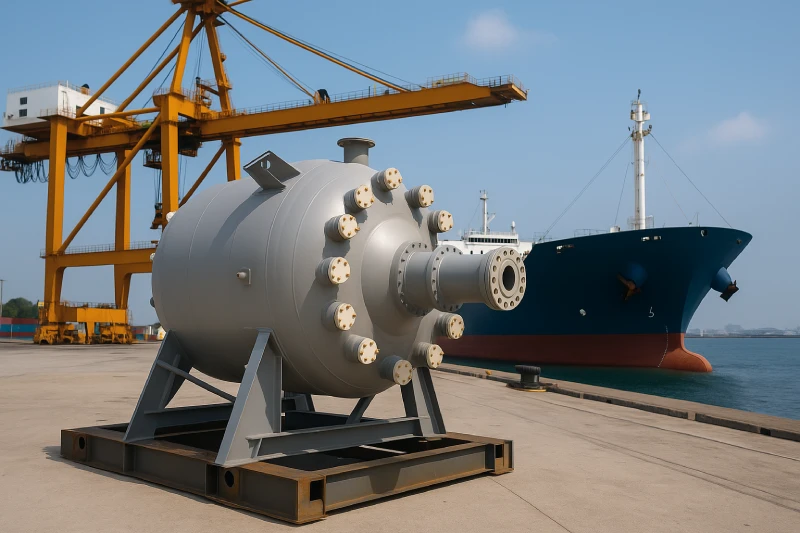
Below is the end-to-end workflow used by professional China breakbulk freight forwarders and project logistics teams.
Step 1 — Feasibility Study & Technical Assessment
Every breakbulk shipment begins with a detailed evaluation to determine whether breakbulk, Ro-Ro, or container-based OOG transport is the best solution.
Key actions include:
- Reviewing cargo drawings, dimensions, weight, lifting points, and center of gravity
- Checking factory loading conditions and special equipment needs
- Comparing options: breakbulk vs. flat rack vs. open-top vs. Ro-Ro
- Identifying possible constraints at both origin and destination ports
- Assessing seasonal factors such as wind restrictions, tides, and vessel frequency
A professional feasibility study helps avoid hidden risks and ensures accurate cost planning before booking.
Step 2 — Route Planning & Port Selection
The next step is determining the optimal load port, discharge port, and inland routing based on the cargo profile and project schedule.
Factors considered during port planning:
- Availability of suitable berths and heavy-lift equipment
- Vessel calls by major MPP/heavy-lift carriers
- Congestion levels and typical waiting times
- Distance from factory to port (domestic trucking feasibility)
- Road & bridge restrictions for oversize transport
- Customs requirements for sensitive or regulated cargo
For example, a transformer produced in Henan may ship more efficiently via Qingdao or Tianjin, while wind tower sections from Jiangsu often depart from Shanghai or Ningbo.
The goal is to shorten the inland leg, maximize lifting compatibility, and secure favorable freight rates.
Step 3 — Stowage, Lifting & Securing Plan (Engineering Stage)
Engineering is the core of safe breakbulk shipping.
Deliverables include:
Lifting Plan
- Defines how the cargo is lifted (single-point / two-point / multi-sling)
- Specifies lifting gear, shackle sizes, spreader bar requirements
- Ensures lifting points comply with structural limits
Stowage Plan
- Determines cargo position on deck or in hold
- Accounts for vessel stability, load distribution, visibility, and access
- Prevents interference with hatch covers or crane operations
Lashing/Securing Plan
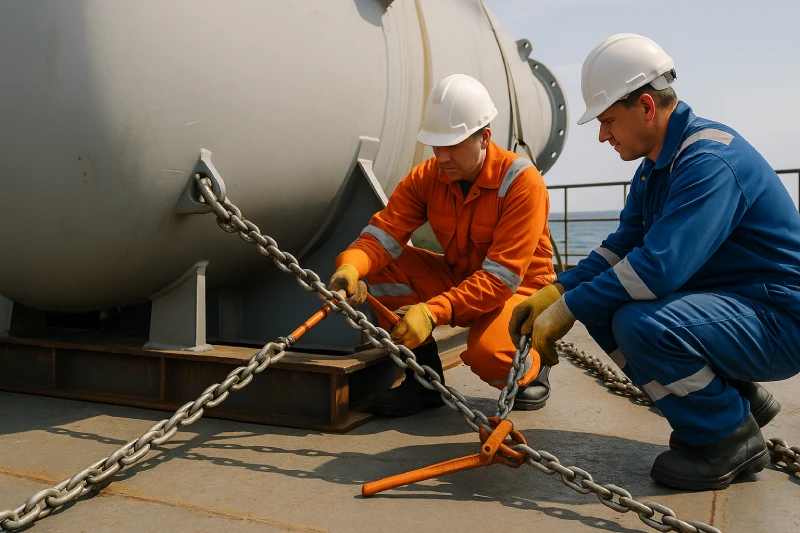
- Specifies chains, wires, lashings, turnbuckles, stoppers, wedges, saddle pads
- Ensures compliance with IMO/ISPS/port regulations
- Prevents cargo movement under sea conditions
This stage may involve ship owner’s engineers, third-party surveyors (SGS/BV/DNV), and the freight forwarder’s own technical team.
Step 4 — Pre-Carriage: Inland Transport & Port Operations in China
Once the engineering plan is confirmed, the cargo is moved from the factory to the selected port.
Inland Transport (Factory → Port)
- Heavy trucks or multi-axle trailers (8–18 axles depending on weight)
- Escort vehicles, road permits, and police escorts for oversized loads
- Route survey to verify bridge load capacity and turning radius
- Loading with cranes or gantry systems at the factory
Port Handling & Preparation
- Gate-in arrangements and pre-berth waiting
- Storage in open yard or designated OOG/breakbulk area
- Cargo cleaning and final measurement checks
- Pre-lashing, additional reinforcement, and marking (weight, COG, lifting points)
Accurate coordination at this stage minimizes port storage charges and avoids last-minute delays.
Step 5 — Vessel Loading & On-Site Supervision
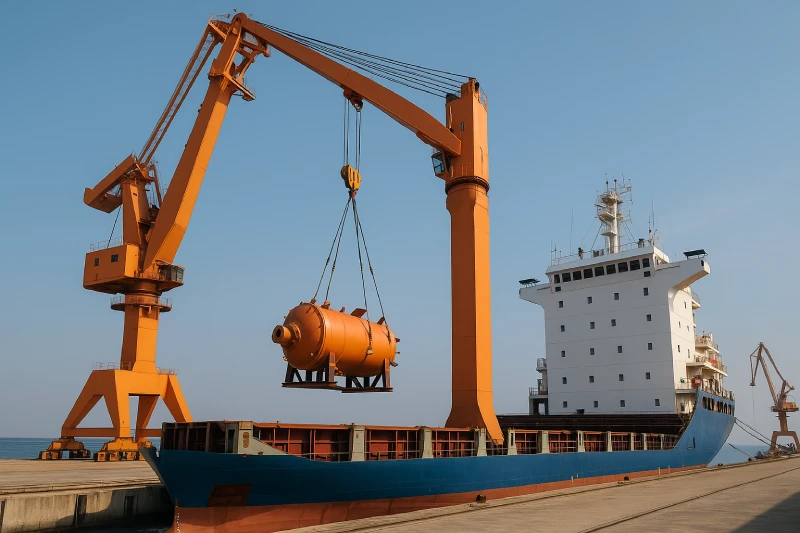
When the vessel arrives, breakbulk cargo is loaded onboard using heavy-lift cranes—either from the vessel itself or the port terminal.
Key operations during loading:
- Supervising lifting sequence and rigging configuration
- Ensuring cargo is lifted from correct points
- Monitoring sling angle and load distribution
- Adjusting dunnage, timber, beams, and steel supports
- Applying lashing materials exactly per plan
- Photographing each stage for traceability and insurance
A dedicated Port Supervisor or Marine Surveyor is usually present to verify safe execution before the vessel departs.
Step 6 — Ocean Transport & In-Transit Management
During the voyage:
- ETA updates are provided regularly
- Sea/weather conditions monitored
- Master’s notes recorded for heavy-lift cargo
- Client receives milestone updates (Loaded → Sailed → Transshipment → Arrival)
For project-critical cargo, additional measures such as vibration monitoring or sealing verification may be used.
Step 7 — Discharge, On-Carriage & Final Delivery
Upon arrival at the destination port:
Discharge Operations
- Surveyor present to supervise the unloading
- Cranes lift cargo to the quay or directly onto trailers
- Lashing materials removed safely
- Cargo inspected for visible damage
Inland Delivery to Jobsite
- Permit application and escort if oversized
- Low-bed or modular trailer transport
- Crane lifting and positioning at final location
- Delivery documentation, condition reports, and sign-off
Once the shipment is delivered intact and on schedule, the project phase of logistics is successfully completed.
Engineering, Safety & Risk Management for Breakbulk Cargo
Breakbulk and heavy-lift shipping requires engineering precision, detailed planning, and strict safety compliance.
Unlike standard container shipments, which follow fixed processes and terminal automation, breakbulk operations involve custom lifting, stowage, and securing for each individual piece.
Proper engineering reduces risk, protects cargo integrity, and ensures compliance with international maritime standards.
1. Engineering Support for OOG & Project Cargo
Engineering is the backbone of safe breakbulk shipping. For high-value equipment—such as turbines, generators, boilers, transformers, or long-length structures—proper calculations and technical drawings are essential.
Our engineering support includes:
① Lifting Analysis
- Reviewing lifting points, working load limits (WLL), and center of gravity (COG)
- Selecting spreader bars, shackles, lifting beams, and sling configurations
- Ensuring proper load distribution to avoid structural stress or deformation
- Preventing swing, tilt, or uncontrolled rotation during lifting
② Stowage & Stability Planning
- Collaborating with vessel planners and ship owners on optimal stowage positions
- Balancing deck and hold loads to maintain vessel stability
- Adjusting dunnage and saddle systems for curved or uneven cargo surfaces
- Planning for motion in heavy seas (roll, pitch, heave)
③ Lashing & Securing Design
- Determining the correct amount and type of chains, wires, turnbuckles, stoppers, hooks
- Designing customized cradles, steel frames, support blocks, and wedges
- Complying with IMO CSS Code, AAR standards, and shipping line requirements
- Reducing risk of cargo shift—one of the leading causes of breakbulk damage
④ Route Analysis & Feasibility
- Checking port restrictions, lifting capacities, quay strength, air draft limits
- Analyzing inland road conditions: bridge loads, turns, slopes, height limits
- Matching vessel type with cargo weight and geometry
2. Compliance, Documentation & Marine Standards
Breakbulk freight involves a significant amount of documentation to ensure compliance with port regulations, carrier policies, and marine safety standards.
Key documentation includes:
- Method Statement
- Lifting Plan & Rigging Plan
- Stowage & Securing Plan
- Risk Assessment Report
- Survey Reports(pre-loading survey、on-board survey、discharge survey)
- Material Certificates for shackles/chains/lashing gear
- Packing List, Cargo Drawing, and COG data
- Export licenses (if applicable to controlled equipment)
Compliance Standards We Follow
- IMO / SOLAS / ISPS / IMDG (if applicable)
- Port Authority regulations at both origin & destination
- Carrier technical rules for heavy-lift and breakbulk cargo
- International surveying standards (BV, DNV, ABS, SGS)
For many cargo types (energy equipment, petrochemical units, large machinery), compliance is the key to accepting the cargo at the port.
3. Cargo Packaging, Protection & Marking
Proper packaging reduces vibration, moisture, and impact risks during transport.
Recommended breakbulk packaging solutions:
- Heavy-duty wooden crates (ISPM15 compliant)
- Steel frames or skids for machinery
- Anti-corrosion wrapping, VCI protection
- Shock absorbers and rubber pads
- Reinforced lifting lugs
- Waterproof tarpaulin for deck cargo
Mandatory cargo marking:
- Weight & center of gravity marking
- Lifting point indicators
- Handling instructions (“Do Not Stack”, “Fragile”, “Keep Upright”)
- Serial numbers and identification labels
Clear markings help crews handle cargo correctly during loading and unloading.
4. Survey, Inspection & Quality Control
Surveyors play a critical safety role in breakbulk shipping.
Types of surveys:
- Pre-loading Survey
Check cargo condition, packaging, labeling, COG, lifting points - On-board Lashing Survey
Verify that lashing is applied per plan, secure and compliant - Discharge Survey
Confirm condition at destination and detect any possible damage
Surveyors we work with:
- SGS
- BV (Bureau Veritas)
- DNV
- CCIC
- ABS
These inspections create a verifiable record for insurance claims and project quality control.
5. Marine Insurance & Risk Mitigation
Breakbulk cargo is exposed to more external risks than containerized freight. Proper insurance is essential.
Recommended coverage:
- All-Risk Marine Cargo Insurance
- Heavy-Lift / Project Cargo Insurance
- Delay-in-startup (DSU) for EPC projects
- Third-party liability coverage
- War risk (for certain regions)
Risk mitigation actions:
- Conducting third-party survey at loading and discharge
- Using verified lifting gear with valid certificates
- Ensuring vessel type matches cargo requirements
- Avoiding poorly rated ports or carriers
- Monitoring weather, swell, and port closure conditions
A strong risk management framework reduces the chances of damage, delay, and financial loss.
6. Health, Safety & Environment (HSE) Compliance
Breakbulk operations involve heavy lifting, working at height, engine-powered machinery, and potential environmental hazards.
A professional breakbulk forwarder follows strict HSE protocols.
Typical HSE measures:
- PPE (helmets, gloves, reflective vests, steel-toe boots)
- Hot-work, suspended-load, and confined-space permits
- Toolbox talks before every lifting operation
- Controlled zones around lifting and lashing areas
- Spill control & environmental protection on deck
- Emergency response procedures
Strong HSE adherence protects workers, cargo, vessel, and environment.
China Breakbulk Shipping Costs & Transit Times
Breakbulk shipping pricing is more complex than standard container freight because each shipment requires individual handling, specialized lifting, and customized engineering. Understanding the cost structure and typical transit times helps importers, EPC contractors, and project managers budget accurately and avoid surprises.
Below is a detailed breakdown of what drives breakbulk freight rates from China—and what delivery timeline you can expect on major global routes.
1. Key Cost Drivers for Breakbulk Cargo Services
Breakbulk freight rates are influenced by multiple operational, engineering, and port-related factors.
Compared with FCL or Ro-Ro, the cost is more dependent on physical characteristics and terminal handling requirements.
① Cargo Dimensions & Weight
This is the most important pricing factor.
- Larger volume = more deck/hold space
- Heavier units require heavy-lift cranes
- Extreme dimensions may limit available vessels
- Cargo shape affects lifting/lashing complexity
Even a few centimeters may determine whether a piece can be stowed inside the hold—or must be lashed on deck at a higher cost.
② Number of Units & Consolidation Needs
Cost changes depending on whether:
- You ship one single heavy piece
- Multiple pieces on one voyage
- Consolidation or temporary storage is required
More units often reduce the per-ton or per-cubic-meter cost.
③ Load Port & Discharge Port Pairing
Different ports have different:
- Lifting capabilities
- Terminal handling charges
- Congestion levels
- Access to MPP / heavy-lift carriers
Ports like Shanghai, Tianjin, Qingdao, Ningbo offer competitive rates due to strong breakbulk capacity.
④ Vessel Type & Carrier Availability
Breakbulk freight mainly uses:
- MPP (Multi-Purpose Vessels)
- Heavy-lift carriers
- General cargo vessels
- Semi-submersible carriers (special cases)
Rates depend on seasonal supply, fuel costs, port rotation, and regional project cargo demand.
⑤ Lashing, Securing & Survey Fees
Breakbulk requires customized sea-fastening:
- Chains, wires, stoppers, wooden dunnage
- Welding for saddles or frames
- Surveyor fees (SGS/BV/DNV)
- Onsite manpower and supervision
These can represent 15–30% of the handling cost depending on cargo complexity.
⑥ Port Charges & Documentation
Breakbulk port charges include:
- Handling (loading/unloading)
- Wharfage
- Yard storage
- Crane usage
- Documentation fees
- Special permits for heavy-lift cargo
Each port has its own tariff structure.
⑦ Marine Insurance
For heavy-lift cargo, insurance is strongly recommended.
Premiums depend on:
- Cargo value
- Fragility
- Risk level of the route
- Weather, piracy, or warzone exposure
⑧ Inland Trucking & Pre-Carriage (China Side)
For oversized cargo, inland transport requires:
- Low-bed / multi-axle trailers
- Escort vehicles
- Road permits
- Possible nighttime delivery
- Route survey and infrastructure checks
All are priced based on cargo dimensions and location.
2. Typical Cost Structure
Below是一份典型的 breakbulk shipping成本结构(示意,不含具体价格):
| Cost Component | Description |
|---|---|
| Ocean Freight | Based on weight/volume/space + vessel type |
| Port Handling (POL/POD) | Lifting, storage, yard moves |
| Lashing & Securing | Chains, wires, welding, stoppers |
| Surveyor Fees | Pre-loading, on-board, discharge surveys |
| Engineering Plans | Lifting plan, stowage plan, method statement |
| Trucking (China Side) | Specialized trailers, permits, escorts |
| Crane Service (Factory/Jobsite) | Loading/unloading lift service |
| Marine Insurance | All-risk or project cargo coverage |
This breakdown helps clients prepare accurate budgets and avoid hidden charges.
3. Typical Transit Times for Breakbulk Cargo From China
Breakbulk vessels have lower frequency than container carriers, but they operate stable project-focused routes around the world.
Middle East
- China → UAE / Oman / Qatar / Saudi Arabia
18–32 days
(Common for machinery, steel structures, project cargo)
Africa
- China → East Africa (Kenya, Tanzania)
25–38 days - China → West Africa (Nigeria, Ghana, Ivory Coast)
30–45 days - China → South Africa
20–28 days
Europe
- China → Mediterranean (Turkey, Egypt, Greece, Italy)
22–32 days - China → North Europe (Germany, Netherlands, Belgium)
30–45 days
South America
- China → Brazil / Chile / Peru
35–55 days
South & Southeast Asia
- China → India
15–25 days - China → Vietnam / Indonesia / Malaysia / Philippines
7–18 days
Variables that influence transit time:
- Port rotation
- Transshipment vs. direct sailing
- Weather conditions (monsoon, typhoon season)
- Port congestion
- Carrier availability
Breakbulk transport prioritizes cargo safety and port handling conditions, so schedules may fluctuate more than container shipping.
How to Choose a Reliable Breakbulk Freight Forwarder in China
Breakbulk and heavy-lift transportation requires far more expertise than regular container logistics. Choosing the right China breakbulk freight forwarder directly affects cargo safety, cost control, and project timelines.
A qualified partner must demonstrate technical capability, on-site execution experience, and transparent communication.
Below are the essential criteria and evaluation questions to guide your selection.
1. Core Capabilities to Look For
① Proven Experience With Large Industrial & Project Cargo
Your freight forwarder should have a track record handling:
- Machinery over 20–200+ tons
- Oversized, long-length, or irregularly shaped equipment
- Power-plant components, construction modules, vehicles, steel structures
- Complex multi-unit project shipments
Experience reduces risk, prevents costly handling mistakes, and ensures smooth port coordination.
② Strong Presence in Major Chinese Breakbulk Ports
A reliable forwarder should operate regularly from:
- Shanghai
- Tianjin Xingang
- Qingdao
- Dalian
- Ningbo-Zhoushan
- Guangzhou / Shenzhen
Local teams must understand each port’s yard layout, lifting abilities, congestion patterns, and booking cycles.
③ Engineering & Technical Support
Breakbulk forwarding is not just transportation—it’s engineering.
A strong provider must offer:
- Lifting plan & rigging calculation
- Stowage and securing plan
- Cargo drawings review
- Structural support design (saddles, steel frames)
- On-site inspection and adjustments during loading
Without engineering capabilities, a forwarder cannot guarantee safety or compliance.
④ Reliable Carrier Network (MPP / Heavy-Lift)
Your partner should have established relationships with major breakbulk carriers:
- MPP / heavy-lift operators
- Ro-Ro carriers (if applicable)
- Project cargo lines
- Regional general cargo vessels
Carrier access determines:
- Space availability
- Sailing frequency
- Rate competitiveness
- Route options
⑤ Professional On-Site Supervision & Surveying
During loading and discharge, on-site supervision is essential to:
- Monitor lifting
- Validate lashing
- Record photos/videos
- Document cargo condition
- Coordinate surveyors
This avoids misunderstandings and strengthens insurance claims if damage occurs.
⑥ Transparent Pricing & Documentation
Breakbulk costs can vary widely. A trustworthy forwarder will:
- Provide a detailed breakdown (lashing, lifting, survey, trucking, port charges)
- Explain each cost driver clearly
- Avoid surprise charges at POL or POD
- Offer binding or near-binding quotations after technical review
Transparency builds confidence and prevents budget overruns.
2. Key Questions to Ask a Breakbulk Freight Forwarder
Use these questions to evaluate whether a partner is truly competent:
① “Can you provide breakbulk vs. flat-rack vs. Ro-Ro cost comparisons?”
A good forwarder helps you choose the optimal method—not the most expensive one.
② “Do you have recent case studies or project examples similar to my cargo?”
Cases demonstrate real capability, not just marketing claims.
③ “Will you provide lifting, stowage, and lashing plans before cargo is loaded?”
If the answer is no—avoid them immediately.
④ “Who will supervise the loading and lashing at the port?”
You need direct oversight, not outsourced third parties with no accountability.
⑤ “What are the special requirements at my destination port?”
Ports vary in crane capacity, yard layout, and handling rules.
Your forwarder must understand these constraints.
⑥ “What surveyors do you work with, and what inspections will be conducted?”
Third-party surveys (SGS/BV/DNV) strengthen reliability and insurance protection.
3. Red Flags to Avoid
Be cautious if your prospective forwarder shows any of the following warning signs:
① Overly low pricing without clear breakdown
This usually means:
- Missing lashing fees
- No survey included
- Uncertain vessel availability
- Extra charges will appear at the last minute
② No engineering or technical review
If they cannot provide structural drawings, methods, or lifting calculations, they lack true breakbulk competence.
③ No on-site inspection or supervision
Serious forwarders always send supervisors for breakbulk handling.
④ Inconsistent communication or unclear timelines
Breakbulk projects require precise coordination. Poor communication = high risk.
⑤ Excessive outsourcing to multiple subcontractors
Too many layers reduce control and increase miscommunication and liability.
4. Why Choosing the Right Partner Matters
A competent breakbulk freight forwarder in China helps you:
- Reduce loading/unloading risks
- Avoid port fines and safety violations
- Ensure documentation accuracy
- Prevent cargo deformation, scratches, or lifting damage
- Maintain project schedule for EPC/industrial deliveries
- Optimize costs with the correct shipping mode
- Improve insurance coverage success rates
- Ensure smooth customs clearance and delivery
Your logistics partner directly influences cargo safety and final project performance—choose one with deep technical competency, not just low rates.
Why Work With Winsail Logistics as Your China Breakbulk Freight Forwarder?
Selecting the right partner for breakbulk cargo is crucial—especially when handling oversized, heavy-lift, or project-critical equipment. Winsail Logistics combines deep local expertise, strong engineering capability, and global carrier partnerships to deliver safe, reliable, and cost-effective breakbulk solutions from China to worldwide destinations.
Below are the core strengths that make Winsail Logistics a trusted choice for importers, EPC contractors, project developers, and industrial manufacturers.
1. China-Based Project Team With Port-Level Expertise
Our project cargo team is based in China and operates across every major breakbulk port, including Shanghai, Tianjin, Qingdao, Ningbo, Dalian, Guangzhou, and Shenzhen.
This gives us real-time visibility and operational control where it matters most:
- Direct communication with port operators
- Immediate response to berth changes or vessel delays
- On-site presence during lifting, lashing, and loading
- Faster coordination with customs, truckers, surveyors, and carriers
With Winsail Logistics, your cargo is handled locally by professionals—not through disconnected overseas agents.
2. Proven Experience With Complex Breakbulk & Heavy-Lift Cargo
Winsail Logistics has extensive experience handling oversized and project cargo from China, including:
- Large generators, turbines, and transformers
- Wind energy components (tower sections, nacelles, blades)
- Mining and heavy industrial machinery
- Steel structures for construction & infrastructure projects
- Vehicles and rolling equipment
- Oversized tanks, pipes, skids, and pressure vessels
We understand the technical, operational, and compliance requirements for moving equipment that cannot fit into containers—ensuring safe handling from factory floor to destination port.
3. Engineering-Driven Breakbulk Solutions
Breakbulk shipping is an engineering challenge. Winsail Logistics provides full technical support for safe lifting, stowage, and securing.
Our engineering capabilities include:
- Cargo drawings and COG review
- Lifting plans & rigging calculations
- Stowage planning based on vessel stability
- Lashing plans according to IMO/ISPS standards
- Custom cradles, saddles, and support frame design
- Pre-loading technical inspections
- Detailed method statements for port operations
This engineering-first approach minimizes risk and ensures your cargo meets vessel, port, and insurance requirements.
4. Strong Relationships With MPP & Heavy-Lift Carriers
Winsail Logistics maintains partnerships with major global and regional breakbulk carriers operating:
- Multi-Purpose Vessels (MPP)
- Heavy-lift vessels
- Semi-submersible and project cargo ships
- Ro-Ro carriers (when applicable)
Our network ensures strong sailing coverage to:
- Middle East (UAE, Saudi Arabia, Qatar, Oman)
- Africa (East, West, South)
- Europe (Mediterranean & North Europe)
- South America (Brazil, Chile, Peru)
- South Asia & Southeast Asia
This allows us to offer competitive rates and reliable space even during peak project seasons.
5. On-Site Port Supervision & Third-Party Survey Support
For breakbulk cargo, on-site execution determines safety. Winsail Logistics assigns supervisors to monitor every critical step:
- Cargo arrival & port storage
- Pre-lashing preparations
- Crane lifting operations
- Stowage placement
- Final securing and welding
- Photo/video documentation
We also coordinate SGS, BV, DNV, or CCIC surveyors when required, providing independent inspection and peace of mind.
6. Transparent Pricing & Detailed Cost Breakdown
Breakbulk shipping can involve multiple stakeholders and complex charges. Winsail Logistics ensures complete clarity by providing:
- Detailed quotation with line-by-line cost breakdown
- Lifting, lashing, and survey fees clearly listed
- Transparent terminal handling charges (THC)
- Optional cost comparison: breakbulk vs. flat rack vs. Ro-Ro
- No hidden fees during port operations
Our goal is to help clients plan budgets accurately and avoid unexpected costs at loading or destination ports.
7. One Point of Contact & Real-Time Visibility
Project cargo requires tight coordination. Winsail Logistics assigns a single project manager who provides:
- Pre-shipment consulting
- Engineering review
- Daily milestone reports
- Port operation updates
- ETA notifications throughout the voyage
- Delivery confirmation at destination
This ensures you always know the location and status of your cargo.
8. Track Record of Successful Breakbulk Projects
Winsail Logistics has handled numerous successful shipments across various industries. Examples include:
- Heavy industrial machinery (50–180 MT) from Shanghai/Tianjin to Middle East energy projects
- Long-length steel structures from Qingdao/Ningbo to Africa for construction & infrastructure projects
- Transformers and boilers shipped securely from North China to South Asia/EU markets
- Vehicles, rolling equipment & modular units delivered for mining and construction operations
While respecting client confidentiality, we can share project procedures, lifting photos, stowage plans, and before/after case summaries upon request.
Case Study – From Factory in China to Jobsite
Case 1: 10t Industrial Reactor from Nansha to Djibouti
Cargo: 10-ton industrial reactor
Volume: 115.61 CBM
Origin: Nansha, China
Destination: Djibouti
Carrier: CMA
Transit Time: 16 days
We arranged breakbulk ocean freight for a 10-ton pressure reactor destined for an industrial facility in East Africa.
The oversized unit required customized lifting equipment, reinforced steel framing, and on-site supervision to ensure safe loading at the Nansha terminal.
Thanks to proper engineering review—focusing on lifting points, center of gravity, and securing method—the reactor was successfully loaded on a CMA MPP vessel. The shipment arrived in Djibouti within just 16 days, demonstrating our capability in handling sensitive, oversized industrial equipment for African markets.
Case 2: Cement Mill Spare Parts from Lianyungang to Umm Qasr
Cargo: Cement mill spare parts
Volume: 61.05 CBM
Origin: Lianyungang, China
Destination: Umm Qasr, Iraq
Carrier: Ocean Favor
Transit Time: 30 days
We managed a breakbulk shipment of large-diameter cement mill components from Lianyungang to Umm Qasr.
Due to their irregular shape and heavy metal structure, containerization was not feasible.
Our team arranged specialized lifting, custom supports, and secure lashing to withstand long-haul sea conditions on the Middle East route.
The shipment reached Umm Qasr in 30 days, showcasing our experience with industrial breakbulk cargo and deliveries to high-demand construction markets across Iraq and the wider Middle East.
FAQs
What qualifies as breakbulk cargo when shipping from China?
Breakbulk cargo refers to oversized, heavy, or irregularly shaped items that cannot fit into standard containers. These include machinery, reactors, steel structures, large crates, power-plant components, and construction modules. Each piece must be handled individually using cranes instead of being containerized.
Which ports in China are commonly used for breakbulk shipments?
The main breakbulk export hubs include Shanghai, Tianjin, Qingdao, Dalian, Ningbo-Zhoushan, and Guangzhou/Shenzhen. These ports offer strong lifting capacity, heavy-lift berths, and regular MPP/heavy-lift vessel calls. The best port depends on factory location and carrier availability.
How is the cost of breakbulk shipping calculated?
Pricing depends primarily on cargo size, weight, lifting complexity, and the amount of deck/hold space required. Port handling, lashing, survey fees, inland trucking, and vessel availability also influence the total cost. A technical review of drawings and dimensions is usually required before quoting.
What documents are needed for breakbulk shipments from China?
In addition to standard export documents, breakbulk shipments typically require engineering information such as cargo drawings, center-of-gravity data, lifting points, and securing instructions. Survey reports or method statements may also be required depending on the cargo type and destination port.
How do you ensure breakbulk cargo is safely handled during loading and transit?
Safety starts with proper engineering—lifting plans, stowage layouts, and certified lashing materials. At the port, supervisors monitor lifting and securing to ensure compliance with the plan. During the voyage, cargo is checked, weather is monitored, and updates are shared to minimize risks and protect high-value equipment.
Summary
Breakbulk cargo plays a vital role in global project logistics, especially for oversized, heavy, or irregular equipment that cannot be containerized.
If you want to evaluate breakbulk vs. container vs. Ro-Ro solutions—or need help reviewing your cargo drawings, dimensions, or lifting points—our team can provide a free feasibility assessment.
