
For importers in the UAE, shipping speed is often just as important as shipping cost. Whether you are importing electronics, retail products, machinery, furniture, or e-commerce inventory, understanding realistic delivery timelines helps avoid stock shortages, warehouse delays, and customer complaints.
One of the most popular solutions today is DDP shipping from China to UAE. Under DDP (Delivered Duty Paid), the freight forwarder handles pickup, export clearance, international transportation, UAE customs clearance, taxes, and final delivery. This creates a simpler process for buyers, especially businesses without a local customs clearance team.
However, many importers still ask the same question: how long does DDP shipping from China to UAE actually take?
The answer depends on several factors, including freight method, cargo type, customs processing, and seasonal congestion. In this guide, we break down realistic air freight and sea freight DDP transit times, explain every stage of the shipping process, compare DDP with standard shipping methods, and show how to reduce delays.
If you are new to UAE imports, you can also read our complete guide to China–UAE shipping timelines through the Shipping Time pillar page, as well as our detailed DDP main page for customs and delivery explanations.
What Is DDP Shipping from China to UAE?
DDP stands for Delivered Duty Paid. In international logistics, this means the seller or freight forwarder takes responsibility for almost the entire shipping process until the cargo arrives at the buyer’s address in the UAE.
Under DDP shipping, the logistics provider typically handles:
- Cargo pickup from the supplier
- Export customs clearance in China
- International freight transportation
- UAE import customs clearance
- Import duties and VAT
- Final delivery to the consignee
For UAE importers, this reduces operational complexity because they do not need to coordinate separately with customs brokers, shipping lines, or local trucking companies.
Another important point is that DDP shipping time refers to total door-to-door delivery time — not only the international transit segment. Many buyers mistakenly compare airport-to-airport transit with DDP delivery timelines, but DDP includes customs clearance and last-mile delivery as well.
Average DDP Shipping Time from China to UAE
Shipping timelines vary significantly depending on whether you choose air freight or sea freight.
Air Freight DDP Shipping Time
Air freight is the fastest DDP shipping option from China to UAE.
Typical door-to-door delivery time:
- Express air DDP: 5–8 days
- Standard air DDP: 7–12 days
Air freight is commonly used for:
- Electronics
- Fashion products
- Urgent replenishment stock
- High-value cargo
- E-commerce inventory
Flights from major Chinese cities such as Shenzhen, Guangzhou, Shanghai, and Hong Kong operate frequently to Dubai and Abu Dhabi, making air cargo relatively stable throughout most of the year.
However, during peak seasons such as Q4 or before Chinese New Year, air freight delays may still occur because of limited cargo capacity.
Sea Freight DDP Shipping Time
Sea freight is slower but much more cost-effective for large-volume shipments.
Typical door-to-door delivery time:
- FCL sea freight DDP: 20–30 days
- LCL sea freight DDP: 25–38 days
Sea freight is suitable for:
- Furniture
- Machinery
- Bulk commercial cargo
- Construction materials
- Large B2B inventory orders
The largest UAE destination port is Jebel Ali Port in Dubai, which handles most container imports from China.
Compared with air freight, sea shipping involves more variables such as port congestion, vessel schedules, and container handling delays.
Full Door-to-Door DDP Shipping Time Breakdown
To understand realistic timelines, it is important to look at each shipping stage individually.
Stage 1: Cargo Pickup in China
The first step is collecting cargo from the supplier or factory.
Typical timeframe:
- 1–3 days
Pickup time depends on:
- Factory location
- Supplier readiness
- Packaging completion
- Distance to export warehouse
For example, cargo from Shenzhen may move faster than cargo from inland manufacturing regions because coastal export infrastructure is more efficient.
Delays often happen when suppliers are not ready on schedule or when products require repacking and labeling adjustments.
Stage 2: Export Customs Clearance in China
After pickup, the shipment enters China export customs procedures.
Typical timeframe:
- 1–2 days
This stage includes:
- Export declaration
- Commercial invoice review
- HS code verification
- Cargo inspection (if required)
Incorrect documentation is one of the biggest causes of delays at this stage. Missing product descriptions or inaccurate declared values may trigger customs review.
Experienced freight forwarders usually help suppliers prepare export documents before cargo reaches the port or airport.
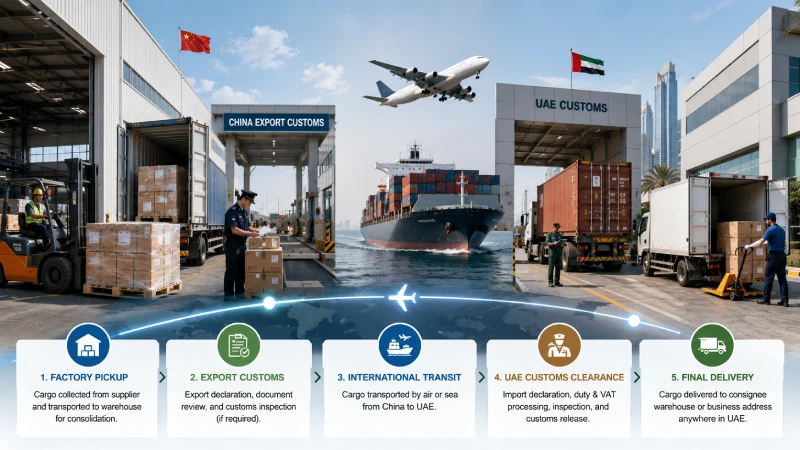
Stage 3: International Transit
This stage varies the most depending on freight method.
Air Freight Transit
Typical transit duration:
- 1–5 days
Direct flights to Dubai are naturally faster than transshipment routes. However, cargo may wait for flight availability during busy seasons.
Sea Freight Transit
Typical transit duration:
- 12–25 days
Transit time depends on:
- Shipping route
- Port congestion
- Vessel schedule
- Transshipment requirements
Direct vessel services generally provide more predictable schedules.
Stage 4: UAE Customs Clearance
Once cargo arrives in the UAE, import customs procedures begin.
Typical timeframe:
- 2–5 days
This stage includes:
- Import declaration
- Duty and VAT processing
- Customs inspection (if required)
- Clearance approval
Under DDP shipping, the freight forwarder usually handles these procedures on behalf of the importer.
Customs delays may happen because of:
- Incomplete documents
- Product compliance checks
- Sensitive cargo categories
- Random inspections
Stage 5: Last-Mile Delivery in UAE
After customs clearance, the shipment moves to final delivery.
Typical timeframe:
- 1–3 days
Delivery speed depends on:
- Destination city
- Warehouse accessibility
- Delivery appointment requirements
- Trucking availability
Dubai deliveries are usually faster because most cargo enters through Jebel Ali Port or Dubai Airport.
Deliveries to Abu Dhabi, Sharjah, Ajman, or inland industrial areas may require additional trucking time.
Air Freight DDP Shipping Time: Detailed Analysis
Air freight is often chosen by businesses prioritizing speed and inventory stability.
Standard Air Freight DDP
Standard air freight usually combines cargo from multiple customers before booking airline space.
Advantages:
- Lower shipping cost
- Stable scheduling
- Suitable for regular replenishment
Typical delivery:
- 7–12 days door-to-door
Express Air DDP
Express air services use faster customs handling and priority airline arrangements.
Advantages:
- Faster delivery
- Better tracking visibility
- Reduced warehouse handling time
Typical delivery:
- 5–8 days
This option is popular for urgent commercial shipments and e-commerce orders.
Common Air Freight Delay Factors
Even air cargo can experience delays.
Typical causes include:
- Airline space shortages
- Security inspections
- Peak season congestion
- Weather disruptions
- Airport handling delays
Q4 holiday demand often creates major pressure on air cargo capacity between China and the Middle East.
Sea Freight DDP Shipping Time: Detailed Analysis
Sea freight remains the preferred option for cost-sensitive importers.
FCL Shipping Time
FCL (Full Container Load) shipments move faster because the entire container belongs to one consignee.
Advantages:
- Lower handling risk
- Faster customs process
- More stable delivery timeline
Typical delivery:
- 20–30 days
LCL Shipping Time
LCL (Less than Container Load) shipments require cargo consolidation and deconsolidation.
This adds extra warehouse handling steps.
Typical delivery:
- 25–38 days
LCL delays commonly happen because cargo must wait for container consolidation before departure.
Common Sea Freight Delay Factors
Sea freight delays are much more common than air freight delays.
Typical problems include:
- Port congestion
- Vessel rollover
- Bad weather
- Container shortages
- Customs inspection holds
Global shipping disruptions can also affect vessel schedules for several weeks.
Factors That Cause DDP Shipping Delays
Understanding delay risks is extremely important for UAE importers.
Incorrect Shipping Documents
One small documentation mistake can delay customs clearance for days.
Common issues include:
- Wrong HS codes
- Invoice mismatch
- Missing consignee information
- Incorrect cargo value declaration
UAE Customs Inspection
Some products receive additional inspection because of compliance requirements.
This is common for:
- Electronics
- Cosmetics
- Food-related products
- Medical items
Inspection delays are difficult to predict and may extend clearance time significantly.
Peak Shipping Seasons
Certain periods create major shipping pressure.
Examples include:
- Chinese New Year
- Ramadan preparation season
- Black Friday inventory rush
- Q4 holiday shipping peak
During these periods, both air and sea freight timelines become less predictable.
Supplier Production Delays
Sometimes the shipment delay has nothing to do with transportation.
Factories may delay:
- Production completion
- Packaging
- Quality inspection
- Cargo handover
Many importers incorrectly blame freight forwarders for supplier-side delays.
DDP vs Standard Shipping Time
Many buyers compare DDP with FOB or CIF shipping.
DDP vs FOB
Under FOB shipping, the buyer handles UAE customs clearance independently.
Although the international transit portion may appear similar, actual delivery often becomes slower because multiple parties must coordinate separately.
DDP usually creates smoother final delivery operations.
DDP vs CIF
Under CIF shipping, freight cost is included, but customs clearance and final delivery are still handled by the buyer.
This creates additional coordination work after cargo arrives in the UAE.
DDP often reduces administrative delays because the same logistics provider controls the full process.
How to Reduce DDP Shipping Delays from China to UAE
Reducing delays starts before cargo even leaves the factory.
Prepare Accurate Documents Early
Ensure all documents are complete:
- Commercial invoice
- Packing list
- Product descriptions
- HS codes
Early document review prevents customs issues later.
Choose the Correct Freight Method
Use air freight for:
- Urgent inventory
- High-value goods
- Fast-moving products
Use sea freight for:
- Bulk cargo
- Heavy products
- Long-term inventory planning
Choosing the wrong method often creates avoidable supply chain pressure.
Avoid Peak Seasons
Booking earlier before major holidays helps reduce congestion risk.
Many experienced importers plan shipments several weeks ahead of Chinese New Year and Q4 demand surges.
Work with an Experienced DDP Freight Forwarder
A reliable logistics provider can significantly improve delivery consistency.
Experienced forwarders usually offer:
- Better customs coordination
- Faster issue resolution
- More stable carrier networks
- Better shipment visibility
This becomes especially important for UAE imports involving commercial clearance procedures.
FAQs
What is the fastest DDP shipping option from China to UAE?
Express air freight DDP is usually the fastest option, with delivery around 5–8 days.
How long does sea freight DDP to Dubai usually take?
Most sea freight DDP shipments take around 20–38 days depending on whether the shipment is FCL or LCL.
Does DDP include UAE customs clearance time?
Yes. DDP shipping normally includes customs clearance, import duties, and final delivery.
Why do DDP shipments get delayed at customs?
The most common reasons are incorrect documentation, compliance inspections, and peak-season congestion.
Conclusion
DDP shipping from China to UAE offers a convenient door-to-door logistics solution for importers who want simplified customs handling and predictable delivery management.
In most cases:
- Air freight DDP takes around 5–12 days
- Sea freight DDP takes around 20–38 days
However, total delivery time depends on much more than transportation alone. Supplier readiness, documentation accuracy, customs processing, and seasonal congestion all play major roles.
For UAE businesses, the best strategy is to combine realistic planning with an experienced freight forwarder that understands both China export procedures and UAE import requirements.
If you regularly import cargo from China, building a stable DDP shipping workflow can help reduce delays, improve inventory planning, and create more reliable supply chain operations over time.
