
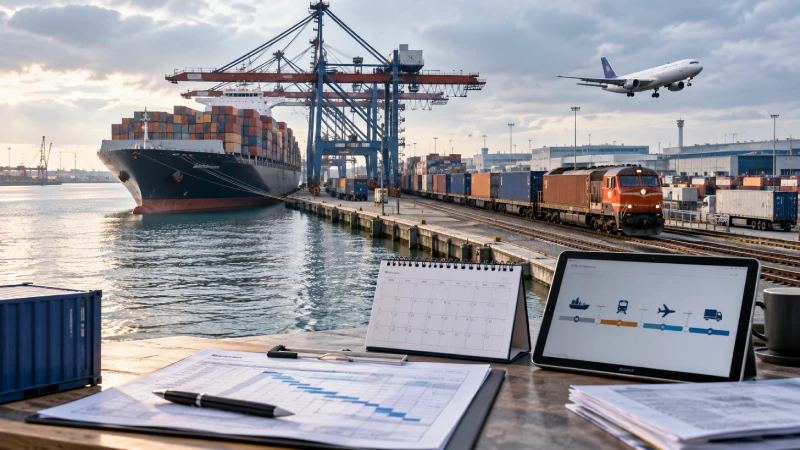
Shipping from China to Germany can take a few days by express, around one week by air freight, several weeks by rail, or roughly six to ten weeks by sea when the full delivery process is considered.
But this is where many transit-time comparisons become misleading.
A carrier may quote 43 days from Shanghai to Hamburg, for example, but that normally does not mean your cargo will be delivered to your warehouse in Germany 43 days after it leaves the supplier. Pickup in China, export handling, waiting for departure, customs clearance, terminal release and final German inland delivery can all add time.
So if your real question is:
“My goods must arrive in Germany by a certain date. When should I ship?”
you need to plan around the total door-to-door lead time, not only the main international transit.
For a broader overview of routes, costs, shipping methods and customs, see our Shipping from China to Germany guide. This article focuses specifically on timing and delivery-date planning.
China to Germany Shipping Time at a Glance
The following ranges are useful for initial planning. They are not guaranteed delivery times, and current schedules should always be checked before booking.
| Shipping Method | Main / Gateway Transit | Practical Planning Window | Main Germany Gateway | Best Used When |
|---|---|---|---|---|
| Express | Integrated courier network | About 3–6 days | Nationwide | Samples, parcels and very urgent shipments |
| Air freight | About 4–8 days depending on service | About 6–10 days | Frankfurt | Urgent commercial cargo |
| Premium rail service | Around 12 days on specific Xi’an–Duisburg services | Longer once pickup and final delivery are included | Duisburg | Time-sensitive rail-compatible cargo |
| Standard rail freight | Often around 18–25+ days terminal-to-terminal | Commonly several weeks door-to-door | Duisburg | Cargo too urgent for sea but less urgent than air |
| FCL sea freight | Roughly 38–50+ days on many current China–Germany port pairs | Often around 50–65+ days overall | Hamburg / Bremerhaven | Regular containerized cargo |
| LCL sea freight | Ocean voyage plus consolidation time | Often around 55–70+ days overall | Hamburg / Bremerhaven | Smaller, non-urgent shipments |
Current Hapag-Lloyd schedules illustrate why old “25–35 day China–Germany sea freight” estimates should not be used as a universal rule. Its current NE2 service lists Shanghai–Hamburg at 43 days and Yantian–Hamburg at 38 days, while the NE4 service lists Ningbo–Bremerhaven at 40 days and Ningbo–Hamburg at 42 days. Hapag-Lloyd route schedules
For air freight, recent September 2026 market quotations showed Shanghai Pudong–Frankfurt services at roughly 5–8 days and Shenzhen–Frankfurt at roughly 4–8 days depending on service level. Flexport PVG–FRA rate data
Important: These are planning ranges. Your actual shipment time depends on the cargo-ready date, Chinese origin city, next available departure, routing, capacity, customs status, cargo type and final delivery postcode in Germany.
Pro Tip: When comparing quotations, ask for both the estimated departure/arrival dates and the estimated final delivery date. A quoted “40-day transit” may refer only to the international leg.
Transit Time vs Door-to-Door Lead Time: Know What Your Quote Means
Before comparing shipping methods, make sure everyone is measuring the same thing.
A 12-day railway service, a 43-day ocean schedule and a six-day air service do not necessarily describe the same start and end points.
Main Carriage Time
Main carriage is the principal international transportation leg.
Depending on the mode, this may mean:
- the vessel voyage between ports;
- the main train movement between rail terminals;
- the international air cargo movement between airports.
Main carriage generally does not represent the complete time from your Chinese supplier to your warehouse in Germany.
There may still be time required before departure and after arrival.
Port-to-Port, Airport-to-Airport and Terminal-to-Terminal
These terms refer to movement between transport gateways.
Typical examples include:
- Shanghai Port → Hamburg Port;
- Ningbo → Bremerhaven;
- Shanghai Pudong Airport → Frankfurt Airport;
- Xi’an rail terminal → Duisburg rail terminal.
They are useful for comparing international services, but they are not the same as door-to-door lead time.
If your factory is in Dongguan and your customer warehouse is outside Munich, neither location is represented by a simple Yantian–Hamburg port-to-port transit figure.
Total Door-to-Door Lead Time
For an importer with a fixed delivery deadline, this is normally the most useful measurement.
A complete shipment may involve:
Supplier ready → pickup in China → origin handling → export procedures → waiting for departure → international transport → arrival handling in Germany → customs clearance → cargo release → German inland delivery
A practical planning formula is:
Door-to-door lead time = origin handling + departure waiting time + main carriage + destination handling/customs + inland delivery
This distinction becomes especially important when comparing sea, rail and air quotations from different freight forwarders.
A service with a shorter advertised main-carriage time is not necessarily the service that will reach your warehouse first.
How Long Does Sea Freight from China to Germany Take?
For most importers, sea freight requires the longest planning horizon.
Current China–North Europe schedules are also materially longer than some historical transit-time guides still visible online.
Current FCL Transit Times to Hamburg and Bremerhaven
For current planning, a useful starting point is approximately 40–50+ days port-to-port on many direct or mainstream China–Germany FCL services, although individual routes can fall below or above that range.
For example, current Hapag-Lloyd schedules show:
| Route | Published Transit Time |
|---|---|
| Shanghai → Hamburg | 43 days |
| Yantian → Hamburg | 38 days |
| Ningbo → Bremerhaven | 40 days |
| Ningbo → Hamburg | 42 days |
| Qingdao → Bremerhaven | 45 days |
| Qingdao → Hamburg | 47 days |
These figures are carrier schedule times, not guaranteed final delivery times. Hapag-Lloyd route schedules
The difference between two quotations can result from:
- the carrier used;
- the exact service rotation;
- direct versus transshipment routing;
- the number and sequence of port calls;
- current Cape or Suez routing;
- blank sailings;
- port congestion;
- vessel schedule changes.
That is why it is risky to plan a production launch or customer delivery around a generic statement such as “China to Germany takes 30 days by sea.”
Live marketplace data can show even longer total shipment windows once inland movements and handling are incorporated. Current Shanghai–Frankfurt market examples, for instance, show FCL transit windows around 55–69 days. Freightos Shanghai–Frankfurt route data
For a shipment with a firm deadline, the actual booked carrier schedule matters much more than an industry-wide average.
Pro Tip: Before confirming an FCL shipment, request the carrier, vessel/service, cut-off, ETD and ETA. Compare the actual sailing schedule instead of relying only on a generic website transit estimate.
Why LCL Usually Takes Longer Than FCL
LCL sea freight normally requires more handling than FCL.
A typical LCL movement looks like this:
Supplier → consolidation warehouse → wait for consolidation cut-off → container loading → export handling → sea voyage → destination CFS → deconsolidation → customs/release → inland delivery
With FCL, the container can usually move through the origin and destination process with fewer cargo-handling stages.
With LCL, your shipment has to be coordinated with cargo belonging to other shippers. If your goods miss a consolidation cut-off, they may have to wait for the next container.
At destination, the container must also be stripped before individual consignments can be released.
Current Freightos examples for Shanghai to Frankfurt show around 55–69 days for FCL versus approximately 57–74 days for LCL, illustrating how consolidation and deconsolidation can lengthen the total process. Freightos Shanghai–Frankfurt route data
This does not mean LCL always adds exactly two, five or seven days. The difference depends heavily on the consolidation schedule at origin and destination.
If your shipment has a fixed delivery date, ask:
- What is the next LCL warehouse cut-off?
- Which sailing will the cargo actually use?
- Is the service direct or transshipment?
- How frequently does the consolidation depart?
- Where will the container be deconsolidated in Germany?
- When can the individual shipment realistically be released?
These questions are often more useful than asking only for the vessel transit time.
How Long Does Air Freight from China to Germany Take?
For urgent commercial cargo, air freight is usually measured in days rather than weeks.
Frankfurt Airport is one of the main gateways for China–Germany air cargo.
Recent September 2026 quotations showed approximately:
- Shanghai Pudong (PVG) → Frankfurt (FRA): about 5–8 days
- Shenzhen (SZX) → Frankfurt (FRA): about 4–8 days
The exact time changes according to whether the service is priority, standard or deferred. Flexport PVG–FRA rate data
A broader Shanghai–Frankfurt marketplace comparison currently shows approximately 6–10 days for air freight. Freightos Shanghai–Frankfurt route data
Why a Short Flight Does Not Mean Next-Day Cargo Delivery
The aircraft itself may cross Eurasia relatively quickly, but commercial air freight involves more than flying time.
Before departure, the shipment may require:
- pickup from the supplier;
- delivery to the export warehouse;
- cargo acceptance;
- security screening;
- export declaration;
- airline space allocation;
- palletization or ULD handling.
After arrival in Frankfurt, it may still require:
- airline terminal handling;
- import customs processing;
- cargo release;
- forwarder collection;
- German inland trucking.
This is why a freight forwarder may quote several days even when the physical flying time is much shorter.
Standard vs Priority Air Freight
If your deadline is strict, ask which air service is being quoted.
A priority service may use faster handling and more favorable flight connections.
A standard service can still be suitable for many urgent shipments but may allow more flexibility in routing.
A deferred or consolidated service may cost less but should not be treated as the same product as priority air freight when your delivery deadline is fixed.
The right comparison is therefore not simply:
air vs sea
but:
Which specific air service can depart after my cargo is ready and still leave enough time for German customs and final delivery?
How Long Does Rail Freight from China to Germany Take?
Rail freight occupies the middle ground between air and sea and is particularly relevant for Germany because Duisburg is one of the major European rail freight hubs.
However, China–Germany rail transit times are often oversimplified.
China to Duisburg Rail Transit Time
DB Cargo currently promotes a premium Full Time Schedule Train between Xi’an and Duisburg with an average lead time of approximately 12 days, operating several times per week. DB Cargo Eurasia
That is a genuine service, but it should not be interpreted as meaning every China–Germany rail shipment takes 12 days.
Different rail products, origins, border conditions and departure schedules can produce substantially longer transit times.
Recent operational tracking data provides a useful comparison. In a recent sample, the latest ten Chengdu–Duisburg trains took approximately 18–25 days station-to-station, averaging around 20.7 days. Across a wider 90-day sample, the average was higher, demonstrating how much rail performance can vary over time. China–Europe rail transit data
Therefore:
- 12 days can be realistic for a specific premium Xi’an–Duisburg product;
- 18–25+ days is a more realistic reference for some standard recent rail movements;
- neither figure represents every China–Germany shipment.
Pro Tip: If a quotation says “12 days by rail,” ask whether it refers to a named premium full-time-schedule service, or whether it is simply being used as a generic China–Europe marketing transit time.
What Adds Time Before and After Duisburg?
Rail transport may also require:
- trucking from the Chinese factory to the departure terminal;
- LCL rail consolidation;
- export declaration;
- waiting for the scheduled train;
- border handling and gauge transfer;
- EU entry procedures;
- Duisburg terminal handling;
- customs clearance;
- deconsolidation if applicable;
- delivery by truck to the final German address.
The final distance can matter significantly.
Duisburg is particularly well positioned for destinations in North Rhine-Westphalia and western Germany, but a shipment destined for another part of Germany requires additional inland movement.
A frequently quoted market planning range for complete rail shipments is around 25–35 days door-to-door, depending on origin, consolidation and destination.
Needs confirmation before publishing: Winsail should verify this door-to-door rail range against its current Germany rail products before using it as a branded service commitment.
How Long Does Express Shipping from China to Germany Take?
For samples, spare parts, documents and small urgent shipments, international express is usually the fastest practical option.
Current marketplace estimates for Shanghai to Germany are approximately 3–6 days. Freightos Shanghai–Frankfurt route data
Unlike traditional freight, express courier services are generally sold as an integrated pickup-to-delivery network. Therefore, separating airport-to-airport time from final delivery is less useful.
Actual delivery can still be affected by:
- late supplier pickup;
- incorrect product descriptions;
- customs value discrepancies;
- restricted commodities;
- lithium battery documentation;
- customs inspection;
- remote delivery areas;
- weekends and public holidays.
If a shipment is linked to a critical sample approval, production stoppage or exhibition date, confirm the exact service level before collection.
Pro Tip: Do not wait until a parcel arrives in Germany to resolve unclear product descriptions or battery documentation. Customs-ready paperwork should be checked before pickup.
When Should You Ship to Meet a Required Delivery Date?
Instead of asking:
“What is the fastest shipping method?”
start with:
“When must the goods physically arrive at my warehouse?”
Then work backwards.
A useful formula is:
Required delivery date – realistic door-to-door lead time – contingency buffer = target cargo-ready date
The buffer should depend on how costly a late shipment would be.
Goods needed for normal inventory replenishment can tolerate a different level of risk from goods required for:
- a product launch;
- an exhibition;
- a production line;
- a retail promotion;
- a customer installation;
- a Christmas sales campaign.
If Your Delivery Deadline Is Less Than One Week Away
Express courier is normally the first option to investigate for small and suitable shipments.
Even then, do not assume that every China–Germany parcel will arrive within three days.
Check:
- pickup availability;
- commodity restrictions;
- courier service level;
- customs documents;
- destination postcode.
Traditional air freight may be possible in some circumstances, but once export handling, Frankfurt arrival, customs and final trucking are included, there may not be enough margin for a hard one-week deadline.
If Your Delivery Deadline Is About One to Two Weeks Away
Air freight is normally the most realistic commercial option.
Small shipments may still move by express.
For air cargo, confirm:
- cargo-ready date;
- next available flight/service;
- chargeable weight;
- required documents;
- estimated Frankfurt arrival;
- final delivery requirement.
Do not plan using the flight date alone.
If Your Delivery Deadline Is Around Three to Five Weeks Away
Rail freight may be worth checking.
It can provide an attractive middle ground when the shipment is:
- too urgent for current ocean schedules;
- too large or costly to move economically by air;
- compatible with the available rail service.
However, whether rail can meet a three- or four-week deadline depends on:
- your supplier location;
- access to the departure hub;
- next train departure;
- consolidation cut-off;
- route conditions;
- Duisburg arrival;
- customs;
- final delivery.
Do not assume every rail shipment can meet a three-week door-to-door deadline.
If Your Delivery Deadline Is Seven to Ten Weeks Away
Sea freight becomes realistic for many shipments, particularly FCL.
However, the lower end of this window can still be tight if:
- production finishes late;
- you miss the intended vessel cut-off;
- the routing is longer than expected;
- the container is rolled;
- customs documents are incomplete;
- you are shipping LCL;
- the cargo requires additional inspection.
For LCL, plan more conservatively because consolidation and destination deconsolidation introduce additional timing variables.

China to Germany Transit-Time Examples
The following examples show why route and service details matter.
| Origin → Destination | Mode | Current Planning Reference |
|---|---|---|
| Shanghai → Hamburg | FCL sea | Around 43 days on Hapag-Lloyd NE2 |
| Yantian → Hamburg | FCL sea | Around 38 days on Hapag-Lloyd NE2 |
| Ningbo → Bremerhaven | FCL sea | Around 40 days on Hapag-Lloyd NE4 |
| Ningbo → Hamburg | FCL sea | Around 42 days on Hapag-Lloyd NE4 |
| Qingdao → Bremerhaven | FCL sea | Around 45 days on Hapag-Lloyd NE4 |
| Shanghai PVG → Frankfurt FRA | Air freight | Roughly 5–8 days depending on service |
| Shenzhen SZX → Frankfurt FRA | Air freight | Roughly 4–8 days depending on service |
| Xi’an → Duisburg | Premium rail | Around 12 days on DB Cargo Full Time Schedule Train |
| Chengdu → Duisburg | Recent standard rail operations | Latest observed examples around 18–25 days |
| China → Germany | Express | Roughly 3–6 days in current marketplace estimates |
Sea schedule examples are based on current Hapag-Lloyd service data; air examples reflect recent Flexport quotations; the rail examples distinguish DB Cargo’s premium product from recent operational rail records.
These figures should be treated as planning references, not permanent route guarantees.
Schedules change.
Before promising a delivery date to your customer, confirm the actual departure available after the cargo is ready.
What Can Delay Shipping from China to Germany?
The international transport leg is only one source of delay.
In practice, missing a cut-off or having incomplete customs information can sometimes cause a larger delay than choosing a slightly slower shipping service.
Cargo Is Not Ready Before the Cut-Off
The planned departure only matters if the goods are actually ready.
Common problems include:
- production finishing late;
- incomplete export packing;
- missing labels;
- inspection delays;
- final carton dimensions not confirmed;
- supplier delivering after the warehouse or CY cut-off.
If you miss a weekly ocean sailing, losing one day at the factory may effectively cost a full week.
The same principle applies to LCL consolidation and scheduled rail departures.
Direct vs Transshipment Routing
Two sea freight quotations from Shanghai to Hamburg may show very different transit times even when both are quoted as FCL.
One service may have a relatively direct North Europe rotation.
Another may involve:
- more port calls;
- transshipment;
- a different European gateway;
- feeder transport.
For deadline-sensitive cargo, ask how the shipment is routed instead of comparing only price and headline transit time.
LCL Consolidation and Deconsolidation
LCL timing is particularly sensitive to consolidation schedules.
The shipment can be delayed before sailing while waiting for:
- warehouse receiving;
- customs preparation;
- consolidation;
- container stuffing;
- the scheduled vessel.
At the German end, the cargo must normally be unloaded from the shared container and individually released.
This is why the vessel ETA should never be treated as the LCL delivery date.
Rolled Containers and Blank Sailings
Carriers may adjust capacity around holidays or changing demand.
For example, Hapag-Lloyd announced that its NE2 service would have no Shanghai sailing for voyage 641W on October 10, 2026 during the Golden Week period, while alternative departures were offered on other services. Hapag-Lloyd Golden Week service update
This is a useful example of why importers should not calculate delivery dates from a generic weekly schedule months in advance.
A missed or cancelled sailing may change the entire delivery plan.
Rail Border and Terminal Delays
China–Europe rail freight crosses multiple railway systems and borders.
Potential delay points include:
- border handover;
- gauge changes;
- container transfer;
- terminal congestion;
- train re-marshalling;
- capacity constraints;
- network disruption.
Rail performance can therefore vary significantly even on the same origin–destination pair.
Recent Chengdu–Duisburg data illustrates that variation: while the latest observed trains were around 18–25 days, the broader 90-day average was longer. China–Europe rail transit data
Air Capacity and Flight Connections
Air freight is fast, but not all cargo travels on the next direct flight.
Your shipment may depend on:
- available cargo space;
- direct versus connecting flights;
- airline handling;
- consolidation schedules;
- security screening;
- cargo type.
A quotation should therefore be tied to the cargo-ready date and current capacity rather than treated as a permanent transit time.
Peak Seasons: When Should You Allow More Time?
If the required delivery date falls around a major shipping peak, use a more conservative schedule.
Chinese New Year
Chinese New Year can affect:
- factory production;
- trucking;
- export warehouses;
- port operations;
- available shipping capacity.
The biggest mistake is calculating transport time from the date you place the purchase order instead of the date the finished goods will actually be available for pickup.
Confirm the factory’s final production and packing schedule first.
China Golden Week
Golden Week can create a production rush before the holiday and carrier schedule adjustments around the holiday period.
As noted above, Hapag-Lloyd announced specific Far East–Europe sailing changes around Golden Week 2026. Hapag-Lloyd Golden Week service update
If your goods need to arrive in Germany in October or November, do not assume the same sailing pattern that applied earlier in the year will still be available.
Pre-Christmas European Peak
Before the European Christmas sales season, importers may face:
- higher cargo volumes;
- tighter air capacity;
- warehouse congestion;
- delivery appointment constraints.
If inventory must be available before a promotional date, work backwards from the warehouse-ready date, not merely the expected port arrival date.
Weather and Winter Operations
Weather can affect:
- vessel schedules;
- North European ports;
- airport operations;
- rail networks;
- domestic trucking.
Snow, severe weather or operational disruption may influence final delivery even after the cargo has entered Germany.
For hard deadlines, additional contingency is more important than trying to predict an exact number of weather-delay days.
How German Customs Can Affect the Delivery Date
Arrival at Hamburg, Bremerhaven, Frankfurt or Duisburg does not automatically mean the goods are ready for delivery.
German import processing depends on having accurate customs and product information available.
Check EORI and Customs Information Before Departure
An EORI number is mandatory for relevant customs operations in the EU, including import, export and transit. European Commission EORI guidance
Depending on the shipment, customs preparation may involve information and documents such as:
- importer/EORI details;
- commercial invoice;
- packing list;
- transport document;
- correct commodity description;
- HS/TARIC classification;
- customs value;
- country of origin;
- product-specific certificates or documents where applicable.
If the paperwork does not match the actual goods, customs may need additional information before the shipment can be released.
There is no reliable universal rule that “German customs always takes one or two days.”
Straightforward shipments with complete documents may move quickly, while inspections, classification questions or product compliance issues can extend the process.
ICS2 Data Must Be Accurate
Goods entering or transiting the EU are subject to the EU’s Import Control System 2.
Economic operators bringing goods into or through the EU must provide safety and security data through an Entry Summary Declaration. The European Commission notes that incomplete or inaccurate ENS information can be rejected or trigger requests for additional information, potentially delaying entry processing. European Commission ICS2 guidance
For importers, the practical lesson is simple:
Provide accurate cargo information before departure rather than waiting until the shipment reaches Europe.
Product Compliance Can Also Delay Release
There is no single compliance checklist that applies to every product shipped from China to Germany.
Requirements depend on the commodity.
Depending on what you import, areas that may require additional attention include:
- electrical and electronic products;
- machinery;
- batteries;
- chemicals;
- consumer products;
- food;
- medical products.
Some goods may fall under CE-related legislation, but it is incorrect to assume that every product automatically requires CE marking or the same set of documents.
EU Access2Markets should be checked using the specific product classification and destination because import requirements can differ by product. EU Access2Markets
If a shipment has a hard deadline, product compliance should be checked before the goods leave China, not when customs asks for supporting documents.
German Inland Delivery After Hamburg, Bremerhaven, Frankfurt or Duisburg
One of the most common planning mistakes is treating arrival at the German gateway as the delivery date.
There are still several steps between arrival and receipt by the consignee.
After Arrival at Hamburg or Bremerhaven
An FCL shipment may still require:
- vessel discharge;
- container availability;
- customs clearance;
- carrier/terminal release;
- truck appointment;
- inland haulage;
- consignee unloading;
- empty-container return.
For LCL, destination deconsolidation must normally take place before individual shipments can be released.
After Arrival at Frankfurt Airport
Air cargo may still require:
- airline terminal handling;
- customs procedures;
- cargo release;
- freight forwarder pickup;
- domestic trucking.
Therefore, Frankfurt arrival time is not the same as warehouse delivery time.
After Arrival at Duisburg
Rail freight may still need:
- terminal release;
- customs or transit procedures;
- deconsolidation for LCL cargo;
- truck dispatch;
- delivery to the final address.
How long inland delivery takes depends on factors including:
- destination postcode;
- distance from the gateway;
- container, FTL or LTL service;
- warehouse receiving hours;
- delivery appointments;
- special unloading requirements;
- weekends and public holidays.
Needs confirmation before publishing: Do not publish a universal “Germany inland delivery takes 1–3 days” promise unless Winsail confirms that range for the specific product and service being offered.
How to Reduce the Risk of Missing Your Required Delivery Date
A reliable shipment plan starts before the cargo reaches the port, airport or railway terminal.
1. Tell Your Forwarder the Required Delivery Date
Do not send only:
“Please quote sea freight to Germany.”
Instead, provide both the cargo-ready date and the required warehouse delivery date.
That allows the forwarder to evaluate whether the requested method makes sense.
2. Confirm the Real Cargo-Ready Date
Ask your supplier when the goods will be:
- fully manufactured;
- packed;
- labeled;
- inspected if required;
- ready for pickup.
A booking made before the factory can provide a reliable cargo-ready date has limited planning value.
3. Confirm the Next Actual Departure
Ask for:
- cut-off;
- ETD;
- ETA;
- routing;
- carrier or rail service where relevant.
A service advertised as “40 days” is irrelevant if the shipment has to wait another ten days for departure.
4. Ask What the Transit Time Actually Measures
Clarify whether the quotation is:
- port-to-port;
- airport-to-airport;
- terminal-to-terminal;
- door-to-port;
- door-to-door.
This single question prevents many timeline misunderstandings.
5. For Sea Freight, Check the Routing
Ask whether the service is:
- direct;
- transshipment;
- routed via additional hubs;
- currently operating via the Cape or another routing.
The answer may explain why one quotation is materially faster than another.
6. For Rail, Confirm the Product Being Used
Do not assume a premium 12-day Xi’an–Duisburg service represents all rail freight.
Confirm:
- Chinese departure terminal;
- terminal cut-off;
- actual train departure;
- expected Duisburg arrival;
- whether the service is premium or standard;
- time required for final delivery.
7. Prepare Customs and Compliance Information Early
Resolve:
- EORI;
- HS/TARIC classification;
- commercial documents;
- product requirements;
- battery or dangerous-goods documentation where relevant
before the shipment arrives in Europe.
8. Plan From the Conservative End of the Range
If air freight is estimated at 6–10 days and the goods absolutely must arrive by a certain date, planning on six days gives you almost no protection against disruption.
For critical deliveries, work from a realistic conservative scenario.
9. Leave Extra Margin for Fixed Events
Allow additional contingency when cargo is required for:
- exhibitions;
- installations;
- factory production;
- product launches;
- seasonal campaigns;
- contractual customer deadlines.
Pro Tip: The fastest advertised transit is not always the safest option. A slightly slower service with confirmed space and a reliable departure can sometimes be a better deadline choice than a faster service with uncertain capacity.
For pricing alongside timing, see our Shipping Cost from China to Germany guide.
FAQ
How long does shipping from China to Germany take?
It depends on the shipping method and what part of the journey you are measuring. Express can take around 3–6 days, air freight roughly 6–10 days for many commercial shipments, rail normally several weeks, and sea freight can require roughly six to ten weeks once the complete shipping process is considered. Do not confuse main-carriage transit with total door-to-door lead time.
How long does sea freight from Shanghai to Hamburg take?
Current Hapag-Lloyd schedules list Shanghai to Hamburg at approximately 43 days port-to-port. Other carriers, services and routings may be faster or slower. Pickup, origin handling, customs, terminal release and German inland delivery must be added when planning the total delivery time.
How long does rail freight from China to Duisburg take?
It depends on the rail product. DB Cargo publishes an average 12-day Xi’an–Duisburg lead time for its premium Full Time Schedule Train, while recent tracked Chengdu–Duisburg movements have shown roughly 18–25 days station-to-station. Pickup, consolidation, customs and final trucking increase total door-to-door time.
How long does air freight from China to Frankfurt take?
Recent market quotations showed approximately 5–8 days from Shanghai Pudong to Frankfurt and 4–8 days from Shenzhen to Frankfurt, depending on service level. A broader 6–10 day planning window may be more suitable when additional handling stages are included.
Why does LCL take longer than FCL from China to Germany?
LCL shipments normally require origin consolidation and destination deconsolidation, adding CFS receiving, consolidation cut-offs, container stuffing, destination stripping and individual cargo release. Missing a consolidation cut-off can also push the shipment to a later departure.
How early should I ship if I have a fixed delivery date in Germany?
Work backwards from the required delivery date using the realistic total door-to-door lead time and an appropriate contingency buffer. Express or air may suit deadlines measured in days, rail can work for some deadlines several weeks away, and sea freight normally requires the longest planning window.
