
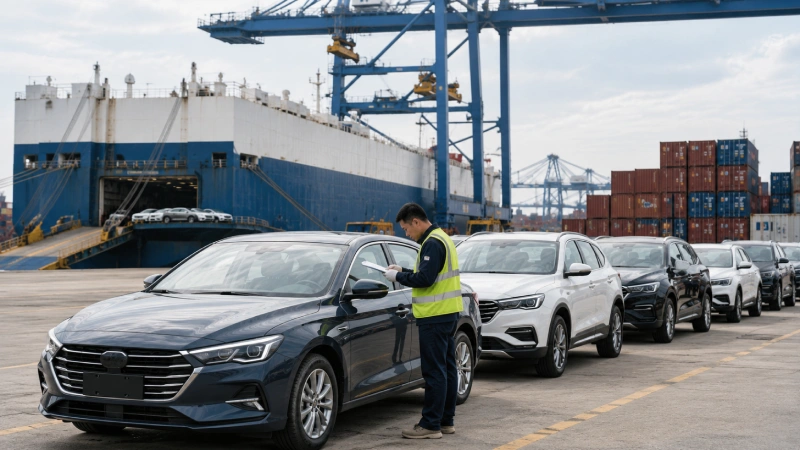
China’s used-vehicle export process involves more than buying a car and booking ocean freight. The vehicle must pass China-side ownership, registration, inspection, licensing, and customs checks, while the overseas buyer must separately confirm destination import and registration eligibility.
Quick Answer
To export a used car from China, verify its ownership, legal status, condition, registration dates, and destination eligibility. An approved used-car export enterprise—not the seller, freight forwarder, or overseas buyer—must complete transfer-for-export registration, arrange inspection, apply for the export license, and support the customs declaration. The vehicle can then move by container or Roll-on/Roll-off (RoRo), subject to carrier acceptance. The overseas importer remains responsible for destination permits, taxes, inspections, customs clearance, and registration.
Key Takeaways
- Not every used vehicle is exportable or acceptable at the destination.
- China’s export process and the destination country’s import process are separate.
- Production date and first-registration date are not interchangeable.
- From January 1, 2026, vehicles registered for 180 days or less require additional manufacturer documentation.
- Container and RoRo acceptance depends on condition, power source, ports, and carrier rules.
- Eligibility checks should be completed before full payment.
Who Is Legally Responsible for a Used Car Export from China?
The approved used-car exporter is the China-side legal export principal. Supporting parties do not replace its licensing duties.
| Party | Main responsibility | Does not decide |
|---|---|---|
| Seller | Provides the vehicle and ownership evidence | Export-license issuance |
| Used-car exporter | Handles transfer registration, inspection, licensing, and export compliance | Destination approval |
| Freight forwarder | Coordinates pickup, storage, booking, loading, lashing, and document flow | Legal vehicle eligibility |
| Customs broker | Submits the declaration under authorization | Import eligibility abroad |
| Overseas importer | Confirms permits, standards, taxes, inspection, and registration | China’s license decision |
Under China’s official used-vehicle export framework, the actual exporter applies for the license, provincial commerce authorities issue it, and traffic-registration authorities handle transfer and deregistration.
A freight forwarder may coordinate vehicle shipping from China, but it is not the licensing authority.
How to Export Used Cars from China: 8-Step Process
Follow this sequence so that the vehicle, documents, booking, and destination requirements remain aligned.
- Check the vehicle before purchase.
- Identify the relevant vehicle dates.
- Complete transfer-for-export registration.
- Arrange inspection and condition evidence.
- Apply for the export license.
- Select container or RoRo shipping.
- Coordinate pickup, customs, loading, and shipping documents.
- Recheck destination import readiness.
Step 1: Check the Vehicle Before Purchase
Complete legal-status and destination checks before releasing full payment.
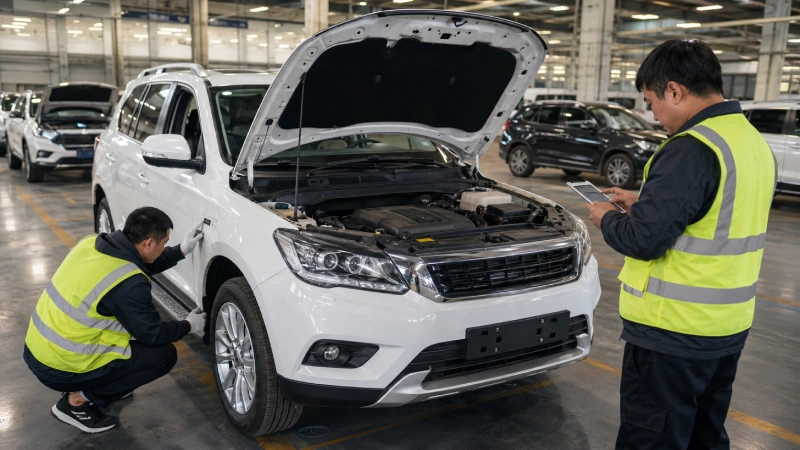
Verify the Vehicle Identification Number (VIN), registered owner, registration certificate, mileage, condition, maintenance history, accident information, and unresolved violations.
China’s framework excludes vehicles in certain situations, including vehicles under mortgage, pledge, seizure, or customs supervision; vehicles with incomplete legal documents; illegally assembled or stolen vehicles; vehicles that fail inspection; and vehicles at or near mandatory scrapping limits.
The importer must separately check destination vehicle-age calculations, steering-side rules, emissions, conformity, permits, inspection, damaged-vehicle restrictions, taxes, and registration eligibility.
Step 2: Distinguish the Important Vehicle Dates
“Vehicle age” is not a universal measurement. Different procedures may rely on different dates.
| Date | Meaning | Why it matters |
|---|---|---|
| Production date | Date manufactured | Specifications and some destination rules |
| Model year | Manufacturer or market designation | May differ from production year |
| First-registration date | First official registration | China’s 180-day rule |
| Transfer-for-export date | Registration for pending export | Must align with the license |
| Shipment or arrival date | Transport milestone | Used by some destination rules |
From January 1, 2026, a vehicle registered for 180 days or less, including day 180, requires an After-sales Maintenance Service Confirmation issued and stamped by the manufacturer. It must identify the export country, vehicle, and after-sales network. Without it, the export license is not issued.
This is an additional document condition, not a universal ban on recently registered vehicles.
Step 3: Complete Transfer-for-Export Registration
The vehicle must enter the approved exporter’s registration workflow before licensing.
The exporter acquires the vehicle and applies for transfer registration. The traffic-registration authority records “transfer pending export” in the Motor Vehicle Registration Certificate. A temporary plate may be issued, linked to compulsory traffic insurance and capped at 60 days under the February 2024 framework.
After this endorsement, the vehicle cannot simply be transferred to another domestic owner. The exporter should coordinate the sales contract, inspection, license application, booking, and port plan before completing this stage.
Step 4: Arrange Inspection and Prepare the Export-License File
A third-party inspection supports licensing, while a separate condition file protects the commercial handover.
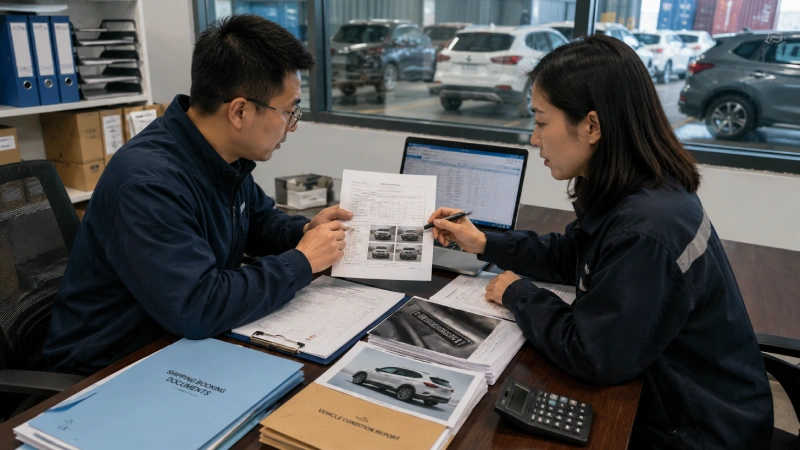
Used passenger vehicles and used commercial vehicles or trailers must meet their applicable export quality requirements. A qualified third-party testing organization issues the inspection report.
The application normally includes the export contract, a Chinese translation when required, the registration certificate, inspection report, and a stamped destination-market compliance declaration. Vehicles covered by the 180-day rule also need the manufacturer’s after-sales confirmation.
Exporter name, VIN, brand, model, first-registration date, and transfer-for-export date must match across the documents. The license is China-side authorization; it does not approve importation abroad.
Also retain VIN photographs, odometer reading, exterior and interior condition, powertrain status, visible damage, tire condition, keys, and inspection date. These records do not replace the mandatory report.
Step 5: Choose Container or RoRo Shipping
Select the method after confirming dimensions, condition, power source, ports, and carrier acceptance.
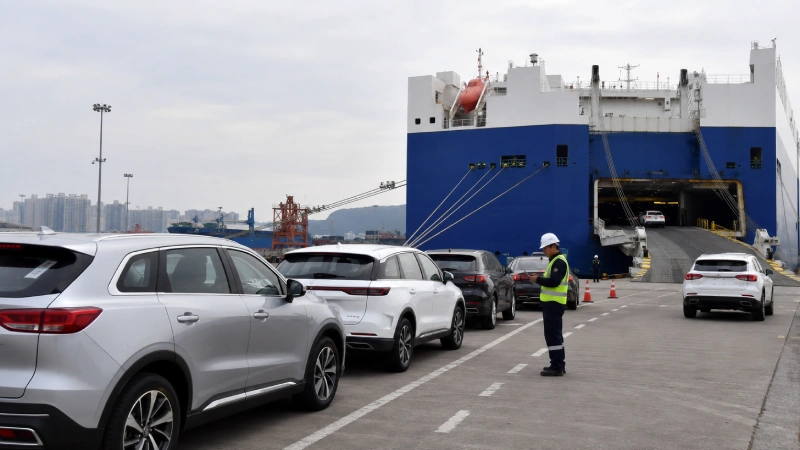
| Factor | Container shipping | RoRo shipping |
|---|---|---|
| Condition | Can suit running or specially handled non-running units | Commonly requires drivable or towable units |
| Protection | Enclosed and sealed | Open terminal handling |
| Loose parts | May be accepted if declared and secured | Often restricted |
| Loading | Positioned, blocked, restrained, and lashed | Driven or towed aboard |
| Main check | Loading plan and carrier approval | Terminal and carrier approval |
Container shipping may suit enclosed protection, routes without practical RoRo service, or approved spare parts shipped with the vehicle. The loading plan must account for dimensions, weight, wheel restraint, lashing points, and safe access.
RoRo may suit roadworthy vehicles moving between compatible terminals. See RoRo ocean freight from China for a fuller mode explanation.
The International Maritime Dangerous Goods (IMDG) Code 2024 Edition, including Amendment 42-24, became mandatory on January 1, 2026. Application depends on the vehicle, battery, fuel system, damage, stowage, and special provisions. Follow the booked carrier’s written requirements.
Step 6: Coordinate Pickup, Loading, Lashing, and Port Delivery
Create a vehicle record at pickup and update it at each handover.
Record the VIN, mileage, keys, visible damage, running condition, collection time, and responsible party. Repeat the condition check at warehouse receiving.
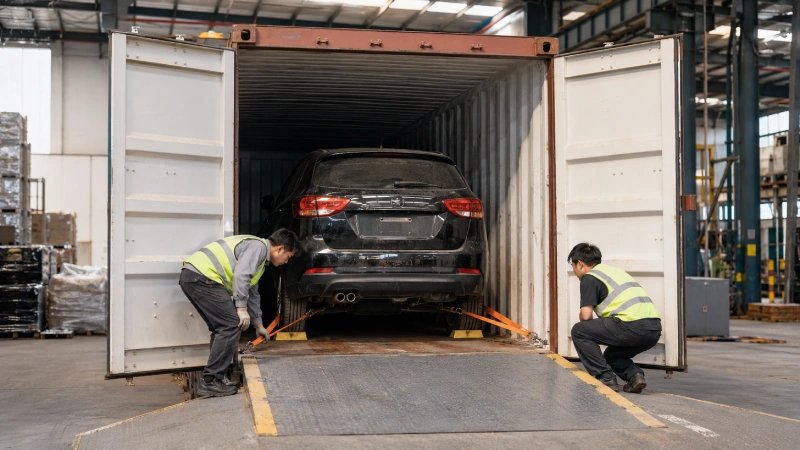
For containers, confirm the container type, vehicle dimensions and weight, loading equipment, wheel chocks, approved lashing points, seal number, and photographs. Do not assume a fixed vehicle capacity without a model-specific loading plan.
For RoRo, confirm terminal cut-off, driveability or towability, leakage status, keys, battery or fuel preparation, and booking references. Electric, hybrid, modified, damaged-battery, and non-running vehicles require carrier acceptance before delivery.
Step 7: Complete Customs Declaration and Shipping Documents
The declaration, booking, vehicle list, and bill of lading must use consistent data.
The authorized customs broker declares the vehicle using the exporter’s license and supporting documents. China Customs electronically verifies the license. The official framework requires the goods description to identify the vehicle as used and include relevant brand, engine-displacement, and vehicle-type information.
Review the bill of lading draft for shipper, consignee, notify party, quantity, VIN or chassis references where required, container and seal numbers, ports, cargo description, and freight terms.
| Document | Prepared or issued by | Main use |
|---|---|---|
| Export contract | Exporter and buyer | License and commercial terms |
| Registration certificate | Traffic-registration authority | Ownership and transfer evidence |
| Inspection report | Third-party testing organization | License application |
| After-sales confirmation, if applicable | Vehicle manufacturer | Recently registered vehicles |
| Export license | Provincial commerce authority | China customs clearance |
| Invoice and vehicle list | Exporter | Customs and importer records |
| Customs declaration | Exporter and customs broker | Export clearance |
| Bill of lading | Carrier or agent | Transport and destination release |
After export clearance, the exporter must apply for vehicle deregistration within two months.
Step 8: Recheck Destination-Country Import Readiness
China export clearance does not guarantee destination entry, customs release, roadworthiness approval, or registration.
The importer should reconfirm the importer of record, permits, customs registration, original documents, pre-shipment inspection, conformity rules, taxes, and registration eligibility before departure.
Countries may calculate age from the production date, model year, first-registration date, shipment date, arrival date, or customs-entry date. Obtain current guidance from the responsible authority.
For route planning, buyers may review shipping from China to Kenya or shipping from China to Saudi Arabia. These pages do not replace official vehicle-admission rules.
Common Mistakes and Delay Risks
Most serious delays begin before port delivery.
- Paying before destination eligibility is confirmed.
- Confusing production and first-registration dates.
- Using inconsistent exporter, VIN, model, quantity, or consignee information.
- Missing manufacturer confirmation under the 180-day rule.
- Booking RoRo for a vehicle that fails terminal requirements.
- Failing to disclose an electric, hybrid, modified, damaged, leaking, or non-running vehicle.
- Delivering before inspection, licensing, or carrier approval is complete.
- Assuming China export clearance guarantees destination clearance.
What Winsail Can Coordinate
Winsail Logistics can coordinate transport after the exporter and buyer establish a workable compliance path.
Depending on the confirmed scope, coordination may include pickup, warehouse receiving, container selection, loading and lashing, RoRo booking, port delivery, ocean freight, shipping-document flow, customs coordination through authorized parties, and destination-agent coordination.
Winsail does not issue the export license, approve exporter qualifications, determine legal export eligibility, decide destination import eligibility, or guarantee customs clearance and registration.
For commercial transport information, review used car shipping from China.
Pre-Shipment Operational Checklist
- The approved exporter is confirmed.
- The VIN matches every document.
- Ownership and legal restrictions are checked.
- Production and first-registration dates are recorded separately.
- Destination eligibility is verified.
- Transfer-for-export registration is complete.
- The inspection report is available.
- Manufacturer confirmation is available when applicable.
- Export-license data match the registration certificate.
- Container or RoRo acceptance is confirmed.
- Power source, leakage, damage, and running condition are disclosed.
- Pickup, loading, lashing, and port cut-offs are coordinated.
- Bill of lading instructions are approved.
- The importer holds the destination documents.
Send Vehicle Details for Review
Before pickup or booking, send the brand, model, VIN, production date, first-registration date, power source, running condition, China location, quantity, destination country, and destination port.
Winsail can review preliminary logistics and document readiness, help identify a suitable shipping method, and coordinate the confirmed transport scope. Export licensing and destination approval remain the responsibility of the exporter, importer, and authorities.
Sources Reviewed
- Ministry of Commerce and Four Other Departments: Announcement on Used-Vehicle Exports, Announcement No. 6 of 2024
- Notice on Strengthening Used-Vehicle Export Management
- Notice on Further Implementing Used-Vehicle Exports
- International Maritime Organization: IMDG Code
- Maersk: Cars in Containers
- Maersk: Requirements for Booking Vehicles
FAQ
Can any used car be exported from China?
No. It must meet China’s ownership, legal-status, inspection, registration, licensing, and customs requirements, plus the destination country’s import and registration rules.
Who applies for a used-vehicle export license in China?
The approved used-car export enterprise applies. The provincial commerce authority issues the license; the seller, overseas buyer, or freight forwarder cannot replace the exporter.
Is a vehicle registered for 180 days or less banned from export?
Not automatically. From January 1, 2026, it requires an After-sales Maintenance Service Confirmation from the manufacturer. Without it, the export license is not issued.
Which is better for a used car, container or RoRo shipping?
Container shipping may suit enclosed transport, special handling, or routes without practical RoRo service. RoRo may suit accepted, drivable vehicles moving between compatible terminals.
Does China export clearance guarantee destination customs clearance?
No. The importer must separately satisfy destination customs, inspection, tax, conformity, and vehicle-registration requirements.
