
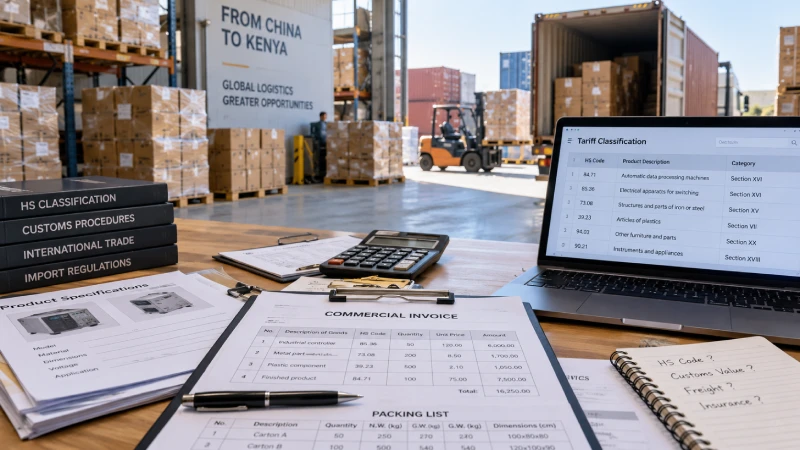
An HS code and a customs value answer two different questions, but both can change the amount an importer ultimately pays when goods enter Kenya.
The HS code answers what the goods are for customs purposes. Customs valuation determines what value should be used when assessing the shipment.
This distinction matters when importing from China because the information available at the sourcing stage is often incomplete. A supplier may describe a product simply as “electronics,” “machine parts,” or “accessories,” provide a Chinese export HS code, and issue a commercial invoice based on an FOB, EXW, or other sales term.
That may be enough to prepare a preliminary shipping estimate. It may not be enough to support the final Kenyan customs declaration.
The Kenya Revenue Authority states that customs duties are assessed according to both the customs value and the applicable tariff classification, while customs valuation generally begins with the price actually paid or payable for the imported goods.
For importers sourcing from China, the practical objective should therefore be to resolve important classification and valuation questions before the cargo leaves China, rather than waiting until the shipment is already in the Kenyan clearance process.
Data Note: Kenya customs rules, EAC tariff measures, product-specific requirements, and customs exchange rates can change. Classification also depends on the actual characteristics of the goods. Always check the current EAC tariff and applicable KRA requirements before shipment.
Quick Answer: How Do HS Codes and Customs Valuation Work in Kenya?
Goods imported into Kenya must be classified under the applicable East African Community customs tariff. The EAC tariff uses the Harmonized System framework, applies the General Rules of Interpretation for classification, and uses detailed EAC tariff codes for customs declarations.
A Chinese supplier’s HS code can be a useful reference, but it should not automatically be treated as the final Kenya classification. The importer and clearing agent should verify the product against the applicable EAC tariff using the actual function, materials, specifications, and presentation of the goods.
Customs valuation is a separate question. The transaction value—the price actually paid or payable—is normally the starting point, subject to the applicable valuation conditions and adjustments. Freight, insurance, and other costs must be treated according to the EACCMA valuation rules, and imports by air require particular care because the legislation treats air-freight costs differently from normal transport additions.
If the classification or valuation methodology remains materially uncertain before shipment, KRA provides an advance-ruling process for tariff classification, origin, and specified valuation questions.
For a broader overview of freight methods, route planning, customs, and inland delivery, see Shipping from China to Kenya.
HS Code and Customs Value Are Two Different Decisions
It is easy to look at an import-duty estimate as one calculation:
Product value × tax rate = customs cost
In practice, there are important decisions before that calculation can be reliable.
HS Code Determines How the Product Is Classified
The first question is:
What exactly are the goods?
A tariff classification places the product under the appropriate customs heading and subheading.
That classification may affect:
- the applicable import-duty treatment;
- whether product-specific measures apply;
- whether additional permits or regulatory requirements need to be checked;
- how the goods should be described in customs documentation;
- and ultimately the importer’s landed-cost estimate.
The EAC Online Customs Tariff states that goods on customs declarations must be classified under an appropriate tariff code and that the tariff code is directly linked to the applicable rate of duty. It also identifies six General Rules of Interpretation used for classification.
Customs Value Determines the Value Used for Assessment
The second question is:
What value should Customs use?
A commercial invoice is important evidence, but the number printed at the bottom of the invoice is not automatically the complete answer in every transaction.
The customs-value calculation may need to consider the transaction price together with applicable adjustments under the customs valuation rules.
So if an importer receives two different tax estimates, the first diagnostic question should be:
Did the HS classification change, or did the customs value change?
Those are different problems and should be investigated separately.
How to Classify an Import for Kenya Before It Leaves China
Classification should begin with the physical and technical characteristics of the product—not the marketing name used by the supplier.
The EAC tariff operates within the international Harmonized System framework and uses detailed tariff classifications for EAC customs purposes. The EAC describes its classification codes as eight-digit codes, with the first six digits corresponding to the internationally harmonized chapter, heading, and subheading structure.
That is important for China-to-Kenya shipments because a supplier may give the importer a code used in China’s own export declaration system. Even where the internationally harmonized portion is relevant, national or regional subdivisions and the final EAC classification still need to be checked.
Start With Product Facts, Not the Alibaba Product Name
Before trying to identify a tariff code, collect enough information to answer basic classification questions.
Depending on the product, this may include:
- exact technical product name;
- primary function;
- material or composition;
- model number;
- dimensions and capacity;
- voltage, wattage, or other electrical specifications;
- whether the product is complete or unfinished;
- whether it is a standalone product, component, part, or accessory;
- the machine or equipment it is designed for;
- manufacturing drawings;
- product photos;
- technical catalogue;
- ingredient or chemical composition;
- and how the goods are presented or packaged.
You do not necessarily need every item for every shipment.
A simple finished consumer product may be relatively straightforward. A specialized industrial component, chemical product, multifunction machine, or assembled kit may require considerably more technical information.
Check the EAC Tariff, Not Only the Supplier’s Export Code
The supplier’s HS code is useful because it gives the importer and clearing agent a starting point.
It should not become the only evidence.
A sensible workflow is:
- Identify the actual product.
- Document its function and construction.
- Review the relevant EAC tariff section and chapter.
- Review applicable section and chapter notes.
- Apply the General Rules of Interpretation where necessary.
- Identify the proposed EAC tariff line.
- Have the importer or Kenyan clearing agent review the classification where appropriate.
- Escalate material uncertainty rather than relying on a guess.
The EAC Online Customs Tariff allows users to browse tariff sections and chapters, view legal notes, and search tariff codes by keyword or tariff number.
Use the Tariff Notes and Classification Rules When More Than One Heading Looks Possible
Classification is not simply a keyword search.
Two products that sound similar in ordinary English can be treated differently when their:
- function;
- material;
- level of completion;
- technical design;
- or relationship to another machine
is different.
The General Rules of Interpretation exist to resolve these types of classification questions systematically.
For the importer, the practical lesson is simple:
Do not choose an HS code only because its description contains the same words used by your supplier.
The tariff description, legal notes, and actual product characteristics need to fit together.
Pro Tip: For specialized products, ask the Chinese manufacturer for the technical catalogue, material composition, model specifications, and product photos while the order is still being prepared. These documents are much easier to obtain before the shipment leaves the factory.
Why “Electronics,” “Machine Parts” and “Accessories” Create Customs Risk
One of the most preventable documentation problems begins with a description that is technically true but far too broad.
| Weak Description | What Is Missing? | Better Documentation Approach |
|---|---|---|
| Electronics | Exact device, function, electrical specifications, model | State what the device actually is, what it does, ratings, and model |
| Machine parts | Parent machine, part function, material, dedicated use | Identify the exact part, machine, material, and function |
| Accessories | Accessory for what product? Material? Function? | Identify the actual item, use, construction, and compatible equipment |
Suppose a supplier writes:
Electronics
That could refer to hundreds of fundamentally different products.
A much more useful description might be:
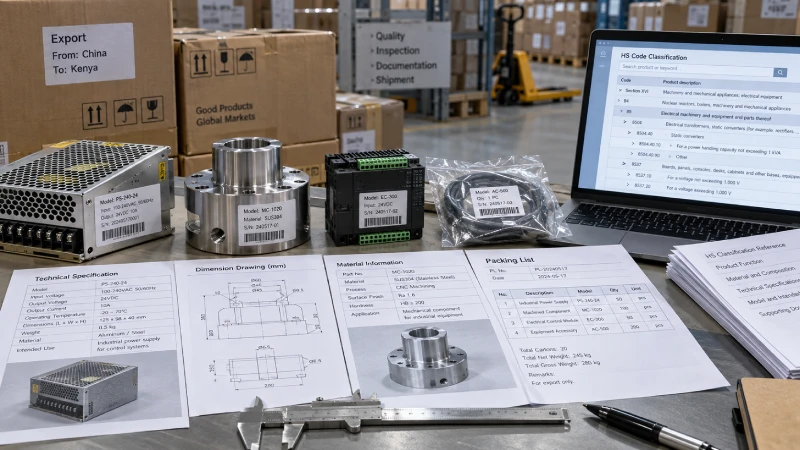
24V DC switching power supply, input 100–240V AC, output 24V/10A, standalone unit, Model XX.
Likewise:
Machine parts
provides very little classification evidence.
A better description could be:
CNC-machined steel spindle housing designed for Model XX packaging machine, supplied without motor or electrical components, drawing attached.
And instead of:
Accessories
the documentation could state:
Silicone protective case designed for handheld barcode scanner Model XX.
These examples demonstrate documentation quality only. They are not HS-code determinations.
The level of information matters because KRA’s own advance-ruling guidance asks applicants for detailed product facts that may include the product’s brand, function, use, composition, origin, catalogue, model and specifications, manufacturer, certificates, samples, and other technical evidence.
What a Customs-Ready Product Description Should Contain
A good commercial description normally allows someone who has never seen the goods to understand what is being shipped.
Depending on the product, include:
Product name + function + material/composition + important specification + model
You do not need to turn every invoice line into a paragraph. The objective is to remove avoidable ambiguity.
Warning: Avoid using only descriptions such as “parts,” “samples,” “accessories,” “equipment,” or “electronics” when a more precise commercial description is available.
This becomes even more important when several suppliers are being consolidated into one LCL shipment or container.
If five factories supply different products, maintain clear SKU-level descriptions and values rather than collapsing them into one generic line such as “mixed accessories.”
Review My Cargo Before Shipping
For complex or mixed shipments, prepare the product information before pickup:
- product name;
- model;
- photos;
- material;
- function;
- technical specification;
- quantity;
- supplier;
- package details;
- and Kenya destination.
This makes it easier to coordinate freight documents with the importer and Kenyan clearing agent before cargo moves.
How Customs Valuation Works for Imports into Kenya
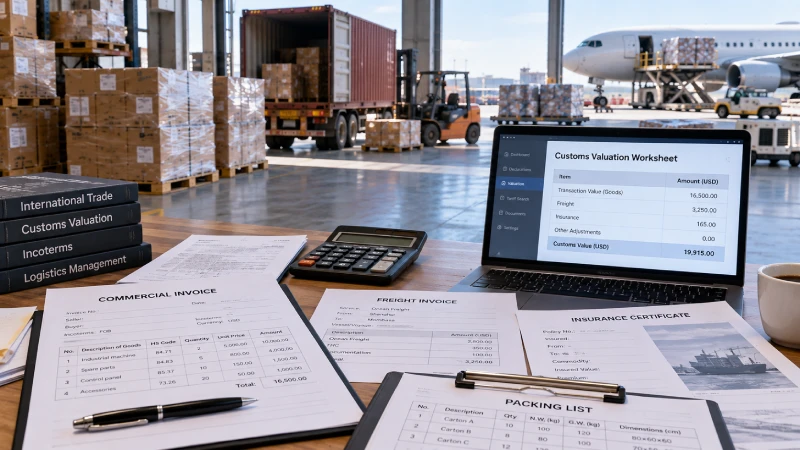
Correct classification does not by itself create an accurate landed-cost estimate.
The importer also needs a defensible customs value.
KRA explains that customs valuation is based on the price actually paid or payable for the imported goods.
Under the EAC customs valuation framework, this transaction value is the primary method where the relevant legal conditions are satisfied.
Transaction Value Is the Starting Point
Imagine a Kenyan buyer purchases machinery from a supplier in Guangzhou.
The commercial invoice shows the agreed selling price.
That invoice is important evidence of the transaction, but Customs may also need to understand:
- the Incoterm;
- what costs are already included in the price;
- whether freight is included;
- whether insurance is included;
- whether packing charges are included;
- whether the buyer supplied materials, tooling, or design work connected with production;
- whether certain commissions, royalties, or licence fees are relevant;
- and whether another statutory valuation adjustment applies.
This is why two shipments with the same factory price do not necessarily produce an identical customs-value calculation when their commercial arrangements are different.
How Freight, Handling and Insurance Affect Customs Value
For imported goods, the EACCMA valuation framework provides for specified additions to the price actually paid or payable, including relevant transport to the port or place of importation, loading, unloading, handling connected with that transport, and insurance.
The correct treatment therefore depends partly on what is already included in the supplier’s selling price.
For example:
EXW price
may exclude substantially more transport-related costs than:
CIF Mombasa price
But the customs declaration should not simply add the same costs twice.
The importer and clearing agent need to understand what the invoice price already includes and apply the valuation rules accordingly.
Air Freight Requires Different Treatment
This is one area where simplified online customs calculators can be misleading.
It is common to see an explanation that customs value is simply:
Cost + Insurance + Freight
for every type of shipment.
That is too broad for Kenya.
The Fourth Schedule valuation provision of the EACCMA states that transport to the port or place of importation is normally added, but specifically provides that for imports by air, freight costs are not added to the price paid or payable. Loading, unloading, and handling associated with transport and insurance are addressed separately.
That does not mean importers should improvise their own air-shipment valuation formula.
It means an air shipment should not automatically be calculated using the same international-freight treatment as sea freight.
If the customs-value calculation materially affects the buying decision, ask the Kenyan clearing agent to review the transaction structure and applicable valuation treatment before relying on the estimate.
When Transaction Value Cannot Be Used
Transaction value is the primary valuation method, but it is not the only method available under the EAC customs framework.
Where customs value cannot be established under the transaction-value method, the rules provide a sequence of alternative methods, broadly covering:
- transaction value of identical goods;
- transaction value of similar goods;
- deductive value;
- computed value;
- a fallback method where the earlier methods cannot determine the value.
For a normal commercial importer, there is no reason to attempt these methods independently unless a valuation question actually arises.
The important point is that:
“Customs did not accept my invoice value” does not automatically mean Customs can use an arbitrary number.
There is a legal valuation framework for determining the appropriate customs value.
What Documents Support Your HS Code and Customs Value?
Classification and valuation become easier to defend when the commercial documents tell the same story.
KRA lists a range of documents that can be required when clearing imported goods, including the commercial invoice, pro forma invoice, Bill of Lading or Air Waybill, Certificate of Origin, freight invoice for sea cargo, packing list, purchase orders or contracts, permits for restricted goods, and CoC for regulated products where applicable. KRA also states that importers of general merchandise should engage a licensed customs clearing agent.
For classification and valuation specifically, it is useful to separate clearance documents from supporting technical evidence.
| Document / Evidence | What It Can Help Establish | Typical Source |
|---|---|---|
| Commercial invoice | Product description, quantity, and transaction price | China supplier |
| Purchase order / sales contract | Agreed price, Incoterm, and transaction structure | Buyer + supplier |
| Proof of payment | Evidence supporting the commercial transaction | Importer |
| Packing list | Quantity, packages, and SKU consistency | China supplier |
| Product datasheet | Function and specifications | Manufacturer |
| Technical drawing | Identification of machinery/components | Manufacturer |
| Catalogue / model information | Product identity and intended use | Supplier/manufacturer |
| Material or composition data | Classification evidence | Manufacturer |
| Bill of Lading | Sea transport details | Carrier/forwarder |
| Air Waybill | Air transport details | Airline/forwarder |
| Freight invoice | Transport charges where relevant | Forwarder/carrier |
| Insurance evidence | Insurance amount where relevant | Insurer/shipper |
| Certificate of Origin | Origin evidence | Appropriate issuing authority |
| Certificate of Conformity | Required for regulated products where applicable | Authorized PVoC process |
| Import permit / licence | Controlled goods where applicable | Relevant Kenyan authority |
Not every shipment requires every item in this table.
A steel machine component may need drawings and material information.
A regulated electrical appliance may involve different technical and compliance evidence.
A chemical shipment may require SDS/MSDS information in addition to its transport and import documentation.
Keep the Invoice, Packing List and Technical Description Consistent
Suppose the purchase order calls the product:
Automatic liquid filling machine
but the commercial invoice says:
Machine parts
and the packing list says:
Equipment accessories.
Even if there is an innocent explanation, the documents now create unnecessary questions.
Before shipment, compare the:
- purchase order;
- invoice;
- packing list;
- product catalogue;
- export information;
- and shipping instructions.
Descriptions do not have to be character-for-character identical, but they should clearly refer to the same goods.
Certificate of Origin
KRA introduced a mandatory Certificate of Origin framework for imported consignments in 2025. KRA’s notice states that imports must generally be accompanied by a COO issued by a competent authority in the country of export, while also identifying specified exceptional cases and provisional measures.
For goods exported from China to Kenya, the COO should therefore be considered during pre-shipment document preparation rather than after the cargo arrives.
PVoC and CoC Are Separate Compliance Questions
An HS code may help identify the product, but classification does not automatically answer whether a particular product falls under KEBS PVoC requirements or another regulatory regime.
For regulated products, KRA lists a Certificate of Conformity from the applicable PVoC process among the relevant import documents.
Check product-specific compliance separately.
Check My Kenya Import Requirements
Before booking, review whether your cargo requires:
- COO;
- CoC/PVoC;
- import permits;
- technical certificates;
- dangerous-goods documents;
- or other product-specific approvals.
This is particularly important for machinery, electrical goods, batteries, chemicals, medical products, and other regulated cargo.
Why KRA May Question a Declared HS Code or Customs Value
A customs query does not always mean there has been deliberate misdeclaration.
Sometimes the available evidence simply does not support the declaration clearly enough.
Classification Questions
A classification may require further review when:
- the invoice description is too vague;
- technical specifications are missing;
- the goods appear different from the invoice description;
- the product’s principal function is unclear;
- an item described as a “part” may have an independent function;
- the declared heading does not fit the material or construction;
- or multiple headings appear potentially applicable.
This is why technical evidence matters.
A clear datasheet can often explain more than a long email exchange after arrival.
Valuation Questions
A declared customs value may require further support when:
- the invoice and payment evidence do not align;
- freight or insurance information is inconsistent;
- the Incoterm is unclear;
- invoice components have not been properly separated;
- the buyer and seller arrangement requires additional examination;
- required valuation adjustments have not been addressed;
- or the underlying commercial transaction cannot be adequately supported.
The importer should retain relevant commercial records rather than treating the supplier invoice as the only document that matters.
What If the Original Estimate Changes?
Start by identifying the reason.
Ask:
Was the HS code changed?
If yes, determine which product characteristic or tariff interpretation caused the classification difference.
Then ask:
Was the customs value changed?
If yes, determine what transaction or valuation component changed.
Finally ask:
Did the tax rule itself change?
A new classification, a different valuation basis, and a new statutory tax measure are three different explanations. They should not be mixed together.
Warning: If two estimates differ, do not simply compare the final tax totals. Compare the tariff code, declared value, Incoterm, freight treatment, exchange rate, and tax assumptions line by line.
When Should an Importer Ask KRA for an Advance Ruling?
For many ordinary products, the importer and licensed clearing agent can prepare the declaration using the applicable tariff and supporting product information.
Some shipments justify a higher level of certainty.
KRA operates an Advance Ruling process through Customs and Border Control. According to KRA, an applicant can request an advance ruling concerning:
- tariff classification;
- origin of goods;
- or the appropriate customs valuation methodology or criteria under a particular set of facts.
The application is made before importation. KRA states that the ruling is binding on Customs and the applicant for the goods and conditions covered by the ruling.
When an Advance Ruling May Be Worth Considering
Examples include:
- high-value recurring imports;
- specialized industrial machinery;
- components whose classification depends heavily on their function;
- products that appear to fit more than one plausible tariff heading;
- a classification difference that materially changes landed cost;
- unusual transaction structures;
- or a recurring valuation issue.
For a one-off low-value shipment with a straightforward product, an advance ruling may not always be commercially necessary.
For a business planning repeated imports of the same high-value product, getting greater certainty before committing to a sourcing program can be much more valuable.
What Information May Be Required?
KRA’s current guidance asks applicants for detailed information that may include:
- applicant details;
- product brand and name;
- function and use;
- composition;
- country of origin;
- catalogue;
- demonstration information;
- samples;
- model and specifications;
- manufacturer;
- certificates;
- MSDS where relevant;
- packaging;
- relevant permissions;
- sales contract;
- intended ports;
- import timeline;
- and the applicant’s suggested classification or valuation methodology.
KRA also asks about relevant existing rulings and pending matters involving the goods.
The detail requested reinforces an important lesson:
Good classification begins with good product information.
How Long Does an Advance Ruling Take?
KRA currently states that:
- the application is free;
- it should be submitted before importation;
- an advance ruling will be issued within 30 days after all requisite information has been received;
- and a ruling is valid for 12 months from the effective date stated in the ruling.
These details should be rechecked if the article is updated in the future.
Can Winsail Issue a Binding Kenya HS-Code Decision?
No.
Winsail can help coordinate China-side freight and shipment information within the scope of the shipment—for example, collecting supplier specifications, organizing cargo details, preparing freight information, and aligning transport documentation.
A freight forwarder’s opinion should not be presented as a legally binding Kenyan customs classification.
Where a binding determination is required, the appropriate KRA process should be used.
China-to-Kenya Workflow: Resolve Classification Before Shipment
For importers sourcing from China, HS-code preparation should be part of the pre-shipment workflow rather than a task left until the vessel is approaching Mombasa.
01 — Collect Product Information From the China Supplier
Before pickup, obtain:
- exact product name;
- photos;
- model;
- material/composition;
- technical specifications;
- use/function;
- catalogue;
- drawings where necessary;
- and SKU quantities.
If several suppliers are involved, collect this information separately for each supplier.
02 — Identify the Proposed EAC Classification
Compare the product facts against the applicable EAC tariff.
Do not rely only on the supplier’s Chinese export code or a generic HS-code website.
The EAC tariff search and legal notes should form part of the review.
03 — Review With the Kenya Importer and Clearing Agent
The importer should ensure that the licensed Kenyan clearing agent has enough information to prepare the import documentation.
This is particularly important when:
- classification is uncertain;
- multiple SKUs are involved;
- permits may apply;
- the shipment contains regulated products;
- or landed cost is sensitive to the tariff classification.
04 — Check Product-Specific Import Requirements
Classification and product compliance should be reviewed together, but they are not the same thing.
Check whether the goods require:
- PVoC / CoC;
- KEBS-related compliance;
- another government agency permit;
- dangerous-goods documentation;
- special labelling;
- or other product-specific approvals.
05 — Align the Commercial Documents
Before booking, compare:
- pro forma invoice;
- final commercial invoice;
- packing list;
- purchase order;
- product specifications;
- and shipping instructions.
Resolve inconsistent descriptions before they are copied into additional documents.
06 — Arrange Pickup, Consolidation and Freight
Once the shipment information is sufficiently clear, cargo can move through the normal China-side logistics process:
Supplier pickup → warehouse/consolidation where required → export preparation → FCL/LCL/air booking → departure
This article is not intended to compare the advantages of sea freight, air freight, LCL, and FCL. Those decisions should be made according to shipment size, urgency, and cost requirements.
07 — Complete Applicable Pre-Loading Information
For containerized shipments destined for Kenyan ports, Kenya introduced its Advance Cargo Declaration platform in August 2026.
KRA’s implementation notice states that exporters shipping applicable containerized cargo to Kenya must obtain the ACD reference at the port of loading. The required upload documents listed by KRA include:
- draft Bill of Lading;
- commercial invoice;
- freight invoice;
- and export declaration.
The ACD portal also indicates that draft information should contain container details and HS codes.
This makes pre-shipment classification even more operationally important.
If the HS code is still being guessed after the container has been packed and is waiting to load, the process is already much less controlled than it should be.
08 — Customs Declaration and Clearance in Kenya
KRA states that importers should engage a licensed customs clearing agent, who uses the relevant import documents to lodge the customs declaration and coordinate the clearance process.
A practical division of responsibility looks like this:
| Party | Practical Role |
|---|---|
| China supplier | Provides accurate product, manufacturing, and commercial information |
| Winsail | Coordinates China-side cargo and freight documentation within agreed service scope |
| Kenya importer | Manages import-side commercial and compliance responsibilities |
| Licensed Kenyan clearing agent | Prepares customs declaration and coordinates clearance |
| KRA | Customs authority and source of binding customs decisions |
For sea freight arriving through Mombasa, the shipment may subsequently move toward Nairobi, Nairobi ICD, or another inland destination depending on the booked route and clearance arrangement.
Those inland-routing decisions should be handled separately from the HS classification itself.
Why Did My Kenya Import Tax Estimate Change?
An estimate prepared during sourcing is only as good as the assumptions behind it.
If the final assessment differs from an earlier calculation, compare the underlying inputs rather than assuming the difference is simply a “customs charge.”
| What Changed? | Why It Matters | What to Check |
|---|---|---|
| HS tariff line | Different tariff treatment may apply | Product facts and EAC tariff |
| Product specification | A different function/material may change classification | Datasheet, model, photos |
| Transaction value | Changes the starting value | Invoice, contract, and payment |
| Freight information | May affect customs valuation | Incoterm and freight invoice |
| Insurance | May affect applicable valuation adjustment | Insurance documentation |
| Shipping mode | Air treatment should not automatically follow sea-freight assumptions | EACCMA valuation rules |
| Currency conversion | KRA customs exchange rates change over time | Applicable customs FX schedule |
| Product-specific measure | Different tax/regulatory treatment may apply | Current law and tariff |
| Exemption/remission | Eligibility must be established | Official documentation |
| Mixed SKU allocation | Products may require separate classifications and values | SKU-level invoice data |
| Document inconsistency | Customs may request clarification | Invoice, packing list, and technical documents |
Currency Can Also Change the Calculation
A supplier may quote in USD, EUR, CNY, or another currency while customs assessment ultimately needs a Kenya-shilling equivalent.
KRA publishes customs foreign-exchange schedules on a recurring basis. At the time this article was researched, KRA had published a schedule covering September 21–27, 2026.
That means two calculations prepared at different times can vary even where the supplier’s foreign-currency invoice value has not changed.
Do not build an evergreen tax estimate using a permanently fixed exchange rate.
Pro Tip: If a landed-cost estimate is important to the purchasing decision, save the assumptions used in the calculation—not just the final number. Record the proposed HS code, supplier value, Incoterm, freight basis, currency basis, and applicable product requirements.
Pre-Shipment HS Code and Customs Valuation Checklist
Before cargo leaves China, work through this checklist.
Product Classification
- Do we know exactly what the product is?
- Do we have the model and technical specifications?
- Is the function clear?
- Are the main materials or composition documented?
- If it is a part, do we know which machine or product it belongs to?
- Has the proposed EAC tariff classification been reviewed?
- Are we relying on more than the Chinese supplier’s HS code alone?
Commercial and Valuation Information
- Does the commercial invoice reflect the actual transaction?
- Is the Incoterm clear?
- Do we have the purchase order or sales contract?
- Can the importer support the transaction value where required?
- Is freight information available?
- Is insurance information available where relevant?
- Have sea and air shipments been treated according to the appropriate valuation rules?
Documentation
- Does the packing list match the invoice?
- Are product descriptions consistent across documents?
- Has the Certificate of Origin requirement been addressed?
- Has PVoC/CoC been checked for regulated products?
- Have any import permits or licences been checked?
- Are technical documents available if Customs needs clarification?
Shipment Coordination
- Does the Kenyan importer have the shipment information?
- Has the licensed clearing agent reviewed important compliance questions?
- Has significant classification uncertainty been escalated before departure?
- For applicable containerized cargo, has the current ACD requirement been addressed?
The earlier these questions are resolved, the easier it is to correct a supplier document, obtain a missing technical file, or adjust a shipment plan.
Once cargo has departed, the available options are normally more limited.
FAQ
Can I use the HS code provided by my Chinese supplier when importing into Kenya?
Use it as a reference, not automatically as the final Kenyan classification. The Kenyan declaration should use the applicable EAC tariff classification based on the product's actual function, materials, specifications, and presentation.
Does Kenya use 6-digit or 8-digit HS codes?
The internationally harmonized portion of the HS extends through six digits, while the EAC customs tariff uses eight-digit classifications for regional customs purposes.
Is customs value the same as the commercial invoice value?
Not necessarily. The transaction price is generally the starting point under the primary customs valuation method, but applicable valuation conditions and statutory adjustments must also be considered.
Is freight included in Kenya customs value?
Freight treatment depends on the applicable valuation rules and shipping mode. Sea freight and air freight should not automatically be treated the same, and the EACCMA specifically provides different treatment for air-freight costs.
What happens if KRA disagrees with my HS code or declared customs value?
Customs may request additional information or evidence. The importer and clearing agent should determine whether the issue concerns classification, valuation, supporting documentation, or another regulatory requirement before responding.
Can I get an official Kenya HS-code decision before shipping?
Yes. KRA provides an advance-ruling process that can cover tariff classification, origin, and specified customs valuation methodology questions. Binding determinations should come through the appropriate KRA process.
What information should I request from my Chinese supplier before checking an HS code?
Ask for the exact product name, function, material or composition, model, technical specifications, product photos, catalogue, drawings where relevant, manufacturer information, and certificates or MSDS where applicable.
Resolve Customs Questions Before the Cargo Leaves China
For most China-to-Kenya shipments, the biggest classification problems do not begin at Customs.
They begin earlier:
A vague supplier quotation becomes a vague invoice.
The vague invoice is copied into the packing list.
The supplier’s export HS code is accepted without checking the EAC tariff.
Several products are consolidated under a generic description.
A duty estimate is calculated before anyone confirms the actual classification.
Then the cargo leaves China.
By the time those assumptions are questioned in Kenya, changing documents, collecting factory evidence, or reconciling different product descriptions becomes considerably more difficult.
A better workflow is:
Supplier product data → proposed EAC classification → compliance review → commercial documents → freight booking → pre-loading documentation → Kenya customs declaration
For containerized cargo, Kenya’s 2026 ACD implementation makes this pre-shipment discipline even more relevant because applicable cargo information is being collected before loading at the origin port.
Winsail Logistics can coordinate supplier pickup, consolidation, FCL/LCL or air freight, and China-side shipment documentation for cargo exported from China. For Kenya import-side classification and clearance, the importer should work with the appropriate licensed clearing agent and Kenyan authorities where an official determination is required.
Send Cargo Details
Before arranging your China-to-Kenya shipment, prepare:
- China pickup city;
- number of suppliers;
- product name;
- product photos and specifications;
- quantity;
- number of packages;
- dimensions;
- gross weight;
- commercial value;
- Incoterm;
- preferred shipping mode;
- and final destination in Kenya.
For complex products, providing the technical information before pickup can help identify documentation or compliance questions while the goods are still in China.
Regulatory Note: This article provides general shipping and documentation information for goods exported from China to Kenya. HS classification, customs valuation, taxes, and regulatory requirements depend on the actual product, transaction, and applicable law. Winsail Logistics does not issue legally binding Kenyan customs classifications or valuation rulings. Binding customs determinations should be obtained through the appropriate Kenya Revenue Authority process where required.
