
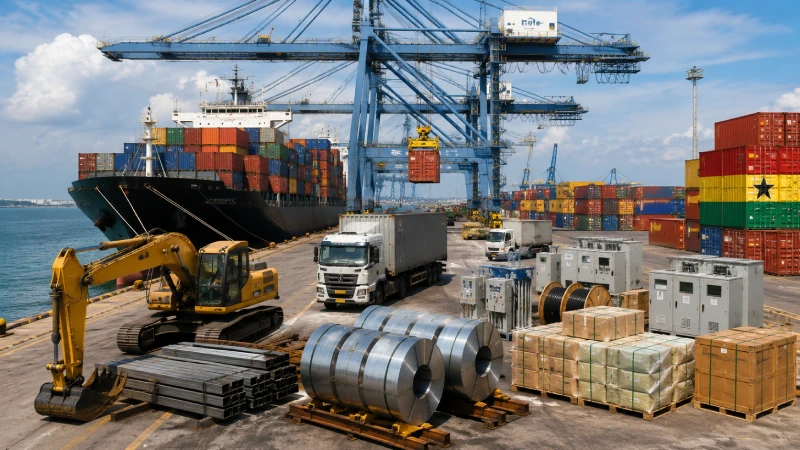
China is Ghana’s largest individual source of imported goods, but understanding what Ghana imports from China requires more than looking at products commonly seen in shops and markets.
According to 2025 Ghana-reported trade data compiled from UN Comtrade, Ghana imported approximately US$4.59 billion worth of goods from China. Ghana’s total merchandise imports were about US$20.17 billion in the same year, meaning China accounted for roughly 22.8% of the country’s imports on the same data basis.
The important point for importers is that a large import value does not automatically mean a product is easy to sell, highly profitable, or suitable for a new business. Customs data measures the value of goods entering Ghana. It does not tell us the retail margin, number of competing distributors, inventory turnover, or how quickly a particular product sells.
This article therefore uses trade data as a starting point: to identify the major products Ghana imports from China, then examine what those categories mean for sourcing, shipping, compliance and commercial decision-making.
Data note: The main ranking in this article uses full-year 2025 Ghana-reported import data. As of August 31, 2026, a directly comparable full-year 2026 dataset is not yet available. Any 2026 information discussed below is therefore used only for regulatory or current-market context, not as a replacement for the 2025 annual ranking.
Quick Answer: What Does Ghana Import from China?
By trade value, Ghana’s largest imports from China in 2025 were machinery, iron and steel, vehicles, electrical and electronic equipment, plastics and miscellaneous chemical products.
Together, the six largest HS2 chapters accounted for approximately 68.2% of Ghana’s US$4.59 billion in imports from China.
| Rank | HS Code | Product Category | 2025 Import Value |
|---|---|---|---|
| 1 | 84 | Machinery, mechanical appliances and boilers | US$847.21M |
| 2 | 72 | Iron and steel | US$727.68M |
| 3 | 87 | Vehicles and related products | US$691.32M |
| 4 | 85 | Electrical and electronic equipment | US$303.28M |
| 5 | 39 | Plastics and plastic articles | US$286.60M |
| 6 | 38 | Miscellaneous chemical products | US$273.49M |
| 7 | 73 | Articles of iron or steel | US$187.92M |
| 8 | 40 | Rubber and rubber articles | US$92.99M |
| 9 | 94 | Furniture, lighting and prefabricated buildings | US$79.89M |
| 10 | 25 | Salt, sulphur, stone, plaster, lime and cement | US$66.43M |
Source: UN Comtrade-based 2025 data, Ghana as reporter, imports from China. Values are rounded. Data reference.
The ranking immediately shows why import statistics should not be confused with consumer-product rankings. Machinery, steel and vehicles alone represented about 49.4% of Ghana’s imports from China by value. Furniture, footwear and many textile products are commercially visible in Ghana, but they are much smaller at the HS2 customs-value level.
Ghana–China Import Snapshot
Ghana imported approximately US$4.59 billion from China in 2025, compared with around US$20.17 billion from all countries. China was therefore responsible for roughly 22.8% of Ghanaian merchandise imports and was the country’s largest individual import partner in the 2025 UN Comtrade-based country ranking.
Ghana’s own Statistical Service also maintains monthly merchandise-trade data by HS2 code and partner country. The StatsBank data is sourced from the Customs Division of the Ghana Revenue Authority and compiled under Ghana’s international merchandise-trade methodology. Ghana Statistical Service StatsBank.
For businesses evaluating an import business from China to Ghana, however, national trade value should be viewed as a market-size signal—not a ready-made product recommendation.
The next step is to look inside these broad categories.
Top Product Categories Ghana Imported from China by Trade Value
The top-10 ranking is dominated by industrial equipment, metals, transport equipment and intermediate goods rather than only consumer products. This is important for buyers researching high demand imports in Ghana: customs value can show where substantial purchasing activity exists, but it cannot prove retail demand or profitability for a specific product.
Before treating any HS2 category as a market opportunity, the category should be broken down to HS4 or HS6 level and matched with the actual Ghanaian buyer segment, sourcing specifications, landed cost and regulatory requirements.
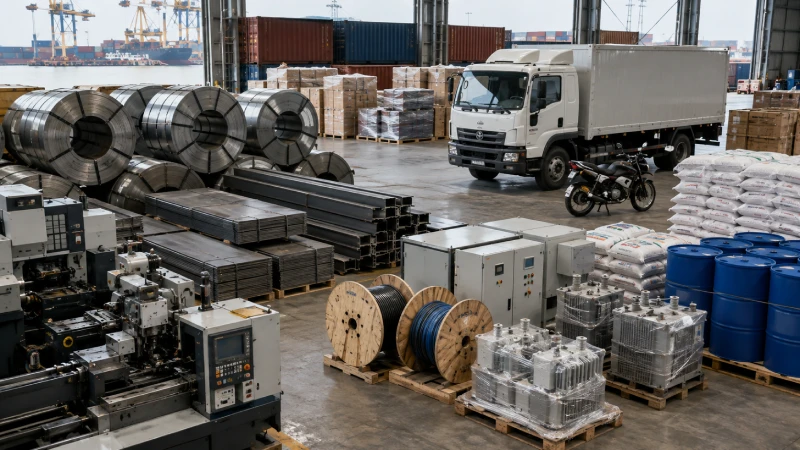
1. Machinery and Mechanical Equipment — HS84
Machinery was Ghana’s largest import category from China in 2025, worth approximately US$847.21 million.
The category is much broader than factory equipment. Major subcategories included approximately:
- US$252.88 million in self-propelled bulldozers, graders and scrapers
- US$61.78 million in sorting, screening, crushing and mixing machinery
- US$58.53 million in refrigerators, freezers and heat pumps
- US$34.56 million in parts for lifting and handling equipment
- US$26.68 million in pumps for liquids
These figures help explain why simply saying “machinery is in high demand in Ghana” is not useful enough. Mining equipment, construction machinery, refrigeration equipment and industrial pumps serve completely different buyers.
Logistics Considerations
Small machines and spare parts can move by LCL or air freight. Standard industrial machines commonly move in FCL containers, while excavators, loaders and oversized equipment may require flat-rack, open-top, RoRo or project-cargo solutions.
Before freight is quoted, importers should obtain the packed dimensions, gross weight, lifting points and centre of gravity.
Commercial Considerations
For machinery, buyers should evaluate capacity, technical specifications, spare-parts availability, installation support, warranty and after-sales service—not only FOB price.
The Ghana Standards Authority also lists industrial machinery among broad groups of High Risk Goods subject to import inspection requirements. Ghana Standards Authority import inspection information.
2. Iron, Steel and Fabricated Steel Products — HS72 and HS73
Iron and steel was Ghana’s second-largest China-origin import chapter in 2025.
Ghana imported approximately US$727.68 million of HS72 iron and steel from China, while articles of iron or steel under HS73 accounted for another US$187.92 million. These chapters should remain separate when presenting statistical totals.
China’s position is especially significant in HS72. Ghana imported around US$806.85 million of iron and steel from the world in 2025, of which approximately US$727.68 million originated in China. That corresponds to roughly 90.2% of Ghana’s HS72 imports on the same reporting basis. World Bank WITS HS72 data.
Important China-origin subcategories included coated or plated flat-rolled steel, semi-finished iron and steel, cold-rolled products, structural sections, bars and rods.
Logistics Considerations
Steel is usually a freight-density problem rather than a cubic-volume problem. A container can reach its practical payload limit well before all available cubic space is occupied.
Long profiles, structures and oversized fabricated items may also require open-top containers, flat racks or breakbulk handling. Corrosion protection, blocking and lashing should be planned before loading.
Commercial Considerations
Importers need to confirm steel grade, dimensions, thickness tolerance, coating, mechanical properties and mill certificates.
“Building materials” should also not be treated as one statistical product. Ghana imports construction-related goods through many chapters, including HS72, HS73, ceramics, glass, aluminium, stone-based materials and plastics.
For a logistics-specific discussion, see Winsail’s guide to shipping building materials from China.
3. Vehicles, Motorcycles and Automotive Products — HS87
HS87 imports from China reached approximately US$691.32 million in 2025, making vehicles the third-largest China-origin import chapter.
But the entire US$691.32 million should not be described as “auto parts.”
The category included approximately:
- US$265.83M in goods transport vehicles
- US$142.88M in motorcycles and motor-assisted cycles
- US$95.91M in tractors
- US$89.03M in passenger cars and vehicles
- US$45.66M in trailers and semi-trailers
- US$19.60M in motor-vehicle parts and accessories
Across all supplying countries, Ghana imported approximately US$3.11 billion of HS87 products in 2025. China supplied about 22.2% of that amount. World Bank WITS HS87 data.
Logistics Considerations
Complete vehicles may move by RoRo, container or flat rack depending on the vehicle and route. Motorcycles are commonly crated and containerized, while mixed spare parts may move by LCL or FCL. Urgent electronic components and lightweight replacement parts can justify air freight.
2026 Compliance Update
Importers of used vehicles need to pay particular attention to Ghana’s changing conformity requirements.
The Ghana Standards Authority announced that its Pre-Export Verification of Conformity programme for imported used vehicles is scheduled to take effect on October 1, 2026. Under the announced regime, imported used vehicles will need to comply with GS 4510:2022 before shipment from the country of origin. Ghana Standards Authority vehicle standards update.
Because that date is still in the future at the time of this article’s August 2026 update, importers should verify the final implementation status before arranging a shipment.
For spare-parts shipments specifically, see Winsail’s guide to shipping auto parts from China.
4. Electrical and Electronic Equipment — HS85
Ghana imported approximately US$303.28 million of electrical and electronic equipment from China in 2025.
The category included telecommunications equipment, semiconductor devices, generating sets, electrical cables, transformers and static converters, batteries and televisions. For example, line-telephony equipment accounted for about US$78.04 million, while semiconductor devices contributed about US$32.89 million.
This chapter illustrates why logistics and compliance often overlap.
High-value or urgent electronics may justify air freight. Appliances and bulk electrical products usually favor sea freight. Batteries can introduce additional transport restrictions depending on chemistry and configuration.
Ghana also regulates several energy-related products. The Energy Commission publishes dedicated standards and labelling regulations covering solar panels, renewable-energy batteries and inverters, including LI 2449, LI 2452 and LI 2461. Energy Commission regulations.
Importers should therefore verify the exact product and HS code rather than assuming all “electrical equipment” follows the same rules.
5. Plastics and Plastic Articles — HS39
Plastics represented approximately US$286.60 million of Ghana’s imports from China in 2025.
A common mistake is to imagine this entire category as finished household plastic products. In reality, a large share consists of industrial raw materials.
Polyethers, epoxides and polyesters in primary forms alone accounted for approximately US$113.24 million. Other notable categories included polyethylene polymers, polypropylene and other olefin polymers, plastic household articles, sheets and films, packaging articles, pipes and fittings.
This creates two very different logistics profiles.
Plastic resins can be relatively dense and weight-driven, while finished plastic household or packaging products may cube out a container before reaching its weight limit.
Commercial evaluation should therefore include polymer grade, technical data sheets, end-use specifications, MOQ and packaging—not merely the broad HS39 market value.
6. Chemical Products — HS38 and Related Chapters
Miscellaneous chemical products under HS38 reached approximately US$273.49 million in China-origin imports during 2025. Ghana also imported about US$55.97 million of organic chemicals under HS29 and US$52.22 million of inorganic chemicals under HS28 from China.
These chapters must remain separate statistically.
From a freight perspective, the first question should not be “FCL or LCL?” It should be:
Is the specific product classified as dangerous goods for transport?
Depending on the chemical, the importer and freight forwarder may need an SDS, UN number, packing group, flash point and carrier approval before transportation can be arranged.
Ghana Revenue Authority also distinguishes unrestricted goods from imports that require licences, certificates or other regulatory approvals. GRA import prohibitions and restrictions.
For chemical sourcing, the commercial checklist should include grade, purity, certificate of analysis, shelf life, packaging and storage conditions.
7. Furniture, Lighting and Prefabricated Buildings — HS94
Furniture, lighting signs and prefabricated buildings accounted for approximately US$79.89 million of Ghana’s imports from China in 2025.
This is a useful example of the difference between market visibility and customs value.
Chinese furniture may be highly visible in wholesale and retail channels, but HS94 is far smaller by import value than machinery, steel, vehicles, electrical equipment or plastics.
Furniture is typically volumetric cargo. Flat-pack design, carton dimensions and loading efficiency can have a major effect on landed cost. For wholesale shipments, FCL can become attractive even when the goods themselves are not especially heavy.
Importers should calculate CBM per saleable unit and consider damage, finish consistency, replacement fittings and assembly requirements.
Other China-Origin Import Categories Worth Watching
Several smaller categories are still commercially relevant:
| Product Category | HS Code | 2025 Imports from China |
|---|---|---|
| Rubber | 40 | US$92.99M |
| Stone, plaster, lime and related materials | 25 | US$66.43M |
| Footwear | 64 | US$60.10M |
| Organic chemicals | 29 | US$55.97M |
| Inorganic chemicals | 28 | US$52.22M |
| Wadding, felt, nonwovens and cordage | 56 | US$47.39M |
| Other made textile articles | 63 | US$46.57M |
| Ceramic products | 69 | US$32.81M |
| Glass and glassware | 70 | US$30.25M |
Source: UN Comtrade-based 2025 Ghana-reported imports from China. Values rounded. Data reference.
Textiles should not be presented as one number unless the included HS chapters are clearly defined. The same applies to solar equipment and construction materials, both of which span multiple tariff classifications.
High-Value Imports Are Not Necessarily High-Volume Imports
Trade value, physical volume and freight volume are three different measurements.
Trade value measures the customs value of the goods.
Physical volume may be reported in kilograms, tonnes, pieces, square metres or another statistical unit.
Freight volume refers to the weight and dimensions that determine how cargo occupies transport capacity.
A US$1 million shipment of electronics and a US$1 million shipment of steel can have completely different transportation requirements.
For this reason, import-value rankings should never be described as rankings by “volume” unless reliable quantity or net-weight data is available for the same products and period.
Heavy, Bulky and High-Value Cargo Require Different Shipping Strategies
The product itself often determines freight economics.
Heavy and dense cargo such as steel, stone, industrial machinery and some raw materials is frequently limited by container payload.
Bulky cargo such as furniture, footwear, textile products and many finished plastic goods is more likely to be limited by cubic capacity.
High-value or sensitive cargo such as electronic components and control systems requires greater attention to packaging, security, damage exposure and transit time.
Oversized and rolling cargo such as excavators, trucks and large machinery may require RoRo, flat rack, open-top or project logistics.
For a broader comparison of routes and shipping options, see Winsail’s shipping from China to Ghana guide.
Regulated Goods vs Standard Commercial Cargo
Product selection should also account for regulatory complexity.
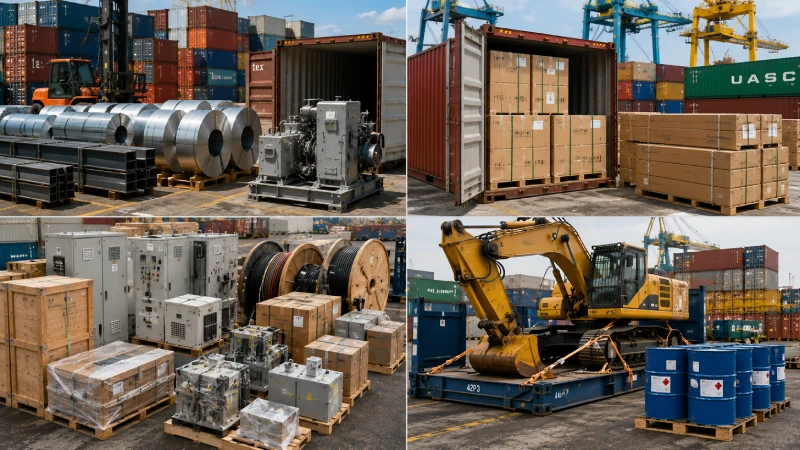
The Ghana Standards Authority identifies a range of High Risk Goods subject to import inspection, including chemicals, electrical appliances and products, electronic products, building materials, vehicle spare parts and industrial machinery. Ghana Standards Authority import inspection information.
That does not mean every other product is automatically “unregulated.” Requirements can depend on the exact HS classification, materials, intended use and applicable Ghanaian standard.
This matters commercially because a product with attractive factory pricing may become a poor business choice if the importer has not budgeted for testing, certification, labelling or product-specific approvals.
How to Evaluate Whether a Product Is Worth Importing
Trade data can help identify market size, but it cannot make the investment decision for you.
A more useful framework is to evaluate at least ten factors:
| Factor | What to Evaluate |
|---|---|
| Market size | Ghana import value at HS4 or HS6 level |
| Competition | Existing importers, distributors and sales channels |
| Product margin | Realistic selling price minus landed and operating costs |
| MOQ | Supplier minimum order and packaging requirements |
| Freight density | Gross weight and CBM per unit |
| Damage risk | Fragility and packaging requirements |
| Regulatory complexity | Standards, licences, testing and approvals |
| Working capital | Deposits, production, freight and inventory funding |
| Inventory turnover | Expected time required to sell and reorder |
| After-sales | Warranty, spare parts, installation and service |
Trade databases can provide useful evidence for market size and China’s supplier share.
They cannot reliably tell you your margin, the competitive intensity of your local sales channel or how quickly your inventory will turn. Those require actual Ghanaian market research.
Choosing a Shipping Method by Product Category
| Product | Typical Shipping Options | Main Consideration |
|---|---|---|
| Machinery | FCL, flat rack, open-top, project cargo | Weight and dimensions |
| Steel | 20GP/FCL, flat rack, breakbulk | Payload and lashing |
| Vehicles | RoRo, container, flat rack | Vehicle type and condition |
| Auto parts | LCL, FCL, air | SKU mix and urgency |
| Electrical goods | LCL, FCL, air | Value, damage and compliance |
| Plastics | LCL or FCL | Raw-material weight vs finished-goods CBM |
| Chemicals | LCL/FCL subject to acceptance | Dangerous-goods classification |
| Furniture | LCL or FCL | Cubic volume and damage |
| Footwear/textiles | LCL, FCL, air | Volume and seasonality |
| Tiles/glass/stone | FCL | Weight and breakage |
The cheapest freight mode on paper is not necessarily the lowest-risk option once cargo characteristics are considered.
Before Choosing a Product to Import from China to Ghana
Before committing capital to a China–Ghana import business, move from broad trade statistics to product-level evidence.
- Identify the exact HS6 or Ghana tariff classification.
- Check Ghana’s import value for that specific product—not only the HS2 chapter.
- Compare China with Ghana’s other supplying countries.
- Research actual Ghanaian distributors, wholesalers and selling prices.
- Obtain supplier MOQ, unit price, carton dimensions and gross weight.
- Calculate landed economics using real freight and import-cost assumptions.
- Check Ghanaian standards and regulatory requirements before paying a large deposit.
- Test samples and confirm technical specifications.
- Estimate how long your capital will remain tied up.
- Plan for warranty, replacement parts and after-sales support where required.
The complete sourcing and import procedure is a separate subject. New importers can refer to Winsail’s how to import from China to Ghana guide for that workflow.
Common Mistake: Choosing Products Only by Import Value
One of the biggest mistakes is seeing that Ghana imported US$847.21 million of machinery from China and concluding that importing almost any machine must be a good business opportunity.
HS84 contains hundreds of different products serving construction companies, mines, factories, retailers, infrastructure contractors and other buyers.
A large national import figure can also be influenced by expensive equipment and large institutional or commercial purchases.
A more reliable decision path is:
HS2 category → HS4/HS6 product → local buyer segment → competition → landed cost → compliance → working capital → commercial viability.
Not:
Large import value → buy the product.
Final Takeaway
The major products Ghana imports from China are dominated by industrial and capital-intensive categories.
Full-year 2025 data shows machinery at approximately US$847.21 million, iron and steel at US$727.68 million and vehicles at US$691.32 million, followed by electrical equipment, plastics and miscellaneous chemicals.
That information is useful because it shows where significant China–Ghana trade already exists. But trade value should be the beginning of product research, not the final answer.
For an importer, distributor or manufacturer evaluating the Ghanaian market, the stronger approach is to move down from HS2 statistics to the exact HS4 or HS6 product, identify the real Ghanaian buyer, calculate landed economics, understand freight characteristics and check regulatory requirements before placing an order.
A product can belong to one of Ghana’s largest import categories and still be unsuitable for your business. Conversely, a smaller customs category can be commercially attractive to a company with the right distribution channel, cost structure and technical expertise.
The data tells you where trade is happening. Your product-level research determines whether there is an opportunity for you.
FAQ
What does Ghana import most from China?
By 2025 trade value, Ghana’s largest imports from China were machinery, iron and steel, vehicles, electrical and electronic equipment, plastics and miscellaneous chemical products.
How much did Ghana import from China in 2025?
Ghana imported approximately US$4.59 billion worth of goods from China in 2025 according to UN Comtrade-based Ghana-reported data.
Is China Ghana’s largest import supplier?
Yes on the 2025 UN Comtrade-based country ranking. China supplied approximately US$4.59 billion of Ghana’s US$20.17 billion in merchandise imports, or about 22.8%.
Are electronics, clothing and furniture Ghana’s biggest imports from China?
Not by customs value. Machinery, iron and steel, vehicles, electrical equipment, plastics and chemicals ranked above furniture, footwear and most individual textile chapters in 2025.
Does a high import value mean a product is profitable in Ghana?
No. Import data does not measure retail margin, competitive intensity, inventory turnover or your operating costs. Those factors require separate commercial research.
Which products are easiest to ship from China to Ghana?
There is no single easiest category. Shipping depends on weight, CBM, dimensions, fragility, cargo value, dangerous-goods classification and regulatory requirements.
Which China-origin products may require extra compliance checks in Ghana?
Examples include electrical products, industrial machinery, selected building materials, chemicals, vehicle spare parts and used vehicles. The exact requirement should always be checked against the individual product and HS code.
Is complete 2026 Ghana–China import data available?
This article uses 2025 as the latest verified complete calendar year for the main product ranking. Any 2026 YTD data should only be added when the period, reporter, partner and HS classification are directly comparable with the equivalent 2025 period.
