
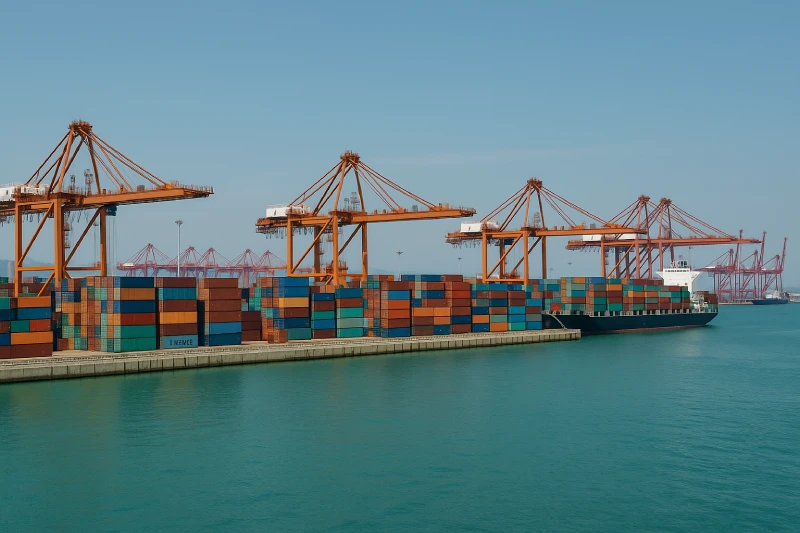
Qingdao Port is one of China’s most important export hubs, offering world-class automated container terminals and fast access to major global routes. It provides highly competitive transit times to the U.S., Middle East, Europe, and Africa, making it ideal for FCL, LCL, Ro-Ro, and bulk shipments.
For manufacturers in Shandong, Hebei, and northern Jiangsu, Qingdao is often the most efficient and cost-effective port to ship machinery, appliances, auto parts, tools, and agricultural products worldwide.
Overview
Qingdao Port, located on the Yellow Sea in Shandong Province, is one of China’s busiest and most strategically important seaports for international trade.
As a core gateway for North China’s manufacturing industries, the port handles millions of TEUs each year and is well known for its world-class automated terminals, deep-water berths, and highly efficient cargo-handling systems. Its position along major Asia–Europe and Trans-Pacific routes makes it a preferred origin port for exporters shipping to the United States, Middle East, Europe, Southeast Asia, and Africa.
The port is divided into several major areas — including the Qianwan Container Terminal, the fully automated Qingdao New Qianwan Terminal (QQCTN), and the Dongjiakou Port Area for bulk cargo — enabling it to support a wide variety of shipment types. From machinery, appliances, and automotive parts to chemicals, agricultural goods, and metal products, Qingdao Port serves as a central export hub for Shandong, Hebei, Henan, and northern Jiangsu.
With reliable carrier schedules, strong consolidation services for LCL, and competitive transit times across global routes, Qingdao Port is an efficient, cost-effective choice for businesses seeking smooth international logistics from northern China.
Port Facts
| Item | Details |
|---|---|
| Port Name | Qingdao Port (青岛港) |
| UN/LOCODE | CNTAO |
| Location | Qingdao City, Shandong Province, China |
| Geographical Coordinates | 36.07° N, 120.32° E |
| Port Type | Deep-water seaport, automated container port |
| Annual Throughput | Over 25 million TEU (approx.) |
| Global Ranking | Top 5–7 busiest container ports worldwide |
| Main Port Areas | Qianwan Container Terminal; Qingdao New Qianwan Automated Terminal (QQCTN); Dongjiakou Port Area; Old Port Area |
| Water Depth | Up to 20 meters (suitable for ULCS vessels) |
| Major Cargo Types | Containers, Ro-Ro, bulk cargo, oil & chemicals |
| Main Export Products | Machinery, appliances, automotive parts, tools, textiles, plastics, agricultural products, metals |
| Major Carriers Operating | Maersk, MSC, COSCO, CMA CGM, Evergreen, ONE, Hapag-Lloyd |
| Suitable Regions | Shandong, Hebei, Henan, Tianjin region, northern Jiangsu |
| Best Shipping Modes | FCL, LCL, Ro-Ro, bulk, chemical logistics |
| Key Trade Routes | USA West & East Coast, Middle East, Europe, Africa, Southeast Asia |
Terminals & Facilities
Qingdao Port is structured into several major port areas, each designed to handle specific cargo types and provide efficient operations for international shipping. Its modern container terminals, deep-water berths, and advanced automation make it one of the most capable seaports in Asia.
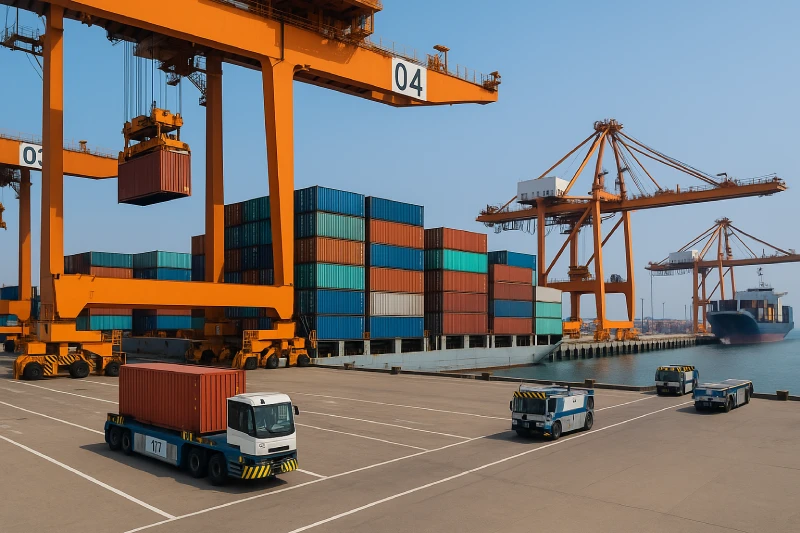
1. Qianwan Container Terminal (QQCT)
The Qianwan Container Terminal is the core hub for containerized exports and one of the busiest terminals in northern China. It supports large-scale FCL and LCL operations, offers stable weekly sailings to major global destinations, and is equipped with high-efficiency quay cranes, RTGs, and advanced tracking systems. This terminal handles the bulk of Qingdao’s outbound shipments of machinery, appliances, auto parts, textiles, chemicals, and general manufactured goods.
2. Qingdao New Qianwan Automated Terminal (QQCTN)
QQCTN is one of the world’s first fully automated container terminals and a key competitive advantage of Qingdao Port. It uses automated guided vehicles (AGVs), automated stacking cranes (ASCs), and intelligent scheduling systems to achieve fast, stable, and low-error operations. The terminal is designed to serve ultra-large container vessels and offers some of the region’s most reliable handling efficiency and turnaround times, especially for high-volume FCL exports.
3. Dongjiakou Port Area
Dongjiakou is a deep-water port zone specializing in bulk and energy cargo. It handles shipments such as iron ore, grain, coal, petroleum, and chemical products. With berths reaching depths of 20 meters, it can accommodate some of the world’s largest bulk carriers and is a critical point of export for northern China’s heavy industry, agriculture, and petrochemical sectors.
4. Old Port Area (Qingdao Port Proper)
The Old Port Area supports general cargo, Ro-Ro shipments, and regional feeder services. It remains an important facility for smaller vessels, domestic shipping lines, and special cargo that requires flexible operations. This terminal is frequently used for vehicles, equipment, breakbulk shipments, and short-sea logistics within East Asia.
5. Supporting Infrastructure & Logistics Facilities
Across all port areas, Qingdao Port provides a wide range of supporting logistics services, including bonded warehouses, cold-chain storage, LCL consolidation depots, customs inspection centers, and multimodal rail-sea connections. These facilities allow exporters to move goods efficiently from inland factories to global markets, making Qingdao an ideal origin point for companies across Shandong, Hebei, Henan, and northern Jiangsu.
Main Export Commodities
Qingdao Port serves as one of northern China’s most important export gateways, supporting a wide range of industrial, consumer, and agricultural products. Its strong manufacturing base in Shandong, Hebei, and surrounding provinces enables the port to handle diverse cargo types across FCL, LCL, Ro-Ro, and bulk shipments.

The following are the major categories of goods exported through Qingdao Port:
1. Machinery & Industrial Equipment
Shandong and northern China are leading production hubs for heavy machinery, pumps, compressors, manufacturing equipment, agricultural machinery, and industrial components. These products represent one of the largest outbound cargo categories from Qingdao, commonly shipped via FCL due to their volume and weight.
2. Home Appliances & Consumer Electronics
Factories in Qingdao, Yantai, Weifang, and surrounding cities produce a significant share of China’s refrigerators, washing machines, air conditioners, small home appliances, and electronic components. These goods are frequently exported to the U.S., Europe, the Middle East, and Africa.
3. Automotive Parts & Vehicles
Qingdao and the greater Shandong region host major automotive parts suppliers. Common exports include brake systems, engine parts, bearings, wheels, EV components, and complete vehicles via Ro-Ro. This category continues to grow due to rising global demand for Chinese auto parts.
4. Metal Products & Construction Materials
Shandong is a major base for metal processing and manufacturing. Typical exports include steel pipes, hardware tools, valves, fasteners, aluminum products, construction fittings, and fabricated metal parts.
5. Plastics, Rubber Products & Packaging Materials
Plastic containers, packaging films, household plastics, rubber parts, and industrial packaging materials are exported in large volumes, especially through LCL consolidation services.
6. Furniture, Household Goods & DIY Products
Provinces near Qingdao manufacture wooden furniture, metal furniture, shelving systems, cleaning tools, garden supplies, and other home-related products. These goods ship regularly to Europe, the Middle East, and Africa.
7. Agricultural & Food Products
Qingdao is also a major export hub for agricultural goods from Shandong and northeast China. Common products include peanuts, garlic, ginger, apples, seafood, grains, and processed food items. Many of these rely on cold-chain facilities and reefer containers.
8. Chemicals & Raw Materials
The port handles large volumes of industrial chemicals, coatings, resins, fertilizers, textiles-related chemicals, and raw materials produced across Shandong’s chemical industry belts.
Key Trade Routes & Major Destinations
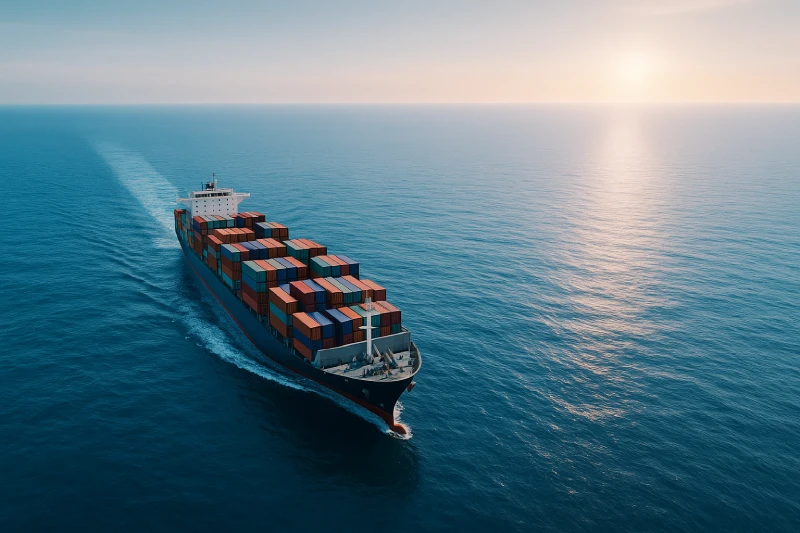
Qingdao Port is a major international gateway linking northern China to key global markets. With frequent sailings operated by major carriers such as Maersk, MSC, COSCO, CMA CGM, and Evergreen, the port offers reliable connections to the United States, Europe, the Middle East, Africa, and Southeast Asia. Its strategic location on the Yellow Sea makes it one of the most important origin ports for exporters shipping both FCL and LCL cargo.
1. United States & Canada
Qingdao has strong Trans-Pacific services to major ports on the U.S. West Coast and East Coast.
Common destinations include:
- Los Angeles
- Long Beach
- Oakland
- Seattle / Tacoma
- New York / New Jersey
- Vancouver
These routes are favored by exporters of machinery, electronics, appliances, tools, and e-commerce goods.
2. Middle East & Gulf Countries
Qingdao is a high-volume export origin for the Middle East due to strong Shandong manufacturing industries and stable carrier schedules.
Key ports include:
- Jebel Ali (Dubai, UAE)
- Dammam & Jeddah (Saudi Arabia)
- Doha (Qatar)
- Kuwait (Shuwaikh / Shuaiba)
- Sohar (Oman)
Machinery, auto parts, building materials, and home appliances dominate this trade corridor.
3. Europe (Northern & Mediterranean)
Qingdao connects directly to major European gateways via Asia–Europe mainline services.
Popular destinations:
- Rotterdam
- Hamburg
- Antwerp
- Felixstowe
- Barcelona
- Piraeus
These routes carry electronics, industrial components, metals, and consumer goods.
4. Africa (East, West & South)
Qingdao exports to Africa have grown rapidly in recent years, especially machinery, tools, household goods, and construction materials.
Common destinations:
- Mombasa (Kenya)
- Dar es Salaam (Tanzania)
- Durban (South Africa)
- Lagos / Apapa (Nigeria)
- Tema (Ghana)
Many of these services operate via transshipment hubs such as Singapore or Port Klang.
5. Southeast Asia & South Asia
Due to proximity and high trade volume, Qingdao maintains extremely frequent sailings to regional hubs.
Key ports:
- Singapore
- Port Klang
- Bangkok / Laem Chabang
- Ho Chi Minh City
- Manila
- Colombo
These routes often handle LCL consolidation, fast lead times, and short-haul feeder services.
6. Latin America
Qingdao is a growing origin port for shipments to Mexico, Brazil, Chile, and Peru.
Common destinations:
- Manzanillo
- Veracruz
- Santos
- Callao
- Valparaíso
Typical cargo includes tools, machinery, automotive parts, furniture, and consumer goods.
Transit Time Table (Qingdao → Global Ports)
Transit times vary depending on the carrier, route, vessel type, and transshipment hubs. The following table provides the typical FCL ocean freight transit time ranges from Qingdao Port to major global destinations. These estimates reflect commonly used schedules for 2024–2025 and serve as a practical reference for exporters planning shipments.
United States & Canada
| Destination Port | Typical Transit Time |
|---|---|
| Los Angeles / Long Beach | 12–16 days |
| Oakland | 16–20 days |
| Seattle / Tacoma | 14–18 days |
| New York / New Jersey | 28–35 days |
| Savannah | 30–38 days |
| Vancouver | 15–20 days |
Middle East & Gulf Countries
| Destination Port | Typical Transit Time |
|---|---|
| Jebel Ali (Dubai) | 18–25 days |
| Dammam | 22–28 days |
| Jeddah | 20–27 days |
| Doha (Hamad Port) | 22–30 days |
| Kuwait (Shuwaikh / Shuaiba) | 22–30 days |
| Sohar | 20–26 days |
Europe (Northern & Mediterranean)
| Destination Port | Transit Time |
|---|---|
| Rotterdam | 30–38 days |
| Hamburg | 32–40 days |
| Antwerp | 30–38 days |
| Felixstowe | 32–40 days |
| Barcelona | 28–36 days |
| Piraeus | 24–32 days |
Africa (East, West & South)
| Destination Port | Transit Time |
|---|---|
| Mombasa (Kenya) | 22–30 days |
| Dar es Salaam | 25–33 days |
| Durban (South Africa) | 26–34 days |
| Lagos / Apapa (Nigeria) | 35–45 days |
| Tema (Ghana) | 35–45 days |
Southeast Asia & South Asia
| Destination Port | Transit Time |
|---|---|
| Singapore | 6–10 days |
| Port Klang | 7–11 days |
| Ho Chi Minh City | 7–12 days |
| Manila | 6–10 days |
| Bangkok / Laem Chabang | 7–13 days |
| Colombo | 12–18 days |
Latin America
| Destination Port | Transit Time |
|---|---|
| Manzanillo (Mexico) | 25–32 days |
| Veracruz | 30–38 days |
| Santos (Brazil) | 35–45 days |
| Callao (Peru) | 32–40 days |
| Valparaíso (Chile) | 35–45 days |
Advantages of Qingdao Port
Qingdao Port offers several strategic advantages that make it one of the most efficient and cost-effective export gateways in northern China. When compared with other major Chinese ports such as Shanghai, Ningbo, and Tianjin, Qingdao stands out in terms of automation, handling efficiency, inland coverage, and stability of shipping schedules.
1. Best Origin Port for Northern China Factories
For manufacturers located in Shandong, Hebei, Henan, Shanxi, and northern Jiangsu, Qingdao Port is typically the fastest and most economical export option.
Compared with Shanghai or Ningbo, trucking distances are significantly shorter, reducing inland freight cost and overall transit time.
2. World-Class Automated Terminal (Higher Efficiency)
Qingdao New Qianwan Automated Terminal (QQCTN) is one of the world’s first fully automated container terminals.
Compared with Shanghai and Ningbo, Qingdao often delivers:
- Faster vessel turnaround
- More stable loading/unloading efficiency
- Lower error rate
- Smoother peak-season operations
This is a major benefit for high-volume FCL exporters.
3. Strong Coverage of Middle East, Africa & Southeast Asia Routes
While Shanghai and Ningbo dominate trans-Pacific services, Qingdao offers excellent direct and transshipment routes to:
- UAE (Jebel Ali)
- Saudi Arabia (Jeddah / Dammam)
- Qatar (Doha)
- Kenya & Tanzania
- South Africa
- Vietnam / Thailand
These regions strongly match the export profiles of Shandong’s machinery, appliances, and auto parts industries.
4. Lower Congestion Risk Compared With Shanghai & Ningbo
Shanghai and Ningbo often face seasonal congestion due to extremely high TEU volume.
Qingdao typically experiences:
- Shorter gate-in waiting time
- More stable yard operations
- Fewer vessel delays
This improves schedule reliability for time-sensitive shipments.
5. Competitive LCL Consolidation Services
Qingdao offers dense LCL consolidation networks connecting to Southeast Asia, Middle East, Africa, and Europe.
For medium-sized exporters, LCL options are often cost-competitive vs Tianjin or Dalian and more frequent in sailing schedules.
6. Deep-Water Berths Suitable for ULCS Vessels
Qingdao’s deep-water berths (up to 20m) support ultra-large container ships (18,000–24,000 TEU).
This gives Qingdao an advantage over Tianjin, where water depth limits vessel size.
7. Balanced Multi-Type Cargo Handling (Containers + Ro-Ro + Bulk)
Qingdao’s diversified terminal capabilities make it ideal for exporters of:
- Machinery
- Vehicles (Ro-Ro)
- Chemicals
- Agricultural goods
- Bulk commodities
This versatility makes it more suitable for mixed cargo industries compared with ports that specialize narrowly.
8. Stable Carrier Availability & Competitive Freight Rates
Because many major carriers operate large capacity in Qingdao, freight rates to key regions (Middle East, Southeast Asia, Africa) are often competitive compared with Shanghai and Ningbo.
Shipping Modes: FCL / LCL / Ro-Ro / Bulk
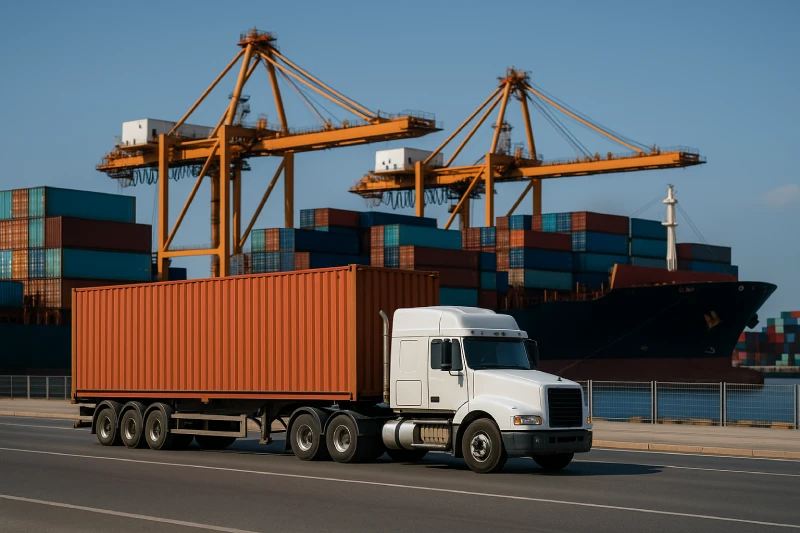
Qingdao Port supports multiple shipping modes, making it a versatile and reliable gateway for exporters across northern China. Whether you are shipping full containers, partial loads, vehicles, or large volumes of raw materials, the port’s diversified terminal infrastructure ensures smooth and efficient operations.
1. FCL (Full Container Load)
FCL is the most common mode for exports through Qingdao Port.
Qingdao offers:
- Stable weekly sailings operated by major carriers
- Competitive rates to the U.S., Middle East, Europe, Africa, and Southeast Asia
- Fast vessel turnaround due to automated terminal operations
- Efficient handling of machinery, appliances, automotive parts, metals, chemicals, and industrial goods
For factories in Shandong, Hebei, Henan, and northern Jiangsu, Qingdao is often the fastest and most economical FCL gateway.
2. LCL (Less than Container Load)
Qingdao’s consolidation network is one of the strongest in northern China.
Benefits include:
- Frequent weekly LCL departures to Southeast Asia, the Middle East, Europe, and Africa
- Bonded warehouses and consolidation depots near the port
- Cost-effective solutions for small and medium-sized exporters
- Reliable handling of electronics, tools, textiles, small appliances, and consumer products
LCL is ideal for businesses exporting in smaller quantities while keeping logistics costs under control.
3. Ro-Ro (Roll-on/Roll-off)
Qingdao is an important Ro-Ro port for northern China’s rapidly growing automotive export sector.
Common Ro-Ro cargo includes:
- Passenger vehicles
- Commercial trucks
- Trailers and machinery
- Agricultural equipment
- EV components and chassis
With expanding Ro-Ro capacity and strong routes to the Middle East, Africa, and Southeast Asia, Qingdao is a preferred export hub for vehicle manufacturers and equipment suppliers.
4. Bulk Cargo (Dry & Liquid Bulk)
Bulk cargo is primarily handled at the Dongjiakou Port Area, one of the deepest and most advanced bulk terminals in China.
Typical exports include:
- Metals and minerals
- Grain and agricultural products
- Chemicals and petrochemical products
- Industrial raw materials
Dongjiakou’s 20-meter-deep berths can accommodate the world’s largest bulk carriers, offering high loading efficiency and reduced vessel waiting times.
Nearby Manufacturing Hubs
Qingdao Port serves as the primary export gateway for one of China’s strongest manufacturing regions. Shandong Province and the surrounding northern provinces host a diverse industrial base, producing machinery, electronics, automotive parts, chemicals, household goods, and agricultural products. Its proximity to these major industrial clusters makes Qingdao Port an efficient origin for both FCL and LCL shipments.
1. Qingdao
Qingdao itself is a major manufacturing center specializing in:
- Home appliances (refrigerators, washing machines, air conditioners)
- Electronics
- Machinery & industrial equipment
- Rubber products
- Food processing & seafood exports
Brands such as Haier, Hisense, and Qingdao’s machinery suppliers export heavily via Qingdao Port.
2. Yantai & Weihai
These coastal cities near Qingdao host strong manufacturing sectors, including:
- Automotive parts & components
- Machinery & metal parts
- Chemical and petrochemical products
- Tools, hardware, and fasteners
Yantai also has large EV and automotive production facilities exporting through Qingdao.
3. Weifang & Zibo
Located in central Shandong, these cities specialize in heavy industry and materials:
- Industrial machinery
- Chemical products
- Ceramics & glass
- Plastic goods
- Construction materials
High-volume FCL cargo from these areas moves naturally through Qingdao Port.
4. Jinan (Capital of Shandong Province)
Jinan is a key hub for industrial equipment, auto parts, and electronics manufacturing.
Common exports include:
- Pumps, compressors, and machine tools
- Vehicle components
- Electrical equipment
- IT hardware and control systems
Many Jinan factories choose Qingdao due to shorter inland transit time compared with Shanghai or Ningbo.
5. Linyi & Rizhao
South Shandong is known for its large-scale manufacturing clusters for:
- Furniture
- Wood products & plywood
- Plastic household goods
- Lighting & DIY products
- Hardware tools
These goods frequently ship via LCL consolidation in Qingdao.
6. Hebei & Henan Provinces
Qingdao Port also serves inland northern China via road and rail links.
Major industries include:
- Steel products & metal fabrication
- Agriculture and food processing
- Machinery & construction equipment
- Automotive and truck parts
For many factories in Hebei and Henan, Qingdao offers shorter transit distances and more stable export routes than Tianjin.
7. Northern Jiangsu
Northern Jiangsu (Xuzhou, Lianyungang region) has fast-growing manufacturing sectors such as:
- Construction machinery
- Industrial parts
- Mining equipment
- Electrical appliances
Although Shanghai and Ningbo are commonly used, Qingdao remains a competitive alternative for exporters seeking shorter inland transport or specific Middle East/Africa routes.
Freight Example
To help exporters better understand real shipping operations from Qingdao Port, here are two recent cases handled by Winsail Logistics. These examples show how different cargo types—automotive parts, industrial machinery, and small-volume shipments—are efficiently managed through Qingdao’s container terminals.
1. LCL Shipment – Brake Discs from Qingdao to Dubai
Case Link: Ocean LCL Freight Service Brake Discs From Qingdao To Dubai
Qingdao Port is an excellent origin for small and medium-volume exports to the Middle East. In this case, we arranged 1.65 CBM of brake discs via LCL service, ensuring safe packing and fast consolidation.
The cargo sailed with EMC and arrived in Dubai in 23 days, demonstrating the speed and reliability of Qingdao’s routes to the UAE. This shipment highlights the port’s strong handling of automotive parts and its cost-efficient LCL network.
2. FCL Shipment – CNC Router from Qingdao to Dammam
Case Link: Ocean Freight Service CNC Router From Qingdao To Dammam
For larger and heavier industrial equipment, Qingdao’s deep-water terminals provide smooth loading operations. In this project, we managed 20.57 CBM of CNC routers shipped in an FCL container with HMM.
The cargo reached Dammam in 27 days, reflecting Qingdao’s strong connectivity to Saudi Arabia and the broader Gulf region. This example shows how the port supports machinery exporters across Shandong and northern China.
FAQ
1. Is Qingdao Port a good choice for shipping to the Middle East?
Yes. Qingdao has strong and frequent routes to the UAE, Saudi Arabia, Qatar, Oman, and Kuwait. With efficient automated terminals and competitive freight rates, it is one of the best origin ports in northern China for Middle East-bound cargo, especially machinery, auto parts, appliances, and construction materials.
2. What is the typical shipping time from Qingdao to Dubai or Saudi Arabia?
Transit time to Dubai is usually around 18–25 days, while shipments to Dammam or Jeddah take about 20–30 days. The exact schedule depends on the carrier, route, and whether transshipment is involved. Qingdao generally offers stable and predictable lead times for both FCL and LCL shipments.
3. Does Qingdao Port support LCL consolidation for small shipments?
Yes. Qingdao has an extensive LCL consolidation network with weekly departures to Southeast Asia, the Middle East, Europe, and Africa. This makes it suitable for small exporters shipping tools, electronics, household goods, spare parts, or mixed cargo that does not fill a full container.
4. Which types of products are most commonly exported from Qingdao?
Major export categories include machinery, industrial equipment, automotive parts, home appliances, metal products, plastics, chemicals, food products, and agricultural goods. Qingdao’s diverse manufacturing base makes it one of China’s most important multi-category export hubs.
5. Should factories in Shandong and Hebei choose Qingdao over Shanghai or Ningbo?
In most cases, yes. For factories located in Shandong, Hebei, Henan, and northern Jiangsu, Qingdao offers shorter trucking distances, lower inland logistics costs, and faster gate-in handling. For many Middle East, Africa, European, and Southeast Asian routes, Qingdao is more efficient and cost-effective compared with Shanghai or Ningbo.
Work With a Reliable Qingdao Freight Partner
Shipping from Qingdao can be simple and cost-effective with the right logistics support. Whether you need FCL, LCL, Ro-Ro, or machinery shipping, our team helps you plan routes, compare carriers, manage documentation, and deliver your cargo safely to its destination.
If you have an upcoming shipment from Qingdao or want a customized quote, our logistics specialist is ready to assist you.
