
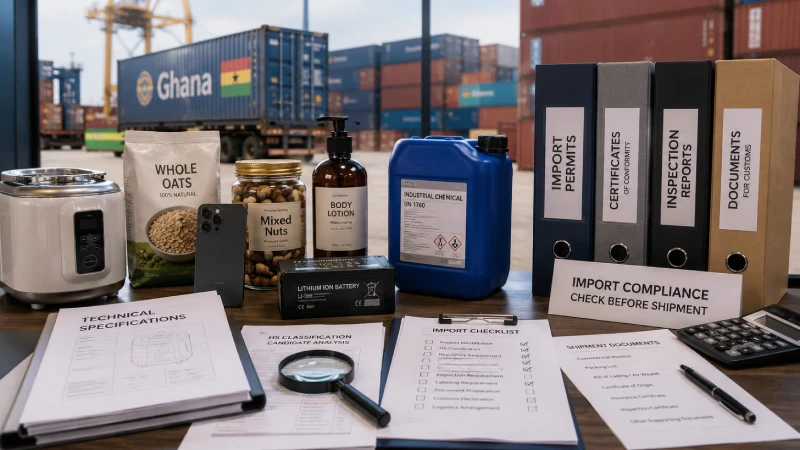
Importing goods into Ghana is not simply a matter of finding an HS code, paying freight and clearing the cargo at Tema Port. For many products, the more important question comes earlier:
Can the product legally enter the Ghanaian market, and what approval must be obtained before it leaves China?
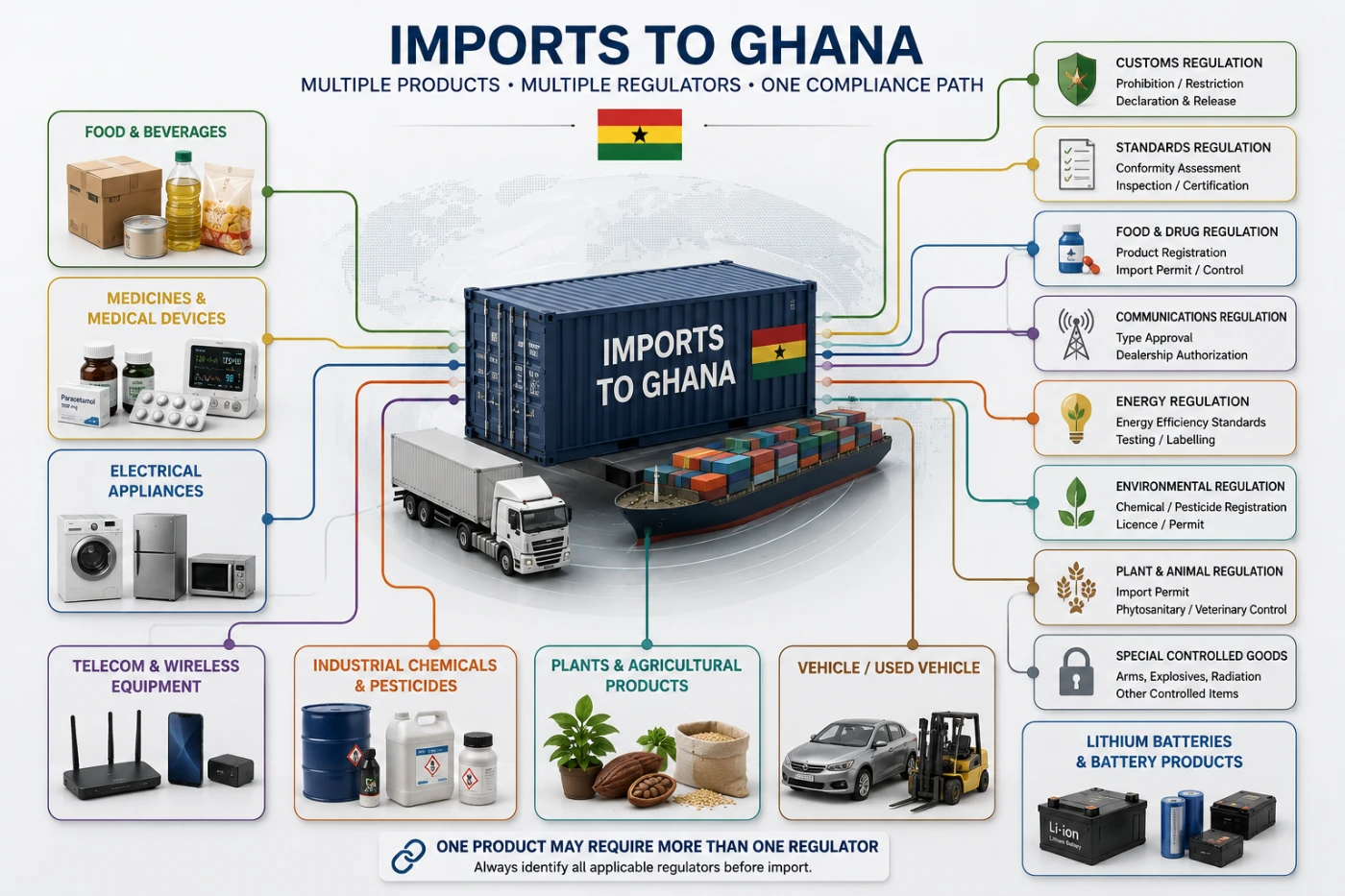
Ghana Revenue Authority (GRA) distinguishes goods that are prohibited from goods that may be imported only after conditions such as licences, permits or certificates have been satisfied. At the same time, sector regulators including the Ghana Standards Authority (GSA), Food and Drugs Authority (FDA), National Communications Authority (NCA), Energy Commission and Environmental Protection Authority (EPA) may impose additional product-specific requirements.
For the complete commercial process from sourcing through shipment and clearance, see How to Import from China to Ghana. For freight routes, transit times and shipping options, see Shipping from China to Ghana.
For an importer, the safest sequence is therefore:
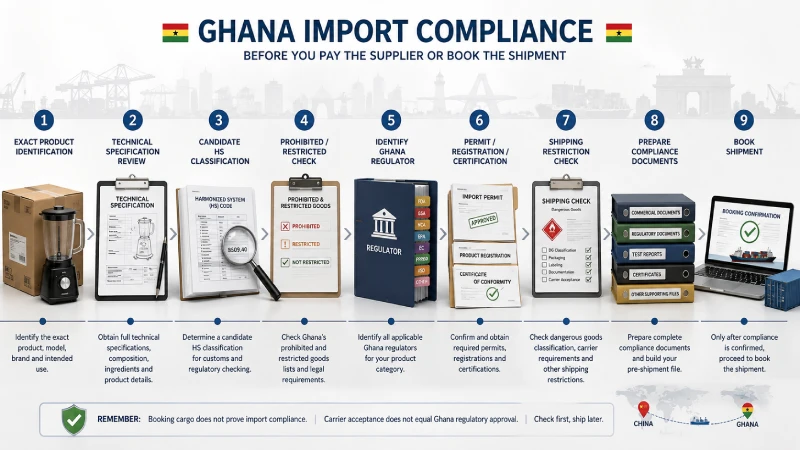
identify the exact product → confirm specifications → determine a candidate HS classification → check prohibition/restriction status → identify the regulator → confirm registration, permit, certification or inspection requirements → check transport restrictions → prepare documents → book the shipment.
Booking cargo does not prove import compliance, and carrier acceptance does not equal Ghana regulatory approval.
Prohibited, Restricted and Regulated Imports in Ghana: What Is the Difference?
These terms should not be used interchangeably.
Prohibited goods
Prohibited goods are products whose importation is barred under Ghanaian law. GRA maintains an official list of absolute import prohibitions, including certain dangerous weapons, counterfeit currency, contaminated food and other goods whose importation is prohibited under Ghanaian law.
Official source: GRA — Import Prohibitions and Restrictions
If a product is genuinely prohibited, obtaining freight space, an invoice or a shipping document does not make it admissible.
Restricted goods
Restricted goods are not necessarily banned. They may be imported only when specific legal conditions have been met.
GRA describes conditional import restrictions as goods requiring licences, certificates, permits or another form of approval before entry. Examples in its current schedule include certain plants and plant products, arms and ammunition, explosives and other goods regulated under specific legislation.
Regulated products
A regulated product may not appear on a simple “prohibited goods Ghana” list at all.
Instead, it may be subject to requirements such as:
- product registration;
- importer licensing;
- an import permit;
- conformity assessment;
- Type Approval;
- testing;
- labelling;
- pre-shipment inspection; or
- regulator inspection before release.
This is particularly important for food, medicines, cosmetics, medical devices, electrical appliances, telecommunications equipment, chemicals and agricultural products.
The compliance terms importers should keep separate
| Term | What It Means |
|---|---|
| Import permit | Authorization from a competent regulator for an import covered by that regulator’s mandate. |
| Product registration | Approval or registration of the particular product, formulation, brand or model for the Ghanaian market. |
| Conformity assessment | Evaluation of whether the product complies with applicable technical standards. |
| Certificate of Conformity | Evidence generated through an applicable conformity-assessment route; it is not the same as Customs release. |
| Pre-shipment inspection | Inspection or verification performed before export where a specific scheme requires it. |
| Import declaration | Customs declaration used for classification, valuation, statistics and border control. |
| Customs release | Final Customs/border release after applicable Customs and regulatory requirements have been addressed. |
GRA confirms that an import declaration is required even where an imported shipment does not contain dutiable goods. It also lists regulatory permits among the documents that may be required during Customs clearance.
There is therefore no single universal “Ghana import licence” that replaces all of these requirements.
Who Regulates Imported Products in Ghana?
The correct regulator depends on what the product actually is.
| Product or Issue | Authority to Check |
|---|---|
| Customs prohibition, restriction, declaration and release | Ghana Revenue Authority — Customs Division |
| Standards and conformity of applicable imported goods | Ghana Standards Authority |
| Food, medicines, cosmetics, medical devices and household chemicals | Food and Drugs Authority |
| Telecommunications, radio and relevant ICT equipment | National Communications Authority |
| Specified energy-efficient appliances and renewable-energy products | Energy Commission |
| Pesticides, industrial chemicals and hazardous waste | Environmental Protection Authority |
| Plants, plant products and regulated agricultural articles | PPRSD, Ministry of Food and Agriculture |
| Animals and animal products | Veterinary Services Directorate |
| Arms and ammunition | Ministry of the Interior / Ghana Police |
| Radioactive materials and radiation equipment | Nuclear Regulatory Authority |
More than one regulator may apply to the same product.
A medical X-ray machine, for example, can raise FDA medical-device requirements and separate Nuclear Regulatory Authority requirements. NRA currently publishes a specific import-permit form for medical X-ray equipment.
Ghana Product Compliance Matrix
Use the following table as a starting point, not as a substitute for checking the exact product.
| Product Category | Status | Regulator | Typical Requirement | When to Check |
|---|---|---|---|---|
| Goods on GRA absolute prohibition list | Prohibited | GRA Customs | Import not permitted unless a lawful exception specifically applies | Before purchase |
| Food and beverages | Regulated | FDA | Product registration and applicable import permit/control | Before shipment |
| Medicines and related health products | Regulated / potentially restricted | FDA | Registration, importer authorization and applicable import controls | Before purchase/shipment |
| Medical devices | Regulated | FDA; NRA where relevant | Registration/authorization and possible radiation permit | Before shipment |
| GSA high-risk/standards-controlled goods | Regulated | GSA | Applicable conformity assessment or inspection | Before shipment |
| Specified energy-regulated appliances | Regulated | Energy Commission | Testing, standards, model/labelling requirements as applicable | Before shipment |
| ICT/radio equipment | Regulated | NCA | Type Approval and applicable dealership authorization | Before import |
| Plants and plant products | Restricted/regulated | PPRSD | Import permit, phytosanitary controls and inspection | Before shipment |
| Pesticides and regulated chemicals | Regulated | EPA | Product/activity-specific registration, licence or permit | Before shipment |
| Arms and ammunition | Restricted | Interior / Police | Special government authorization | Before purchase/shipment |
| Used vehicles | Regulated | GRA/GSA | Vehicle controls; new GSA PVoC scheduled for 1 October 2026 | Before purchase/shipment |
The critical point is that the commercial product name is not enough to make a regulatory determination.
Food, Beverages, Medicines, Cosmetics and Medical Devices: Check FDA First
The FDA’s Centre for Import and Export Control regulates the importation of food, drugs, cosmetics, household chemical substances, medical devices, tobacco and other products within its statutory mandate.
Official source: FDA Ghana — Imports and Exports Control
For FDA-regulated products, importers should normally establish the product’s registration and import status before the shipment arrives. The FDA currently instructs importers to ensure that regulated products are registered before importation and states that its import permits are handled through ICUMS. It also explicitly distinguishes an FDA import permit from a clearing permit.
Before paying a Chinese supplier for an FDA-regulated product, verify:
- exact product category;
- ingredients or formulation;
- brand and manufacturer;
- label design;
- product registration status;
- Ghana importer status;
- applicable import permit;
- certificates of analysis or other supporting documents where required; and
- whether another regulator also applies.
FDA currently states that commercial quantities of unregistered regulated products may be subject to re-export, confiscation or disposal.
For medical equipment, do not assume FDA is always the only regulator. Equipment involving ionising radiation may additionally require NRA authorization.
Products Subject to Ghana Standards and Conformity Controls
The Ghana Standards Authority conducts import inspection and conformity assessment for relevant products and describes a range of high-risk goods that can be subject to its controls, including electrical goods, electronics, building materials, vehicle parts, machinery, toys and other product groups.
Official source: Ghana Standards Authority — Import Inspection
However, importers should be careful when reading older GSA webpages.
The GSA Import Inspection page still contains legacy references to GCNet, while Ghana Customs now operates through ICUMS. More importantly, GSA issued a clarification in July 2026 regarding management of the Ghana EasyPASS Programme. GSA stated that EasyPASS is not a newly introduced programme and confirmed that, from 1 July 2026, applications under the programme are submitted directly to GSA.
Do not therefore assume that:
- every product imported into Ghana requires the same Certificate of Conformity;
- EasyPASS is a new universal import licence;
- an old GCNet-based operating procedure remains current; or
- passing a conformity assessment automatically guarantees Customs release.
For products potentially falling within GSA controls, provide the exact model, specification, applicable test reports, labels and manufacturer information and verify the current conformity route before shipping.
Electrical Appliances: GSA and the Energy Commission May Both Matter
Not every electrical appliance follows the same Ghana import requirement.
The Energy Commission maintains specific Energy Efficiency Standards and Labelling regulations for defined product groups, including products such as solar panels, inverters, lighting products and other regulated appliances.
Official source: Energy Commission Ghana — Energy Efficiency Regulations
The importer should therefore identify the exact model and determine whether a current legislative instrument covers it.
This can affect:
- testing;
- minimum energy-performance standards;
- product/model approval;
- labelling; and
- supporting technical documentation.
Used electrical products also require separate attention. The Energy Commission’s current regulations list includes L.I. 1932, covering the prohibition on manufacture, sale or importation of specified products including used refrigerators, refrigerator-freezers, freezers and used air-conditioners.
Do not generalize this into “all used electrical goods are prohibited.”
Telecom, Wi-Fi, Bluetooth and Radio Equipment: Check NCA Type Approval
Products containing communication or radio functionality may trigger National Communications Authority requirements.
NCA states that Type Approval is used to ensure that applicable ICT and electronic communications equipment meets relevant technical and safety requirements. Its current application portal provides both Type Approval Certificate and Dealership Licence processes.
Official source: NCA Ghana — Application Portal
Before importing products such as routers, cellular devices or equipment containing radio modules, check:
- exact model;
- wireless technology;
- operating frequencies;
- RF modules;
- intended use;
- existing Ghana Type Approval status; and
- whether the importer needs the applicable dealership authorization.
A CE or FCC mark should not be treated as automatic Ghana NCA approval.
Chemicals, Pesticides, Hazardous Materials and Waste
The Environmental Protection Authority is another regulator that may become relevant depending on the chemical, activity and intended use.
Under the Environmental Protection Act, 2025 (Act 1124), the EPA has functions including issuing permits and licences for activities involving pesticides, industrial and consumer chemicals and hazardous waste, and registering pesticides, pesticide products and industrial chemicals.
Official source: Environmental Protection Authority Ghana
For chemical cargo, do not submit an inquiry saying only “chemical.”
Provide:
- chemical name;
- CAS number where applicable;
- composition;
- concentration;
- intended use;
- Safety Data Sheet;
- packaging;
- quantity; and
- dangerous-goods classification.
An SDS is important shipping documentation, but an SDS itself is not an EPA permit or proof that the product is legal to import.
For specific refrigerants, ozone-depleting substances or HFC quota requirements, Further verification required before publication.
Plants, Agricultural Products and Animal Products
PPRSD’s Plant Quarantine Division regulates imports of plants, plant products and regulated articles through import permits, phytosanitary controls, inspections and other plant-health measures.
Official source: Ministry of Food and Agriculture — PPRSD
An importer should establish the exact botanical or commodity identity, origin, intended use, phytosanitary status and import conditions before shipment.
There is, however, an important official-source conflict.
GRA’s current Customs FAQ answers “No” to the question of whether live animals and plants can be imported commercially, while PPRSD describes procedures for importing plants and regulated plant articles. The Veterinary Services Directorate also states that it regulates imports of meat and animal products and quarantines animals entering Ghana.
Winsail should not resolve that conflict on behalf of the authorities.
Further verification required before publication.
For an actual commercial shipment involving live plants or animals, the importer should obtain current product-specific confirmation directly from Customs and the relevant agricultural regulator before purchase or shipment.
Arms, Ammunition and Other Specially Controlled Goods
GRA classifies arms, ammunition and explosives among restricted goods requiring specific authorization.
The Ghana Police Central Firearms Registry states that applications for permits to import or export arms and ammunition by licensed dealers or individuals are submitted to the Minister responsible for the Interior.
Official source: Ghana Police — Central Firearms Registry
These goods must never be treated as ordinary freight simply because a carrier is technically capable of transporting them.
A freight forwarder cannot issue or guarantee the required government authorization.
Used Vehicles: Check the Effective Date Before Shipping
Used vehicles require particularly careful checking in 2026.
GRA’s vehicle-import information requires key vehicle data such as VIN/chassis number, make, model and year for Customs processing. Ghana’s Customs legislation also contains restrictions concerning right-hand-steering vehicles unless the applicable approval is obtained.
Official source: GRA — Vehicle Importation
Separately, GSA announced a new pre-export verification requirement for imported used vehicles under GS 4510:2022.
As of 31 August 2026, this requirement is scheduled to take effect on 1 October 2026. GSA states that used vehicles under the programme will have to demonstrate conformity before shipment from the country of origin.
If you are reading this guide on or after 1 October 2026, the current GSA requirements should be rechecked before relying on this section.
Used Goods Are Not One Legal Category
“Second-hand” should itself trigger a compliance check.
GSA’s official Import Inspection page identifies certain second-hand goods whose commercial importation is prohibited, including used handkerchiefs, underpants, mattresses and sanitary ware.
Other used products can fall under different rules. Used cooling appliances have specific Energy Commission controls, used vehicles have their own regime, and refurbished medical devices raise FDA questions.
The correct conclusion is therefore not:
“Ghana prohibits used goods.”
It is:
“The condition of the product may change its regulatory status, so check the exact category.”
Lithium Batteries: Import Compliance and Shipping Compliance Are Different
A lithium battery shipment can create two separate compliance questions.
First:
Is the battery or battery-powered product compliant with Ghana’s applicable product regulations?
Second:
Can it be legally and safely transported by the chosen carrier and mode?
Battery chemistry, capacity, configuration and application matter. A standalone battery, battery installed in machinery and renewable-energy storage product may not follow the same regulatory pathway.
Documents used for dangerous-goods transport do not replace Ghana product approvals.
Transport compliance answers whether the carrier can transport the cargo. Import compliance answers whether Ghana can admit and release it.
Why the HS Code Matters — and Why It Is Not Enough
An HS code is an important regulatory search key because Customs classification affects tariff treatment and can help identify product-specific controls.
But the code should be combined with technical information.
For example:
- “router” does not identify the RF bands;
- “battery” does not identify chemistry or application;
- “chemical” does not identify composition or concentration;
- “medical equipment” does not tell you whether it emits radiation;
- “vehicle” does not establish age, steering configuration or condition.
During procurement, treat a supplier’s HS code as a candidate classification, not automatic proof of Ghanaian regulatory treatment.
Regulatory Decision Tree Before You Pay the Supplier
Use this sequence before committing to a regulated shipment:
Before You Pay the Supplier
↓
Identify the Exact Product
↓
Obtain Full Technical Specifications
↓
Determine a Candidate HS Classification
↓
Check Ghana Prohibited and Restricted Status
↓
Identify Every Applicable Regulator
↓
Confirm Product Registration Requirements
↓
Confirm Import Permit or Licence Requirements
↓
Confirm Certification, Type Approval or Inspection Requirements
↓
Check Labelling and Testing Requirements
↓
Check Separate Carrier / Dangerous-Goods Restrictions
↓
Build the Compliance File
↓
Book the Shipment
If official sources conflict or you cannot establish the product’s regulatory status, stop the compliance decision and obtain clarification from the competent Ghana authority.
Why Check Compliance Before Paying the Supplier’s Final Balance?
Waiting until cargo reaches Tema can remove many of your practical options.
Before shipment, the Chinese supplier may still be able to:
- provide test reports;
- modify labels;
- supply technical documentation;
- clarify materials or ingredients;
- change a model;
- correct packaging; or
- provide manufacturer authorization.
After arrival, the importer may instead face regulator review, inspection, testing, delayed release and additional storage-related costs.
This is why regulatory verification should be treated as part of procurement, not only as part of Customs clearance.
Before Shipment Checklist
Before Winsail receives a booking for regulated cargo, the importer should ideally have a file containing:
- exact product description;
- manufacturer and brand;
- model/SKU;
- intended use;
- composition or ingredients;
- new, used or refurbished status;
- clear product and label photos;
- candidate HS code;
- applicable Ghana regulator;
- product registration details;
- import permit/licence where applicable;
- technical test reports;
- conformity or Type Approval documents;
- SDS for relevant chemicals;
- battery specifications;
- RF information for wireless equipment;
- phytosanitary or veterinary documents where applicable; and
- VIN, year and steering information for vehicles.
For FDA-regulated shipments, FDA itself advises clearing agents not to wait for the consignment to arrive before applying for the relevant permit.
What If the Cargo Has Already Arrived at Tema Without the Required Approval?
The exact outcome depends on the product and governing law.
Possible risks include:
- regulator hold;
- inspection or testing;
- delayed release;
- document corrections;
- storage, demurrage or detention exposure;
- re-export;
- confiscation or disposal where authorized by law; and
- inability to obtain Customs release.
FDA expressly warns of re-export, confiscation or disposal for certain unregistered commercial imports. GRA separately makes clear that restricted goods require the applicable licences, permits or certificates.
There is no responsible way to quote one universal “penalty for missing an import permit in Ghana.” The consequences depend on the product, violation and regulator.
If you need the broader destination-side process rather than product-admission rules, keep that separate from this page and refer to your Ghana Customs clearance workflow. Freight-cost planning can also be handled separately in Shipping Cost from China to Ghana.
What a Freight Forwarder Can — and Cannot — Do
A freight forwarder can help organize the shipment around the compliance process.
Winsail Logistics can:
- request detailed product information;
- identify likely regulatory triggers;
- ask whether approvals have been obtained;
- organize shipping documentation;
- identify dangerous-goods or carrier restrictions;
- coordinate shipping after the required approvals are available; and
- recommend verification with the competent Ghana regulator.
A freight forwarder should not claim to:
- decide whether a regulated product is legally admissible;
- issue an FDA import permit;
- register a product with FDA;
- issue NCA Type Approval;
- issue an EPA licence;
- guarantee GSA conformity;
- guarantee an HS classification; or
- guarantee Ghana Customs release.
The legal decision remains with the competent Ghanaian authorities.
Build a Pre-Shipment Compliance File
For recurring imports from China, create one compliance folder for each product or model.
A practical structure is:
01 — Product Identity
Specifications, photos, composition, model and intended use.
02 — HS Classification
Candidate HS code and supporting classification records.
03 — Regulatory Determination
Applicable authority, official guidance and regulator correspondence.
04 — Approvals
Registrations, permits, licences, conformity documents, Type Approval and test reports.
05 — Shipping Documents
Commercial invoice, packing list, purchase order and transport documents.
06 — Special Cargo Documents
SDS, battery information, phytosanitary certificates, veterinary documents, RF information or vehicle records.
For repeat orders, also check the validity date of every approval. Do not assume a document used for an earlier shipment remains valid indefinitely.
Common Ghana Import Compliance Mistakes
The most preventable problems usually start before the cargo moves:
- Checking regulations using only a marketing product name.
- Treating the Chinese supplier’s HS code as final.
- Assuming “not prohibited” means “no permit required.”
- Confusing product registration with an import permit.
- Assuming a Certificate of Conformity equals Customs release.
- Starting the regulatory review after the container has sailed.
- Assuming a freight forwarder or shipping line can approve the product.
The better approach is to identify compliance requirements while there is still time to change the purchase.
Who to Contact by Product Type
Use this routing guide as a first check:
| Product Type or Compliance Question | Authority |
|---|---|
| Food, medicines, cosmetics, medical devices | FDA Ghana |
| Mandatory standards / applicable high-risk goods | Ghana Standards Authority |
| Radio, ICT and communications equipment | National Communications Authority |
| Specified energy-regulated appliances and renewable-energy products | Energy Commission |
| Pesticides, industrial chemicals and hazardous waste | Environmental Protection Authority |
| Plants, plant products and fertilizers | PPRSD |
| Animals and animal products | Veterinary Services Directorate |
| Arms, ammunition and explosives | Ministry of the Interior / Ghana Police |
| Radioactive material or ionising-radiation equipment | Nuclear Regulatory Authority |
| Border prohibition, restriction, declaration and release | Ghana Revenue Authority — Customs Division |
If two descriptions apply to the same product, check both regulators rather than selecting only one.
Final Pre-Shipment Rule
For restricted imports in Ghana, the safest question is not:
“Can my supplier ship this?”
Ask instead:
“Which Ghana authority regulates this exact product, and what must be completed before I pay the supplier or allow the cargo to leave China?”
Start with the exact specification. Identify the regulator. Verify the current official requirement. Obtain the required evidence. Then arrange the shipment.
Ghana’s Customs system operates through ICUMS, and GRA requires applicable regulatory permits as part of the import-clearance documentation where relevant. But Customs clearance is the final border process—it should not be the first time the importer discovers that a product needed FDA registration, GSA conformity assessment, NCA Type Approval, EPA authorization or another approval.
For current regulatory verification, consult the competent authorities directly:
- Ghana Revenue Authority — Import Prohibitions and Restrictions
- Ghana Standards Authority
- Food and Drugs Authority Ghana
- National Communications Authority
- Energy Commission Ghana
- Environmental Protection Authority Ghana
Last regulatory verification: 31 August 2026.
Important: Ghanaian regulations, implementation procedures and regulator guidance can change. Product admissibility should always be confirmed against the exact specification, intended use, condition and current official requirements before shipment.
FAQ
What is the difference between prohibited and restricted imports in Ghana?
Prohibited goods cannot normally be imported under the applicable prohibition. Restricted goods may be imported only after specified conditions such as permits, licences or certificates are satisfied. Regulated products may additionally require registration, conformity assessment, Type Approval or inspection.
Does every commercial shipment require a Ghana import licence?
No. There is no single universal import licence for every product. The required permit, registration, certification or approval depends on the exact goods and the competent regulator.
Do FDA-regulated products need approval before shipment?
Importers should verify product registration, importer status and applicable FDA import-permit requirements before importation rather than waiting until the cargo reaches the port.
Does a Certificate of Conformity guarantee Ghana Customs clearance?
No. A Certificate of Conformity addresses an applicable standards requirement. Customs declarations, sector permits, duties, inspections and other regulatory requirements may still apply.
Does electronic equipment need NCA approval or Energy Commission approval?
It depends on the product. Radio or electronic communications functionality may trigger NCA Type Approval, while specified energy-regulated appliances may fall under Energy Commission rules. Some products can also require GSA compliance.
Can a freight forwarder confirm that my product is legal to import into Ghana?
A freight forwarder can identify likely regulatory triggers and coordinate logistics, but only the competent Ghana authority can provide the applicable regulatory authorization or final determination.
What can happen if cargo reaches Tema without the required permit?
Depending on the product and regulator, the shipment may face delayed release, inspection, testing, document corrections, storage-related costs, re-export or other enforcement action.
Why should used goods and lithium batteries be checked separately?
Used condition can change a product's regulatory treatment, while lithium batteries can involve both Ghana product compliance and separate dangerous-goods transport rules.
