
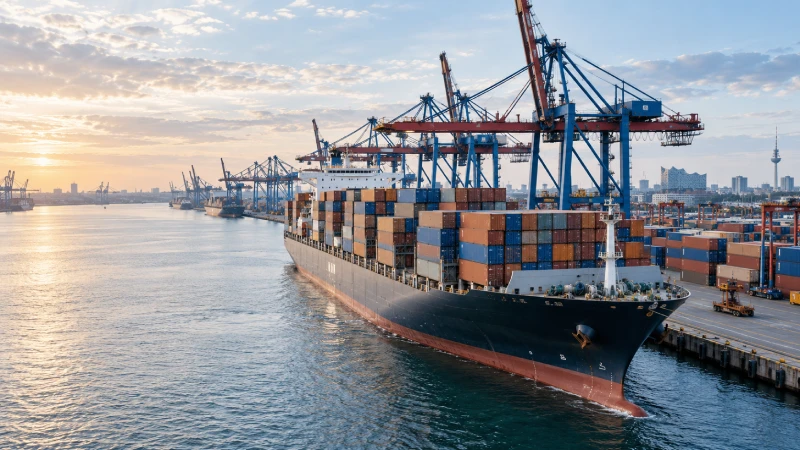
Sea freight from China to Germany is usually the most practical option for regular commercial shipments that are too large for economical air transport and do not require urgent delivery. However, choosing ocean freight is only the first decision.
You still need to decide between LCL and FCL, choose the right Chinese origin port, compare carrier routings, determine whether Hamburg or Bremerhaven offers the better overall solution, understand German destination charges, prepare customs documentation, and arrange inland delivery before free time expires.
The cheapest port-to-port ocean rate is therefore not always the cheapest way to move the shipment.
This guide focuses specifically on ocean freight operations from China to Germany. For a broader comparison of sea freight, air freight, rail freight, express, and door-to-door shipping, see our Shipping from China to Germany guide.
Quick Answer
For most non-urgent commercial cargo, sea freight becomes increasingly attractive as shipment volume and weight increase.
- LCL is normally suitable for smaller shipments that do not justify a full container.
- FCL becomes more attractive as cargo volume increases or when reducing handling, damage exposure, and destination CFS charges is important.
- Major Chinese origins include Shanghai, Ningbo, Yantian/Shenzhen, Nansha, Qingdao, and Xiamen.
- Hamburg and Bremerhaven are the two main German gateways to compare for China-origin container cargo.
- Typical port-to-port planning can range around 30–45+ days, but actual transit depends heavily on the carrier service, port rotation, Suez or Cape routing, transshipment, and congestion.
- German import planning should include destination terminal charges, customs clearance, import duty and VAT, inland transport, and possible storage, demurrage, or detention.
The best route should therefore be chosen based on the complete origin-to-final-destination movement, not ocean freight alone.
When Is Sea Freight the Best Option from China to Germany?
Sea freight works best when cost efficiency matters more than speed.
It is particularly suitable for importers moving regular inventory, machinery, furniture, building materials, auto parts, consumer products, and other commercial cargo in volumes that make air freight expensive.
| Shipment situation | Sea freight fit | Why |
|---|---|---|
| 2–5 CBM commercial shipment | Good | LCL can provide an economical solution |
| 10–15 CBM shipment | Compare LCL and FCL | Destination charges may change the economics |
| 20+ CBM shipment | Strong | FCL often becomes increasingly competitive |
| Heavy machinery | Strong | Sea freight handles high weight efficiently |
| Furniture or bulky cargo | Strong | 40HQ can provide efficient volume utilisation |
| Regular inventory replenishment | Strong | Suitable when lead time can be planned |
| Urgent 200 kg spare parts | Weak | Air freight may better match the deadline |
| High-value, low-weight cargo | Compare | Speed and security may justify air freight |
These ranges are decision prompts rather than fixed rules. There is no universal CBM point at which every shipment should automatically switch from LCL to FCL.
Cargo That Typically Works Well by Sea
Common examples include:
- Industrial machinery
- Mechanical components
- Auto parts
- Furniture
- Homeware
- Building materials
- Textile products
- Consumer goods
- Larger electronics orders
- Palletised commercial cargo
- Heavy or high-density products
- Regular replenishment inventory
When Sea Freight May Not Be the Best Choice
Sea freight may be less suitable when:
- Your delivery deadline is only a few days away.
- Production has already been delayed and there is no schedule buffer.
- The shipment is very small.
- A factory shutdown or line stoppage depends on the goods.
- The cargo has a very high value relative to its weight.
- Missing a launch, exhibition, or sales event would cost more than upgrading the freight method.
In these situations, compare alternative transport methods through the Shipping from China to Germany guide rather than choosing sea freight purely because it has a lower freight rate.
LCL vs FCL from China to Germany
Choosing between Less than Container Load (LCL) and Full Container Load (FCL) has a much bigger impact than simply choosing a per-CBM rate or a container rate.
The correct comparison needs to include origin handling, ocean freight, German destination charges, customs, and inland delivery.
How LCL Shipping Works
With LCL, your goods share container space with cargo belonging to other shippers.
A typical movement looks like:
Supplier → Origin CFS → Consolidation → Container loading → Ocean transport → German CFS → Deconsolidation → Customs release → Delivery
The cargo is normally delivered to a consolidation warehouse or collected from the supplier and moved there. The consolidator groups compatible shipments before loading them into a container.
At the destination, the container is unloaded at a Container Freight Station before the individual shipment can be released.
Advantages of LCL
LCL can be suitable when:
- Your shipment does not fill enough of a container to justify FCL.
- You want to ship smaller batches more frequently.
- Your supplier cannot store goods until a full container quantity is ready.
- Inventory flexibility is more important than minimising handling.
LCL is usually charged based on weight or measurement, often expressed as W/M, together with origin and destination handling charges.
LCL Considerations
The ocean freight component can look very inexpensive, but LCL has more handling stages.
Your cargo may be:
- Collected from the supplier.
- Unloaded at the consolidation warehouse.
- Stored before container loading.
- Loaded with other cargo.
- Unloaded at the destination CFS.
- Segregated from other shipments.
- Reloaded for final delivery.
That extra handling is one reason good export packaging is especially important for fragile, high-value, or moisture-sensitive LCL cargo.
Destination CFS and deconsolidation charges can also make a major difference to the total cost.
How FCL Shipping Works
With FCL, one shipper books the container for the shipment.
A typical movement is:
Empty container positioning → Factory stuffing → Export terminal → Vessel loading → Ocean transport → German terminal → Customs/release → Container pickup → Delivery → Empty return
The container normally stays sealed from the shipper’s loading location until it reaches the consignee or an authorised inspection point, subject to customs or security controls.
Advantages of FCL
FCL generally provides:
- Less cargo handling
- Better control over loading
- Lower exposure to other shippers’ cargo
- Easier loading of palletised or irregular cargo
- More predictable destination handling
- Better economics as cargo volume increases
- Lower risk of CFS delays
FCL can also be attractive before the container is completely full if the LCL destination charges are high enough.
However, FCL introduces another operational issue: container free time.
Once the container is discharged, customs clearance, pickup, warehouse unloading, and empty return must all be properly coordinated.
When Does FCL Become Cheaper Than LCL?
There is no universal answer such as “always use FCL above 15 CBM.”
The actual FCL/LCL crossover depends on:
- Shipment volume
- Gross weight
- Number and dimensions of packages
- Origin CFS charges
- FCL container rate
- LCL W/M rate
- German LCL deconsolidation charges
- Carrier destination charges
- Final German postcode
- Loading efficiency
- Seasonal capacity
- Equipment availability
- Cargo characteristics
For example, one 13 CBM shipment may still make sense as LCL, while another 13 CBM shipment with heavy destination handling, fragile goods, or difficult pallet dimensions may justify comparing a 20GP container.
Pro Tip: Never compare an LCL per-CBM freight rate with an FCL ocean rate alone. Request an all-in origin-to-destination calculation for both options.
| Factor | LCL | FCL |
|---|---|---|
| Main pricing basis | CBM / W/M | Per container |
| Suitable shipment size | Smaller loads | Medium to large loads |
| Consolidation | Required | Not required |
| Destination deconsolidation | Required | No |
| Cargo handling | Higher | Lower |
| Handling damage exposure | Higher | Lower |
| Destination CFS charges | Yes | No |
| Container demurrage exposure | Generally indirect | Important |
| Container detention exposure | Generally no importer-held carrier container | Important |
| Empty-container return | No | Yes |
| Shipment frequency flexibility | High | Depends on cargo volume |
Main China Ports for Sea Freight to Germany
The best Chinese origin port is not simply the largest port or the one with the lowest published ocean rate.
Your supplier location, domestic trucking cost, sailing frequency, container availability, and actual Germany-bound service should all be considered.
Shanghai
Shanghai is a major choice for suppliers in:
- Shanghai
- Jiangsu
- Eastern Zhejiang
- The wider Yangtze River Delta
It offers extensive North Europe services and high sailing frequency.
For factories around Suzhou, Kunshan, Wuxi, and other Yangtze River Delta manufacturing centres, Shanghai may provide an efficient export gateway.
However, nearby Ningbo should also be compared where supplier geography and sailing options allow.
Ningbo-Zhoushan
Ningbo is especially relevant for exporters in Zhejiang and the southern Yangtze River Delta.
Its manufacturing hinterland includes:
- Ningbo
- Yiwu
- Shaoxing
- Taizhou
- Parts of Hangzhou and surrounding Zhejiang
Ningbo has strong North Europe connectivity.
For example, Hapag-Lloyd’s 2026 NE4 service publishes a rotation from Qingdao and Ningbo via Tanjung Pelepas and London Gateway before calling Bremerhaven and Hamburg, illustrating how one service can serve both major German container gateways. Hapag-Lloyd
Shenzhen / Yantian
Yantian is one of the main choices for cargo produced in:
- Shenzhen
- Dongguan
- Huizhou
- Eastern Pearl River Delta
It is particularly important for electronics, consumer products, and manufacturing cargo from South China.
A supplier located in Dongguan, for example, should not automatically be trucked to Shanghai simply because a Shanghai ocean rate appears attractive. The additional domestic haulage, time, and handling may remove the apparent saving.
Guangzhou / Nansha
Nansha can be a strong option for cargo originating from:
- Guangzhou
- Foshan
- Zhongshan
- Jiangmen
- Western Pearl River Delta
Its advantage often comes from reducing China-side trucking distance for factories located west of the Pearl River.
Whether Nansha is better than Yantian depends on the available North Europe service, transshipment pattern, and total cost.
Qingdao
Qingdao is an important origin for cargo from Shandong and nearby northern Chinese industrial areas.
Typical cargo profiles include:
- Machinery
- Tyres
- Chemicals
- Industrial components
- Metal products
- Consumer products
Some North Europe services also originate or call Qingdao before Ningbo and Europe.
Xiamen and Other Origins
Xiamen can be suitable for Fujian cargo, while Tianjin/Xingang may be considered for factories in northern China.
Smaller Chinese ports can also connect into major export services through feeder networks.
The key question is therefore not “which Chinese port is the biggest?” It is:
Which export gateway gives this shipment the best combination of China inland cost, sailing schedule, routing, and German delivery cost?
| China origin | Main manufacturing area | Typical Germany routing | Key decision factor |
|---|---|---|---|
| Shanghai | Shanghai / Jiangsu | North Europe services | Frequency and supplier location |
| Ningbo | Zhejiang | Bremerhaven / Hamburg | Strong Germany connectivity |
| Yantian | Shenzhen / Dongguan | North Europe | Pearl River Delta cargo |
| Nansha | Guangzhou / Foshan | Direct or hub connection | Lower inland pickup for western PRD |
| Qingdao | Shandong | North Europe | North China industrial cargo |
| Xiamen | Fujian | Direct or transshipment | Supplier proximity |
Pro Tip: A port that is slightly farther from Germany can still provide a better shipment if it gives you a stronger sailing schedule, lower China inland cost, and fewer operational handoffs.
Hamburg vs Bremerhaven: Which German Port Should You Use?
For China-origin container shipments, Hamburg and Bremerhaven are the two German gateways most importers should compare.
There is no universal winner.
Your final German postcode, carrier service, terminal, rail option, trucking rate, and free-time conditions can matter more than a small difference in ocean freight.
Hamburg
Hamburg is Germany’s largest seaport. In the first half of 2026, the Port of Hamburg handled approximately 4.0 million TEU. The port also reported that ongoing terminal modernisation had reduced capacity during part of the period. Port of Hamburg
Hamburg can be particularly attractive when:
- Your selected Asia–North Europe service calls Hamburg directly.
- Your final delivery location is efficiently connected through Hamburg.
- Rail or trucking capacity fits the shipment.
- The carrier’s terminal arrangement is favourable.
- Hamburg is an early call in the European rotation.
Hamburg’s position as a major rail-linked port also makes it relevant for inland German distribution.
Bremerhaven
Bremerhaven is another major container gateway with strong rail and road hinterland infrastructure.
The ports of Bremen and Bremerhaven handled approximately 2.6 million TEU in the first half of 2026, an increase of 5.7% year on year. bremenports
Rail is particularly important to the Bremen ports’ hinterland operations. Bremenports reported that rail’s share of container hinterland traffic reached 51.2% in 2023, meaning more than half of those hinterland container movements were carried by train. bremenports
Bremerhaven can be attractive when:
- The service calls Bremerhaven before Hamburg.
- Its inland rail solution is more competitive for your destination.
- Equipment or pickup availability is better.
- Your carrier uses a favourable terminal arrangement there.
- The resulting port-to-door cost is lower.
Hamburg vs Bremerhaven Comparison
| Factor | Hamburg | Bremerhaven |
|---|---|---|
| China connectivity | Very strong | Very strong |
| Container function | Major German gateway | Major container hub |
| Rail hinterland | Extensive | Extensive |
| Road connectivity | Extensive | Extensive |
| Best choice depends on | Service + final destination | Service + final destination |
| Main mistake | Choosing only from ocean price | Choosing only from ocean price |
Suppose one service quotes Hamburg at EUR 150 less than Bremerhaven.
That does not automatically make Hamburg the cheaper solution.
If Bremerhaven offers:
- An earlier vessel call
- Faster release
- A better rail connection
- Lower final-mile trucking
- More practical empty-container return
the total landed logistics cost may be lower.
Pro Tip: Give your forwarder the final German delivery postcode before deciding between Hamburg and Bremerhaven.
Wilhelmshaven can also be relevant for some services, but for most general China–Germany planning, Hamburg and Bremerhaven should be compared first.
Carrier and Routing Decisions Matter More Than the Carrier Name
Many importers ask which shipping line is best from China to Germany.
A more useful question is:
Which specific carrier service is best for this shipment?
A carrier can operate several service strings with different port rotations, transit times, and transshipment arrangements.
Direct Call vs Transshipment
A relatively simple routing could look like:
Ningbo → North Europe → Bremerhaven
Another might involve:
China port → Asian hub → North Europe → Germany
The second option is not automatically bad.
Hub-and-spoke networks can provide high schedule frequency and competitive transit times.
But each additional connection creates another operational dependency. If the first vessel arrives late, the cargo may miss its connecting vessel.
When comparing routings, check:
- Number of transshipment points
- Connection time
- Port rotation
- Schedule frequency
- Published transit time
- Schedule reliability
- Terminal call
- Price
- Contingency options
Compare the Service String, Not Just the Logo
Hapag-Lloyd’s NE4 service is a useful example:
Qingdao → Ningbo → Tanjung Pelepas → London Gateway → Bremerhaven → Hamburg → Rotterdam → Algeciras → Tanjung Pelepas. Hapag-Lloyd
A published 2026 schedule for this service showed transit times of roughly:
- Ningbo → Bremerhaven: 40 days
- Ningbo → Hamburg: 42 days
- Qingdao → Bremerhaven: 45 days
- Qingdao → Hamburg: 47 days
These numbers apply to that particular service and should not be treated as universal China–Germany transit times. Current schedules should always be checked before booking.
A different carrier or service can follow a very different route.
Questions to Ask Before Booking
| Ask your forwarder | Why it matters |
|---|---|
| Which carrier? | Identifies operator |
| What exact service/string? | Shows actual network product |
| Direct or transshipment? | Identifies connection risk |
| What is the port rotation? | Reveals ports before Germany |
| ETD and ETA? | Supports planning |
| Cargo cut-off? | Factory coordination |
| SI cut-off? | Documentation |
| VGM cut-off? | FCL loading compliance |
| Which German terminal? | Pickup and local-charge planning |
| How much free time? | Demurrage/detention risk |
| Where is the empty return depot? | Inland cost |
| What is the alternative sailing? | Contingency planning |
China–Germany Ocean Freight Market Update — September 2026
Asia–Europe routing remains dynamic.
Maersk reported on September 9, 2026 that selected AE19 and AE15 services operated with Hapag-Lloyd were shifting through the Suez Canal rather than the Cape of Good Hope. However, Maersk described these as targeted changes rather than a wider return of the entire East–West network.
The same update also highlighted East Asian typhoon disruption, pressure at German terminals, and congestion at key North European gateways. Maersk Europe Market Update
For importers, the practical lesson is simple:
Do not calculate your delivery date using a generic “China to Germany = X days” assumption. Check the actual sailing and routing being offered for your shipment.
Choosing the Right Container
For standard FCL cargo, the main choices are generally:
- 20GP
- 40GP
- 40HQ
Special cargo may require reefer, open-top, or flat-rack equipment.
20GP
A 20ft general-purpose container is often suitable for:
- Machinery
- Metal parts
- Dense cargo
- Heavy industrial products
The limiting factor may be weight rather than cubic capacity.
40GP
A 40GP provides more loading volume while retaining standard container height.
It can be useful for general cargo where a 20GP is too small but the extra height of a high cube is unnecessary.
40HQ
The 40ft high cube is particularly common for:
- Furniture
- Cartons
- Consumer products
- Household goods
- Light industrial products
- Other high-volume, relatively light cargo
It offers more internal height and volume than a standard 40GP.
| Container | Approx. nominal internal volume | Typical cargo profile |
|---|---|---|
| 20GP | ~33 m³ | Heavy or dense cargo |
| 40GP | ~68 m³ | General cargo |
| 40HQ | ~76 m³ | High-volume cargo |
| Reefer | Varies | Temperature-controlled cargo |
| Open Top | Varies | Over-height machinery |
| Flat Rack | Varies | Oversized/project cargo |
These are equipment planning figures, not guarantees of usable cargo capacity. Actual equipment specifications and allowable transport weight should be checked for the specific container and inland movement.
Why 33 CBM Does Not Mean You Can Load 33 CBM
Actual utilisation depends on:
- Carton dimensions
- Pallet dimensions
- Stacking restrictions
- Cargo shape
- Weight distribution
- Packaging
- Loading method
- Product fragility
A shipment with 28 CBM of poorly stackable machinery may use container space less efficiently than 30 CBM of uniform cartons.
Pro Tip: Ask for a loading calculation based on package dimensions rather than selecting a container from total CBM alone.
Special Containers
Reefer
Used for products requiring controlled temperature, such as certain food, pharmaceutical, or chemical cargo.
Open Top
Suitable for cargo that must be loaded from above or exceeds normal container height.
Flat Rack
Used for oversized machinery and cargo that exceeds normal container dimensions.
Special equipment requires earlier planning because availability, loading requirements, securing, and pricing differ from standard containers.
How Long Does Sea Freight from China to Germany Take?
A realistic answer is:
It depends on the actual service.
For planning purposes, many China–Germany ocean shipments may fall into approximately 30–45+ days port-to-port, but current services can fall outside that range depending on origin, routing, and network conditions.
| Origin | German destination | Indicative planning range | Main variable |
|---|---|---|---|
| Shanghai | Hamburg / Bremerhaven | ~30–45+ days | Service routing |
| Ningbo | Hamburg / Bremerhaven | ~30–45+ days | Service string |
| Yantian / Shenzhen | Hamburg / Bremerhaven | ~30–45+ days | Network and Suez/Cape route |
| Nansha | Hamburg / Bremerhaven | ~30–45+ days | Direct vs connection |
| Qingdao | Hamburg / Bremerhaven | ~35–50+ days | Port rotation |
These are planning ranges, not sailing guarantees.
Current carrier schedules should always be checked before booking.
Why LCL May Take Longer Than FCL
Ocean sailing time may be similar, but LCL requires additional operational steps.
Before departure:
- Cargo collection
- CFS receiving
- Consolidation
- Container planning
- Loading
After arrival:
- Container discharge
- Transfer to CFS
- Deconsolidation
- Shipment segregation
- Release
This can add days compared with an FCL shipment that is released and collected directly from the terminal.
Port-to-Port Time Is Not Door-to-Door Time
A 35-day ocean transit does not mean your shipment will reach the German warehouse in 35 days.
The complete process can include:
Factory pickup → Origin warehouse/container positioning → Export customs → Terminal → Vessel departure → Ocean transport → German discharge → Customs/release → Rail/truck transport → Final warehouse
When planning inventory, build the schedule from cargo-ready date to warehouse delivery, not simply vessel ETD to ETA.
How China–Germany Sea Freight Pricing Actually Works
Ocean freight quotations can be confusing because two forwarders may quote completely different scopes.
One may show a very low sea freight figure but exclude Germany-side costs.
Another may appear more expensive while including terminal handling, customs support, and final delivery.
Always compare the same cost boundary.
FCL Cost Structure
A complete FCL calculation may include:
China pickup + export customs/documentation + origin terminal charges + ocean freight + carrier surcharges + German destination charges + customs brokerage + duty and import VAT + inland transport + possible exceptional charges
The actual ocean freight rate is therefore only one component.
LCL Cost Structure
LCL commonly includes:
Pickup + origin CFS handling + export documentation + W/M freight + destination CFS/deconsolidation + local release charges + customs clearance + final delivery
The difference between LCL and FCL destination handling can materially affect the crossover point.
What Changes Sea Freight Rates?
Ocean freight rates can change because of:
- Supply and demand
- Carrier capacity
- Equipment availability
- Origin port
- Destination port
- Service routing
- Peak season
- Chinese Golden Week
- Chinese New Year
- Blank sailings
- Port congestion
- Fuel-related surcharges
- Environmental surcharges
- Red Sea/Suez routing
- Typhoons and severe weather
- Dangerous goods requirements
- Oversized cargo requirements
This is why freight rates should usually be treated as shipment-specific quotations with validity dates, not permanent price lists.
| Cost item | FCL | LCL |
|---|---|---|
| China pickup | Yes | Yes |
| Origin terminal/CFS | Terminal charges | CFS charges |
| Main freight | Per container | W/M |
| Destination handling | Yes | Yes |
| Destination CFS | No | Yes |
| Documentation | Yes | Yes |
| Customs | Separate unless included | Separate unless included |
| German inland delivery | Separate unless included | Separate unless included |
| Container D&D | Important | Different storage structure |
Pro Tip: When comparing quotations, ask every forwarder to show exactly what is included, excluded, and payable at destination.
German Destination Charges You Need to Budget For
Germany-side charges are one of the most important areas to understand before selecting an ocean freight quotation.
A cheap freight rate can lose its advantage if destination charges are high.
Destination Terminal Handling
FCL shipments normally incur terminal-related charges associated with handling the container after arrival.
The exact structure depends on:
- Carrier
- Terminal
- Port
- Contract
- Equipment
- Service terms
Documentation and Cargo Release
There may be carrier or agent charges associated with destination documentation and release.
Check whether these are included in the forwarder’s quotation.
Customs Brokerage
Customs brokerage is different from customs duty.
The broker’s fee pays for customs-clearance services.
Duty and import VAT are government charges determined by the cargo and import transaction.
Customs Examination or Inspection
If customs or another authority selects the shipment for examination, additional charges can occur for:
- Container movement
- Inspection handling
- Scanning
- Warehouse handling
- Labour
- Storage
These costs are not necessarily predictable before arrival.
LCL Deconsolidation and CFS Charges
LCL shipments may incur:
- CFS handling
- Deconsolidation
- Warehouse handling
- Documentation
- Release charges
- Per-BL charges
- Per-CBM/W/M charges
This is why the destination cost should be checked before choosing LCL.
Inland Delivery and Empty Return
For FCL, the final German transport cost may depend on:
- Container size
- Delivery postcode
- Truck or rail solution
- Delivery appointment
- Container unloading time
- Empty return depot
- Depot availability
- Drop-off requirements
Carrier tariffs can also include specific inland and empty-return-related charges. Maersk’s Germany import information, for example, publishes different charges for various empty-container depot arrangements, illustrating why return location can materially affect inland planning. Maersk Germany Import
| German-side cost | FCL | LCL | Can it often be controlled? |
|---|---|---|---|
| Destination handling | ✓ | ✓ | Limited |
| Documentation/release | ✓ | ✓ | Limited |
| CFS/deconsolidation | — | ✓ | No |
| Customs brokerage | ✓ | ✓ | Quotable |
| Inspection | Possible | Possible | No |
| Storage | Possible | Possible | Often |
| Demurrage | ✓ | — | Often |
| Detention | ✓ | — | Often |
| Inland delivery | ✓ | ✓ | Yes |
| Truck waiting | Possible | Possible | Often |
Port-to-Port vs Door-to-Door Sea Freight
Your quotation should clearly state where the forwarder’s responsibility begins and ends.
Port-to-Port
A basic port-to-port movement may cover:
China port → Hamburg/Bremerhaven
The importer may still need to arrange:
- Customs brokerage
- Import release
- Terminal coordination
- Trucking or rail
- Delivery appointment
- Unloading
- Empty-container return
Port-to-port can work well for experienced importers with their own German logistics partners.
But it can create coordination gaps for companies unfamiliar with German import operations.
Door-to-Door
Door-to-door freight extends the logistics movement to the consignee’s specified location.
It can include:
- China pickup
- Export handling
- Ocean freight
- Germany destination coordination
- Customs brokerage
- Inland delivery
However, door-to-door does not automatically mean DDP.
Responsibility for import duty, VAT, and importer-of-record obligations depends on the agreed Incoterm and service scope.
| Task | Port-to-port | Door-to-door |
|---|---|---|
| China pickup | Optional | Usually included |
| Export handling | Included/contract-specific | Coordinated |
| Ocean freight | Yes | Yes |
| German terminal coordination | Importer/agent | Coordinated |
| Customs brokerage | Importer | Can be included |
| Duty/VAT | Importer | Depends on Incoterm |
| German inland delivery | Importer | Included |
| Empty return | Importer/haulier | Coordinated |
Not Sure Whether FCL or LCL Is Better?
Send the following shipment information:
- Commodity
- Number of packages
- Package dimensions
- Gross weight
- Total CBM
- China pickup location
- Cargo-ready date
- German delivery postcode
We can compare LCL and FCL routing, destination charges, and port-to-door options based on the actual shipment.
Compare Sea Freight Options
Documents Required for China–Germany Ocean Freight
Preparing documentation before the vessel arrives is one of the easiest ways to reduce customs and storage risk.
| Document / information | FCL | LCL | Main purpose |
|---|---|---|---|
| Commercial Invoice | ✓ | ✓ | Customs value and transaction |
| Packing List | ✓ | ✓ | Package/weight details |
| Bill of Lading / Sea Waybill | ✓ | ✓ | Transport document |
| HS/TARIC classification | ✓ | ✓ | Customs classification |
| EORI | ✓ | ✓ | EU customs identification |
| VGM | ✓ | Container-level | Vessel loading |
| ICS2 / ENS data | ✓ | ✓ | EU safety/security filing |
| Product certificates | If applicable | If applicable | Product compliance |
| DG declaration | DG only | DG only | Dangerous goods |
Commercial Invoice
The commercial invoice should accurately describe:
- Seller
- Buyer/importer
- Product
- Quantity
- Unit value
- Total value
- Currency
- Incoterm
- Country of origin where applicable
Descriptions should be sufficiently specific for customs classification.
Avoid generic descriptions such as “parts,” “samples,” “accessories,” or “goods” where a more accurate commercial description is available.
Packing List
The packing list should show details such as:
- Number of cartons/pallets/crates
- Net weight
- Gross weight
- Package dimensions
- Marks and numbers
These figures should remain consistent with the shipping documents.
Bill of Lading or Sea Waybill
The transport document identifies key parties and shipment details.
Before issuing the final B/L, check:
- Shipper
- Consignee
- Notify party
- Port of loading
- Port of discharge
- Cargo description
- Package count
- Container/seal information
Incorrect consignee or release information can delay the cargo at destination.
EORI
An Economic Operators Registration and Identification (EORI) number is required for customs operations in the EU, including imports. European Commission
The importer should therefore confirm its customs setup before the shipment reaches Germany rather than trying to solve it after vessel arrival.
ICS2 and ENS Data
The EU’s Import Control System 2 requires advance safety and security information through an Entry Summary Declaration (ENS) for goods entering or transiting the EU.
The European Commission states that goods entering or transiting the EU are subject to ICS2 safety and security data requirements and that accurate, complete information is important for successful filing. European Commission ICS2
This makes accurate house-level cargo descriptions and party information increasingly important.
VGM for FCL Containers
Under SOLAS requirements, the verified gross mass of a packed container must be provided before vessel loading.
The IMO states that the shipper is responsible for providing VGM and that verified container mass is a condition for loading a packed container onto the vessel. International Maritime Organization
Do not leave the VGM process until after the terminal cut-off.
Pro Tip: Finalise consignee details, commodity description, package information, and HS-code review before documentation cut-off. Fixing errors before departure is usually easier and cheaper than fixing them after arrival.
Customs Clearance in Germany for Sea Freight
German customs clearance should be prepared before the container arrives.
A basic import process normally involves checking:
- Importer/EORI
- HS/TARIC code
- Customs value
- Commercial invoice
- Packing list
- Transport documents
- Product-specific restrictions
- Customs broker instructions
- Duty and VAT funding
- Product compliance documentation
Customs Duty
There is no single customs-duty percentage for goods shipped from China to Germany.
The tariff depends on:
- HS/TARIC classification
- Product
- Origin
- Applicable EU trade measures
- Possible anti-dumping or additional duties
- Quotas or other measures
EU Access2Markets and TARIC should be used to verify the actual product-specific rate and import requirements. EU Access2Markets
For this reason, customs duty should always be checked using the actual commodity code rather than estimated from a generic “China import duty” percentage.
German Import VAT
Germany’s standard import VAT rate is 19%, while a reduced rate of 7% applies to certain goods. German Customs confirms these rates in its import guidance. German Customs
However, import VAT should not simply be calculated as:
product value × 19%
The taxable base can also include customs duty and relevant transport or ancillary costs.
German Customs gives examples showing how customs value and import-VAT calculations can include relevant transport costs. Your customs broker should calculate the actual amount from the shipment documents and applicable rules.
If the First EU Port Is Not Germany
Not every shipment ultimately delivered to Germany has to enter the EU through Hamburg or Bremerhaven.
For example:
China → Rotterdam → Germany
or:
China → Antwerp → Germany
can also be used.
In these cases, the first EU entry point affects safety/security and customs procedures, while the cargo may subsequently move under the appropriate customs transit or clearance arrangement to Germany.
This is another reason to understand the actual carrier routing rather than looking only at the final delivery country.
Planning Hamburg or Bremerhaven to the Final German Delivery Point
The ocean leg ends at the port.
Your supply chain does not.
The inland movement from Hamburg or Bremerhaven can materially affect both total cost and total transit time.
Start With the Final Postcode
Before choosing the German discharge port, provide the final delivery postcode.
Typical destinations might include:
- Hamburg
- Berlin
- Hannover
- Bremen
- Duisburg
- Essen
- Düsseldorf
- Cologne
- Frankfurt
- Nuremberg
- Stuttgart
- Munich
For a southern German destination, the lowest ocean rate may not produce the lowest inland cost.
Your forwarder should compare:
Ocean rate + destination charges + rail/trucking + empty return + free-time exposure
Truck vs Rail vs Barge
Truck
Truck delivery can provide flexible door delivery and can be practical for shorter inland distances or time-sensitive container movement.
Rail
Rail can be particularly attractive for long-distance container transport between northern German ports and inland logistics hubs.
Bremerhaven has a strong rail-focused hinterland network, with more than half of its container hinterland traffic moving by rail according to bremenports data. bremenports
Barge
Barge connections may form part of some inland European solutions, particularly through river-connected hubs.
However, water levels can affect capacity and schedules, so current inland conditions should be checked when barge is part of the route.
FCL Delivery Process
A typical import FCL sequence is:
- Vessel arrives.
- Container is discharged.
- Customs documents are processed.
- Customs release is obtained.
- Carrier/terminal release is confirmed.
- Truck or rail pickup is arranged.
- Container reaches the consignee.
- Cargo is unloaded.
- Empty container is returned.
Every step needs to happen within the available operational window.
Check the Receiving Warehouse Before Delivery
Before dispatching the container, confirm:
- Delivery appointment
- Opening hours
- Forklift availability
- Loading dock
- Container access
- Unloading equipment
- Labour
- Maximum unloading time
- Restrictions for 40ft containers
- Heavy cargo requirements
- Whether the container needs to remain on chassis
- Whether grounding is required or possible
If a truck arrives and the warehouse cannot unload the container, waiting-time and detention costs can increase quickly.
Pro Tip: The best German port is the one that gives you the best complete delivery solution, not necessarily the port with the cheapest ocean freight.
Demurrage, Detention and Free Time in Germany
For FCL imports, demurrage and detention are among the most avoidable extra costs.
What Is Demurrage?
Demurrage generally applies when the full carrier container remains inside the terminal or relevant facility beyond the agreed free time.
What Is Detention?
Detention generally applies when the container has left the terminal but remains with the consignee or haulier beyond the allowed free period before empty return.
What About Storage?
Terminal storage and carrier demurrage charging structures can differ.
Do not assume every “storage” or “demurrage” line item refers to the same thing.
Always check the tariff and booking conditions.
Free Time Is Not a Universal Germany Rule
There is no single free-time allowance for every container arriving in Germany.
Terms depend on the:
- Carrier
- Contract
- Port
- Equipment
- Inland transport mode
- Negotiated rate
For example, Maersk’s Germany import tariff effective August 1, 2026 states that its demurrage/detention free time is calculated in calendar days and defines demurrage from full-container discharge until gate-out and detention from full-container gate-out until empty-container return. Maersk Germany Import
That is a carrier tariff example, not a general rule for every Germany shipment.
Common Causes of Demurrage and Detention
| Problem | Possible result | Prevention |
|---|---|---|
| Customs documents submitted late | Container remains at terminal | Prepare clearance before ETA |
| Incorrect B/L details | Release delayed | Check draft before issue |
| Importer/EORI issue | Customs delay | Verify before shipping |
| Receiver unavailable | Delivery postponed | Confirm warehouse appointment |
| Customs examination | Extra dwell time | Allow contingency |
| Port congestion | Reduced operational window | Monitor ETA and terminal status |
| Empty depot confusion | Late empty return | Confirm return depot early |
| Slow unloading | Detention/waiting | Prepare labour/equipment |
| Weekend or holiday | Calendar-day exposure | Check tariff definition |
Pro Tip: Ask for demurrage and detention free-time terms before booking. Confirm whether days are calendar or working days and where the empty container must be returned.
What Cargo Is Suitable for China–Germany Sea Freight?
Ocean freight can handle a very broad range of commercial cargo, but different commodities require different planning.
| Cargo | Sea freight suitability | Main consideration |
|---|---|---|
| Machinery | Excellent | Weight and securing |
| Furniture | Excellent | Volume / 40HQ utilisation |
| Auto parts | Excellent | Packaging and classification |
| Consumer products | Excellent | Inventory planning |
| Electronics | Good | Moisture and security |
| Batteries | Conditional | DG classification |
| Chemicals | Conditional | IMDG requirements |
| Food | Conditional | Import/product requirements |
| Temperature-sensitive cargo | Reefer | Temperature control |
| Oversized machinery | Special equipment | Open Top / Flat Rack |
| Urgent spare parts | Poor | Transit time |
Machinery and Heavy Cargo
Sea freight is often particularly suitable for machinery because high weight makes air freight expensive.
However, check:
- Package weight
- Forklift/crane requirement
- Container floor loading
- Weight distribution
- Lashing
- Container payload
- German road weight limitations
- Delivery-site unloading capability
Furniture and Bulky Consumer Goods
Furniture and other high-volume cargo often work well in 40HQ containers.
For these products, loading efficiency and protection against moisture should be considered.
Electronics
Electronics can be shipped by sea when delivery time allows.
Important issues may include:
- Moisture protection
- Anti-static protection
- Theft/security risk
- Lithium batteries
- Product compliance
- Cargo insurance
Batteries and Dangerous Goods
Lithium batteries, chemicals, and other dangerous goods require correct classification and carrier acceptance.
Do not book the cargo as general goods simply to obtain a lower rate.
Misdeclaration can result in:
- Booking cancellation
- Port delay
- Additional charges
- Safety risk
- Regulatory consequences
Common Sea Freight Risks from China to Germany
Good sea-freight planning is less about eliminating every possible delay and more about controlling the risks you can influence.
| Risk | Where it occurs | What to do |
|---|---|---|
| Wrong LCL/FCL choice | Quotation | Compare all-in costs |
| Cheapest but slow routing | Booking | Check service string |
| Transshipment delay | Ocean network | Evaluate routing |
| Cargo rollover | Origin | Book space early |
| Blank sailing | Network | Keep schedule buffer |
| Missed cargo cut-off | China | Coordinate supplier |
| Incorrect VGM | Origin | Verify container weight |
| Weak packaging | CFS/ocean | Use export-grade packaging |
| Container condensation | Ocean | Use moisture protection |
| LCL handling damage | CFS | Reinforce/palletise |
| DG misdeclaration | Booking | Classify correctly |
| Documentation mismatch | Customs | Pre-check documents |
| Customs examination | Germany | Keep contingency |
| Port congestion | Germany | Monitor terminal status |
| Demurrage | Terminal | Pre-clear cargo |
| Detention | Inland | Plan unloading/return |
| Truck waiting | Delivery | Confirm warehouse slot |
China to Germany Sea Freight Booking Checklist
Before asking for a sea freight quotation, prepare enough information for the forwarder to price the shipment correctly.
Before Requesting Rates
Provide:
- Commodity
- HS code if known
- Supplier address
- Number of packages
- Package dimensions
- Gross weight
- Total CBM
- Cargo value
- Dangerous goods status
- Cargo-ready date
- Incoterm
- Final German postcode
Without these details, a freight quotation may only be a rough indication.
Before Choosing a Quotation
Check:
- LCL or FCL
- Container type
- Port of loading
- Port of discharge
- Carrier
- Service string
- Direct or transshipment
- ETD
- ETA
- Cargo cut-off
- SI cut-off
- VGM cut-off
- Origin charges
- Ocean freight
- Destination charges
- Customs brokerage
- Free time
- Inland delivery
- Empty-container return
A quotation that only says “Shanghai → Hamburg, 40HQ, USD X” is not enough to make a complete logistics decision.
Before Vessel Arrival
Confirm:
- Commercial documents completed
- EORI valid
- HS/TARIC reviewed
- Customs broker instructed
- Customs funds available where required
- Arrival notice monitored
- B/L release completed
- Delivery appointment planned
- Truck/rail transport reserved
- Empty return requirements checked
Early preparation gives your broker and forwarder time to solve problems before storage or demurrage begins.
How to Choose the Best Sea Freight Option from China to Germany
The best sea freight solution is rarely determined by one rate.
A practical decision sequence is:
1. Confirm the Cargo
Know the commodity, volume, weight, packages, and ready date.
2. Compare LCL and FCL
For medium-sized shipments, request both calculations.
3. Choose the Most Practical Chinese Origin
Consider supplier location and inland transport rather than ocean freight alone.
4. Review the Actual Carrier Routing
Check the service string, transshipment, port rotation, and current schedule.
5. Compare Hamburg and Bremerhaven
Use your final German postcode and inland transport requirements.
6. Check the Total Cost
Include destination charges, customs, and inland delivery.
7. Prepare German Customs Before Arrival
Do not wait for vessel discharge before resolving EORI, classification, or documentation problems.
8. Confirm Free Time and Empty Return
This is essential for FCL imports.
The objective is not simply to find the lowest ocean freight rate.
It is to find the option that gives the right balance of:
total cost + transit time + routing reliability + cargo handling + customs readiness + inland delivery
Plan Your Sea Freight from China to Germany
Choosing ocean freight is only the beginning of the shipping decision.
The right combination of LCL or FCL, China origin port, carrier service, Hamburg or Bremerhaven routing, and German inland delivery can materially affect both total cost and lead time.
Before booking, compare the complete shipment rather than the ocean rate alone.
Send us your:
- Commodity
- Package quantity and dimensions
- Gross weight
- Total CBM
- China pickup location
- Cargo-ready date
- German delivery postcode
We can compare practical sea freight options from China and help you evaluate FCL vs LCL, carrier routing, German destination costs, and port-to-door delivery.
Compare FCL & LCL Options
FAQ
How long does sea freight from China to Germany take?
Port-to-port ocean freight commonly requires approximately 30–45+ days for planning purposes, although actual transit depends on the Chinese origin, carrier service, Suez or Cape routing, transshipment, port rotation, and congestion. Door-to-door lead time is longer because it also includes origin handling, destination clearance, and inland delivery.
Is Hamburg or Bremerhaven better for shipments from China?
Neither port is automatically better. Compare the actual carrier service, port rotation, final German postcode, rail or truck cost, destination charges, terminal conditions, free time, and empty-container return before deciding.
Should I use FCL or LCL from China to Germany?
LCL is generally more suitable for smaller shipments, while FCL becomes increasingly attractive as volume grows. The decision should be based on complete origin-to-destination cost, not CBM alone.
At what volume should I switch from LCL to FCL?
There is no fixed universal threshold. Once a shipment reaches a medium-sized volume, request both LCL and FCL calculations because German destination handling, cargo weight, package dimensions, and final delivery location can change the crossover point.
Should I use a 20ft or 40ft container?
A 20GP is often suitable for heavy, dense cargo, while a 40GP or 40HQ is more suitable when volume is the main constraint. Package dimensions, weight distribution, and loading restrictions should also be checked.
What charges are paid when a container arrives in Germany?
Possible Germany-side costs include destination terminal handling, documentation or release fees, customs brokerage, customs duty, import VAT, inspection charges where applicable, inland delivery, storage, demurrage, detention, truck waiting, and empty-container-related costs.
What documents are needed for sea freight from China to Germany?
Typical documents and data include a commercial invoice, packing list, Bill of Lading or Sea Waybill, HS/TARIC information, EORI, ICS2/ENS shipment data, VGM for packed FCL containers, product-specific certificates where required, and dangerous-goods documentation when applicable.
What is the difference between demurrage and detention?
Demurrage generally applies while the carrieru0026#x27;s full container remains inside the terminal beyond agreed free time. Detention generally applies after the container has been picked up but the empty container is not returned within the allowed period.
Can a container be delivered directly from Hamburg or Bremerhaven to my warehouse?
Yes. After customs and carrier release, FCL containers can normally move by truck, rail, or an intermodal combination to the consignee. Confirm that the receiving site can accept and unload the selected container within the agreed time.
Is door-to-door sea freight more expensive than port-to-port?
The quoted amount is normally higher because door-to-door includes a wider service scope. Compare both options on the same cost boundary by adding terminal handling, customs coordination, inland transport, and other required charges to the port-to-port option.
