

Shipping cost from China to the USA is not calculated from weight alone. A shipment weighing 100 kg may be billed as 100 kg, 160 kg, or more, depending on its carton dimensions and service type. For a broader overview of available routes, methods, transit times, and import considerations, visit our Shipping from China to USA hub. This guide focuses specifically on calculating per-kilogram costs, checking chargeable weight, and determining whether an air freight or express quotation is complete.
Quick Answer: How Much Does Shipping from China to the USA Cost per KG?
As a general market reference, standard air freight is usually more economical for commercial shipments above approximately 100–150 kg, while express courier services are often more practical for samples and smaller urgent shipments.
Public China–USA benchmarks may suggest approximately $5 per kg for express shipments below about 150 kg and approximately $3 per kg for standard air freight between roughly 150 and 500 kg. These figures should be treated only as broad transportation benchmarks, not guaranteed door-to-door rates. Actual prices can be considerably higher depending on origin, destination, cargo type, dimensional weight, fuel surcharges, season, and available capacity.
Air freight prices can change quickly when capacity tightens or fuel costs increase. Any published rate range should therefore show an update date and be used only for preliminary budgeting. A firm quotation must be based on the final packing details and current market conditions.
For a shipment-specific estimate, you need at least:
- Number of cartons
- Gross weight per carton
- Outer dimensions of every carton
- China pickup city
- US destination ZIP code
- Cargo description
- Required delivery time
- Airport or door service
Weight without carton dimensions is not enough to calculate the final shipping cost.
Step 1: Calculate Actual Weight
Actual weight is the gross physical weight measured on a scale.
It includes:
- The products
- Inner packaging
- Export cartons
- Protective materials
- Pallets or crates, when used
The formula is:
Total actual weight = Sum of the gross weight of all cartons
Suppose you have four cartons weighing 25 kg each:
4 cartons × 25 kg = 100 kg actual weight
Use packed gross weight rather than product net weight. A supplier may describe the products as weighing 92 kg, but the cartons and protective packaging could increase the shipment’s gross weight to 100 kg.
Step 2: Calculate Volumetric Weight
Aircraft capacity is limited by both weight and space. Lightweight cartons that occupy significant space may therefore be charged according to volumetric weight, also called dimensional weight.
The standard formula is:
Volumetric weight = Length × Width × Height × Number of cartons ÷ Dimensional divisor
Where:
- Length, width, and height are the outer carton measurements in centimeters
- The number of cartons applies when all cartons have identical dimensions
- The dimensional divisor depends on the service and carrier
Volumetric Weight for Standard Air Freight
A commonly used planning formula for standard air cargo is:
Air freight volumetric weight = Length × Width × Height ÷ 6,000
The general air cargo calculation compares dimensional weight with actual gross weight. The higher result is normally used to calculate the transportation charge.
For example:
- Carton dimensions: 80 × 60 × 50 cm
- Number of cartons: 4
Calculation:
80 × 60 × 50 × 4 ÷ 6,000 = 160 kg
Even when the four cartons physically weigh only 100 kg, standard air freight may be priced using 160 kg.
Volumetric Weight for Express Shipping
International express couriers frequently use a different dimensional divisor.
A common planning formula is:
Express volumetric weight = Length × Width × Height ÷ 5,000
The exact divisor should always be confirmed for the selected carrier, account, and service.
Using the same four cartons:
80 × 60 × 50 × 4 ÷ 5,000 = 192 kg
The same physical shipment could therefore be calculated as:
- 100 kg actual weight
- 160 kg standard air freight volumetric weight
- 192 kg express volumetric weight
This is why two quotations can show very different billable weights even when both forwarders received the same packing list.
How to Calculate Multiple Cartons
When all cartons have the same dimensions and weight, multiply the single-carton calculation by the number of cartons.
When carton sizes vary, calculate each carton separately:
- Record the outer dimensions and gross weight of each carton.
- Calculate the volumetric weight of each carton.
- Apply the carrier’s rating and rounding rules.
- Add the applicable billable weights together.
- Confirm the final chargeable weight with the forwarder.
Do not calculate from the largest carton and apply that figure to every package unless all cartons are identical.
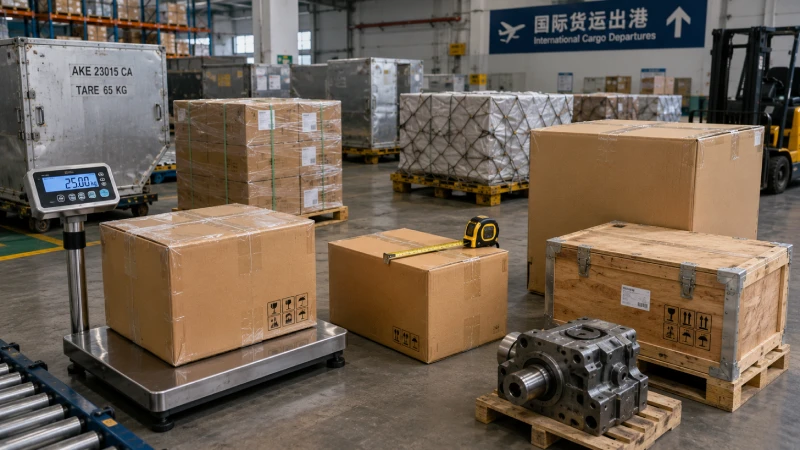
Step 3: Identify the Chargeable Weight
Chargeable weight is the figure used to calculate the transportation charge.
The formula is:
Chargeable weight = Greater of actual weight or volumetric weight
Using the previous example:
| Calculation Method | Weight |
|---|---|
| Actual gross weight | 100 kg |
| Standard air volumetric weight | 160 kg |
| Express volumetric weight | 192 kg |
The chargeable weight would be:
- 160 kg for standard air freight
- 192 kg for express shipping
For dense cargo, actual weight usually controls the price. For lightweight or bulky cargo, volumetric weight is more likely to apply.
Worked Shipping Cost Examples
The following examples demonstrate how dimensions influence the billed weight. They do not represent firm freight quotations.
| Shipment | Packing Details | Actual Weight | Express DIM Weight | Air Freight DIM Weight | Likely Billing Basis |
|---|---|---|---|---|---|
| 10 kg sample | 40 × 30 × 20 cm | 10 kg | 4.8 kg | 4 kg | Actual weight |
| 30 kg express shipment | 2 × 50 × 40 × 30 cm | 30 kg | 24 kg | 20 kg | Actual weight |
| 50 kg carton | 80 × 60 × 50 cm | 50 kg | 48 kg | 40 kg | Actual weight |
| 100 kg bulky shipment | 4 × 80 × 60 × 50 cm | 100 kg | 192 kg | 160 kg | Volumetric weight |
| 300 kg machine parts | 6 × 60 × 40 × 30 cm | 300 kg | 86.4 kg | 72 kg | Actual weight |
Example: Cost to Ship a 50 kg Carton
A carton measures 80 × 60 × 50 cm and weighs 50 kg.
Express volumetric weight:
80 × 60 × 50 ÷ 5,000 = 48 kg
Standard air volumetric weight:
80 × 60 × 50 ÷ 6,000 = 40 kg
Because the actual weight of 50 kg is higher, the chargeable weight remains 50 kg.
Using an illustrative rate of $6.50 per kg:
50 kg × $6.50 = $325 base freight
The $325 figure is not necessarily the total door-to-door cost. Pickup, export handling, customs clearance, and US delivery may still need to be added.
Example: Cost to Ship a 100 kg Bulky Shipment
Four cartons each measure 80 × 60 × 50 cm and weigh 25 kg.
Actual weight:
4 × 25 kg = 100 kg
Standard air volumetric weight:
4 × 80 × 60 × 50 ÷ 6,000 = 160 kg
Using an illustrative standard air freight rate of $4.50 per kg:
160 kg × $4.50 = $720 base freight
Calculating the cost from the physical weight alone would produce:
100 kg × $4.50 = $450
That estimate would understate the base transportation charge by $270.
Example: Cost to Ship 300 kg of Machine Parts
Six cartons each measure 60 × 40 × 30 cm and weigh 50 kg.
Actual weight:
6 × 50 kg = 300 kg
Standard air volumetric weight:
6 × 60 × 40 × 30 ÷ 6,000 = 72 kg
Because 300 kg is higher than 72 kg, the chargeable weight remains 300 kg. Dense products such as metal fittings, tools, motors, and machine parts are therefore normally billed according to actual weight.
How Weight Brackets Affect the Rate per KG
Air freight does not always use one fixed rate for every shipment. Forwarders and airlines commonly quote rates according to chargeable-weight brackets.
A quotation may contain brackets such as:
| Weight Bracket | Typical Application |
|---|---|
| Minimum charge | Very small air cargo shipments |
| Under 45 kg | Small shipments that may be better suited to express |
| +45 kg | Shipments from 45 to 99 kg |
| +100 kg | Shipments from 100 to 299 kg |
| +300 kg | Shipments from 300 to 499 kg |
| +500 kg | Larger commercial air shipments |
The rate per kilogram may decrease as the chargeable weight enters a higher bracket.
For example:
- 92 kg at $5.40/kg = $496.80
- 100 kg at $4.80/kg = $480
In this simplified example, rating the shipment at the 100 kg break would produce a lower total freight charge than rating it at 92 kg.
This is known as a weight-break calculation. It does not mean the cargo physically weighs 100 kg. It means the lower +100 kg rate makes the 100 kg charge more economical.
Always check:
- The chargeable-weight bracket
- The minimum charge
- Whether the quoted rate applies to the full weight
- Whether surcharges are included
- How fractional kilograms are rounded
Express Shipping vs Standard Air Freight
Express shipping and standard air freight may both move by aircraft, but their pricing structures and service scopes are different.
| Factor | Express Courier | Standard Air Freight |
|---|---|---|
| Best suited to | Samples and smaller urgent shipments | Commercial shipments and heavier cargo |
| Common dimensional divisor | Carrier-specific, often 5,000 | Common planning divisor of 6,000 |
| Service scope | Usually integrated door delivery | Airport or customized door service |
| Customs process | Courier-managed under the agreed service | Usually coordinated with a forwarder and broker |
| Rate structure | Courier tariff or account rate | Airline and forwarder weight brackets |
| Additional charges | Remote area, oversize, special handling | Origin, terminal, clearance, and delivery charges |
For a fuller service and transit-time explanation, see Air Freight from China to USA. Readers comparing individual courier networks can refer to DHL vs FedEx vs UPS from China to USA.
Courier formulas must still be checked individually because the dimensional divisor, package measurement rules, and fractional-weight rounding can vary by carrier and account.
Airport-to-Airport vs Door-to-Door Cost per KG
A basic air freight rate normally represents only one part of the complete logistics cost.
Airport-to-Airport
This usually covers the main air transportation between the selected departure and arrival airports.
It may exclude:
- Supplier pickup
- Export declaration
- Origin terminal handling
- Destination terminal charges
- Customs clearance
- Final US delivery
Door-to-Airport
This may include China pickup, export handling, and air transportation, but the importer remains responsible for destination handling, customs clearance, and cargo collection.
Door-to-Door
A door-to-door quote may include pickup in China, export handling, international air freight, destination processing, and delivery to the specified US address.
However, “door-to-door” does not automatically mean that customs duties and taxes are included. The quotation must state whether the shipment is delivered under DAP, DDP, or another agreed arrangement.
A $4/kg airport-to-airport rate cannot be compared directly with an $8/kg door-to-door rate. The service scope must first be standardized.
What Should Be Included in a Complete Quote?
The total logistics cost can be expressed as:
Total shipping cost = Base freight + origin charges + destination charges + customs-related services + final delivery
A complete quotation should clarify the following components:
| Cost Component | What to Check |
|---|---|
| Base freight | Rate per kg and chargeable-weight bracket |
| Minimum charge | Whether a shipment minimum applies |
| China pickup | Supplier address and collection vehicle |
| Export handling | Export declaration and terminal handling |
| Security screening | Whether screening is included |
| Fuel surcharge | Fixed, percentage-based, or adjustable |
| Destination handling | Airport and terminal charges |
| Customs clearance | Brokerage service and document fees |
| Final delivery | ZIP code and delivery conditions |
| Duties and taxes | Included, excluded, or paid by importer |
| Special handling | Batteries, dangerous goods, oversize, or fragile cargo |
Airport handling, screening, fuel, security, dangerous-goods, and terminal handling fees may apply in addition to the standard air transportation charge.
For a broader explanation of costs across air, express, and ocean services, use Shipping Cost from China to USA.
Freight Quote Comparison Checklist
When comparing two quotations, check more than the advertised rate per kilogram.
| Quote Item | Forwarder A | Forwarder B |
|---|---|---|
| Actual weight | ||
| Dimensional divisor | ||
| Volumetric weight | ||
| Chargeable weight | ||
| Weight bracket | ||
| Minimum charge | ||
| Base freight | ||
| Fuel surcharge | ||
| China pickup | ||
| Export handling | ||
| US destination handling | ||
| Customs clearance | ||
| Final delivery | ||
| Duties and taxes | ||
| Quote validity | ||
| Total estimated cost |
Common warning signs include:
- A quote calculated without carton dimensions
- No dimensional divisor shown
- No destination ZIP code used
- Unclear customs-clearance responsibility
- Destination charges marked “to be confirmed”
- No validity date
- No explanation of remeasurement
- A very low rate covering only airport transportation
How to Reduce Chargeable Weight
Reducing unnecessary carton volume can lower the shipping cost without changing the product quantity.
Consider the following actions:
- Use cartons that closely match the product size.
- Remove unnecessary empty space.
- Avoid carton bulges and protrusions.
- Flat-pack products where possible.
- Compress textiles and soft goods safely.
- Review whether retail packaging is required for a bulk order.
- Compare consolidated and separate-carton arrangements.
- Measure finished export cartons rather than product packaging.
- Maintain sufficient protection for fragile cargo.
For example, reducing one carton from 80 × 60 × 50 cm to 80 × 60 × 45 cm changes its express volumetric weight from:
80 × 60 × 50 ÷ 5,000 = 48 kg
to:
80 × 60 × 45 ÷ 5,000 = 43.2 kg
That is a reduction of 4.8 chargeable kilograms per carton. Across ten cartons, the potential reduction would be 48 kg.
Packaging optimization should be completed before the final quote because even a small dimensional change can move the shipment into another chargeable-weight bracket.
Information Required for an Accurate Quote
To receive a firm China-to-USA air freight or express quote, provide:
- Number of cartons
- Gross weight of each carton
- Length, width, and height of each carton
- Cargo description
- Product material or intended use
- Battery, liquid, or dangerous-goods status
- China pickup city or full supplier address
- US destination ZIP code
- Required delivery date
- Airport or door service
- Customs-clearance requirement
- Declared cargo value
- Commercial invoice and packing list, when available
Sending only “100 kg from China to the USA” is not sufficient. The forwarder cannot determine chargeable weight, delivery cost, cargo restrictions, or the appropriate service without dimensions and destination information.
FAQ
How much does shipping from China to the USA cost per kg?
Standard air freight may use a lower per-kilogram rate than express, especially for commercial shipments above approximately 100–150 kg. The final rate depends on chargeable weight, origin, US destination, cargo type, service level, fuel costs, season, and available capacity.
How is air freight chargeable weight calculated?
Calculate the actual gross weight and volumetric weight, then use the higher figure. Standard air freight commonly uses length × width × height ÷ 6,000, but the applicable divisor and rounding rules should be confirmed before booking.
How much does it cost to ship 50 kg from China to the USA?
A dense 50 kg carton may be billed as 50 kg, while a bulky shipment could be billed at a higher volumetric weight. Multiply the confirmed chargeable weight by the applicable weight-bracket rate, then add origin and destination charges.
Why is my 100 kg shipment charged as 160 kg?
The cartons probably occupy more aircraft space than their physical weight represents. Four cartons measuring 80 × 60 × 50 cm have an air freight volumetric weight of 160 kg when calculated with a 6,000 divisor.
Do express and standard air freight use the same divisor?
Not necessarily. Standard air cargo commonly uses 6,000 as a planning divisor, while international express services frequently use 5,000 or another carrier-specific factor.
Does a per-kilogram rate include customs clearance?
Not automatically. Some quotations cover only airport transportation, while others include pickup, clearance, and final delivery. Confirm the service scope and whether duties and taxes are excluded.
Is express cheaper than air freight for 30 kg?
Express is often more practical for a 30 kg urgent shipment because it combines transportation, customs processing, and delivery. Standard air freight may have minimum origin and destination charges that make it less economical at low weights.
Is standard air freight suitable for 300 kg?
It is frequently suitable for time-sensitive commercial cargo around 300 kg, especially when the products are dense. Bulky cargo can produce a much higher chargeable weight, so non-urgent shipments should also be evaluated against Cheapest Shipping from China to USA options before booking.
Get an Accurate China-to-USA Shipping Calculation
To calculate the real shipping cost per kilogram, first measure every packed carton, determine the chargeable weight, identify the correct weight bracket, and confirm which additional charges are included.
Send Winsail Logistics the following details:
- Number of cartons
- Gross weight per carton
- Carton dimensions
- Cargo description
- Pickup city
- Destination ZIP code
- Required delivery time
- Customs-clearance requirement
- Door-to-door or airport service
Winsail will calculate the chargeable weight, review the appropriate air freight or express option, and provide a quotation based on the complete shipment information rather than weight alone.
