

Buying from an Alibaba supplier is only the first part of the import process. Before the order can move, the supplier quotation, Incoterm, packing data, customs responsibilities, and U.S. delivery instructions must become an executable freight plan. This guide focuses on that handoff. For broader route, method, cost, and transit guidance, see shipping from China to the USA.
Audit the Supplier’s Shipping Quote Before You Accept It
A supplier may describe an offer as “shipping included,” “CIF,” or “DDP,” but these phrases are incomplete without a location and service scope. Start by separating product price from logistics charges.
Ask the supplier to show whether the quotation includes:
- Pickup from the factory
- Export documentation and China origin charges
- International freight
- Cargo insurance
- U.S. terminal or handling charges
- Customs entry
- Duties and other import charges
- Delivery to the final address
- Delivery appointments, liftgate service, or unloading
The Incoterm should include a named place. “FOB China” is vague; “FOB Yantian, Incoterms® 2020” is clearer. The official ICC Incoterms® 2020 guidance explains that the rules allocate tasks, costs, and risks, but do not replace a complete sales contract.
Keep the shipping term, production deadline, product specification, and packing requirements in the Alibaba order or another written record. Alibaba’s official Trade Assurance Services Rules govern eligible transactions, but platform protection does not replace cargo inspection, regulatory review, or a defined freight scope.
Build a Quote-Ready Cargo Handoff File
A forwarder cannot build a reliable plan from a product link and estimated order value. Pricing and routing depend on the packed shipment.
Collect the following supplier information:
- Legal company name and contact person
- Factory or warehouse pickup address
- Pickup hours and loading facilities
- Estimated cargo-ready date
- Whether the supplier can complete export formalities
- Alibaba order or purchase-order reference
Then request the final packing data:
- Product and SKU descriptions
- Carton count and units per carton
- Carton dimensions
- Gross and net weight
- Total cubic volume
- Pallet count and pallet dimensions
- Stackability and fragile-carton restrictions
- Photos of the packed cargo
Product descriptions must be specific. “Accessories,” “parts,” or “samples” may be inadequate. Identify the material, use, brand status, value, and any batteries, liquids, magnets, chemicals, wood, food, medical, or radio-frequency features.
The destination is also part of the freight specification. Provide the consignee, ZIP code, receiving hours, appointment rules, dock or forklift availability, and pallet requirements.
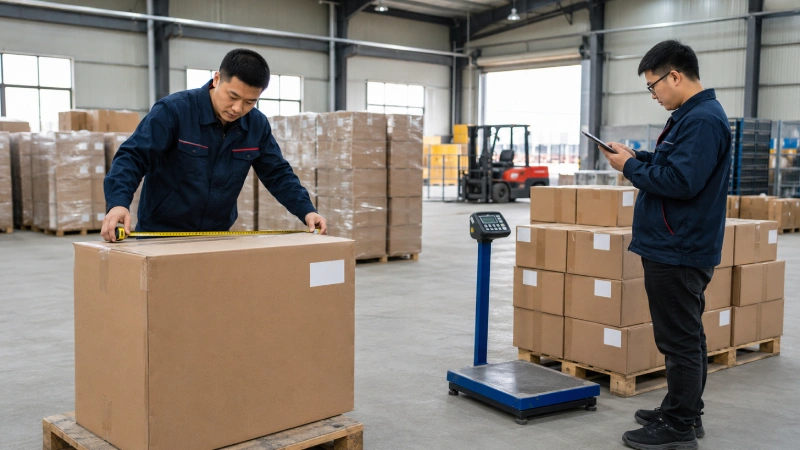
Supplier Shipping or Your Own Freight Forwarder?
Supplier-arranged shipping may work for a small sample or simple one-factory order when the scope is clear.
Buyer-controlled freight may provide more visibility when:
- Several suppliers must be consolidated
- The shipment will move by LCL or FCL
- Inspection, relabeling, or repacking is required
- The destination is a 3PL, Amazon FBA facility, or appointment-only warehouse
- The supplier’s CIF or DDP offer does not identify destination charges
- The buyer needs several routing or delivery scenarios
Do not compare quotations by headline price alone. Compare the same origin point, cargo data, customs scope, destination, delivery type, insurance basis, validity period, and exclusions.
| Quote item | Supplier offer | Forwarder offer | Confirmation needed |
|---|---|---|---|
| China pickup | Included or excluded | Included or excluded | Exact address and loading |
| International freight | Mode and route | Mode and route | Chargeable weight or CBM |
| U.S. charges | Listed or unclear | Listed or estimated | Terminal, broker, exam, and storage |
| Duties | Included, advanced, or excluded | Usually separate unless stated | Importer and payment method |
| Final delivery | Port, curbside, dock, or door | Defined delivery scope | Appointment and unloading |
The lowest initial quote may not produce the lowest landed cost. After confirming cargo data, review best shipping methods from China to the USA.
Match the Handoff to the Incoterm
EXW Orders
Under EXW, the buyer may need to organize factory pickup and export handling. Confirm the address, loading responsibility, and export-document capability.
Introduce the forwarder before production finishes to verify access, cargo readiness, export arrangements, and final packing data.
FOB or FCA Orders
For FOB or FCA, identify the named port, terminal, warehouse, or carrier handoff point. Confirm covered origin charges, booking instructions, cargo cut-off, document cut-off, and handover date.
The Incoterm should not be recorded simply as “FOB.” It should identify the agreed port or location so the supplier and buyer understand where the operational handoff occurs.
CIF or CFR Orders
CIF or CFR may cover carriage to a named U.S. port while leaving destination handling, clearance, duty, and inland delivery to the buyer. Ask for the carrier, routing, bill-of-lading terms, destination agent, and estimated local charges.
CIF includes a seller insurance obligation, but the buyer should still review the coverage, insured value, exclusions, and claims procedure rather than assuming all cargo risks are covered.
DDP Orders
A DDP quotation needs more scrutiny than a statement such as “tax included.” Confirm who will act as importer, whose importer identification will be used, who files the entry, and who bears duties, customs exams, storage, corrections, and redelivery costs.
The buyer should obtain appropriate entry documentation and understand the declared product and value. U.S. Customs and Border Protection notes in its Basic Importing and Exporting guidance that importers retain responsibility for compliance even when using brokers or service providers.
For a fuller explanation of the service model and its limitations, see DDP shipping from China to the USA.
Consolidate Multiple Alibaba Suppliers in China
Consolidation can reduce duplicated origin handling and place several purchases into one coordinated outbound shipment. However, it only works when every supplier follows a shared receiving plan.
Create a supplier schedule showing:
- Supplier name and pickup city
- Cargo-ready date
- Carton count, volume, and weight
- SKU and carton-marking requirements
- Label and document status
- Required warehouse arrival date
The China warehouse should have instructions for appointments, carton counts, condition photos, SKU separation, discrepancy reporting, and release approval. These are logistics controls, not a formal quality inspection.
A late supplier can create storage or delay the consolidation. Set a cut-off and decide whether ready cargo waits, ships separately, or moves without it.
For example, three suppliers in Shenzhen, Dongguan, and Foshan may complete production several days apart. A consolidation warehouse can receive each order, verify the carton count, apply approved shipping marks, and prepare one consolidated packing list before the final shipment is booked.
A multi-supplier plan should also identify which factory is responsible for each SKU. Without this information, shortages, mixed cartons, and labeling errors can be difficult to trace after the cargo reaches the United States.
Complete Packing, Labels, and Documents Before Release
Do not release cargo merely because production is “finished.” Use a release gate.
Before pickup or warehouse dispatch, obtain:
- Final commercial invoice
- Final packing list
- Carton and pallet dimensions
- Gross weight and total volume
- Packing and label photos
- Country-of-origin marking where required
- Confirmed pickup contact
- Destination and delivery instructions
- Required product or transport documents
The commercial invoice needs a precise description and appropriate declared value. CBP explains that transaction value may require additions such as packing, certain assists, commissions, royalties, or proceeds when applicable in its customs valuation guidance.
The factory’s HS code is a starting point, not an automatic final classification. Official CBP tariff-classification guidance states that determining duty begins with the correct HTS classification, which must match the actual product.
For a fuller checklist, refer to documents required to import from China to the USA.
Packing responsibilities should also be assigned in writing. Confirm whether the supplier, consolidation warehouse, or another service provider will apply:
- SKU labels
- Carton marks
- Handling labels
- Country-of-origin marks
- Pallet labels
- Warehouse or purchase-order references
A freight forwarder may coordinate external carton checks, repacking, palletization, or labeling when agreed. These logistics services should not be confused with a formal pre-shipment quality inspection or product-compliance assessment.
Plan for the Final U.S. Receiving Point
A freight plan is incomplete until the delivery location can receive the cargo.
For a commercial warehouse or 3PL, confirm receiving hours, appointment rules, dock access, pallet specifications, purchase-order references, and whether floor-loaded cargo is accepted.
For Amazon inventory, the handoff must include final routing, carton labels, applicable pallet requirements, and an assigned owner for each preparation step. The detailed workflow belongs in shipping to Amazon FBA USA from China.
For port or terminal pickup, confirm the customs-release process, free-time limits, pickup appointments, and the party responsible for arranging the truck, chassis, or other equipment.
For residential or limited-access delivery, check truck access, liftgate, unloading, oversized-item restrictions, and appointments. Never assume these from “door delivery.”
These details should be supplied before the final freight quotation. Adding them after arrival can cause revised delivery charges, storage, redelivery, or delays.
Audit the Total Landed Cost
A useful landed-cost review separates the shipment into five cost layers:
- Product and supplier charges
- China pickup, warehouse, and export handling
- International freight and insurance
- U.S. customs, duty, and destination charges
- Inland delivery and receiving costs
Compare complete scenarios, such as supplier DDP versus buyer-controlled EXW pickup and door delivery. Mark every item as included, excluded, estimated, or event-driven.
Possible event-driven charges include:
- Customs exams
- Demurrage or detention
- Port or warehouse storage
- Relabeling
- Redelivery
- Warehouse waiting
- Packing corrections
These should not automatically be added as fixed costs, but the quotation should explain who bears them if they occur.
Importers should understand classification, value, origin, admissibility, and entry arrangements rather than treating freight purchasing as a transfer of compliance responsibility.
For more detail on the cost components without duplicating them here, see shipping cost from China to the USA.
Send a Complete Shipment Handoff Package
To request an actionable quotation, send the forwarder:
- Supplier quotation and Incoterm
- Supplier name, contact, and pickup address
- Product description and cargo value
- Carton count, dimensions, weight, and CBM
- Production-ready date
- Special cargo details
- Number of suppliers
- U.S. delivery address and ZIP code
- Receiving restrictions
- Requested delivery model and deadline
The forwarder should return the service scope, assumptions, exclusions, missing information, and pre-booking actions.
Before dispatch, confirm the supplier contact, packing data, product details, importer arrangement, labels, documents, delivery conditions, insurance decision, and ready date.
When important information is missing, ask the supplier to provide it rather than allowing the forwarder to quote from unsupported assumptions. A quote based on estimated carton sizes or an incomplete destination address may need to be revised after the cargo is packed.
Get an Alibaba-to-USA Freight Plan
Send Winsail your Alibaba quotation, Incoterm, final packing list, cargo-ready date, and U.S. address. Winsail can review the handoff, identify missing information, and prepare a freight plan based on the confirmed cargo and service scope.
FAQ
Can my freight forwarder collect directly from an Alibaba supplier?
Collection can normally be coordinated when the supplier authorizes pickup and provides the address, contact details, cargo-ready time, packing data, and export information. The exact responsibility depends on the agreed Incoterm.
When should I contact a freight forwarder?
Contact the forwarder before packaging and shipping terms are finalized. Early involvement can prevent unsuitable cartons, incomplete quotations, missed consolidation opportunities, and delivery plans that cannot be executed.
Can I consolidate orders from several Alibaba suppliers?
Yes, subject to the forwarder’s warehouse capability and cargo acceptance. Each supplier needs a delivery reference, cargo-ready date, carton data, labels, and a shared consolidation cut-off.
What if the final cartons are larger than the supplier estimated?
The freight may be re-rated because LCL, air freight, and express charges depend on final volume or chargeable weight. Larger cartons can also change the recommended mode or container plan.
Should samples ship separately from the bulk order?
Often, yes, when samples are needed for product approval, compliance testing, photography, or a launch decision. The bulk order can follow after packaging and freight assumptions are confirmed.
Who is the importer when the supplier offers DDP?
Do not assume the answer. Ask who will be named in the customs entry, whose importer identification is used, who pays duties, and who will provide entry records. Confirm the arrangement with the logistics provider and customs broker before dispatch.
