
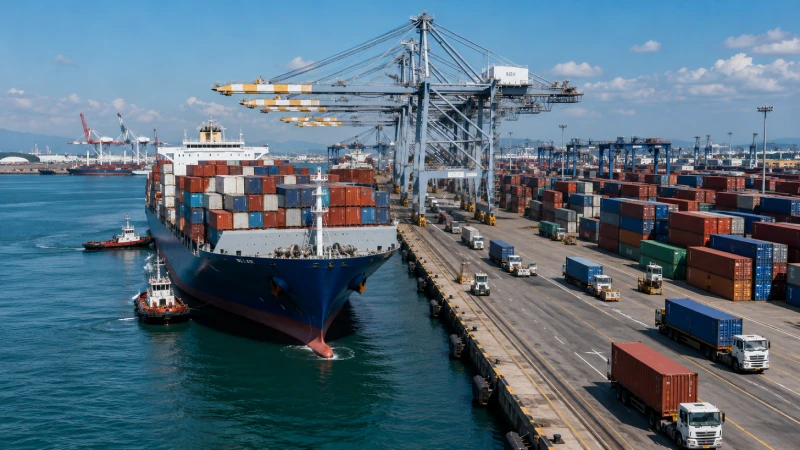
For importers evaluating Shipping from China to USA, Los Angeles and Long Beach are often among the first West Coast gateways considered. However, selecting this gateway should not be based only on the ocean freight rate or estimated sailing time. The real decision is whether the complete route—from the China pickup location to the final US warehouse—provides the right balance of transit time, destination charges, inland transportation and delivery reliability.
A container reaching Southern California has not yet completed its journey. Customs release, carrier release, terminal availability, chassis coordination, truck appointments, warehouse receiving rules and empty-container return requirements can all affect the final cost and delivery date.
This guide explains how to evaluate Los Angeles and Long Beach as an arrival gateway, what happens after vessel arrival, and when local drayage, transloading, cross-docking or rail may be the most suitable inland-delivery option.
Is the Los Angeles–Long Beach Gateway Right for Your Shipment?
Los Angeles and Long Beach are usually worth evaluating when the cargo will be delivered within Southern California, the Inland Empire, Arizona, Nevada or another western US market.
They may also be suitable for importers that need:
- Regular trans-Pacific container services.
- Local access to Southern California warehouses.
- Transloading into domestic trailers.
- Rail connections to inland distribution markets.
- Recurring FCL imports with established drayage capacity.
- Flexible distribution to multiple western states.
However, the gateway is not automatically the best choice for every US destination. A low ocean freight rate can be offset by expensive inland trucking, transloading, rail handling or delivery delays.
| Final delivery requirement | Route to evaluate | Main planning issue |
|---|---|---|
| Los Angeles-area warehouse | Local drayage | Appointment and container return |
| Inland Empire distribution center | Local drayage | Warehouse capacity and unloading time |
| Arizona or Nevada | Direct truck or transload | Distance, weight and empty return |
| Distant inland market | Rail intermodal | Rail availability and final drayage |
| Multiple retail locations | Transloading or cross-docking | Cargo allocation and handling |
| Small LCL shipment | CFS pickup and local delivery | Deconsolidation and storage deadlines |
The final delivery ZIP code should therefore be included in the route evaluation from the beginning. Comparing port-to-port rates without inland-delivery details provides an incomplete cost picture.
How Los Angeles and Long Beach Should Be Treated in Route Planning
Los Angeles and Long Beach operate as separate ports, but they are commonly evaluated as one Southern California gateway during the early planning stage.
From a buyer’s perspective, both ports provide access to the same general regional warehouse, trucking and transloading market. However, they should not be treated as operationally identical after the shipment has been booked.
The final execution plan may depend on:
- The ocean carrier.
- The selected sailing service.
- The assigned marine terminal.
- Terminal appointment rules.
- Container availability.
- Chassis arrangements.
- Empty-return location.
- On-dock or near-dock rail options.
- The location of the receiving warehouse.
For this reason, importers should avoid selecting “Los Angeles” or “Long Beach” only by comparing a single ocean freight number.
A useful quotation should identify the port of discharge, expected terminal process, inland mode, delivery scope and important destination-side exclusions.
China Origins and Ocean-Service Selection
Many major China export regions support ocean services to Southern California. The most suitable origin arrangement normally depends on the factory location, cargo-ready date, container availability and inland pickup cost within China.
Typical origin regions include:
- South China for factories around Guangdong and nearby manufacturing zones.
- East China for suppliers around Shanghai, Ningbo and surrounding provinces.
- North China for production areas connected to ports such as Qingdao or Tianjin.
- Inland locations that require domestic trucking, rail or feeder movement before export.
Importers that need a more detailed origin-port comparison can review Top Ports in China for Shipping to the USA. For this route, however, the origin decision should remain connected to the complete Los Angeles or Long Beach delivery plan.
Important ocean-service factors include:
- Direct sailing versus transshipment.
- Vessel cutoff relative to the cargo-ready date.
- FCL or LCL requirements.
- Equipment availability.
- Carrier and terminal pairing.
- Schedule consistency.
- Inland rail compatibility.
- Required warehouse delivery date.
The cheapest ocean service is not always the least expensive overall. A service that creates a difficult terminal pickup, poor rail connection or missed warehouse appointment may increase the total landed transportation cost.
What Happens After the Vessel Arrives?
Vessel arrival should not be confused with cargo availability.
Several operational steps must be completed before an FCL container or LCL shipment can leave the destination facility.
Vessel Discharge and Terminal Status
After arrival, the container must be discharged and processed by the terminal. The forwarder, customs broker or importer should monitor:
- Discharge status.
- Terminal availability.
- Customs or agency holds.
- Carrier release status.
- Last free day.
- Pickup appointment availability.
A container shown as discharged may still be unavailable because of a hold, missing release or terminal restriction.
Customs Release
Customs entry preparation should begin before arrival whenever the documents are available.
Delays may result from:
- Incomplete commercial documents.
- Incorrect product descriptions.
- Classification questions.
- Importer-of-record problems.
- Government agency requirements.
- Customs inspection.
Customs release is one part of the destination process, but it does not automatically authorize terminal pickup.
Carrier Release and Delivery Order
The ocean carrier or destination agent must also release the cargo.
This may require:
- Freight payment.
- Destination charge settlement.
- Bill of lading release.
- Delivery order issuance.
- Confirmation of consignee details.
- Instructions to the terminal or CFS.
Importers should confirm who is responsible for each release step instead of assuming the trucker can collect the cargo immediately after customs clearance.
Terminal Availability, Chassis and Pickup Appointments
For FCL shipments, the delivery plan should be ready before the container becomes available.
Key questions include:
- Has a terminal pickup appointment been secured?
- Is a chassis included or arranged separately?
- Is the trucker approved for the terminal?
- Can the warehouse receive the container during the available window?
- Is the shipment planned as a live unload or drop?
- Where must the empty container be returned?
For a broader explanation of container-based shipments, see FCL Shipping from China.
FCL Terminal Pickup Versus LCL Deconsolidation
FCL and LCL cargo follow different destination flows.
An FCL container usually moves from the marine terminal to the importer’s warehouse, a transloading facility or an inland rail connection.
An LCL shipment must first be separated from other cargo inside the consolidated container.
The usual LCL destination sequence is:
- The consolidated container arrives.
- The container is discharged.
- It is transferred or released for deconsolidation.
- Individual shipments are separated at the CFS.
- Each shipment receives its own availability date.
- CFS charges and release requirements are completed.
- Loose cargo is picked up or delivered.
The vessel arrival date is therefore not the same as the LCL cargo availability date.
LCL buyers should confirm the CFS location, free storage period, release requirements and local delivery scope. Additional background is available in Sea Freight from China to USA, while this page focuses specifically on destination execution in Southern California.
Choosing the Right Inland-Delivery Path
Once the cargo is available, the next decision is how it should move beyond the port.
Local Drayage to a Southern California Warehouse
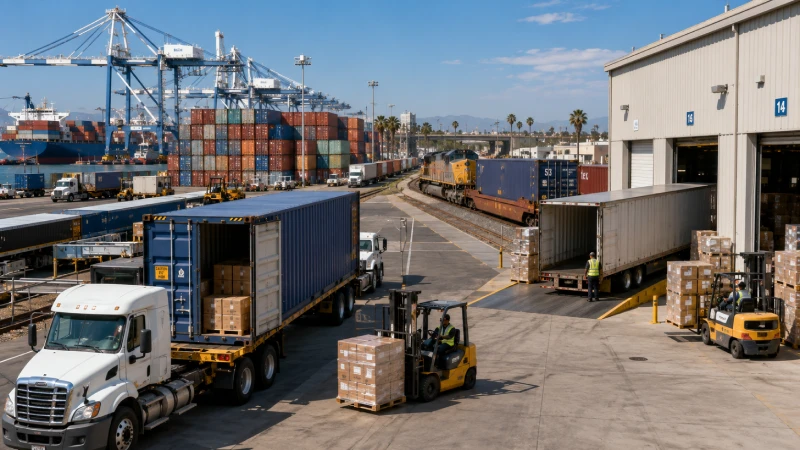
Local drayage is often the most direct option for containers moving to Los Angeles-area warehouses or Inland Empire distribution centers.
It is most suitable when:
- The warehouse can unload promptly.
- The container can be returned within the allowed equipment time.
- A reliable truck appointment can be arranged.
- The receiving location accepts the container type and cargo configuration.
The delivery plan should confirm warehouse receiving hours, appointment rules, unloading time and whether the facility prefers a live unload or drop.
A live unload keeps the driver and container at the warehouse while the cargo is unloaded. A drop allows the container to remain at the facility and be collected later. Drops may provide more unloading flexibility but can create additional equipment-use exposure.
Transloading into Domestic Trailers
Transloading means transferring cargo from the ocean container into a domestic trailer or another transport unit.
It can be useful when:
- Cargo will travel beyond the practical local drayage area.
- The importer wants to return the ocean container quickly.
- Products must be split among several destinations.
- Cargo weight needs to be redistributed.
- A domestic trailer provides better inland flexibility.
- High recurring volume supports a planned transload operation.
Transloading creates extra handling and facility costs, so it should solve a specific transportation or distribution problem.
It is not automatically cheaper than keeping the cargo in the original container.
Cross-Docking for Immediate Distribution
Cross-docking is appropriate when cargo will move rapidly from the inbound container into outbound vehicles without long-term storage.
Common applications include:
- Retail replenishment.
- Pre-allocated purchase orders.
- Several regional delivery points.
- Time-sensitive distribution programs.
- High-volume imports with scheduled outbound capacity.
Successful cross-docking requires accurate carton information, cargo allocation instructions and coordination between the port pickup and outbound trucks.
Rail Intermodal for Inland Destinations
Rail may be suitable for cargo moving to distant inland US markets, particularly when shipment volumes are recurring.
The decision should consider:
- On-dock or near-dock rail availability.
- Rail cutoff and departure timing.
- Destination rail ramp.
- Final-mile drayage.
- Cargo weight and equipment requirements.
- Total door-to-door transit.
- Inventory urgency.
Rail transit alone should not be compared with direct trucking. Importers should evaluate the complete movement, including terminal processing, rail transfer, destination-ramp availability and final warehouse delivery.
Destination Charges to Check in the Quote
A complete destination quotation may include more than port pickup and trucking.
Possible charge categories include:
- Destination carrier charges.
- Delivery order or documentation fees.
- Customs brokerage.
- Customs examination expenses.
- CFS deconsolidation and handling for LCL.
- Chassis usage.
- Drayage.
- Fuel and accessorial charges.
- Pre-pull.
- External yard storage.
- Driver waiting time.
- Redelivery.
- Transloading.
- Cross-docking.
- Rail transportation.
- Destination-ramp drayage.
- Warehouse unloading or receiving costs.
These charges should not be assumed to be included unless they are clearly listed.
For broader national pricing factors, importers can review Shipping Cost from China to USA. For the Los Angeles–Long Beach gateway, the most important issue is identifying which destination-side services are required for the actual final delivery.
Demurrage, Detention, Storage and Free Time
Several different cost clocks may begin after cargo arrival.
Demurrage
Demurrage may arise when a container remains at the marine terminal beyond the applicable free period.
Detention or Per Diem
Detention or per-diem charges may apply when carrier equipment remains outside the terminal longer than allowed.
CFS Storage
LCL cargo may incur storage if it remains at the deconsolidation facility after the free storage period.
External Storage and Waiting
Additional charges may also arise when:
- A container is pre-pulled to an outside yard.
- A warehouse cannot receive the cargo.
- A truck must wait beyond the allowed time.
- Delivery is rejected or rescheduled.
- The empty container cannot be returned as planned.
Importers should verify:
- When free time begins.
- Whether calendar days or working days apply.
- The last free day.
- The empty-return deadline.
- The CFS storage deadline.
- Weekend and holiday treatment.
- Whether pickup appointments are available before free time expires.
The shipment should not be planned around an assumed number of free days. The applicable terms should be verified for the specific carrier, terminal and cargo release.
Practical Delivery Scenarios
FCL Delivery to an Inland Empire Warehouse
The usual plan is terminal pickup, local drayage, warehouse unloading and empty return.
The main risks are missed receiving appointments, long unloading times and delayed empty return.
Delivery to an Amazon Fulfillment Center
Direct container delivery may be possible, but the importer should first confirm appointment rules, unloading method, labels, pallet requirements and whether floor-loaded cargo is accepted.
A transload warehouse may be required when cargo needs palletization, sorting or delivery in domestic equipment.
Delivery to Arizona or Nevada
The importer may compare direct container trucking with transloading near the port.
Direct drayage reduces cargo handling, while transloading may improve equipment flexibility and avoid a long empty-container return.
Rail Delivery to an Inland Market
Rail can support long-distance distribution, but the route should include the destination rail ramp and final drayage.
The importer should compare total transit, inventory requirements and handling points rather than looking only at the rail line-haul rate.
LCL Delivery to a Los Angeles-Area Warehouse
The shipment must first become available at the CFS. After release and charge settlement, it can be collected as loose cargo or delivered by a local truck.
The CFS storage deadline is a critical planning point.
When Another US Gateway May Be Better
Los Angeles or Long Beach may not provide the best total result when the final destination is far from the western United States.
Another gateway may deserve comparison when:
- Northern California is the main delivery market.
- The Pacific Northwest is the final destination.
- Cargo serves Texas or Gulf-region distribution centers.
- The final warehouse is in the eastern United States.
- Inland transportation represents a large share of total cost.
- A different port provides a better rail or delivery connection.
- Inventory planning can support a longer ocean route.
Oakland may be considered for Northern California, while Seattle or Tacoma may fit some Pacific Northwest deliveries. Houston may be more practical for Texas-area distribution, and an East Coast gateway may reduce inland distance for eastern destinations.
The correct comparison is not port versus port. It is one complete port-to-door plan versus another.
Los Angeles and Long Beach Shipping Checklist
Before requesting or approving a quotation, provide:
- China pickup city.
- Cargo-ready date.
- Commodity description.
- Shipment volume and weight.
- FCL or LCL requirement.
- Final delivery ZIP code.
- Required delivery date.
- Warehouse receiving hours.
- Appointment requirement.
- Live unload or drop requirement.
- Maximum unloading time.
- Transloading or cross-docking requirement.
- Rail requirement.
- Customs-clearance requirement.
- Amazon, retailer or distribution-center instructions.
Get a Port-to-Door Shipping Plan
A useful Los Angeles or Long Beach quotation should cover more than the ocean freight rate.
Send Winsail Logistics your China pickup city, cargo-ready date, shipment volume, FCL or LCL requirement and final delivery ZIP code. Include the warehouse receiving hours, appointment rules, live-unload or drop requirements, transloading needs and customs-clearance scope.
Winsail can then evaluate the ocean route, terminal or CFS release, local drayage, transloading, rail and final warehouse delivery as one coordinated port-to-door plan.
FAQ
Should I ship to Los Angeles or Long Beach from China?
The decision usually depends on the ocean service, carrier, assigned terminal, cargo-ready date and inland-delivery plan. Compare the total port-to-door arrangement instead of choosing only by the port name.
Are Los Angeles and Long Beach the same shipping gateway?
They form one Southern California gateway market for broad planning, but they are separate ports with different terminals, vessel calls and operational procedures.
How long does shipping from China to Los Angeles take?
Total time includes ocean transit, vessel discharge, customs release, carrier release, terminal or CFS availability and final delivery. The estimated sailing time should not be treated as the complete door-to-door transit.
Can a container be delivered directly to an Amazon warehouse?
It may be possible when the receiving appointment, unloading rules, cargo configuration and container delivery requirements have been confirmed. Some shipments require transloading, palletization or labeling before Amazon delivery.
Is Los Angeles suitable for delivery to Arizona or Nevada?
Yes, it is often worth evaluating. Importers should compare direct container trucking with transloading into domestic equipment based on weight, distance, unloading time and empty-return requirements.
When should I use transloading in Southern California?
Transloading may be suitable when cargo must travel a long inland distance, be divided among several destinations or move in domestic trailers. It may also help return the ocean container more quickly.
Is rail better than trucking for inland delivery?
Rail may be suitable for longer distances and recurring volumes. The comparison should include rail handling, destination-ramp availability, final drayage and total transit time.
How can I reduce demurrage and detention risk?
Prepare customs documents early, monitor customs and carrier releases, confirm free time, arrange pickup and chassis capacity, secure the warehouse appointment and plan the empty-container return before cargo availability.
