

Shipping lithium batteries from China to the United States requires more preparation than moving ordinary commercial goods. While Shipping from China to USA usually involves decisions about freight mode, supplier pickup, customs clearance and final delivery, battery cargo must first pass a technical and regulatory eligibility review. Battery chemistry, configuration, watt-hour rating, physical condition, test status, packaging and the proposed route can all affect whether a shipment is accepted.
There is no universal answer to whether a lithium battery can travel by air, express or ocean freight. Before requesting a final rate, the importer should build a complete battery file and have the proposed shipment reviewed against the rules and carrier requirements that apply to that specific cargo and route.
Identify the Battery Before Selecting a Freight Method
The product name alone is not enough to classify battery cargo. A wireless speaker, power tool, portable charger or industrial control unit may fall under different transport requirements depending on how its battery is supplied.
The first distinction is battery chemistry:
- Lithium-ion batteries are normally rechargeable. Lithium-polymer and lithium iron phosphate batteries are generally assessed within this category.
- Lithium-metal batteries are normally non-rechargeable and contain lithium metal or lithium alloy.
The second distinction is the battery configuration:
| Configuration | Practical example | Preliminary UN entry |
|---|---|---|
| Lithium-ion batteries shipped alone | Cartons of replacement battery packs or power banks | UN 3480 |
| Lithium-ion batteries packed with equipment | Power tools packed with removable batteries | UN 3481 |
| Lithium-ion batteries contained in equipment | Speakers or laptops with batteries installed | UN 3481 |
| Lithium-metal batteries shipped alone | Cartons of non-rechargeable lithium batteries | UN 3090 |
| Lithium-metal batteries packed with or contained in equipment | Devices supplied with lithium-metal cells | UN 3091 |
This table is only a preliminary guide. The correct proper shipping name, packing instruction and applicable section must be confirmed from the actual battery design and shipment configuration.
Power banks are a common source of misclassification. Because their primary purpose is to provide power to another device, current IATA lithium battery guidance treats them as batteries rather than batteries contained in equipment.
Build a Quote-Ready Battery Technical File
A freight forwarder cannot safely determine eligibility from carton dimensions and gross weight alone. Before requesting a quotation, ask the manufacturer or supplier for the following information:
- Battery manufacturer and exact model number
- Lithium-ion or lithium-metal chemistry
- Nominal voltage
- Capacity in Ah or mAh
- Watt-hour rating
- Lithium content for lithium-metal batteries
- Number of cells in each battery
- Number of batteries per carton
- Net battery weight
- Battery dimensions
- State of charge
- Battery specification sheet
- Clear photos of the battery and rating label
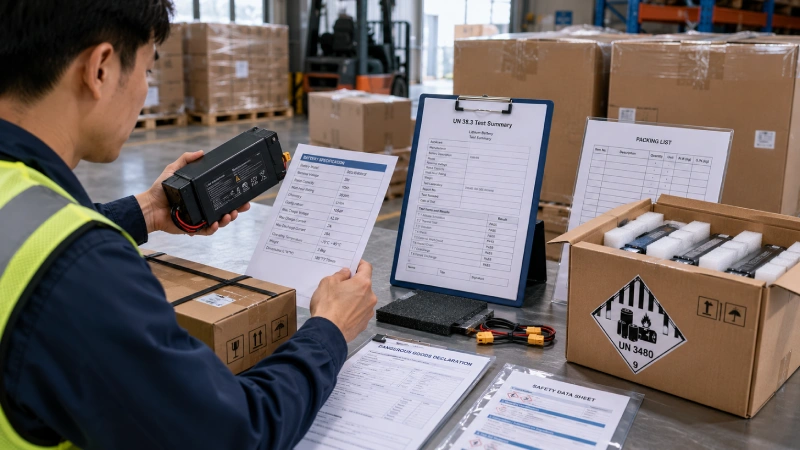
- UN 38.3 test summary
- SDS or MSDS
- Description of how the battery is packed with the product
When watt-hours are not clearly shown, they can be checked using:
Watt-hours = Voltage × Amp-hours
For example, a 12 V battery rated at 5 Ah has a calculated rating of 60 Wh. When capacity is shown in milliamp-hours, divide the mAh value by 1,000 before multiplying it by voltage.
This calculation is useful for checking supplier information, but it does not replace the manufacturer’s technical records. The calculated result should match the battery label, specification sheet and test summary.
Why the UN 38.3 Test Summary Matters
Under the US lithium-battery provisions in 49 CFR 173.185, lithium cells and batteries generally must be of a type proven to meet the applicable UN Manual of Tests and Criteria subsection 38.3 requirements.
A usable test summary should normally include:
- Manufacturer information
- Test laboratory information
- Test-report identification number
- Test date
- Battery chemistry and physical description
- Battery mass
- Watt-hour rating or lithium content
- Exact model number
- Tests performed and pass/fail results
- Reference to the applicable UN test-manual edition
- Name and title of a responsible person
An SDS is useful, but it is not a substitute for a complete UN 38.3 test summary. A supplier statement saying that a product is “UN 38.3 compliant” is also insufficient when the underlying model information and test details are missing.
For ordinary commercial documents beyond the battery file, refer to Documents Required to Import from China to USA rather than treating battery documents as the entire import-document package.
Screen for Batteries That Need Specialist Review
Some shipments should not proceed through a normal quotation workflow.
Stop and request specialist review when the batteries are:
- Swollen, leaking, punctured or crushed
- Corroded or discolored
- Producing an unusual odor
- Showing evidence of overheating or fire
- Damaged during use or storage
- Subject to a safety recall
- Being shipped for disposal or recycling
- Used returns with an unknown condition
- Prototypes that have not completed the normal tests
- Part of a low-production run
- Identified by documents that do not match the physical battery
Do not describe damaged, defective or recalled batteries as ordinary commercial cargo. They may be prohibited from normal air transport and may require specialized packaging, approvals or an alternative handling pathway.
The same caution applies when a supplier provides a test summary for an individual cell but the shipment contains a larger assembled battery pack. The supporting records must cover the battery design being transported or clearly demonstrate how the applicable assembled-battery requirements have been met.
Determine Whether Air Freight Is Available
Air transport should be assessed through three separate acceptance gates:
- Regulatory eligibility
- Compliance with the applicable packing instruction
- Acceptance by the airline, route and handling stations
Passing the first two gates does not require an airline to carry the shipment. Airlines, ground handlers and origin stations may apply restrictions that are stricter than the baseline regulations.
Standalone Batteries Face Greater Restrictions
Standalone lithium-ion batteries under UN 3480 and standalone lithium-metal batteries under UN 3090 face the most restrictive air-freight conditions. Under the current IATA framework, they are forbidden as cargo on passenger aircraft except through narrowly defined approval or exemption pathways. Ordinary commercial shipments normally require a cargo-aircraft solution and compliance with the applicable packing instruction.
Standalone lithium-ion batteries must generally be offered for air transport at a state of charge not exceeding 30% of rated capacity. Shipping them above that level requires the relevant approvals and still does not guarantee carrier acceptance.
Important 2026 State-of-Charge Requirements
From January 1, 2026, IATA guidance applies additional reduced-state-of-charge provisions to lithium-ion batteries packed with equipment under Packing Instruction 966.
For Section I shipments, batteries must generally be offered at no more than 30% state of charge unless the relevant approvals are obtained. Under Section II, the requirement applies to lithium-ion cells and batteries with a watt-hour rating above 2.7 Wh. For batteries contained in equipment under PI 967, reduced state of charge is strongly recommended rather than universally mandatory.
Because carrier variations can be stricter than the base rules, the forwarder should confirm the exact origin airport, destination airport, airline, aircraft type, package quantity and battery configuration before arranging supplier pickup.
Express or courier shipping is not a way around dangerous-goods requirements. Express shipments may still travel by air, and courier networks can impose narrower acceptance limits, account restrictions and origin-station requirements.
For a broader explanation of air schedules and service models, refer to Air Freight from China to USA rather than relying on a generic promise that all battery cargo can move by air.
Determine Whether Ocean Freight Is Available
Battery cargo rejected by an airline is not automatically eligible for sea freight. Ocean shipments still require classification, suitable packaging, marks, labels, dangerous-goods documentation and carrier approval.
The International Maritime Organization states that the IMDG Code 2024 Edition, including Amendment 42-24, became mandatory on January 1, 2026. The IMO IMDG Code addresses the maritime transport of dangerous goods, including packaging, container handling, stowage and segregation.
LCL Battery Shipments
LCL can be possible for some eligible battery cargo, but approval depends on the consolidation warehouse, shipping line, route, classification and compatibility with other goods.
Do not send batteries to an ordinary LCL warehouse before written acceptance. An unapproved delivery can result in:
- Warehouse rejection
- Repacking charges
- Additional storage
- Missed sailing dates
- Return-to-supplier costs
FCL Battery Shipments
FCL may provide better operational control for larger, repeated or palletized battery shipments. However, using a full container does not remove dangerous-goods obligations. The packages, declarations, container loading and securing plan must still satisfy the applicable requirements.
For general sailing and container-service information, refer to Sea Freight from China to USA.
Large industrial battery modules, energy-storage systems and unusually heavy battery assemblies should be assessed individually. Their eligibility may depend on total energy, battery design, package engineering, lifting requirements and the carrier’s own risk policy.
Prepare Packaging and Documents for the Actual Classification
US regulations require lithium batteries to be packaged to prevent short circuits, damage caused by movement within the package and accidental activation of equipment.
Depending on the applicable provision, preparation may include:
- Protecting or insulating exposed terminals
- Placing batteries in suitable inner packaging
- Separating batteries from conductive materials
- Using cushioning to prevent movement
- Protecting batteries from crushing and impact
- Securing installed batteries inside equipment
- Preventing equipment from switching on during transit
- Using tested UN-specification packaging where required
- Applying the correct battery marks and hazard labels
- Adding a Cargo Aircraft Only label where applicable
Do not apply the same marks and labels to every shipment. The required communication depends on the UN number, battery rating, package quantity, configuration, packing instruction, section and transport mode.
A typical review file may include:
- UN 38.3 test summary
- Battery specification sheet
- SDS
- Commercial invoice
- Packing list
- Battery and product photos
- Dangerous-goods declaration where required
- Ocean dangerous-goods documentation where required
- Air waybill or bill-of-lading statements
- Written carrier or consolidator acceptance
The manufacturer must provide accurate battery data. The exporter or shipper remains responsible for presenting the cargo correctly, while the forwarder coordinates routing, booking and document review. A forwarder should never invent a watt-hour rating, alter a test summary or conceal the presence of batteries to obtain acceptance.
Use a Pre-Booking Acceptance Check
Before cargo leaves the supplier, classify the shipment into one of three statuses.
Ready for Carrier Review
The shipment is potentially ready when:
- The battery model is identified
- Chemistry and configuration are confirmed
- Watt-hour rating is known
- The test summary matches the battery
- The batteries are new and undamaged
- Packaging details are available
- Carton quantities and weights are confirmed
Specialist Review Required
Escalate the shipment when it contains:
- Prototypes
- Used batteries
- Large modules
- Mixed configurations
- Inconsistent documents
- Batteries packed with other dangerous goods
- Unusual machinery, mobility devices or vehicles
Do Not Book Through the Normal Workflow
Stop the shipment when batteries are damaged, recalled, leaking, misdeclared or supported by documents that appear false.
The safest operating sequence is:
- Review the technical file
- Confirm the preliminary classification
- Review the packaging
- Check the proposed carrier and route
- Obtain preliminary acceptance
- Authorize supplier pickup
- Complete the final warehouse and booking checks
This sequence reduces the risk of paying for collection, storage and repacking before discovering that the planned route is unavailable.
Can Lithium Batteries Be Shipped DDP?
Eligible battery shipments may sometimes move under a door-to-door or DDP arrangement, but DDP does not change their dangerous-goods classification.
The parties must still identify:
- The exporter or shipper
- The party responsible for battery declarations
- The US importer of record
- The customs broker
- The carrier
- The final delivery location
A low-priced battery “DDP channel” should not be accepted without understanding the transport mode, declarations, importer structure and destination charges. For the commercial and customs responsibilities of this delivery model, refer to DDP Shipping from China to USA.
Request a Lithium Battery Shipping Assessment
Before requesting a final quotation, prepare:
- Battery specification and model
- UN 38.3 test summary
- SDS
- Battery-label photos
- Product photos
- Battery configuration
- Watt-hour rating or lithium content
- State of charge
- Number and condition of batteries
- Carton or pallet dimensions
- Gross and net battery weight
- Pickup city in China
- US destination ZIP code
- Incoterm
- Requested delivery date
Winsail can review the available shipment information and confirm whether a suitable air, ocean or door-to-door solution can be offered. Final routing and pricing should only be issued after the battery classification, documents, packaging and carrier acceptance have been checked.
Request a Lithium Battery Shipping Assessment before arranging supplier pickup.
This article is a shipment-planning resource and is not a substitute for dangerous-goods training, formal classification or shipment-specific regulatory advice. Carrier rules and route availability can change, so acceptance must be reconfirmed for each shipment.
FAQ
Is an SDS enough to ship lithium batteries from China?
No. An SDS can support the review, but it does not replace the battery specification, matching UN 38.3 test summary or mode-specific dangerous-goods documents.
What should I do if the battery model does not match the UN 38.3 test summary?
Stop the booking process and request a matching test summary or a clear manufacturer explanation. The discrepancy should be resolved before carrier submission.
Can power banks be declared as batteries contained in equipment?
Generally no. A power bank is normally treated as a battery because its primary purpose is to supply power to another device.
Can lithium batteries and ordinary products be consolidated in one shipment?
Sometimes, but the warehouse, carrier, packaging, dangerous-goods classification and compatibility with other cargo must be reviewed before consolidation.
Can lithium-battery shipments be delivered DDP to the United States?
Potentially, but DDP does not remove dangerous-goods obligations. The routing, importer of record, customs process and responsible parties must still be confirmed.
How early should battery documents be submitted?
Submit them before supplier pickup. This allows time for classification review, packaging corrections and preliminary carrier acceptance.
Can used or returned lithium batteries be shipped from China to the USA?
They may require additional review. The shipper must disclose their condition, reason for return and whether they are intended for reuse, repair, disposal or recycling.
Why did one forwarder accept my battery shipment while another rejected it?
Acceptance can vary because of carrier policy, route availability, station capability, document quality, packaging and the forwarder’s dangerous-goods handling resources.
