
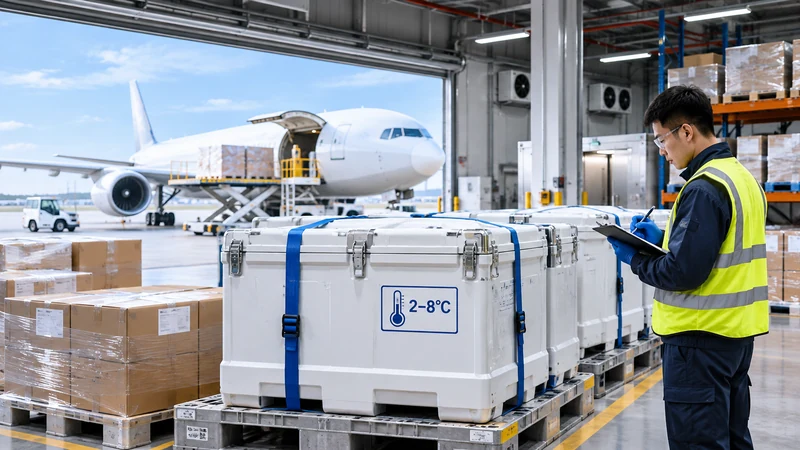
Shipping medical reagents internationally requires more than selecting a fast flight. For temperature-sensitive diagnostic products, maintaining the correct storage conditions throughout transportation is essential to protecting product stability and supporting reliable laboratory results.
Many medical and diagnostic reagents require refrigerated storage between 2°C and 8°C. However, international air freight involves multiple handling stages, including factory collection, airport processing, aircraft loading, customs clearance, and final delivery. Each stage introduces potential temperature-control risks.
For importers sourcing medical reagents from China, the main challenge is ensuring that the selected packaging and logistics arrangements can protect the shipment throughout the entire journey—not simply during the flight.
This guide explains how to ship medical reagents by air from China, including temperature-controlled packaging, cold chain monitoring, airline handling, export documentation, shipping costs, and practical preparation steps.
Quick Answer: Medical reagents requiring 2–8°C transportation should be shipped using a suitable, qualified temperature-controlled packaging system or active container, supported by appropriate handling arrangements and temperature monitoring. The shipping plan must account for airport transfers, customs delays, and last-mile delivery. Product classification and destination-country import requirements should be verified before shipment.
What Are Medical Reagents, and Which Require 2–8°C Shipping?
Medical reagents are substances or prepared materials used in laboratory analysis, diagnostic testing, research, and other medical applications. They may contain enzymes, antibodies, proteins, chemical compounds, or other components that interact with biological samples.
Common categories include:
- In vitro diagnostic (IVD) reagents: Products intended for diagnostic testing of human specimens, such as certain immunoassay and molecular diagnostic reagents.
- Biochemical reagents: Substances used in clinical chemistry testing and laboratory analysis.
- Molecular diagnostic reagents: Materials used in techniques such as PCR and nucleic acid detection.
- Immunoassay reagents: Products involving antibodies, antigens, or other biological components.
- Research laboratory reagents: Materials used in scientific research that may have different storage and regulatory requirements from clinical diagnostic products.
These products cannot all be shipped under the same temperature conditions or regulatory classification.
Why Do Some Medical Reagents Require 2–8°C Storage?
Certain medical reagents contain temperature-sensitive components whose stability may be affected by prolonged heat exposure or accidental freezing.
Depending on the formulation, unsuitable temperatures may contribute to enzyme degradation, protein denaturation, changes in reagent performance, or a reduction in the manufacturer’s validated shelf life.
For diagnostic products, these changes may affect test performance even when no visible damage has occurred.
However, 2–8°C is not a universal requirement for all medical reagents.
| Temperature condition | Typical application | Shipping consideration |
|---|---|---|
| Refrigerated, 2–8°C | Certain diagnostic kits, enzymes, and antibody-based reagents | Protect against both overheating and freezing |
| Controlled room temperature, often 15–25°C | Some stable laboratory reagents | Prevent exposure outside the manufacturer’s specified limits |
| Frozen, commonly −20°C | Certain molecular biology reagents and biological materials | Use a suitable frozen shipping system |
| Ultra-low temperature, such as −70°C or below | Selected specialized biological materials | Requires specialized equipment and handling |
These are illustrative storage categories, not universal product specifications. The manufacturer’s instructions and stability data always determine the required shipping conditions.
Before arranging air freight, importers should obtain the product’s shipping temperature range, permitted excursion limits (if established), and packaging requirements from the manufacturer.
Why Is Maintaining a 2–8°C Cold Chain Challenging in Air Freight?
Air freight reduces long-distance transportation time, but a shorter journey does not automatically mean better temperature protection.
A shipment may pass through several facilities and transportation providers before reaching the consignee. The surrounding temperature, waiting time, and handling conditions can change significantly between these stages.
Temperature Exposure During Ground Handling
Some of the most important cold chain risks occur before or after the aircraft is in flight.
For example, refrigerated cargo may move from a temperature-controlled warehouse into an airport acceptance area. It may then wait for security screening, cargo consolidation, or aircraft loading.
If the cargo is exposed to high ambient temperatures during these operations, its internal temperature may begin to rise.
The UK’s Medicines and Healthcare products Regulatory Agency (MHRA) specifically identifies airport tarmac exposure as a significant risk during pharmaceutical air transportation.
The practical solution is to minimize unnecessary exposure, coordinate handling procedures, and use suitable packaging designed to protect the product during unavoidable delays.
The Risks of Overheating and Accidental Freezing
A common misunderstanding is that keeping medical reagents as cold as possible provides better protection.
For products labeled 2–8°C, temperatures below the permitted range can also create problems.
For example, frozen gel packs placed directly against reagent containers may expose the product to temperatures below 0°C, even if the shipment appears adequately refrigerated overall.
The consequences depend on the formulation. Some products may tolerate limited temperature excursions, while others may not.
Appropriate packaging design must therefore protect against both warming and freezing.
Airport Transfers, Flight Delays, and Customs Clearance
Temperature protection becomes more difficult when a shipment involves connecting flights or prolonged customs processing.
Unexpected delays may occur because of:
- Flight cancellations or schedule changes
- Cargo security inspections
- Missed connections
- Delayed customs documentation
- Limited refrigerated storage availability
- Local delivery disruptions
These possibilities should be considered when selecting the shipping system and its qualified protection duration.
Common Temperature Risks During Air Transportation
| Shipping stage | Potential risk | Recommended control |
|---|---|---|
| Factory or supplier warehouse | Product exposed during packing or staging | Controlled preparation and timely packing |
| Road transportation | Temperature fluctuations during pickup | Suitable refrigerated transport or qualified passive packaging |
| Origin airport | Cargo acceptance and security delays | Advance handling coordination |
| Aircraft loading | Exposure to outdoor temperatures | Minimized ramp exposure |
| Transit airport | Missed connection or extended storage | Suitable transit handling and contingency planning |
| Destination customs | Unexpected clearance delay | Pre-arranged documentation and protected storage |
| Final delivery | Cold chain interruption after customs | Coordinated transport to the consignee |
The most effective cold chain plan treats transportation as one connected process, rather than a series of independent shipping activities.
How to Ship Medical Reagents by Air from China: Step by Step
Importers should begin shipment planning before the products leave the manufacturer’s facility.
The following process covers the main decisions involved in international medical reagent air freight.
Step 1: Confirm Product Details and Temperature Requirements
Start by collecting accurate product information from the supplier.
This should include the product name, intended use, chemical or biological composition, storage temperature, packaging configuration, and any special handling instructions.
For products requiring 2–8°C, confirm whether they must remain within this range continuously or whether the manufacturer has established acceptable short-term excursion conditions.
Important questions include:
- Is the product sensitive to freezing?
- Does it contain hazardous chemicals or infectious materials?
- What is the product’s remaining shelf life?
- What type of packaging has the manufacturer approved?
- Will temperature records be required by the consignee?
These details determine the appropriate transportation solution.
Step 2: Check Export Regulations and Airline Acceptance
Medical reagent shipments may require additional documentation depending on their ingredients, intended use, and regulatory classification.
Some diagnostic reagents may be ordinary cargo from a dangerous-goods perspective, while others may contain flammable, corrosive, toxic, or otherwise regulated substances.
Biological specimens and infectious substances require separate classification assessments.
Before booking, the shipper and freight forwarder should establish whether the cargo is acceptable for air transportation and whether special packing, marking, documentation, or carrier approval is necessary.
The importing country may also have specific requirements for diagnostic products or laboratory materials.
Identifying these requirements early helps prevent cargo rejection and customs delays.
Step 3: Select an Appropriate Temperature-Controlled Packaging System
Packaging selection is one of the most important steps in cold chain shipping.
For relatively small shipments, a qualified insulated container with correctly conditioned phase change materials may provide suitable protection.
Larger or more demanding shipments may require active temperature-controlled containers.
The packaging decision should consider the product’s temperature limits, expected transit time, external temperature conditions, shipment size, and potential delays.
A packaging system should not be selected solely because its supplier advertises a particular number of hours of cooling performance. Its qualification conditions must be relevant to the actual shipment.
Step 4: Coordinate Pickup, Storage, and Airport Handling
Temperature control should begin at the supplier’s facility.
Products need to be packed under suitable conditions, with the required packaging components prepared according to the qualified packing procedure.
During the collection and transfer stages, the cargo should be protected from unnecessary exposure.
Depending on the shipment, suitable arrangements may include refrigerated collection vehicles, protected transfer procedures, cold storage at an origin airport, and advance coordination with the airline.
When a shipment uses passive packaging, the operational plan must remain within the system’s qualified protection period.
Step 5: Monitor the Shipment During Transportation
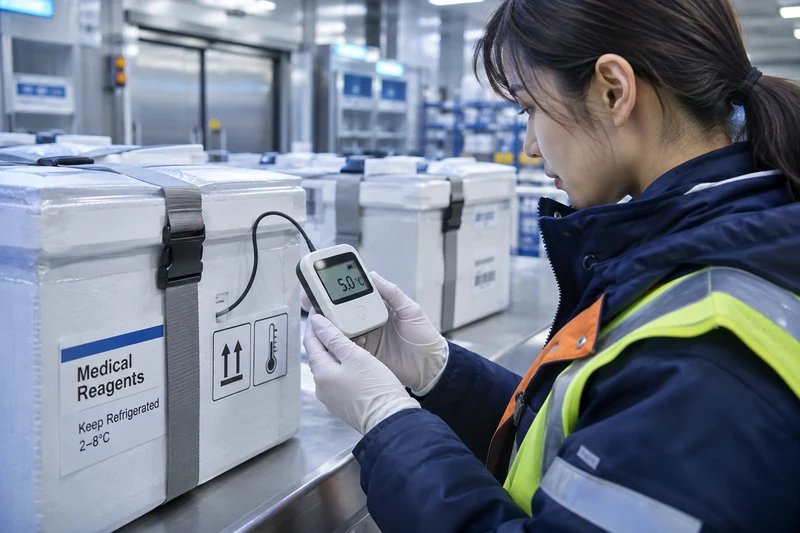
Temperature monitoring provides evidence of the conditions experienced by the shipment.
A suitable temperature data logger can record readings at predetermined intervals throughout transportation.
For valuable or highly sensitive products, the shipper may require calibrated monitoring equipment, defined alarm limits, and a documented procedure for reviewing the results.
The monitoring arrangement should be determined before departure, including the logger’s position within the package and the procedure for retrieving its records.
Wireless or transmitting monitoring devices may require airline approval or operating restrictions. Their use should be confirmed with the carrier.
Step 6: Complete Customs Clearance and Final Delivery
The cold chain does not end when the aircraft lands.
The shipment must still pass through cargo handling, customs clearance, collection, and final transportation to the consignee.
Importers should confirm that the necessary customs and product documentation is ready before arrival.
If a temperature-controlled vehicle or specialized storage facility is required at the destination, these arrangements should be organized in advance.
Upon delivery, the consignee should inspect the shipment, review available temperature records, and follow the manufacturer’s quality procedures before releasing the products for use.
Choosing the Right Packaging for 2–8°C Medical Reagents
Temperature-controlled air freight generally relies on two packaging approaches: passive packaging and active temperature-controlled containers.
Neither option is automatically suitable for every shipment.
Passive Cold Chain Packaging
Passive packaging maintains the required internal temperature through insulation and preconditioned cooling materials rather than a powered refrigeration system.
Typical components may include insulated shipping boxes, phase change materials (PCM), conditioned gel packs, protective separators, and monitoring devices.
The packaging system must be designed and qualified for the required payload, temperature range, handling conditions, and expected shipping duration.
Passive solutions can be practical for smaller reagent consignments and shipments where their qualified performance covers the entire journey.
However, their protective capacity is finite.
Extended delays or inappropriate pack-out conditions may reduce the remaining protection available to the cargo.
Active Temperature-Controlled Containers
Active containers use powered refrigeration or other controlled systems to regulate internal temperature.
They may be suitable for larger, higher-value, or particularly temperature-sensitive shipments where a passive packaging solution cannot adequately address the route’s risks.
Active systems can provide greater temperature-control capability, but they introduce additional operational requirements.
These may include container availability, power or battery management, airline acceptance, ground handling arrangements, and the return or repositioning of the equipment.
Active containers also generally involve higher equipment and handling costs.
Passive vs. Active Cold Chain Packaging
| Factor | Passive packaging | Active container |
|---|---|---|
| Temperature-control method | Insulation and conditioned cooling materials | Powered or controlled cooling system |
| Power supply | Not generally required | May require battery or external power |
| Typical shipment size | Small parcels to larger qualified systems | Often larger or high-value consignments |
| Protection duration | Limited by qualified thermal performance | Depends on operating conditions and power support |
| Initial cost | Often lower | Generally higher |
| Main planning concern | Pack-out, thermal profile, and hold time | Equipment operation, availability, and handling |
The final selection should follow a documented assessment of the product and route rather than a simple cost comparison.
How to Prevent Medical Reagents from Freezing
Products requiring 2–8°C should not be packed with cooling materials in a way that can expose them to damaging sub-zero temperatures.
For example, gel packs taken directly from a freezer may need controlled conditioning before they can be used in a qualified refrigerated pack-out.
Suitable insulating barriers, coolant positioning, and product separation may also be necessary.
The precise method depends on the tested packaging configuration.
Dry ice is not a default cooling solution for 2–8°C medical reagents. Its extremely low temperature can freeze products that require refrigeration rather than frozen storage.
Dry ice is also regulated as UN1845 for air transportation and requires appropriate packaging, marking, and carrier arrangements when used.
For refrigerated medical reagents, the safest approach is to follow a qualified packaging configuration matched to the product’s actual temperature requirements.
Temperature Monitoring and Cold Chain Verification
Temperature-controlled packaging is designed to protect medical reagents, while monitoring helps establish what conditions the shipment experienced.
Both functions are important, but they serve different purposes.
Using Temperature Data Loggers
A temperature data logger records temperature readings over time, allowing the shipment’s thermal history to be reviewed after delivery.
Depending on the monitoring objective, equipment may be positioned inside the protective packaging, near the product, or at other locations established through the monitoring plan.
The device should have suitable accuracy, calibration status, and recording intervals for the intended application.
A logger positioned outside the insulated container measures a different environment from one positioned close to the product.
For this reason, the location of the monitoring device matters when interpreting the results.
The World Health Organization’s guidance on temperature and humidity monitoring for transport operations explains the role of monitoring equipment in evaluating temperature-sensitive pharmaceutical shipments.
What Happens If the Temperature Goes Outside 2–8°C?
A temperature excursion occurs when recorded conditions exceed the product’s specified temperature limits.
However, an excursion does not automatically establish that the product is unusable.
Its significance depends on several factors, including:
- The actual temperature reached
- The duration of exposure
- The product’s formulation and stability data
- Whether the product is sensitive to freezing
- The manufacturer’s established excursion acceptance criteria
If an excursion is detected, the affected shipment should be identified and handled according to the responsible organization’s quality procedures.
The manufacturer or designated quality authority should review the relevant stability information before determining whether the products can be accepted, require further evaluation, or must be rejected.
A freight forwarder should not independently declare that temperature-sensitive medical reagents remain suitable for diagnostic use after an unexplained excursion.
Reviewing Temperature Records After Delivery
When the shipment arrives, the consignee should verify that the cargo and packaging are in acceptable condition.
The receiving process may include checking product identification, batch numbers, physical damage, packaging condition, and available monitoring records.
If the shipment requires documented temperature compliance, those records should be retained according to the applicable quality procedures.
Reliable cold chain transportation depends on documented controls, not simply a statement that the cargo was kept cold.

Documents and Regulations for Shipping Medical Reagents from China
The paperwork required for medical reagent air freight depends on the product classification, composition, destination, and intended use.
Importers should distinguish ordinary customs documents from product regulatory approvals and dangerous-goods documentation.
Basic Commercial and Shipping Documents
Common commercial shipping documents include:
| Document | Main purpose |
|---|---|
| Commercial invoice | Identifies the seller, buyer, product description, quantity, and transaction value |
| Packing list | Specifies packages, weights, dimensions, and contents |
| Air Waybill (AWB) | Records the air cargo transportation details |
| Product specification | Provides product identity, intended use, and handling information |
| Temperature instructions | Defines the required transport conditions |
| SDS, where relevant | Provides information about chemical hazards and handling |
| Certificates or permits, where applicable | Support specific product, export, or import regulatory requirements |
Additional documents may include a certificate of analysis, manufacturer’s declaration, dangerous-goods documentation, or product registration evidence when required.
Not every medical reagent shipment needs every document listed above.
Dangerous Goods Classification: Medical Reagents vs. Biological Samples
One of the most important steps is determining the correct aviation classification of the cargo.
The term medical reagent does not automatically mean that a shipment is classified as dangerous goods.
Some reagents contain hazardous chemical ingredients, while others may be classified as non-dangerous cargo under the applicable air transport rules.
Infectious substances require a separate assessment. UN3373, Biological Substance, Category B, applies only when the material meets the relevant classification criteria.
It should not be applied automatically to every diagnostic reagent or laboratory product.
Where UN3373 applies, the relevant edition of the IATA Dangerous Goods Regulations includes Packing Instruction 650, which specifies packaging and marking requirements.
For chemically hazardous products, the shipper should review the product’s composition and available safety documentation and obtain a competent dangerous-goods classification assessment where necessary.
A Safety Data Sheet can help with this process, but it does not replace the shipper’s responsibility to determine the correct transport classification.
China Export Requirements for Medical Reagents
China’s export requirements depend on the legal classification of the product.
Some goods may be regulated as medical devices or diagnostic products. Other biological materials may fall under special customs or quarantine requirements.
China’s General Administration of Customs Order No. 281, effective August 1, 2026, governs the health quarantine supervision of certain special goods and articles, including specified human tissues, pathogenic microorganisms, and biological products.
The regulation expressly excludes products managed as medicines, veterinary medicines, or medical devices from its particular scope.
This distinction is important: such exclusions do not mean that these products are exempt from all export regulations.
Before shipping, the exporter should confirm the applicable product category, customs classification, and any necessary regulatory procedures.
The official regulation is available through the China Customs Order No. 281 publication.
Destination-Country Import Requirements
Import regulations vary significantly between countries.
For example, the United States Food and Drug Administration (FDA) regulates medical devices, including in vitro diagnostics, when they are imported into the United States.
Applicable requirements may involve device status, manufacturer registration, product listing, regulatory authorization, and import entry procedures, depending on the product.
For the European Union, qualifying in vitro diagnostic medical devices fall under Regulation (EU) 2017/746, commonly known as the IVDR. Research-use-only products and general laboratory reagents may be treated differently depending on their intended purpose.
Other destinations may have their own medical device registration, chemical control, or biological material import requirements.
Importers should verify the regulations applicable to their exact products instead of relying on a generic statement that all medical reagents follow the same procedure.
IATA Requirements for Temperature-Sensitive Air Cargo
The International Air Transport Association (IATA) publishes Temperature Control Regulations covering the air transportation and handling of time- and temperature-sensitive healthcare shipments.
These standards address important operational considerations such as packaging, identification, handling requirements, and coordination between transportation partners.
Shipments booked as time- and temperature-sensitive healthcare cargo require the appropriate IATA handling label under the applicable rules.
Importantly, the handling temperature shown on that label refers to the external transportation conditions specified for the shipment. It should not automatically be assumed to be identical to the temperature maintained inside a qualified insulated package.
The air waybill, handling instructions, and service arrangements should be consistent.
How Much Does Temperature-Controlled Air Freight Cost?
The cost of shipping medical reagents by air from China depends on more than the distance between the origin and destination airports.
Temperature-sensitive shipments may require additional packaging, handling, monitoring, or storage arrangements compared with ordinary commercial cargo.
The main cost factors include:
Cargo weight and dimensions: Airlines commonly calculate freight charges using chargeable weight, which is determined by comparing actual gross weight with volumetric weight under the applicable tariff.
Origin and destination: Available flight capacity, routing, airport facilities, and local delivery conditions affect the final transportation cost.
Packaging requirements: Qualified insulated packaging, coolants, monitoring equipment, and active temperature-controlled containers can add to shipment costs.
Flight routing: A direct flight may reduce transfer complexity, while connecting services can introduce additional handling requirements.
Ground handling and cold storage: Refrigerated collection, airport storage, and specialized terminal services may carry separate charges.
Customs and final delivery: Import processing, inspections, clearance arrangements, and refrigerated final-mile transportation may affect the total cost.
Standard Air Freight vs. Temperature-Controlled Air Freight
| Cost component | Standard air freight | Temperature-controlled air freight |
|---|---|---|
| Airline transportation | Standard cargo rate | Rate based on the selected cargo service |
| Packaging | Conventional protective packaging | Qualified thermal packaging or active container |
| Temperature monitoring | Not normally part of basic service | Often included or arranged separately |
| Airport handling | Standard cargo procedures | May require specialized handling |
| Storage | General cargo storage | Refrigerated storage where required |
| Final delivery | Standard road transportation | Temperature-controlled delivery if necessary |
Temperature-controlled shipping often costs more than standard air freight because of the additional protective measures.
However, selecting the lowest-priced shipping method without evaluating product stability and transportation risks may expose an importer to substantially greater losses.
For reliable planning, compare the total transportation arrangement rather than the airport-to-airport freight charge alone.
An accurate cost assessment requires the cargo specifications, packaging requirements, origin, destination, and expected shipping schedule.
What Information Should You Prepare Before Shipping Medical Reagents?
Preparing complete cargo information early can reduce unnecessary communication, help identify regulatory issues, and support an appropriate transportation plan.
Before contacting a freight forwarder, importers and suppliers should prepare the following information.
| Required information | What to provide |
|---|---|
| Product identification | Product name, intended use, and manufacturer |
| Product composition | Relevant technical details and SDS where available |
| Temperature requirements | Required range, such as 2–8°C, and any excursion restrictions |
| Packaging information | Number of cartons, outer dimensions, and gross weight |
| Cargo value | Commercial value and relevant insurance requirements |
| Pickup location | Supplier or warehouse address in China |
| Destination | Receiving country, city, and delivery address |
| Shipping schedule | Cargo readiness date and required arrival date |
| Regulatory documents | Available certificates, permits, and classification information |
| Monitoring requirements | Whether temperature records or specific data loggers are required |
The manufacturer should also confirm whether the shipment will be supplied in qualified cold chain packaging or whether packaging must be arranged separately.
For shipments involving multiple suppliers, consolidation should be evaluated carefully. Different reagents may have incompatible temperature requirements, packaging methods, or regulatory classifications.
Questions to Resolve Before Booking
Three questions deserve particular attention.
First, can the selected packaging maintain the required product temperature for the complete shipment journey?
The protection period must account for collection, airport processing, flight transportation, clearance, and delivery—not just the scheduled flight time.
Second, can the selected transportation route support the required handling conditions?
This includes airline acceptance, airport facilities, transit arrangements, and contingency options if delays occur.
Third, are export and import responsibilities clearly assigned?
The shipper, freight forwarder, customs broker, and importer should understand which party is responsible for product classification, regulatory documentation, transport arrangements, and quality decisions.
Resolving these issues before cargo collection creates a more predictable shipping process.
FAQ
Do all medical reagents require 2–8°C shipping?
No. Medical reagents have different storage and transportation requirements depending on their formulation and intended use. Some require 2–8°C refrigeration, while others may be stored at controlled room temperature or frozen conditions. Always follow the manufacturer's specified transport requirements.
Can medical reagents be shipped by regular air freight?
Some medical reagents may be transported through standard air cargo services when their classification and packaging allow it. Products requiring strict temperature control need an appropriate protective shipping system and handling arrangements. The suitability of standard air freight depends on the product, route, and packaging qualification.
How can medical reagents be kept between 2°C and 8°C during transportation?
A suitable solution may use qualified insulated packaging, properly conditioned cooling materials, or active temperature-controlled containers. The shipping plan should also address pickup, airport handling, transit delays, customs clearance, and final delivery. Temperature monitoring can provide records of the conditions experienced by the shipment.
Can dry ice be used to ship medical reagents?
Dry ice is used for certain frozen shipments, but it is not the default choice for reagents that must remain between 2°C and 8°C. Its extremely low temperature may freeze refrigerated products. Dry ice is also regulated as UN1845 in air transport and requires appropriate packaging, marking, and carrier arrangements.
What documents are needed to export diagnostic reagents from China?
Common documents include a commercial invoice, packing list, air waybill, and relevant product information. Depending on the classification, additional safety documentation, permits, regulatory certificates, or dangerous-goods documents may be required. Requirements should be verified for the specific product and destination.
What happens if medical reagents experience a temperature excursion during shipping?
The shipment should be assessed under the applicable quality procedures. The manufacturer or responsible quality authority should review the recorded temperature, exposure duration, and product stability data before determining whether the reagents remain acceptable. A temperature excursion does not automatically prove product failure, but it should not be ignored.
Planning a Temperature-Controlled Medical Reagent Shipment from China?
International medical reagent shipping requires careful coordination between the manufacturer, freight forwarder, airline, customs representatives, and destination consignee.
For products requiring 2–8°C transportation, the key is to establish suitable temperature protection throughout the shipment, including the stages where cargo may experience delays or handling changes.
A reliable shipping plan begins with accurate product information, appropriate cargo classification, a qualified packaging solution, and clearly defined handling requirements.
Winsail supports businesses arranging freight shipments from China. For temperature-sensitive medical reagents, our team can review your cargo details and help assess available air freight, packaging, handling, and delivery arrangements with the relevant service providers.
Share your product description, temperature requirements, shipment dimensions, pickup location in China, and destination so that the transportation requirements can be evaluated before booking.
