

Shipping solar panels from China to Tanzania requires more than choosing a freight rate. A complete solar shipment may contain glass photovoltaic modules, inverters, electrical distribution equipment, mounting structures, and energy storage batteries. Although these products work together in a solar power system, they have different packaging, certification, and transport requirements.
For importers, solar distributors, EPC contractors, and project developers, the main challenge is coordinating these requirements before the cargo leaves China. Fragile glass modules need suitable pallets and loading protection. Inverters and other electrical equipment may require product conformity checks. Lithium storage batteries introduce additional classification, documentation, and carrier acceptance requirements.
This guide explains how to prepare different solar products for shipment, check Tanzania’s import requirements, compare freight methods, and organize delivery to warehouses or project sites.
Quick Answer
Solar panels, inverters, and storage batteries can be shipped from China to Tanzania, but they must be assessed separately. Standard photovoltaic modules generally require protective packaging rather than dangerous goods handling. Electrical equipment may be subject to Tanzania Bureau of Standards (TBS) conformity requirements. Lithium batteries require product-specific transport classification, applicable UN38.3 evidence, and carrier acceptance. The appropriate shipping method depends on packed dimensions, handling risks, documentation, and final delivery conditions.
Data Note — October 2026: This guide reflects official product-conformity, customs, and dangerous-goods guidance reviewed in October 2026. Product classifications, carrier acceptance, charges, and available services must be reconfirmed for the actual shipment and booking date.
1. Identify Every Product in Your Solar Shipment
A solar power system is not one cargo category. Different components may require separate packing arrangements, customs classifications, and transport approvals.
Before requesting shipping arrangements, the importer should identify exactly what the Chinese supplier intends to export.
Solar Panels, Inverters, Batteries, and Electrical Components
Most commercial solar projects involve several product groups:
| Solar product | Packaging and handling focus | Battery or certification concern | Freight options to assess |
|---|---|---|---|
| Photovoltaic (PV) panels | Glass protection, approved pallets, loading stability | TBS conformity and HS classification review | FCL or LCL sea freight |
| Solar inverters | Shock protection, moisture control, carton or crate dimensions | Electrical conformity; check for integrated batteries | Sea freight or suitable air freight |
| Charge controllers and distribution boards | Protective cartons, cabinets, secure terminals | Applicable electrical product standards and certification | LCL, FCL, or air freight |
| Lithium storage batteries | Short-circuit protection, compliant packaging, secure handling | Battery classification, UN38.3 where applicable, carrier approval | Sea or restricted air freight, subject to acceptance |
| Battery-integrated equipment | Equipment protection, battery isolation, movement prevention | Determine the correct battery/equipment transport classification | Carrier-dependent |
| Mounting rails and support structures | Bundle security, length, weight distribution | Product classification and import documentation | Primarily sea freight |
The important distinction is that solar products are not automatically dangerous goods simply because they are used in the same electrical system.
Standard PV modules without batteries are not ordinarily classified as dangerous goods. Ordinary inverters without regulated batteries or other hazardous components may also be shipped as general cargo, subject to a product review.
Batteries require separate assessment. The applicable transport rules depend on battery chemistry, configuration, capacity, condition, packaging, and shipping method.
Check Whether Equipment Contains Batteries
A product described as a “hybrid solar inverter” does not necessarily contain a battery. Some hybrid inverters manage an external storage system, while other products include internal battery modules.
This difference matters when preparing a freight booking.
For battery-related equipment, confirm:
- Battery chemistry, manufacturer, and model.
- Whether batteries are standalone, packed with equipment, or contained in equipment.
- Rated voltage, capacity, and watt-hour rating.
- Battery quantity and net battery weight.
- Available test-summary and transport-classification information.
- Whether any battery is damaged, defective, recalled, or being shipped for disposal.
A supplier’s general description, such as “solar generator” or “battery inverter,” is not enough to establish the transport classification.
Prepare a Product-Level Packing List
The packing list should identify individual product categories instead of describing the entire order as “solar equipment.”
For each item, request the model number, quantity, package count, gross and net weight, dimensions, and declared value.
If several suppliers are involved, collect this information separately before arranging consolidation. Differences between supplier invoices, package descriptions, and battery documentation should be resolved before the freight booking is finalized.
2. Protect Glass Solar Panels During Packing and Container Loading
For standard photovoltaic modules, physical damage is often the most important transport concern.
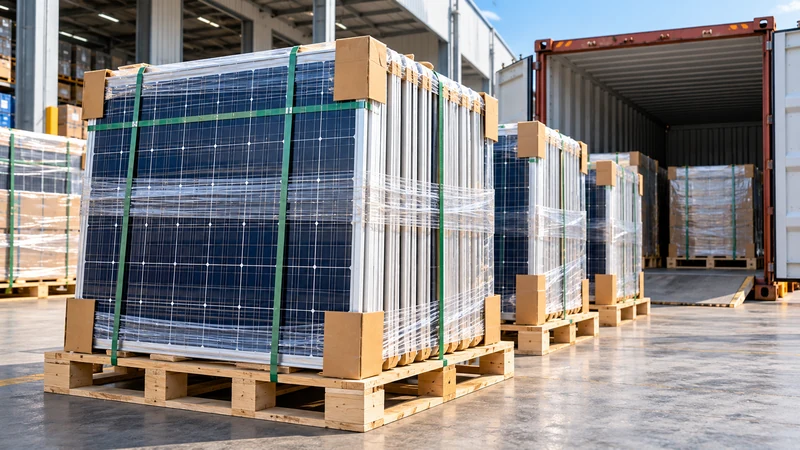
Solar panels combine glass, frames, electrical connections, and sensitive internal components. Poor pallet design, inadequate securing, or unsuitable handling can damage modules even when the outer packaging appears intact.
Use Manufacturer-Approved Solar Panel Packaging
Solar panels should remain in packaging designed or approved for the specific module model whenever practical.
Suitable packaging arrangements commonly address:
- Glass and frame protection: Edge guards, protective materials, and separation between modules.
- Pallet stability: A base capable of supporting the packed load during handling.
- Strapping and restraint: Secure packaging that does not place excessive pressure on glass or frames.
- Moisture protection: Materials appropriate for the expected storage and transport environment.
- Handling access: Clearly identified forklift entry points and package orientation.
Some manufacturers specify upright packing, while others use different approved designs. The correct orientation depends on the module and packaging system.
Do not assume that modules from different manufacturers can safely share an identical pallet arrangement.
If wooden pallets or crates are used, the shipper should also check applicable ISPM 15 phytosanitary requirements for regulated solid-wood packaging.
Secure Solar Panel Pallets Inside the Container
Factory packaging is only one part of cargo protection. Pallets must also be secured inside the container.
Before loading, the shipper should check container condition, floor integrity, visible moisture, and suitability for the intended cargo.
The loading plan should address pallet placement, weight distribution, available clearance, and appropriate blocking, bracing, or lashing.
Heavy inverters, steel mounting rails, and electrical cabinets should not be positioned where they could shift into fragile solar-module pallets.
Stacking should follow manufacturer-approved limits. A warehouse’s ability to place one pallet on another does not establish that the configuration is safe for international transport.
For larger shipments, a documented container-loading plan can help the shipper and receiving team understand how the cargo was secured.
Record Cargo Condition Before Dispatch
Photographs provide useful evidence of packing condition and loading arrangements.
Where practical, request images showing the factory packaging, pallet labels, container condition, securing arrangements, and completed load.
At destination, the receiving team should inspect for visible glass breakage, frame damage, wet cartons, damaged connections, and discrepancies in package counts.
Visible inspection does not replace electrical performance testing. If a module may have suffered hidden damage, any further inspection or testing should follow the manufacturer’s instructions and the buyer’s agreed inspection procedure.
Pro Tip — Keep the Original Pallet Design
Before allowing a consolidation warehouse to repack solar modules, request the manufacturer’s pallet drawing or packing instructions. Replacing approved packaging with generic pallets can introduce avoidable handling and stability risks.
3. Check Tanzania TBS Requirements for Solar Panels and Electrical Equipment
Transport classification and import conformity are two different matters.
A product may be accepted as non-dangerous cargo by an ocean carrier while still being subject to Tanzania’s product standards and import documentation requirements.
For mainland Tanzania, the Tanzania Bureau of Standards administers the Pre-shipment Verification of Conformity (PVoC) programme for regulated imported products.
Check the HS Code for Each Solar Product
The Harmonized System (HS) classification helps determine the applicable customs and product-compliance requirements.
For example, the TBS PVoC regulated HS list published in March 2025 includes 8541.43.00, covering photovoltaic cells assembled into modules or panels.
This provides an important starting point for solar-panel import planning. However, the correct classification, current scope, exemptions, and conformity obligations must be checked for the actual goods.
Solar inverters, distribution boards, cables, and batteries should not automatically use the same classification as photovoltaic modules.
An importer purchasing a complete solar system should therefore request separate technical descriptions and proposed HS classifications for its main components.
An HS code also does not determine whether a battery is dangerous goods for transport. Customs classification and transport classification must be reviewed independently.
Understand PVoC and the Certificate of Conformity
For products subject to Tanzania’s PVoC requirements, conformity assessment should be arranged before shipment according to the applicable procedure.
The process generally involves:
- Confirming the product’s regulated status and applicable standard.
- Preparing technical specifications and available test or conformity evidence.
- Applying through an authorized PVoC service provider where required.
- Completing the applicable document review, inspection, or testing.
- Obtaining the required Certificate of Conformity (CoC) when compliance is established.
The exact route depends on the product and the current programme requirements.
Importers should consult the official TBS PVoC guidance, including its regulated HS lists, procedures, authorized providers, and exemption criteria.
Are CE and IEC Documents Enough for Solar Inverters?
A Chinese inverter manufacturer may provide CE-related declarations, IEC test reports, or other technical certifications.
These documents can be useful evidence, but they should not automatically be treated as a substitute for a Tanzanian CoC where one is required.
The importer should confirm the applicable Tanzanian product standard and whether the available evidence is acceptable to the authorized conformity-assessment provider.
For inverters and electrical distribution equipment, useful supporting information may include the exact model, input and output ratings, manufacturer details, wiring specifications, technical datasheets, and relevant test reports.
This review should occur before the supplier releases the goods for export.
Similarly, importers should not assume that all solar equipment is exempt from import duty or VAT. Tax treatment depends on the applicable classification and current Tanzanian rules.
4. Classify Solar Storage Batteries Before Booking Freight
Storage batteries introduce requirements that do not normally apply to standalone photovoltaic panels.
For solar importers, the first question is not simply whether a supplier can manufacture the batteries. It is whether the batteries can be correctly classified, documented, packaged, and accepted for the intended transport route.
Identify the Battery Chemistry and Configuration
Solar storage systems commonly use lithium-ion technology, including lithium iron phosphate (LiFePO4).
LiFePO4 batteries are still lithium-ion batteries for transport-classification purposes; the name does not create a general exemption from lithium-battery rules.
Other products may contain lead-acid, sodium-ion, or different battery chemistries. These require classification under their own applicable provisions.
For lithium-ion batteries, common transport descriptions include:
- UN3480: Lithium-ion batteries shipped independently.
- UN3481: Lithium-ion batteries packed with equipment or contained in equipment, where the applicable classification conditions are met.
These examples are not a complete list of possible battery classifications.
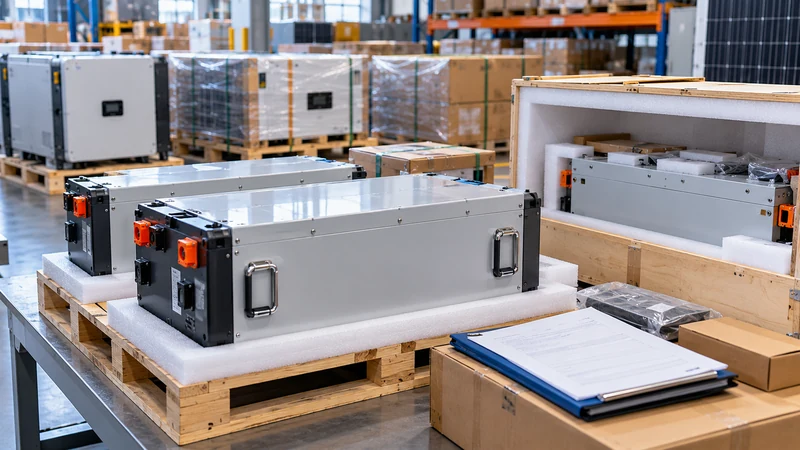
A rack-mounted battery pack, standalone storage cabinet, and inverter with an integrated battery may have different transport requirements.
Do not assign a UN number from a product name alone.
Check UN38.3 Evidence and Battery Documents
For applicable lithium battery types, UN Manual of Tests and Criteria subsection 38.3 is a critical part of transport compliance.
The manufacturer should be able to make the relevant test-summary information available and identify which cell or battery models it covers.
Important details include manufacturer identification, battery type, model, technical ratings, test laboratory information, test report identification, and required test results.
A report relating to the cells does not automatically establish that every subsequently assembled battery pack is covered. The manufacturer must confirm whether the evidence meets the applicable requirements for the actual battery type and configuration.
It is also important to distinguish between regulatory requirements and additional carrier document requests.
A UN38.3 test summary is not necessarily a paper certificate that must accompany every shipment. IATA’s guidance explains the test-summary availability requirement, while individual carriers may request additional evidence.
Likewise, a Safety Data Sheet (SDS) is not a substitute for correct transport classification or required battery test evidence.
For air shipments, consult the IATA 2026 Battery Guidance Document and the applicable Dangerous Goods Regulations.
Apply IMDG Requirements for Ocean Freight
Lithium battery shipments by sea must be assessed against the applicable International Maritime Dangerous Goods (IMDG) Code requirements.
The IMDG Code incorporating Amendment 42-24 became mandatory on January 1, 2026.
The classification review should establish the appropriate UN entry, packing provisions, marking, documentation, and any relevant special provisions.
Some battery shipments may qualify for relief from certain requirements under provisions such as SP188, but only when all applicable conditions are satisfied.
A claim that a battery is “non-DG under SP188” does not mean the shipper can omit its battery information or assume automatic carrier acceptance.
Actual ocean carriers may apply additional declaration and approval requirements.
For example, a CMA CGM customer advisory dated October 7, 2026 requires the declaration of lithium-ion battery cargo, including shipments claimed to qualify under SP188, and describes a pre-loading approval process.
This is an operator-policy example, not confirmation that a particular China–Tanzania sailing accepts the cargo. Importers should check the actual booking office, vessel routing, transshipment services, and terminal requirements.
The published CMA CGM battery declaration advisory illustrates why written carrier confirmation matters.
Air Freight Has Separate Battery Restrictions
Air transport follows ICAO Technical Instructions and the applicable IATA Dangerous Goods Regulations, together with airline and state variations.
Standalone lithium-ion batteries subject to Packing Instruction 965 are generally restricted to cargo aircraft, with passenger-aircraft transport requiring relevant approvals. They are also normally subject to a state-of-charge limit of 30%, with specific approval provisions for exceptions.
Batteries packed with or contained in equipment follow different applicable packing instructions and restrictions.
Large solar storage batteries may be impractical or ineligible for a proposed air service. Never assume an airline will accept a shipment because the same product can be moved by sea.
Battery Documentation and Booking Approval Checklist
| Review item | Evidence to obtain | Why it matters |
|---|---|---|
| Battery identity | Manufacturer, model, chemistry, configuration | Establishes the exact cargo |
| Technical ratings | Wh, voltage, capacity, quantity, net battery weight | Supports classification and packing review |
| Test evidence | Applicable UN38.3 test summary and supporting information | Supports battery-type compliance |
| Transport classification | Applicable UN number and shipping provisions | Determines mode-specific requirements |
| Packaging | Protection, package specifications, required marks and labels | Supports safe handling and acceptance |
| Carrier approval | Written confirmation for the proposed route and booking | Establishes whether shipment may proceed |
If the supplier cannot provide sufficient information for the battery to be properly classified, the shipment should remain on hold for transport review rather than being declared as ordinary cargo.
Review Solar Cargo Requirements
If your solar order includes storage batteries, share the manufacturer specifications, battery models, packing details, and destination with Winsail Logistics. These details can be reviewed to identify outstanding documentation and carrier-acceptance questions before booking.
Pro Tip — Check Batteries Before Consolidation
When PV modules, inverters, and batteries come from different Chinese factories, collect the battery documents before moving everything into one consolidation warehouse. Late identification of batteries can affect booking eligibility, warehouse acceptance, and the loading arrangement.
5. Choose FCL, LCL, or Air Freight Based on Cargo Dimensions and Risk
The most suitable freight method depends on the complete packed shipment.
A small replacement inverter and a container of solar modules should not be evaluated in the same way. Likewise, the presence of batteries may change which services are available.
Compare Freight Methods for Solar Products
| Decision factor | LCL sea freight | FCL sea freight | Air freight |
|---|---|---|---|
| Suitable cargo | Smaller shipments that can be safely consolidated | Larger or dedicated-load shipments | Smaller, urgent, eligible cargo |
| Fragile modules | Additional handling stages to assess | Greater control over the dedicated load | Size and handling limitations |
| Charging basis | W/M, minimums, and other tariff conditions | Container and applicable freight charges | Chargeable weight and airline tariffs |
| Storage batteries | Consolidator and carrier acceptance required | Carrier and DG acceptance required | Strict airline and regulatory restrictions |
| Destination handling | Deconsolidation and collection arrangements | Container pickup, delivery, and return | Airport clearance and onward delivery |
When Does FCL Make Sense for Solar Panels?
Full Container Load (FCL) is worth evaluating when the shipment contains many fragile module pallets, substantial supporting equipment, or packages requiring a controlled loading arrangement.
A dedicated container can reduce some consolidation and deconsolidation exposure compared with LCL, although proper packing and load securing remain essential.
FCL also allows the loading plan to account for module pallets, inverters, and mounting structures together.
However, the decision should not be based on a fixed CBM threshold alone.
The importer should compare the actual packed footprint, container payload limits, securing requirements, freight quotation, destination handling, and final delivery arrangements.
For the broader container process, see our FCL shipping from China to Tanzania guide.
When Is LCL Appropriate?
Less than Container Load (LCL) may be suitable for smaller quantities of solar equipment that can be packed securely and accepted by the consolidator.
It can be useful for sample orders, spare electrical components, and small commercial shipments.
For glass solar modules, consider the number of additional handling stages and whether the factory pallets can remain intact.
For batteries, confirm that the consolidator and relevant carriers accept the exact battery classification. A general LCL service advertisement does not establish battery acceptance.
Calculate Packed CBM Before Comparing Quotes
Freight quotations should use the dimensions of the packed cargo, including pallets or crates, rather than only the dimensions of the products.
Packed volume (CBM) = Length (m) × Width (m) × Height (m)
For example, a hypothetical pallet measuring 2.20 m × 1.10 m × 1.30 m occupies:
2.20 × 1.10 × 1.30 = 3.146 CBM
Two identical pallets would occupy approximately 6.292 CBM before considering any relevant shipment-specific space or stowage requirements.
This is an illustration of the calculation, not a recommended solar-module pallet specification.
Under LCL W/M charging, the applicable tariff compares volume and weight according to its charging rules. Minimum charges and other fees may apply.
For air freight, chargeable weight generally involves comparing actual gross weight with volumetric weight calculated using the carrier’s applicable divisor.
Do not assume that one airline or forwarder’s volumetric divisor applies to every service.
Compare the Total Shipping Arrangement
Before selecting the lowest quoted freight amount, check what the offer actually includes.
Depending on the service, costs may include Chinese factory pickup, export handling, packing or consolidation, main freight, destination charges, customs-related services, storage, inland delivery, and unloading.
Battery handling or acceptance requirements may also affect the quotation.
Because freight rates and carrier services change, shipment-specific quotations are more useful than a fixed published price for this product category.
6. Prepare Tanzania Import Documents Before Shipping
Even a safely packed and correctly classified shipment can encounter problems if the import documents are incomplete or inconsistent.
For solar projects involving multiple suppliers, document coordination should begin before export.
Build a Complete Import Document Set
Typical documents and supporting information include:
- Commercial invoice with accurate product descriptions, quantities, and values.
- Packing list showing individual product categories, package counts, dimensions, and weights.
- Bill of lading or air waybill, as applicable.
- Importer details and authorization for the appointed clearing agent.
- Applicable TBS Certificate of Conformity or verified exemption information.
- Product technical specifications and required import permits.
- Battery transport documentation where applicable.
- Freight, insurance, transaction, and other supporting records where needed for customs review.
The invoice and packing list should be consistent.
For example, if the invoice lists “solar energy equipment” while the packing list separately identifies PV modules, lithium batteries, and distribution cabinets, the underlying product information should be reconciled before customs filing.
Work With a Licensed Tanzanian Clearing and Forwarding Agent
Tanzania’s published import procedures require the importer to appoint a licensed Clearing and Forwarding Agent (CFA).
The agent submits the applicable customs declaration and supporting documents through the Tanzania Customs Integrated System (TANCIS).
Eligible declarations may be prepared before arrival, but early submission does not guarantee customs release.
TRA may review classification, declared values, permits, and other supporting evidence. Inspections or additional queries may also occur.
After customs release, carrier and port requirements must still be satisfied before the cargo can be collected.
For a detailed explanation of the documentation and release process, see customs clearance in Tanzania.
Mainland Tanzania and Zanzibar Require Separate Checks
This guide primarily addresses imports into mainland Tanzania, including cargo arriving through Dar es Salaam.
Zanzibar-bound shipments require an additional review of the Zanzibar Bureau of Standards (ZBS) framework and applicable import procedures.
Do not assume that a mainland TBS conformity arrangement automatically satisfies Zanzibar requirements.
The correct process depends on the destination, product, customs arrangements, and applicable standards scheme.
Door-to-Door Shipping Does Not Automatically Mean DDP
A shipment delivered directly to a Tanzanian warehouse or project site is not necessarily Delivered Duty Paid (DDP).
Under DAP, the seller generally arranges transport to the named destination, while the buyer is responsible for import clearance and applicable import duties and taxes.
Under DDP, the seller assumes contractual responsibility for import clearance and applicable duties and taxes. The seller must also have a legally workable arrangement to fulfill those responsibilities in the destination country.
Before accepting a door-to-door or DDP offer, confirm the legal importer, licensed customs agent, permits, tax responsibilities, named delivery point, and unloading arrangements.
Never assume that freight booking alone determines who will legally import the products.
7. Arrange Delivery to Industrial and Remote Solar Project Sites
For many Tanzanian solar projects, the final destination is not the arrival port.
Equipment may be delivered to a distributor warehouse in Dar es Salaam, an industrial facility, a construction site, or an inland solar installation.
The delivery plan should reflect the physical receiving conditions.
Confirm the Destination Beyond Dar es Salaam
Inland destinations may include Dodoma, Arusha, Mwanza, Mbeya, and other industrial or rural areas.
Before arranging delivery, the buyer should provide the full receiving address, site contact, access instructions, and expected unloading arrangement.
For remote sites, confirm whether the access road can accommodate the intended vehicle, whether there are restrictions on delivery hours, and whether the site has sufficient space for unloading.
For containerized cargo, the receiving plan should also consider container positioning, unloading time, and the applicable empty-container return arrangements.
Match the Cargo to Available Unloading Equipment
Large solar-module pallets, heavy battery cabinets, and long mounting structures may require different unloading methods.
A receiving site equipped only for ordinary cartons may not be suitable for unloading heavy electrical cabinets or full-size PV pallets.
Before dispatch, the buyer should identify:
- Available forklifts, cranes, or other lifting equipment.
- Package weights, dimensions, and lifting points.
- Suitable unloading surfaces and maneuvering space.
- Responsibility for labor and equipment.
- Any container waiting or empty-return restrictions.
These details should be confirmed with the actual inland transport provider rather than relying on general assumptions about local delivery capability.
Inspect and Record the Final Handover
At delivery, the receiving team should compare the cargo against the packing list and record visible discrepancies.
Photographs of damaged pallets, broken panels, deformed cabinets, or missing packages can support subsequent investigation.
The consignee should follow applicable carrier and insurance notification procedures if damage is suspected.
Delivery confirmation should not be confused with successful installation or electrical commissioning. Those activities require their own technical acceptance process.
8. Review Solar Cargo Requirements Before Booking
A reliable solar shipment starts with a complete cargo information pack.
Instead of requesting freight arrangements using only a product description such as “one container of solar equipment,” provide the information needed to evaluate packaging, transport eligibility, customs preparation, and destination handling.
What to Send for a Solar Shipment Review
1. Supplier and cargo details
Provide the Chinese factory or pickup locations, expected cargo-ready dates, and complete product list.
2. Packing specifications
Share pallet or crate counts, packed dimensions, gross weights, and available packing photographs or drawings.
3. Solar equipment information
Identify PV module models, inverter models, electrical equipment, and any other major components.
4. Battery information, if applicable
Provide chemistry, model, Wh rating, battery configuration, condition, available UN38.3 information, and proposed transport classification.
5. Tanzania import arrangements
Confirm the consignee, final destination, intended importer, and whether a licensed clearing agent has been appointed.
6. Delivery and commercial terms
Specify the requested Incoterm, pickup and delivery scope, site-access conditions, and unloading responsibilities.
Confirm the Outstanding Requirements
Before a shipment can be treated as ready for booking, the responsible parties should resolve any outstanding product-conformity, battery-classification, packaging, and carrier-acceptance issues.
This may involve the Chinese manufacturer, shipper, freight provider, carrier, authorized conformity-assessment provider, Tanzanian importer, and licensed customs agent.
The appropriate arrangement depends on the verified cargo details rather than the general label “solar products.”
Review Solar Cargo Requirements
Winsail Logistics can discuss freight planning for solar panels, inverters, and related equipment moving from China to Tanzania.
Share your product list, packed dimensions, battery information, and Tanzania delivery location to review the cargo requirements before shipment.
A complete information pack helps identify the relevant packing considerations, documentation questions, transport options, and items requiring confirmation from carriers or competent authorities.
For a broader overview of shipping methods and route planning, visit our shipping from China to Tanzania guide.
FAQ
Are solar panels considered dangerous goods when shipped from China to Tanzania?
Standard photovoltaic modules without batteries are not ordinarily classified as dangerous goods simply because they generate electricity. Their main shipping considerations generally involve protective packaging, handling, product conformity, and customs documentation. Storage batteries and other regulated components supplied with a solar system must be assessed separately.
Can solar panels and lithium storage batteries ship in the same container?
Potentially, but this depends on the battery classification, packaging, load-securing arrangements, applicable dangerous-goods provisions, and carrier acceptance. Obtain the required battery information and confirmation from the actual carrier before arranging combined loading.
Is a CE certificate enough to import solar inverters into Tanzania?
Not necessarily. A CE-related declaration or test report may provide technical evidence, but it does not automatically replace a Certificate of Conformity required under Tanzania's applicable PVoC programme. Verify the product's HS classification, TBS scope, and accepted conformity procedure.
Can I ship a hybrid solar inverter containing a battery by air?
Air shipment may be possible for certain eligible configurations, but acceptance cannot be assumed. The manufacturer must identify the battery chemistry, capacity, and configuration. The applicable IATA packing instruction, restrictions, documentation, and airline acceptance must then be checked.
Can I arrange door-to-door delivery to Arusha without using DDP?
Yes, subject to an available service and agreed responsibilities. Under DAP, for example, the seller generally arranges transport to the named destination while the buyer is responsible for import clearance and applicable import duties and taxes. Confirm the importer, clearing agent, unloading, and charges before shipping.
Important Shipping and Compliance Notice
The information in this guide is intended for general shipment planning. Actual requirements depend on the products, battery configuration, HS classification, destination, transport route, and regulations applicable at the time of shipment. Product conformity, dangerous-goods classification, carrier approval, import clearance, and final delivery arrangements must be confirmed with the relevant qualified parties. A freight discussion or preliminary quotation does not constitute customs approval or carrier acceptance.
