

For 5kg–100kg shipments from China to Kenya, air freight typically costs more per kg at lower weights and becomes more economical as weight increases.
Express courier suits urgent parcels under ~30kg, while standard air cargo is usually cheaper beyond that. Pricing is based on chargeable (volumetric) weight, not just actual weight.
These are budget ranges, not fixed quotes—final costs depend on dimensions, routing, and clearance model.
What Counts as “Small Parcel” vs “Air Cargo” (5kg–100kg)
In China–Kenya trade, “small parcel” and “air cargo” are often used interchangeably—but in pricing and operations, they are not the same.
For practical budgeting, shipments in the 5kg–100kg range usually fall into three brackets:
- 5–20kg: Typically handled as express courier shipments (DHL, FedEx-type services). These are door-to-door, fast, and simple, but the cost per kg is the highest.
- 21–45kg: This is a grey zone. Express is still common, but standard air freight (airport-to-airport or airport-to-door) may already be cheaper, depending on carton size.
- 46–100kg: Almost always treated as air cargo, not parcels. Pricing shifts to airline weight tiers, and per-kg costs drop noticeably.
The key difference is who controls the process. Courier shipments bundle transport, clearance, and delivery, while air cargo separates freight, customs, and last-mile delivery. Kenya importers typically choose based on urgency, cost sensitivity, and clearance preference, not just weight alone.
How Air Freight Cost Is Calculated
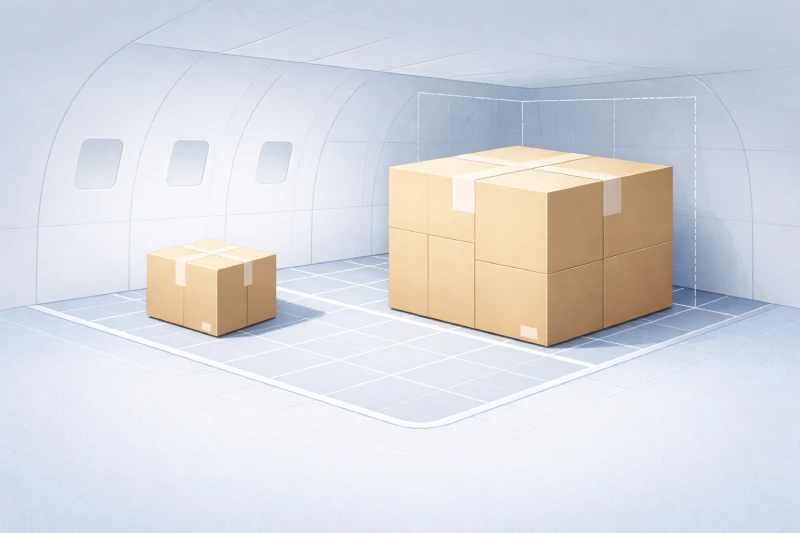
For small air shipments from China to Kenya, airlines and couriers do not charge by actual weight alone. They charge by chargeable weight, which is the higher of actual weight or volumetric (dimensional) weight. This is the single biggest reason why final costs often exceed initial expectations.
Actual Weight vs Volumetric Weight
- Actual weight is what the shipment weighs on a scale.
- Volumetric weight reflects how much space the cargo occupies on the aircraft.
Air freight uses a standard formula (length × width × height ÷ a fixed divisor). If your cartons are large but light, volumetric weight will be higher—and that higher number is what you pay for. This is common with products like shoes, bags, plastic goods, or loosely packed cartons.
Why “Price Per KG” Changes by Weight Tier
Air freight pricing is built on weight brackets. A 12kg shipment may be charged at a much higher per-kg rate than a 45kg shipment, even if the route is identical. Once you cross key thresholds (often around 45kg and 100kg), airlines apply lower rates.
For SMEs, this means splitting or slightly increasing shipment weight can sometimes reduce the average cost per kg, as long as carton size is well controlled.
Express Courier vs Standard Air Freight: Cost Comparison
For China–Kenya shipments under 100kg, the real cost decision is usually between express courier and standard air freight—not “air vs sea.”
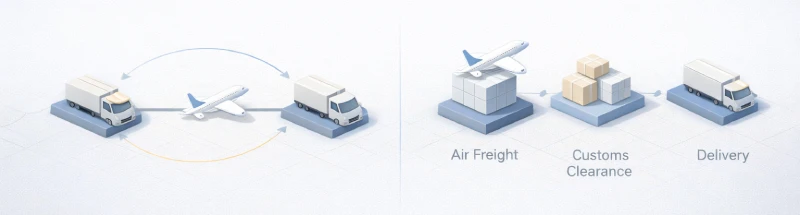
Express courier (door-to-door) is designed for speed and simplicity. It includes pickup, international transport, customs handling, and final delivery in one price. This makes it ideal for urgent shipments, samples, or first-time imports, but the cost per kg is the highest, especially once volumetric weight applies.
Standard air freight (airport-to-airport or airport-to-door) separates the process. Airlines charge only for air transport, while customs clearance and delivery are handled locally. This structure reduces the per-kg cost significantly beyond ~30–45kg, but requires better documentation control and coordination.
Key practical comparison points for Kenya importers:
- Speed: Courier is fastest end-to-end; air cargo is still quick but slightly slower.
- Cost: Courier is cheaper only at very low weights or very small cartons.
- Control: Air freight offers more flexibility on clearance, delivery, and cost structure.
- Risk: Courier feels simpler, but air freight avoids bundled markups once volume grows.
For budgeting, courier = convenience premium, while air freight = cost efficiency with basic logistics planning.
Typical Cost Ranges: 5kg–100kg from China to Kenya
For small air shipments, the most practical way to budget is by weight band and shipping mode, not by searching for a single “price per kg.” Costs drop sharply as weight increases, but only if carton dimensions are controlled and the correct mode is used.
At very low weights (5–10kg), express courier almost always applies, and the per-kg cost is high because pricing is bundled and minimum charges dominate. Between 15–30kg, courier and air freight may overlap—this is where many importers overpay by defaulting to express without comparison. From 45kg upward, standard air cargo is usually the clearly cheaper option, even after adding local clearance and delivery.
Routes also matter. Most air cargo moves into Nairobi (NBO), with final delivery handled locally. The ranges below reflect transport-only estimates under normal market conditions and exclude duties, VAT, and exceptional surcharges.
To make this easier to scan and compare, the table below summarizes indicative cost ranges by weight and mode, showing when each option typically makes sense for China–Kenya small shipments.
Indicative Air Freight Cost Ranges from China to Kenya (5kg–100kg)
| Weight Range | Shipping Mode | Typical Transit Time | Estimated Cost Range (USD/kg) | Best Use Case |
|---|---|---|---|---|
| 5–10 kg | Express Courier (Door-to-Door) | 3–6 days | High range | Samples, urgent documents, very small parcels |
| 11–20 kg | Express Courier / Light Air Freight | 4–7 days | Upper–mid range | Urgent restock, small e-commerce orders |
| 21–30 kg | Courier or Standard Air Freight | 5–8 days | Mid range | Time-sensitive goods where cost comparison matters |
| 31–45 kg | Standard Air Freight (Airport-to-Door) | 5–9 days | Mid–lower range | SMEs optimizing cost without courier premiums |
| 46–70 kg | Standard Air Cargo | 6–10 days | Lower range | Regular commercial shipments, cartons well packed |
| 71–100 kg | Standard Air Cargo | 6–12 days | Lowest range | Bulk urgent goods before switching to sea freight |
What this table helps you understand:
- How cost per kg decreases as shipment weight increases
- Where express courier stops being cost-effective
- Which weight bands justify switching to standard air freight for China–Kenya trade
Note: These are budgeting ranges, not fixed quotes. Final pricing depends on chargeable weight, carton size, pickup city in China, fuel surcharges, and the clearance/delivery model used in Kenya.
Key Cost Drivers You Must Check Before Budgeting
Before using any air freight or small-parcel quote as a budget reference, verify the drivers below. Missing even one can shift the final cost significantly—especially for 5kg–100kg shipments where pricing is sensitive to small changes.
- Chargeable (Volumetric) Weight: Large cartons with low actual weight are the most common reason air costs jump unexpectedly.
- Pickup City in China: Inland pickups (not Shanghai, Shenzhen, Guangzhou) add trucking and time.
- Destination & Delivery Scope: Nairobi door delivery is different from airport pickup or upcountry delivery.
- Fuel & Airline Surcharges: These fluctuate monthly and are rarely visible in headline rates.
- Shipping Mode Chosen: Courier bundles costs; air cargo separates freight, clearance, and delivery.
- Cargo Type & Restrictions: Batteries, branded goods, or sensitive items trigger extra handling or screening.
- Seasonality & Capacity: Peak seasons tighten space and push rates up fast.
- Clearance Model: DDP vs non-DDP directly affects what is included in your “per kg” price.
Treat any quote as conditional until these points are confirmed.
Common Quote Mistakes That Inflate Final Cost
Many Kenya importers think they are comparing “air freight prices,” but in reality they are comparing incomplete or mismatched quotes. The mistakes below are the most common reasons final costs end up far higher than expected.
- Ignoring chargeable weight: Quotes based on actual weight only can double once volumetric weight is applied.
- Comparing courier and air cargo rates directly: These follow different pricing logic and include different services.
- Overlooking local charges in Kenya: Clearance, handling, and delivery fees are often excluded from air-only quotes.
- Assuming express quotes are all-inclusive: Some shipments still incur duties, VAT, or special handling fees.
- Missing fuel or peak-season surcharges: Rates can change between booking and departure.
A reliable quote always clarifies what is included, what is excluded, and how chargeable weight is calculated.
How to Reduce Small Shipment Cost Without Increasing Risk
Lowering air freight or small-parcel cost is not about choosing the cheapest headline rate—it’s about removing avoidable inefficiencies without creating clearance or delivery problems in Kenya.
- Optimize carton dimensions before pickup: Reducing volume often saves more than negotiating per-kg rates.
- Consolidate to cross key weight tiers: Shipping 22–25kg instead of 18kg can lower the average cost per kg.
- Choose air cargo over courier when timing allows: Beyond ~30–45kg, bundled courier pricing becomes inefficient.
- Avoid peak seasons for non-urgent goods: Capacity constraints push air rates up quickly.
- Prepare accurate product descriptions early: Clean documentation reduces inspection and delay risks.
- Pre-check restricted items: Batteries, liquids, and branded goods often trigger extra fees if not declared.
- Decide on DDP vs non-DDP in advance: Changing the clearance model mid-shipment almost always adds cost.
Cost savings should come from planning and packaging, not from cutting compliance corners.
Kenya-Specific Notes for Small Air Shipments
For air freight and small parcels, Nairobi (NBO) is the primary entry point into Kenya. Most international air cargo clears here before final delivery within Nairobi or onward to other regions. Clearance for small commercial shipments is generally straightforward when documentation is complete, but random inspections and valuation checks can still cause short delays.

Door delivery within Nairobi city is usually efficient once clearance is completed. Deliveries to upcountry locations may require additional time and local coordination, which should be factored into budgets. Common delay triggers include incomplete invoices, unclear product descriptions, or HS code disputes.
Importantly, duties and VAT depend entirely on the HS code and declared value, so they are not included in freight-only cost estimates and should be planned separately.
When to Switch from Air to Sea Freight
For most China–Kenya imports, 100kg is the practical decision point where air freight starts to lose its cost advantage. Below this level, air shipping offers speed and manageable costs. Beyond it, the per-kg savings of sea freight usually outweigh the longer transit time.
If your goods are not urgently needed, or if you are shipping regularly, moving from air to sea can reduce logistics costs dramatically—even after adding port charges and clearance time. This is especially true when volume increases faster than weight, pushing air freight into higher chargeable-weight brackets.
For a clearer comparison of transit time, cost structure, and best-use scenarios, refer to Best Shipping Methods from China to Kenya, which breaks down when each mode makes sense operationally and financially.
FAQs
1. Is there a minimum charge for air freight to Kenya, even for very small shipments?
Yes. Both express couriers and airlines apply minimum chargeable weights or base fees, which is why very small shipments (e.g. 3–5kg) often look expensive per kg. This is normal and not specific to Kenya.
2. Can I ship multiple cartons under one air freight shipment to reduce cost?
Yes, but airlines and couriers calculate total volumetric weight across all cartons, not per box. Consolidation helps only if it improves overall packing efficiency or helps you reach a better weight tier.
3. Do air freight quotes to Kenya usually include insurance?
No. Basic air freight and courier rates do not include cargo insurance by default. Insurance is optional but strongly recommended for commercial shipments, especially electronics or branded goods.
4. Is airport pickup in Nairobi cheaper than door delivery?
In many cases, yes. Airport-to-airport or airport pickup avoids local delivery markups, but only makes sense if you or your agent can handle clearance and collection efficiently.
5. Why do two forwarders give very different prices for the same shipment?
Differences usually come from chargeable weight assumptions, included services, routing, or surcharge timing. Always compare quotes line by line, not just the final number.
