
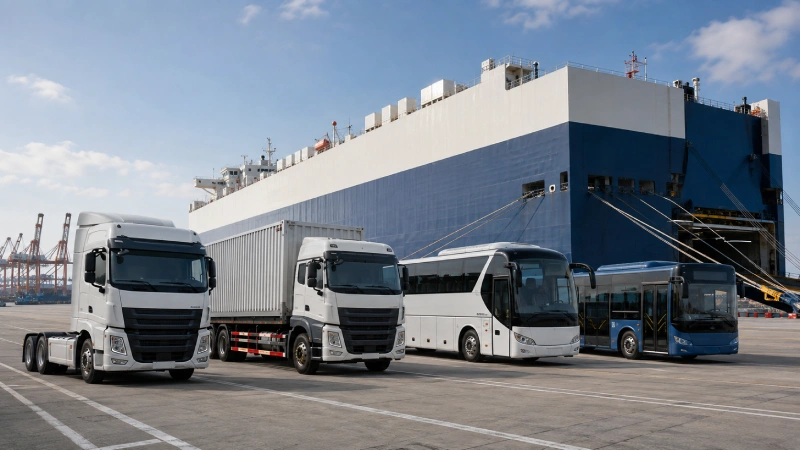
Shipping a complete truck or bus from China normally starts with a PCTC/RoRo feasibility check, especially when the vehicle is fully assembled, operational and able to move safely through the terminal and vessel. Smaller vehicles, dismantled units and oversized cargo may instead require a dry container, flat rack, open top, Mafi or breakbulk solution.
The final method depends on the vehicle’s dimensions, actual shipping weight, operating condition, power system, available route and destination-country eligibility. For broader vehicle-export planning, see Vehicle Shipping from China and the category overview Commercial Vehicle Shipping from China.
What Types of Trucks and Buses Can Be Shipped from China?
Trucks
Truck shipments from China may include tractor heads or prime movers, cargo trucks, dump or tipper trucks, flatbed trucks, box trucks, refrigerated trucks, concrete mixer trucks, tanker trucks, tow trucks, light-duty trucks, medium-duty trucks and battery-electric trucks.
The transport plan must reflect the vehicle’s actual configuration at the time of shipment. A tractor head transported alone is different from a tractor connected to a semi-trailer. A basic chassis is different from a completed truck fitted with a tank, mixer drum, crane, refrigeration system or other body equipment.
Trailers can be included in the same project, but independently shipped semi-trailers and specialized trailers require separate dimensional, loading and securing reviews.
Buses
Bus shipments may include minibuses, school buses, city buses, coaches, airport shuttle buses, double-decker buses, articulated buses and electric buses.
Bus acceptance depends not only on weight and overall dimensions but also on maneuverability. Long wheelbases, low-floor structures, extended front and rear overhangs, roof-mounted air-conditioning systems and limited chassis lashing points can affect whether a bus can safely enter a terminal, cross a vessel ramp and be secured on deck.
Construction machinery is not the main subject of this guide. Fire engines, refuse trucks, mobile workshops and other special-purpose vehicles may be shipped, but they normally require additional technical review because of their body equipment and operating systems.
Information Required Before Requesting a Shipping Quote
A reliable truck or bus freight quotation cannot be prepared from a model name alone. The carrier, terminal and freight forwarder need a complete vehicle data sheet before they can evaluate RoRo, container, OOG or breakbulk feasibility.
Provide the following information:
- Vehicle type, make and model
- New or used condition
- Quantity
- VIN or chassis number
- Manufacturing year and registration year
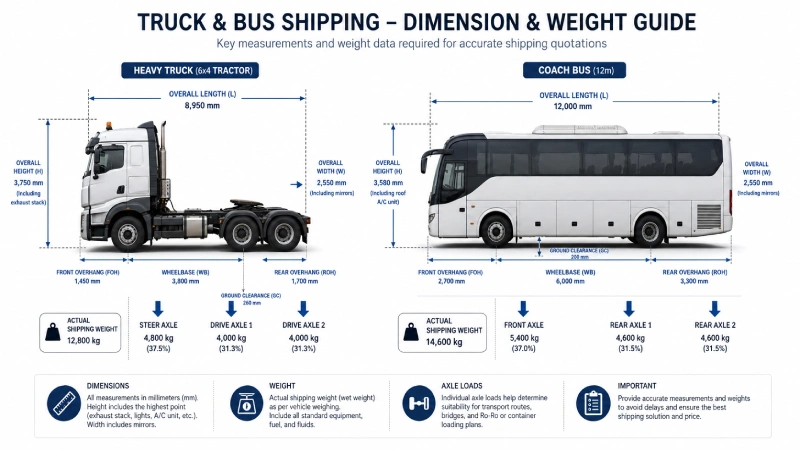
- Length, width and height in shipping condition
- Actual shipping weight
- GVWR and individual axle weights where relevant
- Wheelbase and minimum ground clearance
- Running or non-running condition
- Steering and brake condition
- Diesel, petrol, CNG, LNG, LPG, hybrid or battery-electric power
- Battery chemistry, capacity and state of charge for electric vehicles
- Available lashing and towing points
- Attachments, body equipment and modifications
- Any cargo or spare parts loaded inside
- Clear photographs from the front, rear, both sides and roof where necessary
- Pickup location in China and destination port
Actual shipping weight is not the same as gross vehicle weight rating. GVWR represents the maximum permitted loaded weight, while actual shipping weight is the vehicle’s real weight when presented for transport. Using GVWR as the transport weight may produce an incorrect freight calculation and may affect ramp-load, deck-load, crane and axle-load assessments.
Measurements must reflect the vehicle’s shipping condition. Overall height should include the highest point, such as roof air-conditioning units, exhaust stacks, warning lights or antennas. Overall width should state whether mirrors are included or folded. Before pricing, also confirm whether the shipment is a complete vehicle, chassis, cab, dismantled unit or SKD/CKD cargo.
Shipping Methods for Trucks and Buses from China
PCTC/RoRo Shipping
PCTC means Pure Car and Truck Carrier. These vessels are designed for rolling cargo and normally have wide ramps, adjustable vehicle decks and deck areas with different height and weight capacities.
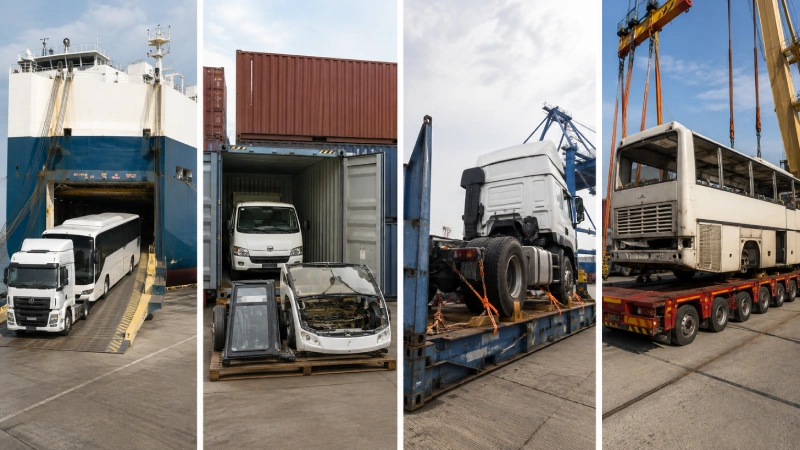
PCTC/RoRo is commonly evaluated first for complete operational trucks, ordinary buses, large coaches and batch OEM vehicle shipments. The vehicle can be driven into the vessel at origin and driven out at destination, reducing the need for dismantling, crane lifting and reassembly.
However, RoRo acceptance is never automatic. The carrier may review the vehicle’s dimensions, actual weight, ground clearance, turning ability, ramp compatibility, lashing points, fuel or battery condition and whether it can start, steer and brake safely. Vehicles should also be clean, leak-free and free from unauthorized cargo.
Available routes and vessel space are more limited than ordinary container services. Carrier acceptance must therefore be obtained before inland delivery to the port. More operational details are available in RoRo Car Shipping from China.
Standard Container Shipping
A standard dry container may be considered for small trucks, vans, some compact minibuses, separate cabs, chassis, dismantled sections and SKD/CKD components.
Most complete heavy trucks, city buses, coaches, dump trucks and concrete mixer trucks exceed standard container internal dimensions. Even when partial dismantling makes container loading physically possible, the process can create additional lifting, securing, reassembly, damage and destination-compliance risks.
A vehicle should not be dismantled simply to obtain a lower advertised ocean-freight rate. The total plan must include dismantling labor, loading equipment, securing, destination unloading, reassembly and any effect on registration or product conformity.
Flat Rack or Open Top Shipping
Flat racks and open top containers can be evaluated for over-height or over-width trucks, separate chassis or cab units, and vehicles that cannot use an available RoRo service but can be lifted and secured as a single transport unit.
The approval process normally considers the OOG dimensions, total weight, center of gravity, lifting points, lashing points, container slot loss, crane capacity, terminal equipment and road restrictions. The origin terminal, transshipment terminal and destination terminal may each need to approve the cargo.
The nominal payload of a flat rack does not by itself prove that a truck can be accepted. Route, vessel and handling limitations remain decisive.
Mafi, Roll Trailer and Breakbulk Shipping
Mafi or roll-trailer transport may be suitable for non-running vehicles, extra-large buses or units that cannot safely move across the vessel ramp under their own power. Breakbulk transport may be considered for overweight, overlength or specially modified vehicles and project fleets.
These methods require individual engineering and carrier review. Towing arrangements, lifting plans, roll-trailer capacity, securing design and terminal equipment must be confirmed before booking. Customers should not assume that every non-running truck or bus can be accepted as ordinary RoRo cargo.
RoRo vs Flat Rack vs Container—Which Option Is Better?
| Shipping scenario | First option to evaluate | Main limitation |
|---|---|---|
| Operational complete heavy truck | PCTC/RoRo | Route, deck and ramp approval |
| City bus or coach | PCTC/RoRo | Height, turning radius and ground clearance |
| Small truck or dismantled chassis | Dry container | Internal dimensions, loading and reassembly |
| OOG truck | Flat rack or open top | OOG space, lifting and securing approval |
| Non-running or extra-large vehicle | Mafi or breakbulk | Engineering review and equipment cost |
| Electric truck or bus | Route-dependent method | Dangerous-goods classification and carrier approval |
The best shipping method is the one that is technically accepted, destination-compliant and commercially workable. RoRo is not automatically the cheapest option, and container shipping is not automatically safer. The comparison should include inland transport, terminal operations, handling equipment, securing, documentation and destination delivery.
Key Shipping Differences Between Trucks and Buses
Truck-Specific Considerations
Truck bookings frequently require actual weight, GVWR and individual axle loads. The carrier may need to know whether the truck is shipped as an empty chassis, a completed unit with body equipment or a vehicle carrying separately declared cargo.
The shipper should confirm whether cargo boxes, tank bodies and mixer drums are empty; whether hydraulic cylinders, cranes, tail lifts and other attachments are locked; and whether a tractor head and semi-trailer will travel together or separately.
Cargo or spare parts inside a truck require prior approval because they change actual weight, axle distribution, customs declarations and securing arrangements. Fuel tanks, gas systems and hydraulic equipment must also be declared accurately. Modified vehicle dimensions should remain consistent with export, registration and conformity documents.
Bus-Specific Considerations
Buses are often longer than trucks of comparable weight and may be more difficult to maneuver through terminals and over vessel ramps. Their wheelbase, turning radius and front or rear overhang can determine whether they can pass ramp transitions without grounding.
Low-floor buses require particular attention to minimum ground clearance. Coaches and double-decker buses may have roof-mounted air-conditioning units that determine the true overall height. The carrier may also need to confirm whether suitable structural lashing points are accessible underneath the bus.
Seats, televisions, luggage racks and interior equipment must be securely fixed. Unapproved loose items should not be placed in the passenger compartment. Articulated and double-decker buses normally require a more detailed route and terminal assessment.
Shipping Electric and Hybrid Trucks and Buses
From 1 January 2026, the mandatory IMDG Code 42-24 framework distinguishes vehicle classifications according to the installed power system and battery chemistry.
| Power system | General sea-freight classification direction |
|---|---|
| Lithium-ion battery-electric vehicle | UN3556, Class 9 |
| Lithium-metal battery-electric vehicle | UN3557 |
| Sodium-ion battery-electric vehicle | UN3558 |
| HEV or PHEV with a combustion engine | Usually the applicable UN3166 entry |
| Diesel or petrol vehicle | Applicable UN3166 entry, subject to relevant conditions |
| CNG, LNG or LPG vehicle | Flammable-gas vehicle requirements |
The carrier may request battery chemistry, battery capacity, state of charge, UN38.3 information and other technical documents. SOC limits must be confirmed with the specific carrier. A 50% limit published by one shipping line should not be presented as a universal IMO requirement.
Damaged, flooded, accident-affected or suspected defective batteries may lead to rejection or require the battery to be removed and handled under separate rules. RoRo carriage in an approved vehicle deck and transport inside a freight container do not necessarily follow the same dangerous-goods treatment.
IMDG classification, port dangerous-goods declaration and carrier acceptance are related but separate processes. Regulatory classification does not guarantee that a specific carrier, terminal or vessel will accept the vehicle. For a detailed classification explanation, refer to the UN3556 Electric Vehicle Shipping Guide.
China Export and Destination Import Compliance
China-Side Export Requirements
Automobiles, complete knock-down sets and chassis remain within China’s export licensing system in 2026. The exporter must meet the applicable automotive export requirements and apply through the correct licensing route for the trade mode and vehicle status.
New vehicles generally use a licence that may support multiple declarations within its validity period under the applicable rules. Used vehicles normally follow a one-batch, one-licence system. Vehicle model, VIN, registration information and customs declaration data must remain consistent.
Modified vehicles may require evidence confirming the authenticity and compliance of the modification. For certain recently registered used vehicles, an after-sales maintenance service confirmation may also be required.
A freight forwarder can coordinate document collection, customs filing and transportation, but cannot issue an automobile export licence or replace the competent licensing authority. The exporter remains responsible for its eligibility and the accuracy of the vehicle documentation.
Destination-Country Eligibility
Import eligibility must be checked before booking. Depending on the market, the buyer may need to verify:
- Whether new and used commercial vehicles are permitted
- Maximum vehicle age
- Left-hand-drive or right-hand-drive requirements
- Emissions and energy-efficiency standards
- Type approval and conformity certificates
- Pre-shipment inspection requirements
- Bus seating and safety standards
- Truck axle, weight and under-run protection rules
- Commercial registration and operating permits
Saudi Arabia and Kenya illustrate why import rules should not be generalized as one Middle East or Africa policy. Saudi requirements may restrict vehicle age and require applicable conformity or energy-efficiency compliance. Kenya commonly applies age, steering-side and pre-shipment roadworthiness requirements to used vehicles, while specific commercial vehicle categories may receive different treatment.
The correct working sequence is:
Import eligibility → product conformity → shipping acceptance → booking.
Step-by-Step Truck and Bus Shipping Process
- Confirm destination-country import eligibility.
- Collect the vehicle specifications, dimensions and photographs.
- Verify the exporter and applicable export-licence route.
- Compare RoRo, dry-container, OOG and breakbulk feasibility.
- Submit vehicle data for carrier acceptance.
- Confirm freight, surcharges, routing and booking conditions.
- Arrange inland pickup and abnormal-load permits where required.
- Prepare and inspect the vehicles.
- Complete customs and dangerous-goods documentation.
- Deliver the vehicles to the terminal or vehicle yard.
- Conduct the condition survey and coordinate loading.
- Issue the bill of lading and monitor the shipment.
- Coordinate destination clearance and inland delivery.
Truck and Bus Preparation Checklist
Before port delivery, confirm that the vehicle:
- Can start, steer and brake safely
- Has no oil, fuel, coolant or hydraulic leaks
- Has properly inflated tires
- Has secured windows and doors
- Has loose parts removed or fixed
- Is supplied with valid keys as required
- Has accessible lashing points
- Meets the carrier’s fuel-level requirement
- Meets the carrier’s battery SOC requirement
- Has alarms and automatic systems disabled where required
- Matches approved dimensions after mirrors or attachments are adjusted
- Is clean and free from prohibited personal effects
- Has a complete photographic condition record
- Contains only approved and independently secured cargo
Vehicle preparation should be completed before terminal delivery. A vehicle rejected at the port may create storage, towing, inspection, rebooking and inland return costs.
Documents Required
Typical documents include:
- Commercial invoice
- Packing list or vehicle list
- Sales contract
- Export customs declaration
- Export licence
- VIN, chassis and specification list
- Bill of lading instructions
- Certificate of origin where required
- Insurance certificate if cargo insurance is purchased
Depending on the shipment, additional documents may include:
- Used vehicle registration or export documents
- After-sales service confirmation
- Modification evidence
- Pre-shipment inspection certificate
- Conformity or type-approval documents
- Dangerous-goods declaration
- Battery test and technical information
- Cargo-securing declaration
- Power of attorney
The final document set depends on whether the vehicles are new or used, the trade mode, the destination-country rules, the power system and the carrier’s acceptance requirements.
Main Chinese Ports and Route Planning
Potential loading areas may include Shanghai/Waigaoqiao, Taicang, Tianjin, Qingdao, Guangzhou/Nansha, Ningbo-Zhoushan, Lianyungang, Yantai, Fuzhou and ports in the Beibu Gulf region.
This is not a fixed port list. The practical origin port should be selected according to the vehicle factory or storage-yard location, available PCTC/RoRo service, destination port, batch size, vehicle type, electric-vehicle acceptance, inland oversize restrictions and transshipment requirements.
Route conditions can change quickly. Red Sea, Suez and Gulf services may be affected by vessel deployment, security conditions and carrier schedule adjustments. Long-term fixed transit-time claims are therefore unreliable. The current sailing schedule, routing and transshipment plan should be confirmed for each shipment.
How Much Does It Cost to Ship a Truck or Bus from China?
Truck and bus shipping costs depend on:
- Overall dimensions and occupied deck area
- Actual shipping weight
- RoRo, container, flat rack, Mafi or breakbulk method
- Direct or transshipment service
- Origin pickup and abnormal-load permits
- Terminal handling and storage
- Lashing, towing, crane or roll-trailer charges
- Dangerous-goods documentation and surcharges
- OOG slot loss
- Customs and transport documentation
- Cargo insurance
- Destination handling and inland delivery
- Route-security or emergency surcharges
The same vehicle may receive substantially different quotations from different ports, carriers and sailing dates. A model name without verified dimensions and weight is not enough for reliable pricing.
Buyers should compare total landed logistics cost rather than ocean freight alone. A lower sea-freight quotation may be offset by dismantling, crane handling, terminal storage, destination unloading or reassembly costs.
Common Risks and How to Avoid Them
Common risks include incorrect dimensions or weight, confusing GVWR with shipping weight, booking before checking destination eligibility, and presenting a vehicle at the port in an unacceptable condition.
Other problems include insufficient lashing points, unapproved cargo inside a truck, incorrect battery or fuel declarations, booking a non-running vehicle as standard RoRo, delayed export licensing, missing pre-shipment inspection and route or transshipment changes.
Demurrage, storage and destination charges can also increase quickly when documents are incomplete or the consignee is not ready. A detailed vehicle data sheet, carrier pre-approval, China-side compliance review and destination eligibility check help reduce these risks.
How Winsail Supports Truck and Bus Shipments
Winsail can coordinate China inland pickup and port delivery, vehicle-data collection, dimensional review, RoRo and OOG method comparison, carrier quotations, acceptance applications, vehicle-yard and loading coordination, customs and transport-document support, electric-vehicle dangerous-goods document alignment, and destination-agent coordination.
Winsail does not issue automobile export licences, approve dangerous goods, determine the final HS code on behalf of customs authorities or guarantee vessel space, transit time or destination clearance. Each shipment remains subject to exporter eligibility, carrier acceptance, terminal capability, route availability and destination-country requirements.
To request an assessment, provide the vehicle type, model, quantity, year, VIN or chassis number, actual dimensions, actual shipping weight, GVWR, running condition, fuel or battery type, photographs, pickup city and destination port.
Frequently Asked Questions
What types of trucks and buses can be shipped from China?
Tractor heads, cargo trucks, dump trucks, mixers, tankers, light trucks, minibuses, city buses, coaches, double-decker buses and electric commercial vehicles can all be evaluated for export shipping.
Is RoRo the best way to ship a truck or bus from China?
RoRo is often the first method evaluated for complete operational vehicles, but oversized, dismantled or non-running units may require a flat rack, Mafi, container or breakbulk solution.
Can a non-running truck or bus be shipped by RoRo?
Sometimes, but it normally requires prior carrier approval and may need towing, a Mafi trailer, a roll trailer or breakbulk handling rather than standard self-propelled RoRo acceptance.
Can cargo or spare parts be loaded inside a truck?
Only with prior approval. Internal cargo changes the vehicle’s actual weight, axle distribution, customs declaration and securing requirements and may affect dangerous-goods acceptance.
Can a full-size bus fit inside a shipping container?
Most city buses and coaches do not fit inside a standard dry container. Compact minibuses, separate chassis or professionally dismantled components may be suitable after dimensional review.
How are electric trucks and buses classified for sea freight?
Lithium-ion battery-electric vehicles generally use UN3556, lithium-metal battery vehicles use UN3557 and sodium-ion battery vehicles use UN3558. Hybrid vehicles with combustion engines normally follow the applicable UN3166 entry.
What information is needed for a truck or bus shipping quote?
Provide the vehicle type, model, quantity, year, VIN or chassis number, actual dimensions, actual shipping weight, GVWR, running condition, power type, battery information, photographs, pickup city and destination port.
How much does it cost to ship a truck or bus from China?
There is no reliable fixed rate. The cost depends on dimensions, actual weight, shipping method, route, carrier, terminal handling, OOG or dangerous-goods surcharges and destination expenses.
