
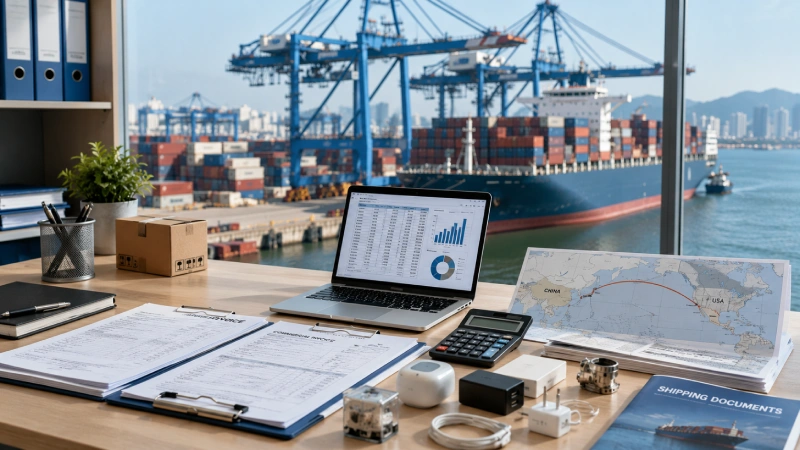
Import duty is only one part of the total cost of shipping from China to USA. Before approving a supplier quotation or placing a purchase order, importers need to identify the product’s US tariff classification, determine its customs value, check for additional tariffs, and add the customs fees, freight charges, and compliance costs that may apply.
There is no universal “China import tax rate.” Two products purchased for the same price can generate very different import charges because their materials, functions, country of origin, tariff classifications, and regulatory requirements differ.
This guide explains how US import duties and tariffs are calculated and how to build a more realistic landed-cost estimate before your cargo leaves China.
How to Estimate Import Charges from China
A practical landed-cost calculation usually includes:
Customs value
+ ordinary customs duty
+ applicable additional tariffs
+ Merchandise Processing Fee
+ Harbor Maintenance Fee, where applicable
+ possible anti-dumping or countervailing duties
+ customs brokerage and compliance costs
+ international freight and US delivery
= estimated landed cost
These costs should not be combined into one “tax percentage.” Some are government duties, some are customs user fees, and others are private logistics or brokerage charges.
| Cost category | What determines it | Applies to every shipment? |
|---|---|---|
| Ordinary customs duty | US HTS classification and customs value | No; some products are duty-free |
| Additional tariffs | Origin, HTS code, and current trade measures | No |
| Merchandise Processing Fee | Entry type and customs value | Common on formal entries |
| Harbor Maintenance Fee | Qualifying ocean cargo and port use | Not normally applied to air freight |
| AD/CVD deposit | Product scope, origin, producer, and exporter | Only for covered merchandise |
| Agency compliance cost | Product type and applicable regulator | Product-specific |
| Brokerage and freight | Service provider, mode, and route | Shipment-specific |
Before beginning the calculation, collect a detailed product description, material composition, intended use, manufacturer, country of origin, unit price, total invoice value, quantity, shipment mode, and Incoterm.
Step 1: Determine the Correct US HTS Classification
The Harmonized Tariff Schedule of the United States, or HTSUS, is the starting point for identifying the ordinary duty rate.
A Chinese supplier may provide an HS code on the quotation or export declaration. However, that code should be treated as a reference rather than automatic confirmation of the final US classification. The United States applies its own HTS subdivisions, legal notes, and statistical suffixes.
Importers should research the current schedule through the official USITC Harmonized Tariff Schedule. The live schedule should be used because HTS provisions and Chapter 99 measures can change during the year.
Classification depends on the actual characteristics of the product, including:
- principal material
- function and intended use
- level of processing
- whether it is a finished product or component
- dimensions, capacity, or technical specifications
- textile fiber composition
- whether multiple articles form a set
For example, describing an item as “plastic parts” is rarely sufficient. Customs may need to know what the part is used for, whether it is solely or principally designed for a specific machine, and whether another HTS provision describes it more specifically.
Importers should retain product photos, technical drawings, material breakdowns, catalogs, and usage descriptions. They can also search existing decisions in the CBP CROSS rulings database. When classification uncertainty creates a significant financial risk, a formal CBP ruling may be appropriate.
Choosing the code with the lowest-looking rate without sufficient legal and technical support can lead to additional duty assessments, penalties, or clearance delays.
Step 2: Establish the Customs Value
For many commercial imports, transaction value is the primary valuation method. It generally begins with the price actually paid or payable for the merchandise when sold for export to the United States.
However, customs value is not always identical to the subtotal printed on a supplier invoice.
Depending on the transaction, additions may include:
- packing costs
- selling commissions paid by the buyer
- assists supplied directly or indirectly by the buyer
- certain royalties or license fees
- proceeds of a later resale that accrue to the seller
An assist may arise when a US importer provides a mold, die, tooling, design, component, or production material to the Chinese factory free of charge or at a reduced cost. The appropriate value may need to be allocated across the imported production quantity.
International freight and insurance may be treated differently when they are separately identified and properly documented. Importers should not simply deduct an estimated freight amount from a CIF invoice without supporting records.
Related-party purchases, free samples, consignment shipments, transfer-pricing arrangements, and royalty agreements require additional attention. The commercial invoice should also align with the supporting documents required to import from China to the USA.
Step 3: Identify the Ordinary Duty and Additional Tariffs
After confirming the HTS classification and customs value, identify the ordinary duty rate shown in the applicable HTS provision.
The rate may be:
- a percentage of customs value
- a specific amount per unit, kilogram, or other quantity
- a combination of percentage and specific duty
- duty-free
The ordinary rate is not necessarily the final tariff burden. Products originating in China may also be covered by Chapter 99 provisions, including Section 301 measures or other current trade actions.
Importers should therefore check both:
- the product’s classification in Chapters 1 through 97
- any applicable Chapter 99 provision
The USTR Section 301 tariff resource and the USITC schedule should be reviewed together.
Section 301 tariffs do not apply to every product from China at one universal rate. Coverage depends on the HTS subheading and the relevant legal notice. Exclusions must be matched to their specific legal product descriptions; they are not blanket exemptions for an importer or general product category.
Because tariff actions and exclusion periods can change, this part of the calculation should always be checked against the rules in effect on the entry date.
Country of origin also requires care. Shipping Chinese-origin goods through another country does not automatically change their origin. A meaningful production process may be required, and substantial-transformation analysis is product- and fact-specific.
Step 4: Add MPF, HMF, and Other Customs-Related Costs
Merchandise Processing Fee
The Merchandise Processing Fee, or MPF, is a customs user fee rather than an ordinary import duty.
For US fiscal year 2026, the MPF for formal entries is 0.3464% of the value of the imported merchandise, excluding duty, international freight, and insurance. It is subject to a minimum of $33.58 and a maximum of $651.50.
These thresholds are adjusted periodically and should be verified through the current CBP Merchandise Processing Fee guidance when the shipment is entered.
Harbor Maintenance Fee
The Harbor Maintenance Fee generally applies to qualifying commercial cargo loaded or unloaded from a commercial vessel at covered US ports.
The current rate is 0.125% of the relevant cargo value. It is associated with ocean imports and should not be added automatically to an air-freight estimate. Importers should verify applicability using current CBP Harbor Maintenance Fee guidance.
Product-Agency Costs
Some goods are also regulated by agencies such as the FDA, CPSC, EPA, USDA, FCC, or NHTSA.
Potential costs may involve:
- testing and certification
- permits or registrations
- electronic filings
- labeling or marking changes
- inspections
- treatment of wood packaging
- specialist brokerage services
These are product-specific compliance costs, not universal customs taxes. Importers should identify the relevant agency before production rather than after the shipment reaches the United States.
Step 5: Screen for Anti-Dumping and Countervailing Duties
Anti-dumping and countervailing duties can create a much larger financial risk than an ordinary tariff.
AD/CVD orders are product- and scope-specific. Cash-deposit rates may also depend on the producer, exporter, and current administrative instructions. A product’s HTS code alone does not conclusively establish whether it is covered.
Importers can conduct an initial search through the Department of Commerce AD/CVD Search Portal. The portal allows searches by country, product, case number, and HTS number and provides access to proceeding information and scope descriptions.
The written scope of an order is critical. Products such as metal goods, furniture, cabinets, chemicals, paper products, tires, solar-related products, and building materials may deserve additional screening, but coverage should never be assumed from a broad product name.
If potential scope exposure is identified, obtain professional advice before placing the order or loading the cargo.
Landed-Cost Calculation Example
Assume a US importer purchases goods from China with the following hypothetical figures:
- customs value: $50,000
- ordinary duty rate: 3%
- applicable additional tariff: 25%
- ocean shipment
- formal customs entry
The calculation would be:
| Charge | Calculation | Amount |
|---|---|---|
| Ordinary duty | $50,000 × 3% | $1,500.00 |
| Additional tariff | $50,000 × 25% | $12,500.00 |
| MPF | $50,000 × 0.3464% | $173.20 |
| HMF | $50,000 × 0.125% | $62.50 |
| Estimated customs-related charges | $14,235.70 |
The importer would still need to add international freight, customs brokerage, terminal handling, examinations if any, port-to-door delivery, and applicable product-compliance expenses.
This example uses hypothetical duty rates and does not represent a universal rate for goods from China. Actual rates must be checked using the product’s current HTS and Chapter 99 provisions.
A complete comparison should combine customs charges with the transportation expenses covered in shipping cost from China to USA. Landed cost per unit can then be calculated by dividing the total product, import, and delivery cost by the number of saleable units received.

How Incoterms Affect Duty Payment
Incoterms influence who arranges transportation and who is expected to bear particular costs, but they do not determine the legal tariff classification.
Under FOB or CIF arrangements, the Chinese supplier does not normally pay the US import duty. A CIF quotation may include ocean freight and insurance to the named destination port, but it should not be interpreted as a fully delivered, duty-paid price.
Under DAP, the seller arranges delivery to the named destination, while import clearance and duties normally remain with the buyer.
Under DDP, the seller assumes broader responsibility for import formalities, duties, and delivery. However, a US buyer should still verify:
- who acts as Importer of Record
- whose customs bond is used
- what HTS code is declared
- what value is reported
- whether additional tariffs and customs fees are included
- whether entry documentation will be available
A low DDP quotation without customs transparency may expose the buyer to compliance, recordkeeping, or supply-chain risks. For a more detailed responsibility comparison, see DDP shipping from China to USA.
Pre-Shipment Duty Review Checklist
Before approving production or dispatch, confirm:
- detailed product description and function
- material and composition
- technical specifications and photos
- proposed US HTS classification
- country of origin
- manufacturer and exporter
- invoice value and payment terms
- assists, tooling, royalties, or commissions
- ordinary duty rate
- applicable Chapter 99 measures
- current exclusion status
- AD/CVD exposure
- product-agency requirements
- Incoterm and shipment mode
- estimated MPF and HMF
- customs broker and bond readiness
- international freight and final-delivery costs
Do not rely solely on an online duty calculator or a percentage supplied by the factory. The Importer of Record remains responsible for using reasonable care when entering, classifying, and valuing imported merchandise.
FAQ
Are all products from China subject to the same tariff?
No. The duty depends on the product’s HTS classification, customs value, origin, and applicable trade measures. Some goods may have a zero ordinary duty rate but remain subject to an additional tariff.
Can I use the HS code supplied by the Chinese factory?
It may be a useful starting point, but it should be validated against the US HTS. Chinese export classification and US import classification are not always identical.
Are ordinary duty and Section 301 tariffs charged together?
They may be. When a product is covered, the additional tariff is generally assessed in addition to the ordinary HTS duty and applicable customs fees.
Is duty calculated on the FOB or CIF value?
US customs valuation depends on the transaction and supporting documentation. Importers should not assume that either the FOB or CIF invoice total is automatically the correct customs value.
Are shipments valued below $800 automatically duty-free?
No. Low-value entry rules have changed, and importers should verify the current CBP requirements that apply to the shipment’s origin, entry method, product, and value before dispatch.
Does a DDP quotation guarantee that duties are correctly paid?
No. Buyers should verify the Importer of Record, declared value, tariff classification, customs entry, and charge breakdown rather than relying only on the term “DDP.”
Request a Pre-Shipment Landed-Cost Review
Winsail Logistics can help organize the product and shipment information required for freight planning, document preparation, and customs-clearance coordination.
Send us your product specifications, proposed HTS code, commercial value, quantity, shipment weight or volume, Chinese pickup location, US destination, and Incoterm. We can help compare freight options, identify missing cost inputs, and coordinate clearance planning with the appropriate licensed parties before the cargo departs.
This article provides general import and logistics information, not legal or binding customs advice. Tariff classification, valuation, origin, AD/CVD scope, and regulatory admissibility depend on the specific product and transaction. Material decisions should be confirmed with a licensed customs broker, qualified trade professional, or legal counsel where appropriate.
