
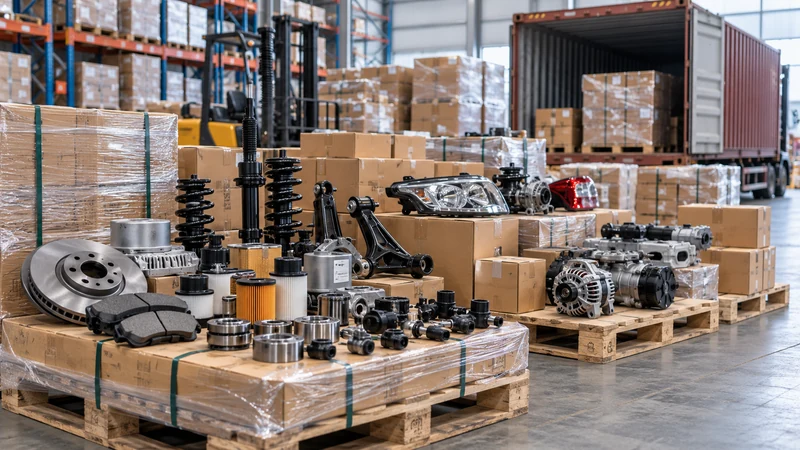
Shipping auto parts from China to Nigeria is rarely as simple as moving one type of product from one factory to one buyer.
A typical spare-parts order may contain brake components from one supplier, suspension parts from another, electrical sensors from a third, and heavy components such as engines or gearboxes from a separate factory. One shipment can therefore contain dozens—or hundreds—of SKUs with different HS classifications, values, packing requirements and compliance risks.
For Nigerian wholesalers, dealerships, repair chains, fleet operators and spare-parts distributors, the main logistics challenge is often not finding a freight rate. It is building a shipment that can be consolidated, documented, packed and cleared without turning a mixed inventory order into a customs problem.
That is why successful shipping of auto parts from China to Nigeria should normally start with the parts list, not with the container size.
The freight method, HS-code review, SON screening, dangerous-goods assessment and packaging plan can then be built around the actual products being purchased. Importers that are still comparing the full route can also review Shipping from China to Nigeria before choosing a specific freight mode.
Can the Auto Parts Be Imported into Nigeria?
Many new automotive components can be imported into Nigeria, but you should never assume that every product described as a “car part” follows the same import rules.
Nigeria Customs Service applies import controls by product and tariff classification. Import eligibility should therefore be checked against the exact item, condition and proposed HS code rather than only the general description “auto parts.”
A practical screening process is:
Is the part new or used?
↓
What exactly does the product do?
↓
Is it a safety-critical component?
↓
Does it contain a battery, liquid, aerosol, chemical or other potentially regulated material?
↓
Is the proposed HS classification subject to an NCS prohibition or special control?
↓
Is the product within SON/SONCAP scope?
↓
Does the carrier require dangerous-goods documentation or special acceptance?
↓
Only then confirm the shipping method and booking.
Used parts require particular care.
It is not safe to make a blanket statement that every used automotive component is either allowed or prohibited. The exact product should be checked before purchase and shipment.
Used tyres are an important exception. Nigeria Customs has repeatedly treated imported used tyres as prohibited goods and has continued to report seizures of used pneumatic tyres in enforcement operations. Importers should therefore not treat used tyres as ordinary spare parts.
For other second-hand components—such as used engines, gearboxes, body panels or assemblies—the importer should confirm current eligibility against the applicable customs rules before the supplier dispatches the cargo.
If the shipment is a complete vehicle rather than components or inventory, use the separate Shipping Cars from China to Nigeria guide because vehicle compliance and shipment procedures are different from spare-parts logistics.
Some Auto Parts Need More Compliance Attention Than Others
Not every spare part carries the same regulatory risk.
A plastic dashboard trim and a vehicle battery may both be sold by an “auto parts supplier,” but they should not be handled as equivalent products from a compliance or freight perspective.
The Standards Organisation of Nigeria identifies engine oil and tyres among examples of life-endangering products when product quality is inadequate. SONCAP is a conformity-assessment system for SON-regulated imported products, but this does not mean every automotive component automatically follows one identical certification route.
| Part Type | Typical Logistics Risk | Compliance Attention | Freight Consideration |
|---|---|---|---|
| Body panels and interior parts | Low to moderate | Confirm classification and import eligibility | Protect against dents, scratches and crushing |
| Mechanical parts | Moderate | SKU-level HS classification | Weight and packing strength can become important |
| Sensors, ECUs and electrical parts | Moderate | Classification plus product-specific screening | Often suitable for air freight |
| New tyres | Higher | SON screening should be completed before shipment | Bulky relative to value |
| Used tyres | Very high | Import prohibition risk | Do not ship without confirmed eligibility |
| Vehicle batteries | High | Product compliance plus DG assessment | Chemistry affects air/sea acceptance |
| Engine oil and lubricants | Higher | SON attention plus transport classification check | SDS and carrier approval may be required |
| Aerosols and workshop chemicals | High | DG and product-specific regulatory check | Carrier restrictions are common |
The important principle is simple:
Screen the individual product, not the industry label.
For example, a shipment containing shock absorbers, bearings, headlamps, batteries and lubricants should not be treated administratively as one undifferentiated commodity simply because everything will eventually be used on vehicles.
For SON-regulated products, the current SONCAP process should be reviewed before shipment. SON states that Product Certificates and SONCAP Certificates are used in the Form M and customs-clearance process for regulated goods. The importer should confirm the exact scope for the relevant product and HS code instead of assuming that all spare parts require the same certificate.
Multi-Supplier Auto Parts Consolidation in China
Multi-supplier consolidation is one of the most useful logistics strategies for Nigerian spare-parts importers.
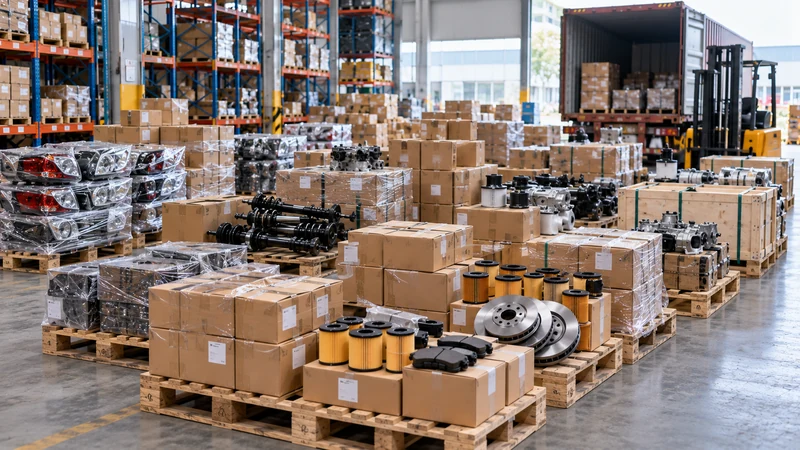
A wholesaler may source filters in Guangzhou, suspension components from Zhejiang, lighting products from another supplier and electronic parts from Shenzhen. Shipping every purchase separately can produce unnecessary freight charges, repeated destination handling and fragmented inventory arrivals.
Instead, the cargo can be brought together before export.
Typical Consolidation Workflow
Supplier A + Supplier B + Supplier C
↓
Delivery to the Winsail warehouse in China
↓
Receive and identify cartons by supplier and SKU
↓
Check quantities, visible packing condition and marks
↓
Separate special cargo such as batteries or liquids for review
↓
Repack, palletize or crate where required
↓
Create a consolidated carton/SKU record
↓
Load as one coordinated export shipment
↓
Air, LCL or FCL shipment to Nigeria
The objective is not merely to combine boxes. A good consolidation process should improve control over the shipment.
For a multi-SKU auto-parts order, that can include:
- identifying which supplier delivered each carton;
- checking carton counts against supplier packing lists;
- applying consistent SKU or carton labels;
- separating fragile electrical parts from heavy metal components;
- replacing weak export cartons;
- building pallets where appropriate;
- creating damage photographs before loading;
- checking whether any supplier inserted batteries, oils or aerosols without declaring them;
- reconciling the master packing list before final shipping documents are issued.
This is particularly useful when a buyer places many small orders over several weeks and wants them shipped together as one inventory replenishment.
For smaller ocean shipments, LCL consolidation services can be useful when the buyer needs to combine multiple suppliers without filling a full container.
Best Shipping Method for Auto Parts from China to Nigeria
There is no single best freight method for every spare-parts shipment.
Urgency, weight, volume, inventory value and the cost of running out of stock all matter.
| Shipping Method | Best For | Shipment Profile | Main Advantage | Main Limitation |
|---|---|---|---|---|
| Express | Samples and very small urgent orders | Small parcels | Fast and simple | Expensive for regular stock |
| Air Freight | Urgent, valuable or lightweight parts | Small to medium commercial shipments | Reduces replenishment time | Higher freight cost per kg |
| Sea LCL | Regular moderate inventory | Several cartons or pallets | No need to fill a container | More handling during consolidation/deconsolidation |
| Sea FCL | Large replenishment orders | High-volume or heavy inventory | Better control of large shipments | Requires sufficient cargo volume |
The decision should not be made from freight price alone.
A per-kilogram comparison may suggest that sea freight is cheaper, but that comparison can be misleading when a repair business, fleet or dealer has vehicles waiting for a critical replacement component.
Air Freight for Urgent Auto Parts
Air freight is commonly suitable for compact, relatively valuable parts where replenishment speed matters.
Examples include:
- sensors;
- ECUs and control modules;
- fuel injectors;
- bearings;
- electronic components;
- small pumps;
- urgent replacement parts;
- high-value components needed to restore fleet vehicles;
- parts required to prevent production or service downtime.
For these products, the relevant calculation is often:
Air freight cost vs. cost of waiting.
Suppose a fleet operator has commercial vehicles unable to return to service because a specific electronic component is unavailable locally.
Sea freight may have a lower transportation cost, but the operational cost of keeping several vehicles idle for additional weeks may be far higher than the air-freight difference.
This is why professional spare-parts purchasing often separates inventory into two groups:
Critical replenishment: ship by air.
Regular stock: combine into the next LCL or FCL shipment.
For route-specific planning, see Air Freight from China to Nigeria.
Air freight also requires accurate checking for restricted contents. Batteries, aerosols, chemicals and some other vehicle-related items cannot simply be added to general air cargo without review.
Lithium batteries are regulated as dangerous goods for air transport. Requirements depend on battery type, configuration, capacity, packing arrangement and current carrier acceptance rules.
Sea Freight for Regular Spare-Parts Inventory
For larger stock replenishment, sea freight normally provides better economics than air freight.
The two main options are LCL and FCL.
LCL Shipping
Less-than-container-load shipping is useful when an importer has more cargo than is economical by air but does not need a full container.
Typical examples include:
- several pallets of filters;
- brake components;
- suspension parts;
- lamps and body components;
- mixed dealership stock;
- regular wholesale replenishment.
LCL allows multiple suppliers’ cargo to be consolidated in China and shipped without paying for an entire container.
However, LCL involves more cargo handling than FCL. Heavy mechanical items therefore need strong packaging, and fragile products should not rely on thin domestic-market cartons.
FCL Shipping
Full-container-load shipping becomes attractive for larger replenishment programmes, heavy components or extensive mixed inventory.
FCL may also offer operational advantages beyond the freight rate:
- fewer cargo-handling stages;
- easier pallet and SKU organisation;
- more control over loading sequence;
- improved protection for bulky parts;
- easier separation of heavy and fragile cargo.
There is no universal CBM number at which every importer should switch from LCL to FCL.
The correct comparison depends on current ocean freight, origin charges, destination handling, cargo density, container utilization and the number of suppliers involved.
For route, port and FCL/LCL planning, review Sea Freight from China to Nigeria.
Shipping Engines, Gearboxes and Heavy Components
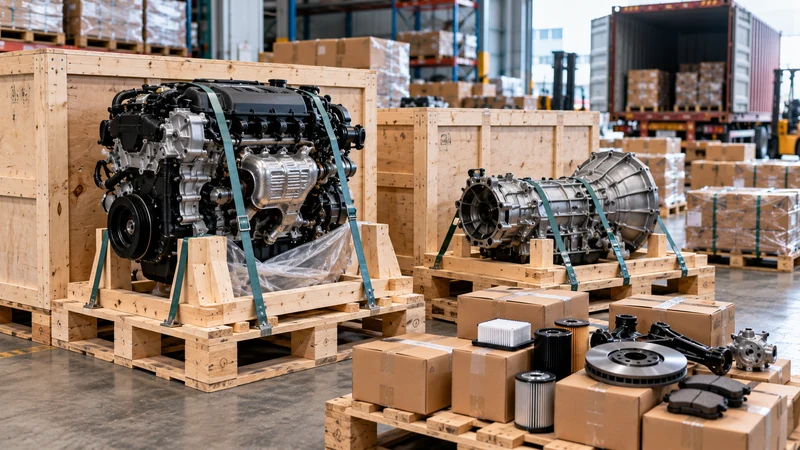
Engines, transmissions, differentials and other heavy assemblies require a different packing standard from ordinary cartonized parts.
The main risks are movement, leakage, forklift damage and inadequate load-bearing strength.
Heavy-Component Packing Checklist
Drain or control residual fluids where required.
Do not assume a carrier will accept an engine containing fuel, oil or other undeclared residue. The required preparation depends on the component, carrier and transport mode.
Prevent leakage.
Use suitable plugs, caps, absorbent material and secondary containment where appropriate.
Use a strong skid or crate.
The base must support the actual component weight throughout handling, not merely look strong when leaving the factory.
Secure the component to the base.
Heavy machinery should not be able to slide or tip inside the crate.
Provide forklift access.
Fork pockets should allow safe handling without pushing forks directly against the component.
Consider the centre of gravity.
Uneven assemblies may tip during handling even when total weight is not extreme.
Mark gross weight and lifting points.
Warehouse staff should be able to understand how the item should be handled before moving it.
Protect against corrosion.
For sea freight, exposed metal surfaces may require rust-prevention measures and moisture protection.
Record model and identification information.
Labels should remain visible or be reproduced on the exterior packing so the receiving team can identify each unit.
Photographs taken after packing but before loading are also useful for high-value heavy components.
Classification Is the Main Documentation Risk
The words “mixed auto parts” may be convenient for warehouse communication, but they are not a good basis for building commercial and customs documentation.
Not every product installed in a vehicle uses the same HS classification.
Tyres, batteries, lamps, electrical equipment, bearings, lubricants and mechanical components can fall under different tariff headings depending on their function, construction and the applicable Harmonized System rules.
For a shipment containing many different spare parts, classification should therefore start at SKU level.
Recommended Auto-Parts Classification Worksheet
| SKU | Precise Description | Function / Use | Material / Composition | Vehicle Model / Part No. | Qty | Value | Proposed HS Code |
|---|---|---|---|---|---|---|---|
| — | — | — | — | — | — | — | — |
| — | — | — | — | — | — | — | — |
| — | — | — | — | — | — | — | — |
For complex orders, additional columns can be added for:
- supplier;
- new/used status;
- carton number;
- gross weight;
- country of origin;
- SON review status;
- dangerous-goods status;
- supporting specification;
- final confirmed HS classification.
Why This Matters
A structured SKU list helps several processes at once.
It allows the importer and customs broker to review classification before arrival. It helps identify which items may require SON documentation. It helps the forwarder detect batteries and liquids. It makes invoice and packing-list reconciliation easier. It also reduces the risk of discovering after shipment that a generic commercial description does not adequately explain what is inside the container.
Nigeria’s import process is document-driven, so product descriptions, HS codes, invoice values and supporting records should be reconciled before cargo departs. For an overview of the destination clearance process, see Customs Clearance in Nigeria.
Pro Tip: Build the commercial invoice structure from the SKU list before consolidation is complete. “Mixed auto parts” is not a sufficient working description for a shipment containing materially different products.
Batteries, Engine Oil and Other Special Cargo
Spare-parts buyers should tell the forwarder about batteries and liquids before booking the shipment.
Do not wait until cargo reaches the consolidation warehouse.
Batteries
Automotive batteries require product and transportation screening.
The exact transport rules depend on battery chemistry and configuration. Lithium batteries, for example, are regulated dangerous goods for air transport and require specific classification, packing and documentation procedures.
Wet batteries can also fall under dangerous-goods classifications for maritime transport.
The supplier should therefore provide the battery specification and, when requested, the relevant Safety Data Sheet and transport documentation before the forwarder confirms acceptance.
Engine Oil and Lubricants
Engine oil deserves two separate checks.
First, SON specifically identifies engine oil as an example of a life-endangering product, so Nigerian product-compliance requirements should be reviewed before shipment.
Second, transport classification should be based on the actual product.
Do not assume every lubricant is automatically dangerous goods, and do not assume every oil product is unrestricted general cargo. The Safety Data Sheet, composition, flashpoint where relevant, packaging and applicable air or maritime regulations should be reviewed.
Aerosols and Chemicals
Brake cleaner, spray lubricant, paint, adhesive, refrigerant and workshop chemicals may introduce separate dangerous-goods classifications.
For mixed shipments, the safest operational rule is:
Tell the forwarder about every battery, oil, liquid, aerosol or chemical before cargo is booked.
Current Dangerous-Goods Rules Matter
International dangerous-goods regulations are updated periodically.
For maritime shipments, the IMDG Code governs dangerous goods carried in packaged form. The currently mandatory 2026 framework should be checked against the exact UN classification and packing method when the shipment contains regulated batteries, chemicals or other dangerous goods.
Air shipments follow applicable ICAO/IATA dangerous-goods requirements, and battery rules can vary depending on whether cells or batteries are shipped alone, packed with equipment or contained in equipment.
Carrier acceptance can also be stricter than the baseline regulations.
A technically transportable battery or chemical is therefore not automatically accepted on every airline, vessel or consolidation service.
Packaging Auto Parts for Export from China
Good packing protects more than the product. It also protects the shipment schedule.
Small Parts
For bearings, sensors, injectors, fittings and fasteners:
- retain suitable individual packaging;
- prevent movement within master cartons;
- use moisture protection where necessary;
- avoid excessive carton weight;
- label each inner box or SKU clearly.
Heavy Parts
For engines, transmissions and metal assemblies:
- use skids or export crates;
- secure the item mechanically;
- provide forklift access;
- control fluids and residues;
- mark weight and centre-of-gravity concerns.
Fragile Parts
For lamps, mirrors and electronic modules:
- use internal cushioning;
- separate them from heavy steel components;
- reinforce outer cartons;
- avoid unsupported void space.
Mixed Pallets
When several SKUs share one pallet:
- keep a pallet-level packing record;
- mark carton numbers;
- use stretch wrapping appropriately;
- avoid hiding SKU labels;
- photograph the pallet before dispatch.
Recommended Packaging Checklist
- small-parts inner packaging checked;
- heavy components crated or skid-mounted;
- liquids protected against leakage;
- exposed metal protected against corrosion;
- weak cartons replaced;
- pallets suitable for export handling;
- every SKU labelled;
- carton numbers recorded;
- gross weights checked;
- damage photos retained before loading.
Costs Beyond the Freight Rate
When comparing quotations for car parts shipping from China to Nigeria, buyers should consider the full logistics cost rather than only the ocean or air linehaul.
China-Side Costs
Possible origin costs include:
- supplier pickup;
- warehouse receiving;
- multi-supplier consolidation;
- cargo inspection or SKU checking;
- repacking;
- palletization;
- wooden crates or heavy-duty skids;
- export documentation;
- dangerous-goods handling where applicable.
Compliance Costs
Depending on the products, additional costs may include:
- testing;
- inspection;
- certification;
- SONCAP-related processes;
- specialist dangerous-goods packaging or documentation.
Freight Costs
The main freight options include:
- express courier;
- air freight;
- LCL ocean freight;
- FCL ocean freight;
- applicable carrier and fuel-related surcharges.
Nigeria-Side Costs
Destination costs can include:
- customs clearance;
- import duty and applicable taxes;
- terminal or airline handling;
- port or warehouse charges;
- customs-agent fees;
- storage or demurrage if delays occur;
- inland transport to Lagos, Abuja, Kano, Port Harcourt or other destination cities.
This is another reason accurate classification matters: the HS code can influence the applicable customs treatment and therefore the landed cost of each product group.
Auto Parts Compliance Checklist for Nigeria
Before shipping, review the following:
- Complete SKU-level product descriptions
- New or used status identified
- Proposed HS codes reviewed
- Current NCS import eligibility checked
- SON/SONCAP applicability screened
- Tyres checked separately
- Batteries identified by chemistry and specification
- Oils and liquids identified
- Aerosols or chemicals declared
- DG status checked with the carrier
- Supplier invoice data reconciled
- Packing-list quantities reconciled
- Form M information prepared consistently
- PAAR and clearance-document requirements coordinated with the Nigerian importer or customs agent
SON describes SONCAP as a pre-shipment conformity-assessment system for regulated imported goods. The key wording is regulated products.
Do not interpret that as meaning every SKU in an automotive shipment automatically requires the same SON certificate.
Information Needed for an Auto Parts Freight Quote
For an accurate shipping plan, prepare:
- complete parts list;
- new or used status;
- quantity by SKU;
- number of suppliers;
- supplier locations in China;
- total cartons or pallets;
- carton dimensions;
- gross weight;
- estimated total CBM;
- battery content;
- oil, liquid or aerosol content;
- heavy items requiring crates;
- preferred shipping speed;
- Nigerian destination city.
For hundreds of SKUs, an Excel parts list is normally more useful than sending separate screenshots or supplier chat messages.
Review Auto Parts Shipment
Before cargo leaves multiple factories, review the full product list as one shipment.
This makes it easier to identify classification issues, prohibited products, batteries, liquids and packing weaknesses while there is still time to correct them in China.
For mixed spare-parts orders, early review is usually cheaper than solving documentation or cargo-acceptance problems after consolidation is complete.
Consolidate China Suppliers
If you buy auto parts from several factories, the shipments can be coordinated through one China consolidation process.
Winsail Logistics can arrange supplier deliveries into the warehouse, coordinate carton and SKU records, identify cargo that needs special handling, repack or palletize where required and prepare the consolidated shipment for air or sea freight.
This is particularly useful for wholesalers and distributors managing frequent orders from Guangzhou and other Chinese sourcing regions.
FAQ
Can I consolidate auto parts from several Chinese suppliers?
Yes. Different suppliers can send cargo to one consolidation warehouse in China, where cartons can be received, identified and combined into one coordinated air, LCL or FCL shipment. A master SKU list is recommended for complex orders.
Should auto parts ship by air or sea?
Use air freight for urgent, compact or relatively valuable parts when waiting could create a larger operational loss. Use LCL for moderate regular inventory and FCL for larger stock replenishment.
Do tyres require extra compliance checks?
Yes. SON identifies tyres as a higher-safety-risk product category, while used tyres present a separate import-prohibition risk. Confirm the exact tyre type, condition and current requirements before shipment.
Can engine oil ship with dry auto parts?
Possibly, but it should not be added to general spare-parts cargo without prior review. Check the product's SON requirements, Safety Data Sheet, transport classification, packaging and carrier acceptance first.
Can used auto parts be imported into Nigeria?
This should be checked product by product. Do not assume all used parts are allowed. Used tyres are a clear high-risk category, while other second-hand components should be verified against current NCS rules before shipment.
How should engines be packed?
Engines should normally be secured to a strong export skid or suitable crate, protected against leakage and movement, provided with safe forklift access, and marked with the correct gross weight and handling information.
Can all spare parts use one HS code?
No. Tyres, batteries, electrical equipment, mechanical parts, bearings, lamps and lubricants can fall under different tariff headings. Build the invoice from a detailed SKU worksheet and review the final classifications before shipment.
Send Parts List
For shipping auto parts from China to Nigeria, send the parts list before finalizing the freight method.
Include each product description, quantity, supplier, carton dimensions, total weight, whether the item is new or used, and whether the shipment contains batteries, engine oil, liquids or aerosols.
From there, the cargo can be reviewed for consolidation, packing, air freight or sea freight options and the documentation issues that should be resolved before shipment.
Compliance Note: Import restrictions, SON/SONCAP scope, HS classification and dangerous-goods acceptance can change or depend on the exact product. Final classifications and Nigerian import eligibility should be confirmed against current Nigeria Customs Service and Standards Organisation of Nigeria requirements before shipment. Carrier acceptance should also be confirmed before booking batteries, liquids, oils or other potentially regulated cargo.
