
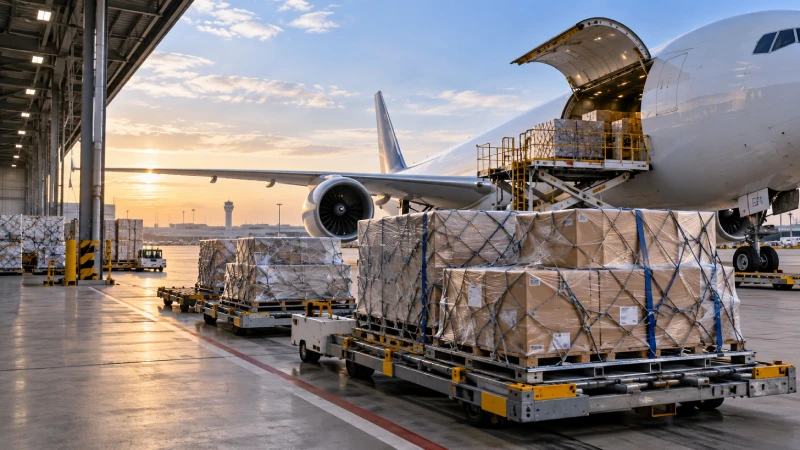
Air freight from China to Nigeria makes commercial sense when the cost of waiting is higher than the extra freight cost.
That distinction matters.
A shipment does not automatically belong on an aircraft simply because it is relatively small. A 200 kg shipment of low-value, non-urgent products may still be better suited to sea freight. By contrast, 500 kg of replacement parts that can restart a production line may justify air freight immediately.
For Nigerian importers, wholesalers, manufacturers and distributors, standard air freight normally means moving commercial cargo from a Chinese airport through an airline or freight-forwarder consolidation service to Nigeria, most commonly through Lagos Murtala Muhammed International Airport (LOS).
Unlike parcel courier services such as DHL, FedEx or UPS, commercial air cargo is usually priced according to chargeable weight and airline weight breaks, with separate coordination for cargo acceptance, airport handling and Nigerian customs clearance.
This guide explains how standard air freight from China to Nigeria works, what determines the rate per kilogram, how chargeable weight is calculated, what happens when cargo arrives in Lagos, and when air cargo is commercially preferable to express or sea freight.
For a broader route overview, see China–Nigeria freight options guide. If you are still comparing transport modes, read Best Shipping Methods from China to Nigeria.
Air Freight from China to Nigeria at a Glance
For most commercial shipments, the important numbers are not simply the flight time and a headline price per kilogram. You also need to know the shipment’s chargeable weight, origin airport, routing, cargo classification and clearance readiness.
| Item | Typical Planning Basis |
|---|---|
| Service | Commercial air cargo / freight-forwarder consolidation |
| Common China origins | Guangzhou (CAN), Shenzhen (SZX), Shanghai (PVG), Hong Kong (HKG) |
| Main Nigeria gateway | Lagos (LOS) |
| Typical planning transit | Around 4–8 days airport-to-airport on many published services; total lead time may be longer |
| Charging basis | Higher of actual gross weight or volumetric weight |
| Common volumetric formula | L × W × H in cm ÷ 6,000 |
| Common weight breaks | Minimum, +45, +100, +300, +500, +1,000 kg |
| Typical cargo | Electronics, machinery parts, commercial goods, urgent replenishment and high-value cargo |
| Rate status | Space- and shipment-specific; live quotation required |
Current air freight rate reference
As of October 3, 2026, public market references show why air freight rates should never be presented as one permanent China-to-Nigeria price.
One current China–Nigeria freight guide publishes approximately $6.1/kg as an October 2026 air-freight reference, while another recent market source gives approximately $5.8–$9.5/kg for larger commercial consignments. These are external planning benchmarks rather than Winsail contracted rates and may not include the same origin handling, destination charges, customs clearance or delivery scope.
A real quotation therefore needs at least:
- cargo description;
- number of packages;
- actual gross weight;
- packed dimensions;
- pickup city in China;
- destination in Nigeria;
- cargo-ready date; and
- confirmation of batteries, liquids, powders, magnets or other restricted characteristics.
Pro Tip: Request both gross weight and final packed dimensions from your supplier before asking for an air freight rate. The dimensions can change the billable weight significantly.
Main China Air Cargo Gateways
China has many international cargo airports, but the best departure airport is not automatically the airport nearest to the factory.
The commercially preferable gateway depends on supplier location, airline capacity, cargo characteristics, consolidation schedules and the rate available for the required departure week.
Guangzhou Baiyun International Airport — CAN
Guangzhou is a major option for cargo originating in Guangzhou, Foshan, Dongguan and the wider Pearl River Delta.
CAN can be particularly practical for exporters and importers sourcing consumer products, equipment, electronics and other goods throughout South China.
For a supplier located nearby, using Guangzhou may reduce domestic pickup time and simplify delivery into the forwarder’s export warehouse.
Shenzhen Bao’an International Airport — SZX
Shenzhen is another important South China cargo gateway.
It can be commercially attractive for shipments originating around Shenzhen, Dongguan and nearby manufacturing centers, particularly when suitable airline capacity or consolidation space is available.
The decision between SZX and CAN should be made from the total routing and freight cost, not from airport distance alone.
Shanghai Pudong International Airport — PVG
PVG is a major gateway for cargo produced around Shanghai, Jiangsu, Zhejiang and the Yangtze River Delta.
For factories in eastern China, trucking cargo all the way to South China purely to obtain a slightly lower airline rate may not reduce the total shipping cost once pickup, handling and additional time are included.
Hong Kong International Airport — HKG
Hong Kong can be useful when its airline schedules, capacity or cargo-acceptance options are commercially advantageous.
However, moving mainland Chinese cargo through HKG creates an additional cross-border logistics step. The routing therefore needs to be evaluated shipment by shipment rather than assuming Hong Kong will always be cheaper or faster.
Other airport options
Other Chinese gateways may also be considered when the factory location, cargo type or current airline capacity makes them competitive.
| Origin Situation | Airport Strategy |
|---|---|
| Supplier in Guangzhou/Foshan | Check CAN first |
| Supplier in Shenzhen/Dongguan | Compare SZX and CAN |
| Supplier in Shanghai/Jiangsu/Zhejiang | Check PVG before trucking south |
| Special cargo or capacity issue | Compare HKG and alternative gateways |
| Multiple suppliers | Consolidate first, then select the most economical gateway |
| Urgent shipment | Prioritize confirmed space and schedule over nominal airport preference |
A good freight plan evaluates pickup + consolidation + airline cost + routing + destination handling, rather than comparing air rates in isolation.
Lagos LOS as the Main Cargo Gateway
For many commercial air shipments from China to Nigeria, Murtala Muhammed International Airport in Lagos (LOS) is the primary planning gateway.
The important point for importers is that air cargo does not simply arrive in the passenger baggage hall.
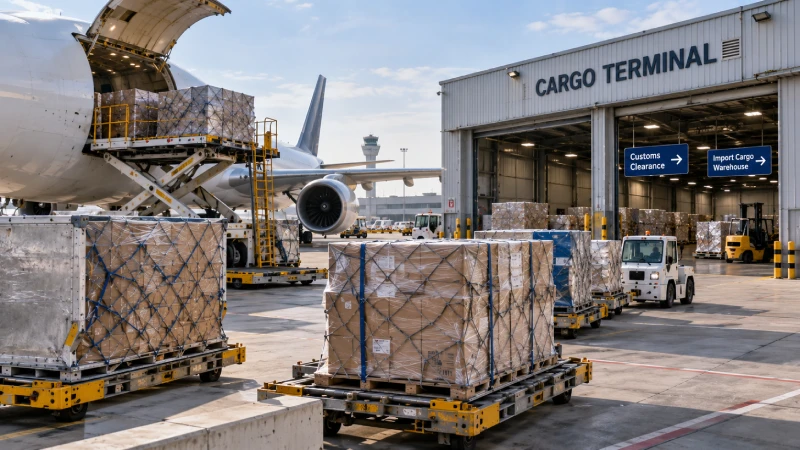
FAAN confirms that MMIA cargo facilities operate in a dedicated part of the airport with separate access, logistics handling systems and cargo procedures. Cargo handling infrastructure includes import and export clearance, loading and unloading, warehousing and related logistics activities.
NAHCO, one of the airport cargo handling operators, describes the Lagos process as including aircraft handling, cargo breakdown, warehousing, customs control and cargo delivery after documentation is completed. Its facilities also include specialist areas for perishables, dangerous goods and valuables.
A simplified arrival process looks like this:
Airline arrival → Cargo terminal → Ground handler → Warehouse → Customs process → Cargo release → Local truck
What happens after the aircraft lands?
The shipment is transferred into the cargo handling system rather than directly to the consignee.
The cargo is typically:
- unloaded from the aircraft;
- transferred to the appointed cargo handler;
- broken down from airline units where required;
- entered into the import cargo warehouse;
- matched with the relevant airway bill and import documentation;
- processed through customs and any applicable regulatory procedures;
- released after clearance and applicable terminal requirements; and
- collected for final delivery.
This is why flight arrival time is not delivery time.
Even if the aircraft lands on schedule, documentation discrepancies, regulatory checks, duty assessment or cargo-release procedures can extend the overall lead time.
Direct vs Connecting Air Cargo Routing
An importer should not assume that air cargo from Guangzhou, Shenzhen or Shanghai will always fly nonstop to Lagos.
Commercial air freight is sold according to the capacity available on a specific airline product and departure date. Depending on the booking, cargo may move:
China → Lagos
or:
China → Transit hub → Lagos
A one-stop routing is not necessarily a poor routing.
In some cases, connecting capacity may offer:
- better space availability;
- a more competitive freight rate;
- more suitable cargo acceptance;
- better departure frequency; or
- a faster confirmed departure than waiting for another service.
What matters is the booked itinerary, not whether the marketing description says “direct.”
Before confirming an urgent order, check:
- booked origin airport;
- intended destination airport;
- scheduled departure;
- expected transfer points;
- number of flight sectors;
- airline acceptance status;
- confirmed space; and
- estimated arrival at LOS.
Airline and routing details should be reconfirmed when the quotation is issued because capacity can change.
How Chargeable Weight Works
One of the most common air-freight pricing mistakes is asking:
“What is your price for 200 kg?”
without providing the carton dimensions.
Airlines sell both weight and aircraft space. A lightweight shipment occupying a large amount of space may therefore be charged at a higher weight than its scale weight.
IATA defines chargeable weight as the actual gross weight or volume weight, whichever is higher. Its general volumetric calculation uses cubic centimeters divided by 6,000.
Air freight volumetric-weight formula
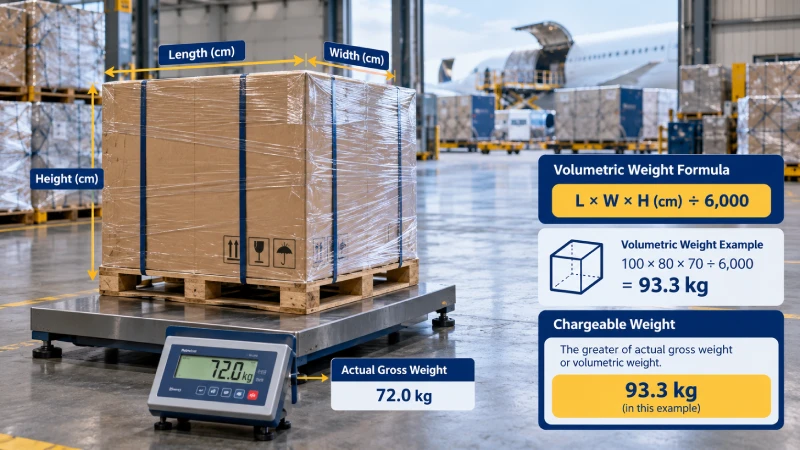
Volumetric weight = Length × Width × Height (cm) ÷ 6,000
For multiple cartons:
Total volumetric weight = sum of the volumetric weight of all packages
Then:
Chargeable weight = greater of gross weight or volumetric weight
Example 1: Light but bulky cargo
Suppose one packed crate measures:
100 × 80 × 70 cm
Volume weight:
100 × 80 × 70 ÷ 6,000 = 93.3 kg
If its actual gross weight is only 65 kg, the shipment is volumetrically heavier.
The freight is therefore based on approximately 93.3 kg before the applicable airline/forwarder rounding rule is applied.
Example 2: Dense cargo
A shipment measures:
80 × 60 × 50 cm
Volumetric weight:
80 × 60 × 50 ÷ 6,000 = 40 kg
If actual gross weight is 72 kg, the scale weight is higher.
The chargeable weight is therefore 72 kg.
| Measurement | Formula | When It Controls |
|---|---|---|
| Actual weight | Physical gross weight | Dense cargo |
| Volume weight | L × W × H ÷ 6,000 | Lightweight/bulky cargo |
| Chargeable weight | Higher of the two | Used for air-freight pricing |
The final calculation remains subject to the tariff and measurement rules applied to the booked shipment.
Air Freight Weight Breaks
Commercial air cargo is commonly quoted using airline weight bands rather than one universal price for every kilogram.
Typical structures can include:
- minimum charge;
- +45 kg;
- +100 kg;
- +300 kg;
- +500 kg; and
- +1,000 kg.
The exact bands and rates depend on the route and booked airline product.
| Pricing Level | Commercial Meaning |
|---|---|
| Minimum | Small shipment subject to minimum freight charge |
| +45 kg | Rate applicable from the relevant 45 kg level |
| +100 kg | Common commercial cargo breakpoint |
| +300 kg | Larger consolidated shipment |
| +500 kg | Higher-volume commercial booking |
| +1,000 kg | Ton-scale air cargo |
A 120 kg shipment and an 800 kg shipment should therefore not be compared using the same generic “air freight price per kg.”
In some tariffs, a forwarder may also check whether rating the shipment at a higher minimum weight produces a lower total freight charge.
The correct question is therefore:
“What is the total freight cost at my shipment’s actual chargeable weight and booked weight break?”
rather than:
“What is the cheapest price per kg?”
Cargo Acceptance: What Needs Checking Before Booking
Not every product can be tendered as ordinary general cargo.
Before an airline booking is made, tell the freight forwarder if the shipment contains:
- lithium or sodium-ion batteries;
- battery-powered equipment;
- liquids;
- powders;
- chemicals;
- aerosols;
- magnetized materials;
- oversized pieces;
- temperature-sensitive products;
- high-value cargo;
- branded goods subject to authorization requirements; or
- any material classified as dangerous goods.
Some of these products can still travel by air. The issue is whether the shipment meets the correct classification, documentation, packaging, marking, labeling and airline acceptance requirements.
Battery cargo is a particularly important example. IATA’s 2026 battery guidance confirms that lithium and sodium-ion battery shipments are subject to specific air-transport requirements depending on battery type, configuration and classification.
A shipment accepted by one airline or service is also not automatically accepted under another airline’s operating conditions.
Pro Tip: Obtain airline acceptance for batteries, dangerous goods or other restricted cargo before committing to the customer’s required departure date.
For sensitive cargo, the order of decision-making should be:
Acceptance first → routing second → rate third
not the other way around.
Air Freight Transit Time: Flight Time Is Not Lead Time
Importers often focus too heavily on how many hours the aircraft spends in the air.
The real supply-chain timeline is longer.
A commercial shipment typically moves through:
Supplier → Forwarder’s warehouse → Airport acceptance → Airline → LOS cargo terminal → Customs → Local truck
A realistic timeline includes several separate stages.
1. Pickup from the supplier
Cargo is collected from the Chinese factory or delivered by the supplier to the forwarder’s warehouse.
2. Consolidation and cargo preparation
The forwarder verifies packages, weight, dimensions, documentation and cargo characteristics before preparing the shipment for the booked flight.
3. Airline booking and acceptance
Space must be confirmed and the airline or handling agent must accept the cargo.
Special cargo can require additional approval.
4. China export handling
Cargo passes the necessary export handling procedures and enters the airport cargo system.
5. Flight and possible transit
The shipment moves directly or through a transfer point according to the booked routing.
6. LOS ground handling
After arrival, cargo is unloaded, transferred to the handler and made available through the import-cargo warehouse process.
7. Nigerian customs clearance
The importer or appointed customs representative completes the relevant customs and regulatory procedures.
8. Release and local delivery
After release, cargo can be collected and delivered by truck to the required destination.
Current public lane references commonly advertise approximately 4–8 or 5–8 days for standard China–Nigeria air cargo, depending on route and service definition. These are planning references rather than guaranteed end-to-end delivery times.
Clearance readiness can be more important than saving several hours on the flight routing.
For a broader comparison of total lead times by transport mode, see Shipping Time from China to Nigeria.
Nigeria Import Documentation for Air Cargo
Air transport does not remove normal Nigerian commercial import requirements.
The exact documentation depends on the product and HS classification, but common documents include:
- commercial invoice;
- packing list;
- Air Waybill (AWB);
- Form M;
- Pre-Arrival Assessment Report (PAAR);
- certificate of origin where required;
- SONCAP documentation for regulated products; and
- other permits or certificates required by the relevant Nigerian authority.
Nigeria Customs Service guidance lists registered Form M, regulatory certificates where applicable, Air Waybill or other transport document, commercial invoice, packing list and certificate of origin among documents associated with the PAAR process.
Form M
Form M is part of Nigeria’s commercial import procedure and should be addressed before the shipment reaches the clearance stage.
Do not wait until cargo has arrived at LOS to investigate whether the import documentation is ready.
PAAR
The Pre-Arrival Assessment Report supports customs assessment before cargo release.
The information across the invoice, packing list, AWB, Form M and regulatory documentation should therefore be consistent.
SONCAP
For products regulated by the Standards Organisation of Nigeria, SON states that the applicable Product Certificate is connected to Form M processing, while the SONCAP Certificate is required for customs clearance of SON-regulated goods.
There was also an important procedural change in 2026. SON announced that from March 27, 2026, activation of relevant SONCAP certificates and import-permit processes for Form M, PAAR and cargo clearance moved to Nigeria’s National Single Window platform.
Requirements can differ by HS code and product category, so importers should verify the current procedure with their Nigerian customs representative and the relevant regulatory authority before departure.
Air Freight vs Express Courier
Standard air freight and express courier both use aircraft, but commercially they are different services.
| Factor | Standard Air Cargo | Express Courier |
|---|---|---|
| Typical use | Commercial consignments | Samples, parcels and small urgent shipments |
| Transport model | Airline cargo + freight forwarder | Integrated courier network |
| Pricing | Airline weight breaks and chargeable weight | Courier tariff based on chargeable weight/service |
| Origin handling | Forwarder consolidation/airport handling | Courier pickup network |
| Destination | Often airport cargo workflow | Usually integrated door delivery |
| Customs coordination | Importer/forwarder/agent coordination | Courier brokerage process |
| Best comparison point | Medium or larger commercial cargo | Small urgent parcels |
There is no universal kilogram at which air freight suddenly becomes cheaper than DHL, FedEx or UPS.
However, once a shipment becomes multiple commercial cartons, palletized cargo or reaches commercial weight breaks such as +100 kg, it is sensible to compare a standard air-cargo quotation with an express quotation.
For a small product sample, express may remain simpler even when its nominal per-kilogram price is higher.
For more detail on courier shipments, see Express Shipping from China to Nigeria.
When Air Freight Makes Commercial Sense
For high-value and time-sensitive cargo, also review the electronics shipping guide.
Air freight should solve an economic problem rather than simply provide the fastest transport mode.
Production stoppage
If a Nigerian factory is waiting for a replacement component and downtime is costing thousands of dollars per day, airfreighting the part may cost far less than waiting for an ocean shipment.
Stockout risk
An importer expecting to run out of profitable inventory before the next sea shipment arrives can use air freight to bridge the gap.
High value-to-weight cargo
Products with high commercial value but manageable weight and volume can absorb air freight more easily than bulky, low-value products.
Product launch deadlines
A missed retail, project or launch date may cost more than the difference between air and sea transport.
Replacement parts
Industrial spare parts are a common air-freight candidate because the value lies in restoring equipment or operations rather than in the physical product itself.
Seasonal replenishment
Air cargo can support short replenishment cycles when missing a sales period would create a larger loss than the freight premium.
Decision matrix
| Situation | Recommended Next Step |
|---|---|
| Urgent + commercial volume + manageable cube | Check standard air freight |
| Tiny parcel or product sample | Compare express courier |
| Bulky and lightweight cargo | Calculate volume weight and compare sea immediately |
| Heavy, low-value cargo | Compare LCL/FCL sea freight |
| Battery or dangerous goods | Confirm acceptance before pricing |
| Deadline-driven replenishment | Compare air premium with cost of stockout |
| No urgent requirement | Review sea freight first |
The best mode therefore depends on the value of time, not only shipment weight.
For landed-cost planning, compare the transport component with Shipping Cost from China to Nigeria.
What to Send for an Accurate China-to-Nigeria Air Freight Check
For a useful air-freight calculation, send:
- product name and description;
- pickup city in China;
- number of cartons, crates or pallets;
- gross weight;
- dimensions of each package;
- cargo value;
- destination city in Nigeria;
- expected cargo-ready date;
- whether the shipment contains batteries, liquid, powder, magnets or chemicals; and
- whether you need airport-to-airport service or additional pickup, clearance or delivery coordination.
Winsail Logistics handles shipments originating from China and can use these details to determine the chargeable weight, suitable China gateway, available air-cargo routing and current commercial rate.
For delivery beyond the airport, see Door-to-Door Shipping from China to Nigeria. If you specifically need a duty-inclusive structure, review DDP Shipping from China to Nigeria.
Calculate Chargeable Weight
Check Current Air Freight Rate
Send Cargo Packing Details
FAQ
How long does air freight from China to Nigeria take?
Current public market references commonly indicate roughly 4–8 or 5–8 days for many standard China-to-Nigeria air-cargo services, depending on origin, destination and routing. Pickup, consolidation, airline acceptance, LOS handling and customs clearance can make the total lead time longer.
How is air freight charged per kg?
Commercial air cargo is normally charged according to the shipment's chargeable weight and the airline rate applicable to its weight break. Origin handling, destination handling, clearance and local delivery may be separate.
What is chargeable weight?
Chargeable weight is generally the higher of the shipment's actual gross weight and volumetric weight. A common air-cargo formula is Length × Width × Height in centimeters ÷ 6,000.
Which airport receives most China air cargo in Nigeria?
Lagos Murtala Muhammed International Airport, airport code LOS, is a major gateway used for commercial air cargo into Nigeria and is the normal planning gateway for many China-origin shipments.
Is air freight the same as DHL or FedEx?
No. Standard commercial air freight normally involves a freight forwarder, airline cargo service, airport cargo terminals and separate customs or delivery coordination, while DHL and FedEx operate integrated express-courier networks.
Can batteries be shipped by air to Nigeria?
Some battery shipments can travel by air, but acceptance depends on battery chemistry, configuration, capacity, packaging and the applicable dangerous-goods rules. Airline acceptance should be confirmed before booking.
Does air freight include Nigerian customs clearance?
Not automatically. A basic air-freight quotation may cover airport-to-airport transportation only, while clearance, duties, taxes, terminal charges and local delivery may be separate.
When is air freight cheaper than express courier?
There is no fixed crossover point. As shipment weight increases and cargo begins qualifying for commercial airline weight breaks such as +100, +300 or +500 kg, standard air freight can become more attractive, but both options should be compared using the same packed dimensions, weight and delivery scope.
Final Takeaway
Air freight from China to Nigeria is best evaluated as a commercial inventory decision, not simply a faster version of sea freight.
Before booking, establish four things:
1. What is the chargeable weight?
Actual kilograms alone are not enough.
2. Is the cargo accepted by the airline?
Batteries, dangerous goods and other sensitive products require confirmation before space is promised.
3. What routing and weight break are actually available?
A connecting service with confirmed capacity may be commercially better than waiting for a preferred routing.
4. Is the Nigerian import documentation ready?
A fast flight cannot compensate for missing Form M, PAAR, SONCAP or other regulatory documentation.
If the cargo is urgent, commercially valuable and reasonably compact, standard air freight can provide an effective balance between the speed of express courier and the lower cost of sea freight.
For bulky or non-urgent shipments, compare Sea Freight from China to Nigeria or Best Shipping Methods from China to Nigeria before committing to air.
Rate and routing review: October 3, 2026. Published market rates are reference figures only and are not guaranteed Winsail quotations. Airline acceptance, routing, rates and capacity must be reconfirmed for each shipment. Nigerian customs and regulatory requirements depend on the product, HS classification and current government procedures.
