

If you are importing goods from several Chinese suppliers or shipping cargo that does not fill an entire container, LCL shipping from China to Tanzania can help you move smaller quantities without paying for a dedicated container.
However, LCL involves more than booking shared container space. Your goods must be prepared, delivered to a consolidation warehouse, documented, loaded with other shipments, and separated again at the destination. Each stage introduces handling requirements, deadlines, and potential charges.
This guide explains how to manage the complete LCL process, from supplier collection in China to cargo release in Dar es Salaam. For a broader comparison of transport modes and routes, see our shipping from China to Tanzania guide.
Quick Answer: LCL (Less than Container Load) shipping allows importers to share container space with other shipments. Goods are received at a China container freight station (CFS), consolidated, shipped to Tanzania, and separated at a destination facility in Dar es Salaam. Successful delivery depends on accurate cargo documents, appropriate packaging, destination CFS arrangements, customs clearance, and payment of applicable charges. Confirm the receiving facility, cut-off dates, and release procedure before booking.
Data Note — October 2026: This guide references Tanzania Revenue Authority import procedures and the Tanzania Ports Authority Sea Ports Tariff Book dated January 2026. Operational steps describe common LCL arrangements, not guaranteed terms for every shipment. Actual consolidation schedules, warehouse charges, carrier conditions, destination CFS fees, and release requirements depend on the booked service and must be confirmed before shipment.
How Does LCL Shipping from China to Tanzania Work?
An LCL shipment passes through several handling and documentation stages before the importer can collect the goods.
Unlike FCL shipping, where one shipment normally occupies a dedicated container, LCL cargo shares container space with other consignments. The consolidator must organize multiple shipments, prepare the container, and arrange for individual cargo separation at the destination.
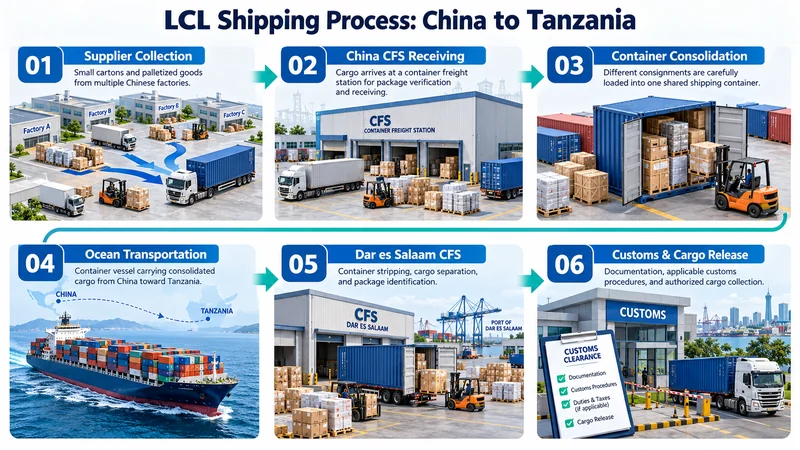
The LCL Shipping Process: China to Dar es Salaam
| Stage | Main Activity | What the Importer Should Verify |
|---|---|---|
| 01. Cargo planning | Confirm suppliers, products, package quantities, dimensions, and gross weight | Cargo acceptance, quotation scope, and supplier readiness |
| 02. China CFS receiving | Suppliers deliver cargo or arrange collection to the designated receiving warehouse | Warehouse address, receiving hours, cut-off, and receipt records |
| 03. Consolidation | Packages are checked, grouped with compatible cargo, and loaded into a container | Final measurements, handling exceptions, and cargo acceptance |
| 04. Ocean transportation | Container departs China for Dar es Salaam, directly or via transshipment | Booking reference, vessel schedule, and shipping documents |
| 05. Destination deconsolidation | Container is transferred to the designated stripping facility and consignments are separated | Actual CFS, cargo availability, and handling charges |
| 06. Customs clearance and release | Customs formalities, applicable payments, and cargo release are completed | Release documents, payment status, and collection authorization |
This sequence illustrates a common LCL shipment. Physical deconsolidation, customs examination, and document release do not necessarily occur in a fixed order for every consignment.
How Long Does China CFS Consolidation Take?
LCL planning should distinguish three separate periods:
- Cargo collection time: How long suppliers need to prepare and transport goods to the assigned warehouse.
- Consolidation and departure preparation: The interval between warehouse receiving, cargo acceptance, container stuffing, and the booked vessel departure.
- Ocean transit and destination handling: Transportation to Dar es Salaam, followed by container processing, deconsolidation, and individual shipment release.
There is no universal consolidation period that applies to every China–Tanzania LCL service.
The cargo receiving cut-off may occur before the vessel’s departure date. Depending on the booking, the forwarder may also impose separate documentation and customs cut-offs.
A supplier delivering cargo after the receiving deadline may miss the planned consolidation and require rebooking.
For example, if one of four suppliers misses the warehouse cut-off, the importer may need to ship the other suppliers’ goods first or hold the entire shipment for a later departure.
Pro Tip — Confirm the Cargo Cut-Off, Not Just the Vessel ETD
Ask your forwarder to provide the exact warehouse receiving deadline, documentation cut-off, and planned vessel departure. Schedule supplier deliveries and pre-shipment inspections around these dates rather than relying on the estimated sailing date alone.
For general ocean routing and transport-time considerations, see sea freight from China to Tanzania.
How to Consolidate Goods from Multiple Chinese Suppliers
One advantage of LCL shipping is the ability to combine smaller orders from different suppliers into a coordinated shipment.
However, purchasing from multiple factories does not automatically mean their cargo can be treated as one shipping or customs consignment.
The receiving warehouse, exporter arrangements, commercial documents, commodity classifications, and cargo compatibility must be checked first.
Arrange Supplier Collection and Pre-Shipment Inspection
Before dispatching goods to the CFS, each supplier should confirm:
- Final product quantities and commercial descriptions.
- Number and type of packages.
- Outer dimensions and gross weight.
- Cargo-ready date and pickup location.
- Export packing condition and shipping marks.
- Any relevant product certificates or regulatory documents.
For goods requiring quality inspection, arrange the inspection at the supplier’s premises or another suitable location before final dispatch.
Typical checks include product quantity, model numbers, visible defects, accessories, carton condition, and consistency with the purchase order.
A freight warehouse’s receipt of cargo should not be treated as confirmation of product quality. Receiving personnel may check package quantities and visible external condition without opening or testing the products.
If repacking, labeling, or internal product inspection is required, confirm whether the service is available and obtain its cost in advance.
LCL Packaging and Shipping Marks
LCL cargo is commonly handled multiple times during warehouse receiving, stuffing, transport, stripping, and delivery.
Strong outer packaging is therefore particularly important.
| Cargo Type | Recommended Packaging | Main Risk to Control |
|---|---|---|
| Electronics | Reinforced cartons with suitable internal cushioning | Impact, moisture, and crushing |
| Machinery parts | Secure crates or pallets with adequate blocking and restraint | Movement, corrosion, and handling damage |
| Glass or fragile products | Protective partitions, cushioning, and reinforced outer packaging | Breakage during handling |
| Furniture | Edge protection, protective wrapping, and suitable crates where needed | Surface damage and deformation |
| Small mixed cartons | Consistent carton numbers and shipment identification | Misidentification or misplaced packages |
Packaging must be appropriate for the actual cargo weight, fragility, stacking requirements, and handling equipment. Wooden packaging may require phytosanitary treatment or marking where applicable.
Every package should carry clear shipping marks, typically including:
- Consignee or shipment reference.
- Destination: Dar es Salaam, Tanzania.
- Carton or package number, such as 1/12, 2/12, through 12/12.
- Gross weight and handling symbols where appropriate.
- Any warehouse-specific identification required by the consolidator.
Avoid using only the factory’s internal product code as the shipping mark.
Check Cargo Compatibility Before Consolidation
Not all products are suitable for ordinary general-cargo LCL services.
Lithium batteries, certain chemicals, aerosols, flammable liquids, temperature-sensitive products, and other regulated cargo may require additional documentation or special acceptance. Some may be rejected from a proposed consolidation entirely.
Even non-dangerous goods can present compatibility concerns when strong odors, liquids, dust, contamination risks, or unusual dimensions are involved.
Ask the consolidator to confirm cargo acceptance before dispatching goods to its warehouse.
A shipment should never be described as general cargo simply to obtain a lower freight rate.
What Documents Are Required for LCL Shipping to Tanzania?
Accurate documentation links the cargo received in China with the transport record, Tanzanian customs declaration, and destination release process.
Document discrepancies may delay customs processing even when the goods have already arrived.
LCL Shipping Document Checklist
| Document | Main Purpose | Responsible Party / Check |
|---|---|---|
| Commercial Invoice | Establishes the transaction, product description, quantity, and declared commercial value | Supplier or seller; importer reviews accuracy |
| Packing List | Identifies packages, contents, dimensions, and weights | Supplier prepares; compare with CFS records |
| House Bill of Lading (HBL), where issued | Records the shipment under the forwarder or NVOCC transport arrangement | Issuing forwarder; verify consignee and release terms |
| Master Bill of Lading (MBL), where applicable | Records the carrier-level sea transport arrangement | Ocean carrier and its contracting party |
| Certificate of Conformity (CoC), where required | Supports compliance for products subject to applicable conformity requirements | Importer and supplier coordinate certification |
| Import Permits or Approvals | Support clearance of regulated products | Importer verifies requirements with competent authorities |
| Customs Declaration and Release Records | Establish customs processing and release status | Licensed Tanzanian clearing agent |
| Delivery Order / CFS Release Authorization | Supports release and collection from the relevant cargo holder | Issuing party and clearing agent |
Additional documents may be needed depending on the product, origin, destination, and transport contract.
Understanding the Relationship Between HBL and MBL
In many consolidated shipments, two transport-document levels exist.
House Bill of Lading (HBL)
An HBL is generally issued by a freight forwarder or non-vessel-operating common carrier (NVOCC) to its customer. It identifies the particular shipment and the contractual transport parties.
Master Bill of Lading (MBL)
An MBL is issued by the ocean carrier under its transport contract. For a consolidated container, the carrier-level document may identify the consolidator or its agent rather than the individual final importer.
Consider a container carrying goods from five unrelated importers.
The consolidator may issue separate HBLs covering the five consignments while contracting with the ocean carrier under an MBL.
At destination, the authorized parties must coordinate the carrier-level release and the release of each individual consignment.
However, not every LCL arrangement follows an identical HBL/MBL structure. Documentation may differ between direct carrier services, NVOCC consolidations, nominated cargo arrangements, and other contractual models.
Before shipment, confirm:
- Who issues the document covering your goods?
- Which consignee and notify-party details must appear?
- Whether original document surrender, an authorized electronic release, or another release method applies.
- Who can request document amendments.
- Which destination agent will handle your specific consignment.
Do not assume that possession of an HBL alone is sufficient for physical cargo collection.
Prepare Tanzania Customs Documents Before Arrival
The Tanzania Revenue Authority requires importers to appoint a licensed Clearing and Forwarding Agent (CFA) for customs clearance.
Import documentation is processed electronically through the Tanzania Customs Integrated System (TANCIS). TRA advises agents to lodge relevant documents at least seven days before vessel arrival.
The requirements include the final invoice, packing list, transport documents, importer authorization, and relevant permits or exemptions.
See the official TRA Import Procedures.
For products covered by Tanzania’s Pre-shipment Verification of Conformity (PVoC) program, a Certificate of Conformity may be mandatory before shipment. Applicability must be checked against the product’s actual classification and current regulatory scope.
Consult the official Tanzania Bureau of Standards PVoC guidance.
Regulatory requirements for Mainland Tanzania and Zanzibar are not automatically identical. Importers with a Zanzibar destination must separately confirm the applicable customs, standards, and onward-shipping arrangements.
What Happens at Dar es Salaam CFS After the Container Arrives?
Dar es Salaam is a major arrival gateway for China–Tanzania LCL cargo, but container arrival does not mean that every package is immediately ready for collection.
The shared container must move through the applicable terminal and destination handling arrangements before individual consignments can be released.
LCL Deconsolidation and Cargo Release Procedure
A typical destination sequence includes:
- Arrival notification: The responsible carrier, forwarder, or destination agent provides shipment arrival information.
- Container handling: The shared container is discharged and moved to its designated stripping location under the applicable port and customs procedures.
- Deconsolidation: Cargo is unloaded, sorted, and identified against the consolidation records.
- Customs processing: The licensed CFA coordinates declarations, assessments, examinations, and applicable payments.
- Document and financial release: The responsible parties confirm transport-document surrender or release, payment of applicable charges, and customs authorization.
- Cargo collection: The authorized importer, clearing agent, or transporter collects the released goods from the designated facility.
The actual sequence can vary. Customs verification and physical stripping may occur under different operational arrangements, and particular consignments may remain on hold after other goods in the same container are available.
The Tanzania Ports Authority’s published import process identifies a registered CFA, transport documents, shipping-agent release documents, port payments, truck authorization, and gate checks as important parts of cargo clearance.
The container being unloaded, customs releasing the goods, and the CFS authorizing collection are separate operational milestones. Confirm all applicable requirements before arranging a truck.
Understanding Dar es Salaam CFS and Port Charges
Importers should distinguish official port-operation charges from the amounts invoiced to individual LCL cargo owners.
The Tanzania Ports Authority Sea Ports Tariff Book, January 2026 provides a useful illustration.
Under Clause 11.1, the published standard LCL stevedoring charge is:
- USD 170 per container up to 20 feet.
- USD 270 per container over 20 feet.
The tariff states that the applicable stevedoring charges include transfer to stripping sites and, for LCL, stripping/stuffing operations. It also specifies that these charges are for the carrier’s account.
These are published container-level port-operation rates—not USD-per-CBM charges and not automatically separate invoices payable by each LCL importer.
A carrier or consolidator may recover its commercial costs through agreed freight or handling charges, but that does not establish a second, independently payable TPA fee for every consignee.
Clause 16 of the same tariff contains CFS and ICD operation charges, including an expressly labeled Export CFS schedule. Its export handling rates must not be presented as a universal import LCL stripping price at Dar es Salaam.
The actual destination CFS invoice depends on the handling facility, applicable tariff, forwarding contract, and services performed.
Destination Charge and Responsibility Matrix
| Charge Category | Who May Invoice or Arrange It | What the Importer Should Check |
|---|---|---|
| Shipping-agent documentation or release | Carrier, shipping agent, or authorized forwarder | Release conditions and contractual fee basis |
| Port or terminal services | Relevant port or terminal billing party | Official or applicable tariff and paying party |
| Destination CFS handling | CFS operator or appointed destination service provider | Facility, service performed, charging unit |
| Customs brokerage | Licensed CFA | Agreed brokerage service and exclusions |
| Import duties and taxes | Relevant government authorities | HS classification, valuation, and assessment |
| Examination or special handling | Relevant authorized provider | Reason, authorization, and itemized charge |
| Cargo storage | Port, CFS, or warehouse operator | Free period, charging start, and daily basis |
| Inland delivery | Transport provider | Collection point, destination, and delivery scope |
Not every listed item results in a separate charge on every shipment. Some services may already be included in a contracted freight or destination-handling package.
Request the actual destination tariff or written charge schedule where available.
Avoid Unexpected Storage Charges
Storage exposure deserves particular attention because LCL cargo may remain at the CFS while the importer completes documentation or other release requirements.
Do not assume the shared container’s free period also applies to each individual shipment after deconsolidation.
Likewise, the FCL storage provisions in an official port tariff should not automatically be used to calculate a stripped LCL shipment’s warehouse storage.
Before arrival, ask the destination agent:
- When does the individual consignment become available for collection?
- When does its applicable storage period begin?
- How much free time applies to the cargo at the named facility?
- What happens if customs examination or document discrepancies delay release?
- How are storage disputes and invoice corrections handled?
These questions help distinguish unavoidable regulatory processing from delays caused by incomplete commercial arrangements.

How Are LCL Freight Charges Calculated?
LCL ocean freight is commonly calculated using Weight or Measurement (W/M).
Under the frequently used convention, the freight provider compares the cargo’s gross volume in cubic meters with its gross weight in metric tons and applies the greater chargeable quantity.
Chargeable W/M = Higher of Cargo CBM or Gross Weight in Metric Tons
For example:
| Hypothetical Shipment | Packed Volume | Gross Weight | Basic W/M Result |
|---|---|---|---|
| Cartons of consumer products | 2.4 CBM | 900 kg | 2.4 W/M |
| Dense machinery components | 1.8 CBM | 2,200 kg | 2.2 W/M |
These figures illustrate the calculation only.
The actual invoice may also reflect shipment minimums, measurement rounding, non-stackable cargo arrangements, and separately chargeable services under the provider’s terms.
Why a Low Ocean Freight Rate May Not Mean a Low Total Cost
An importer comparing two LCL quotations should confirm whether the following are included:
- China supplier pickup.
- Origin CFS receiving and consolidation.
- Export customs and shipping documentation.
- Ocean freight and applicable surcharges.
- Dar es Salaam CFS handling.
- Destination documentation and cargo release.
- Customs brokerage, duties, taxes, and final delivery.
For detailed W/M calculations, minimum charges, and quotation comparisons, see shipping cost per CBM from China to Tanzania.
A quotation described as door-to-door does not automatically mean DDP.
Under DAP, import clearance and applicable import duties and taxes are normally the buyer’s responsibility. Under DDP, the seller assumes import-clearance and duty/tax responsibilities under the agreed Incoterms rule, which requires a legally workable destination arrangement.
Always identify the agreed Incoterms rule, named place, importer of record, and allocation of destination costs.
What Are the Main Risks of Sharing an LCL Container?
LCL can be suitable for smaller shipments, but the cargo typically undergoes additional handling at consolidation and deconsolidation facilities.
The importer also has less control over the other cargo sharing the container.
Common LCL Risks and Prevention Measures
| Risk | What Can Happen | Practical Prevention |
|---|---|---|
| Incorrect shipping marks | Cartons may be misidentified during sorting or release | Use consistent marks and sequential package numbers |
| Weak packaging | Cartons or goods may suffer damage during stacking and handling | Use export-suitable cartons, crates, or pallets |
| Other cargo compatibility | Leakage, odor, contamination, or unsuitable adjacent cargo may affect goods | Declare cargo characteristics and confirm acceptance |
| Another shipment’s inspection or operational hold | Shared-container processing may be affected | Allow a realistic handling buffer and confirm the actual hold |
| Missing documents | Customs or transport-document release may be delayed | Review invoice, packing list, consignee details, and permits before departure |
| Unexpected destination charges | The total payable amount exceeds the ocean freight estimate | Request written destination fees and exclusions |
| Cargo shortage or damage | Discrepancies arise between received and collected quantities | Preserve receiving records, photos, and discrepancy reports |
What to Do When Cargo Is Damaged or Missing
When receiving goods at the destination facility:
- Compare the delivered package count against the cargo release and packing records.
- Inspect visible package condition before signing an unqualified receipt.
- Photograph damage, broken packaging, missing-package indicators, and shipping marks.
- Request that visible discrepancies be recorded by the handling provider.
- Notify the responsible forwarder, carrier, and insurer promptly under their applicable claims procedures.
Do not assume that an ordinary freight quotation includes full-value cargo insurance. Carrier liability may be contractually limited and may not equal the commercial value of the goods.
Pro Tip — Preserve a Three-Stage Cargo Record
Keep photographs and package counts from supplier dispatch, China CFS receipt, and destination collection. Matching these records makes it easier to investigate discrepancies and support a timely claim when handling damage or shortages occur.
For higher-value or easily damaged consignments, consider suitable cargo insurance before shipment.
When Should You Choose FCL Instead of LCL?
LCL is often practical when a shipment is too small to justify a dedicated container. But as cargo volume, handling complexity, or sensitivity increases, FCL may become more attractive.
There is no universal rule stating that every shipment must switch to FCL at a particular CBM figure.
The decision should consider the total costs and handling requirements under comparable service arrangements.
LCL vs FCL Decision Matrix
| Decision Factor | LCL May Be Preferable | FCL May Be Preferable |
|---|---|---|
| Cargo quantity | Smaller quantities that fit an available consolidation service | Sufficient cargo to justify a dedicated container |
| Supplier coordination | Small orders delivered to one consolidation point | Large orders coordinated for container loading |
| Packaging and handling | Standard, well-packed general cargo | Fragile, heavy, non-stackable, or handling-sensitive goods |
| Destination handling | Importer can accommodate shared-container deconsolidation | Importer prefers a dedicated-container delivery arrangement |
| Freight economics | Complete LCL quotation is lower | Complete FCL quotation is competitive or lower |
| Shipment control | Shared-container handling is acceptable | Reduced routine consolidation and stripping is important |
For FCL, equipment suitability, cargo loading arrangements, container access, and unloading capabilities must also be checked.
Compare the Complete Cost of Both Methods
A useful comparison is:
LCL Total Cost = W/M Freight + Origin Handling + Destination Handling + Other Applicable Costs
FCL Total Cost = Container Freight + Origin Charges + Destination Charges + Other Applicable Costs
Both quotations must cover the same pickup point, destination, customs-service boundary, and delivery requirements.
An LCL quotation ending at a Dar es Salaam CFS is not directly comparable with an FCL quotation that includes inland delivery to Arusha.
Request both quotations when increasing LCL freight and handling charges make a full-container option potentially competitive, or when cargo protection requirements favor a dedicated container.
For an overview of the broader shipping arrangements, see Winsail’s ocean freight services.
Plan an LCL Shipment with Winsail Logistics
A reliable LCL shipment begins with complete cargo information and a clearly defined delivery scope.
Winsail Logistics can review your cargo requirements and help assess suitable China–Tanzania sea freight arrangements, subject to routing, cargo acceptance, service availability, and the agreed quotation.
To prepare an LCL shipment plan, provide:
- Supplier locations: Cities or pickup addresses in China.
- Cargo description: Product name, intended use, and relevant specifications.
- Package details: Carton or pallet count, dimensions, and gross weight.
- Cargo readiness: Expected date when all suppliers can dispatch.
- Destination: Dar es Salaam CFS collection or a specified final delivery address.
- Required services: Pickup, consolidation, inspection coordination, customs brokerage, insurance, or inland delivery.
- Special conditions: Fragile goods, batteries, liquids, chemicals, or regulated products.
For multiple suppliers, also indicate whether the goods must move under one coordinated shipment or require separate commercial and customs documentation.
Plan an LCL Shipment — Request a shipment-specific routing assessment, consolidation plan, and itemized quotation with clearly stated inclusions, exclusions, and destination arrangements.
Final Takeaway
LCL shipping from China to Tanzania is not simply a lower-volume alternative to FCL. It involves coordinated supplier dispatch, warehouse receiving, consolidation, transport documentation, destination deconsolidation, customs processing, and individual cargo release.
For importers, the most important controls are straightforward: prepare and inspect goods before dispatch, meet the confirmed CFS cut-off, use accurate shipping marks and documents, verify destination handling charges, and arrange customs clearance before arrival.
Choosing LCL based only on a low ocean freight rate can leave important operational responsibilities unresolved. A complete shipment plan gives buyers better visibility over who handles their goods, what must happen before collection, and when switching to FCL makes commercial sense.
FAQ
Can I combine orders from different Chinese suppliers into one LCL shipment?
Often, yes. Different suppliers can deliver their goods to a designated consolidation warehouse. However, using one container does not automatically merge separate commercial invoices or customs obligations. Confirm exporter arrangements, consignee details, cargo compatibility, and document requirements before consolidating the goods.
Can I ship only one pallet from China to Dar es Salaam?
A single pallet may be suitable for LCL if its cargo characteristics, dimensions, weight, packaging, and destination service meet the consolidator’s acceptance rules. Minimum freight charges and fixed origin or destination fees may apply. For a particularly small shipment, compare the complete LCL cost with alternative transport services.
Who tells me when my LCL cargo is ready for collection?
The responsible destination forwarder, cargo agent, or CFS operator should confirm availability under the booked arrangement. Vessel arrival alone is insufficient. The goods must satisfy the relevant deconsolidation, customs, document-release, payment, and collection requirements.
Can I ship batteries, liquids, or chemicals as LCL cargo?
Possibly, but acceptance depends on the exact product classification, composition, packaging, required declarations, and applicable carrier or consolidator rules. Certain goods may require dangerous goods documentation or a specialized service. Obtain written cargo acceptance before dispatching these products to the consolidation warehouse.
What happens if one supplier misses the China CFS cut-off?
The late cargo may have to move on a later consolidation, subject to the provider’s available services. Alternatively, the importer may decide to delay the coordinated shipment. Rebooking, additional storage, amended documents, or other contractual charges may apply. Confirm the consequences with the forwarder before changing the shipping plan.
Does paying the ocean freight mean my goods are customs-cleared?
No. Ocean freight payment and import customs clearance are separate obligations unless an agreed service expressly includes the relevant activities. The importer and licensed clearing agent must ensure that applicable customs requirements, duties, taxes, and release formalities are satisfied.
Can LCL cargo arriving at Dar es Salaam be delivered to Zanzibar?
Onward delivery may be arranged, but a Dar es Salaam arrival quotation does not automatically include the additional transport, handling, customs arrangements, or Zanzibar-specific regulatory requirements. Confirm the complete routing and applicable authorities before shipment.
