

If you are importing machinery, electronics, household goods, commercial equipment, or other products in quantities too small for a dedicated container, less than container load (LCL) shipping can be a practical option. However, knowing that your goods occupy 3 CBM does not automatically tell you the amount you will pay.
Freight forwarders may calculate ocean charges by weight or volume, apply a shipment minimum, and invoice separate services at the origin and destination. Goods purchased from several Chinese suppliers can introduce additional warehouse and documentation costs. This guide explains how to calculate chargeable CBM, understand LCL quotations, identify potential Dar es Salaam charges, and decide when a full container load (FCL) quotation is worth comparing.
Quick Answer: Shipping cost per CBM from China to Tanzania is not a fixed rate. Most LCL freight quotations use weight or measurement (W/M): the greater of packed cargo volume in cubic meters or gross weight in metric tons, subject to contractual minimums and rounding rules. Your total shipping bill may also include China CFS handling, Dar es Salaam destination charges, customs clearance, taxes, and delivery. Always compare itemized quotations, not just the advertised ocean freight rate.
Data Note — Rates and Billing Rules: Information reviewed in October 2026. The billing explanations reference published carrier and freight-forwarding guidance, while Tanzania port-charge information refers to the Tanzania Ports Authority Sea Ports Tariff Book dated January 2026. No current, binding China–Dar es Salaam LCL freight quotation is represented in this guide. All cargo calculation examples are hypothetical. Actual rates, minimum charges, service inclusions, and local fees require confirmation for your shipment.
For an overview of available transport options, visit our shipping from China to Tanzania guide.
How Much Does Shipping Cost per CBM from China to Tanzania?
There is no universal shipping price for one cubic meter of cargo from China to Tanzania.
An LCL quotation depends on where the goods enter the freight network, how much space and weight they represent, which services are included, and where the forwarder’s responsibility ends.
For example, shipping a pallet from a consolidation warehouse in Guangzhou to a destination CFS in Dar es Salaam is not the same service as collecting cartons from a supplier in Yiwu and delivering them to a warehouse in Arusha. Even when both shipments have the same CBM, their total costs can differ significantly.
Why the Per-CBM Rate Changes
Several factors influence the price offered for a particular shipment:
- Origin location: The distance from the supplier to the designated China CFS, and the available consolidation service.
- Chargeable cargo size: The greater of measured volume or gross weight under the applicable W/M convention.
- Shipment minimums: Minimum billable quantities and fixed booking or documentation charges.
- Cargo characteristics: Density, stackability, packaging, hazardous classification, and special handling requirements.
- Routing and departure arrangements: Consolidation cutoffs, vessel connections, and capacity available for the shipment.
- Destination arrangements: The receiving warehouse or CFS, applicable charges, and whether onward delivery is required.
- Quotation validity: The period for which the rate and relevant surcharges remain applicable.
A rate quoted for general cargo may not apply to heavy machinery, liquids, batteries, hazardous goods, or cargo requiring unusual handling.
Ocean Freight Is Not the Same as Total LCL Cost
Consider three possible quotation scopes:
| Quotation Scope | What You Need to Confirm |
|---|---|
| CFS-to-CFS | Named receiving and destination facilities, loading and deconsolidation services, and excluded local charges |
| Port-to-port | Exact handover and release points, including whether origin and destination CFS handling is included |
| Door-to-door | Pickup and delivery addresses, customs responsibilities, taxes, handling, and excluded expenses |
These descriptions are service scopes, not a substitute for the terms of the written contract.
A quotation described as port-to-port may still have separate CFS or shipping-agent charges. A door-to-door service does not automatically include import duties and taxes.
Before accepting a rate, request the full list of inclusions and exclusions.
What a comparable LCL quotation should identify: The exact China origin, Dar es Salaam destination facility, cargo description, chargeable W/M, minimum billing quantity, rate validity, invoice currency, applicable surcharges, and the parties responsible for destination charges.
If these details are missing, the quoted price per CBM is not enough to calculate your total shipping cost.
How Are LCL Shipping Charges Calculated? CBM, W/M and Minimums
LCL freight calculations begin with two measurements: the physical volume of your packed cargo and its gross weight. The result determines how much freight is chargeable under the applicable quotation.
Step 1: Calculate Your Cargo Volume in CBM
CBM stands for cubic meter. It measures the space occupied by a shipment.
For rectangular cartons or crates, the formula is:
CBM = Length (m) × Width (m) × Height (m) × Number of Packages
If your supplier provides measurements in centimeters:
CBM = Length (cm) × Width (cm) × Height (cm) × Quantity ÷ 1,000,000
For example, one carton measuring 60 × 40 × 50 cm occupies:
60 × 40 × 50 ÷ 1,000,000 = 0.12 CBM
If the shipment contains 10 identical cartons:
0.12 × 10 = 1.20 CBM
For mixed cargo, calculate each package group separately and add the results.
If goods are palletized or placed in wooden crates, use the outer dimensions of the packed shipping units. Measuring the products before export packaging can understate the final shipment volume.
Step 2: Understand Weight or Measurement (W/M)
LCL sea freight is commonly rated using W/M, meaning Weight or Measurement.
Under the widely used 1:1,000 convention:
- 1 CBM represents one measurement unit.
- 1,000 kg of gross weight represents one weight unit.
- The larger numerical value determines the rated W/M.
The calculation is:
Rated W/M = Greater of (Total CBM) or (Gross Weight in kg ÷ 1,000)
For example, suppose your shipment measures 2.5 CBM and weighs 800 kg.
- Volume basis: 2.5 W/M
- Weight basis: 0.8 W/M
- Rated quantity: 2.5 W/M
Now consider a dense shipment measuring 1.2 CBM and weighing 2,000 kg.
- Volume basis: 1.2 W/M
- Weight basis: 2.0 W/M
- Rated quantity: 2.0 W/M
The second shipment occupies less physical space but has a larger chargeable quantity.
This conversion is a freight-rating convention, not a statement that one cubic meter of physical space always carries 1,000 kg safely.
The method is documented in Maersk’s LCL terms and explained in DHL Global Forwarding’s LCL cost guidance.
However, your actual contract may specify alternative minimums, measurement increments, or special cargo conditions.
Step 3: Check the Minimum Chargeable Quantity
A shipment measuring less than one CBM does not necessarily receive a proportionally smaller invoice.
Some LCL quotations apply a minimum billable quantity, such as 1 W/M. Others may use a different minimum or a minimum monetary charge.
Consider a hypothetical shipment measuring 0.6 CBM and weighing 200 kg.
Its rated W/M is 0.6.
If the agreed minimum is 1 W/M, however, the chargeable quantity becomes 1 W/M. The freight calculation would therefore use the contractual minimum rather than 0.6.
Important: A 1 W/M minimum is an example of a possible commercial rule, not a universal requirement for every China–Tanzania LCL service.
Ask whether the minimum applies per shipment, per booking, or per house bill of lading (HBL).
Step 4: Check Rounding and Fixed Charges
The final bill may also depend on how the forwarder rounds measurements. For instance, a quotation may specify a particular decimal increment for freight calculation. Another service provider may use a different rule.
Do not assume that a calculated volume of 1.21 CBM will automatically be invoiced as exactly 1.21 W/M.
Separate fixed charges can also apply, including documentation, warehouse receiving, customs administration, or shipment handling. These charges are not always reduced when cargo volume decreases.
Pro Tip — Measure Your Cargo After Export Packing: Request final outer dimensions, package quantities, and gross weights after the supplier has completed export packing. If the warehouse later remeasures the cargo, ask for the measurement record and check it against the revised invoice.
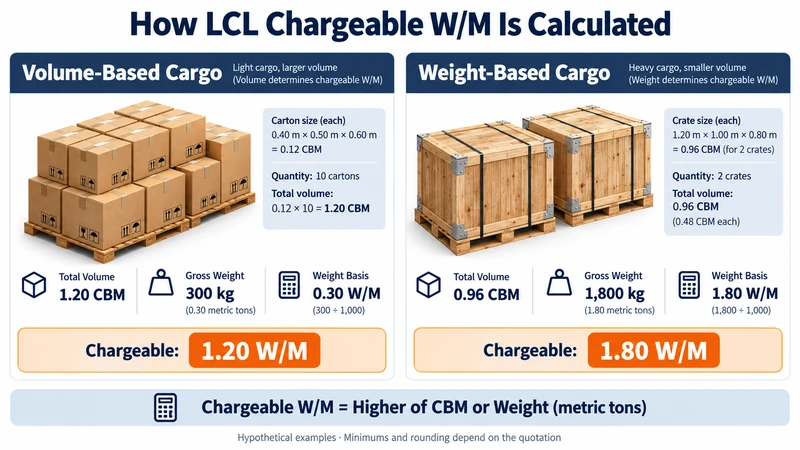
Worked Examples: Calculate Your Billable CBM Before Shipping
The following examples demonstrate how W/M charging works in different situations.
All examples are hypothetical. They do not represent actual Winsail shipments, live freight rates, or guaranteed minimum charges.
LCL Chargeable W/M Calculation Table
| Cargo Scenario | Physical Volume | Gross Weight | Weight Basis | Chargeable W/M |
|---|---|---|---|---|
| A. 10 cartons, each 60 × 40 × 50 cm | 1.20 CBM | 300 kg | 0.30 | 1.20 |
| B. 2 crates, each 100 × 80 × 60 cm | 0.96 CBM | 1,800 kg | 1.80 | 1.80 |
| C. One carton, 50 × 40 × 40 cm | 0.08 CBM | 25 kg | 0.025 | 1.00* |
| D. Two suppliers, combined shipment | 1.10 CBM | 400 kg | 0.40 | 1.10* |
Examples C and D assume a hypothetical 1 W/M minimum per separately billed shipment, with no additional rounding. Actual terms must be confirmed.
Example A: Light Goods Charged by Volume
Ten cartons each measure 60 × 40 × 50 cm.
Their combined physical volume is 1.20 CBM, while their total weight is only 300 kg.
Because 1.20 is greater than 0.30, the freight calculation uses 1.20 W/M, assuming no other applicable minimum or rounding adjustment.
This is typical of the calculation approach for relatively light, bulky goods.
Example B: Heavy Goods Charged by Weight
Two wooden crates each measure 100 × 80 × 60 cm.
Their total physical volume is 0.96 CBM. However, the crates weigh 1,800 kg in total.
Under the stated convention, the weight basis is 1.80 W/M, so the rated quantity is 1.80 W/M.
The quotation must also confirm that the warehouse and consolidator can accept the individual crate weights and their handling requirements.
Example C: Small Cargo Subject to a Minimum
A single carton measures 0.08 CBM and weighs 25 kg.
Its calculated W/M is 0.08.
If the contract specifies a 1 W/M minimum, the billable quantity becomes 1.00 W/M, not 0.08.
This explains why the effective price per physical CBM can be high for very small shipments.
Example D: Combining Two Suppliers
Supplier A provides 0.45 CBM, and Supplier B provides 0.65 CBM.
Their combined physical volume is:
0.45 + 0.65 = 1.10 CBM
Assume the combined gross weight is 400 kg, and the cargo can move as one consolidated shipment.
Under the hypothetical 1 W/M shipment minimum, the combined booking is rated at 1.10 W/M.
If the two consignments are instead invoiced as separate shipments, each may incur its own minimum.
Under the same illustrative rule, the two separate freight charges would be based on a combined 2.00 W/M rather than 1.10 W/M.
This potential saving must be weighed against consolidation handling, documentation, and any additional collection costs.
How to Apply a Quoted Freight Rate
Once you know the chargeable quantity, calculate the ocean freight subtotal using your actual quotation:
Ocean Freight Subtotal = Chargeable W/M × Quoted Freight Rate per W/M
Let R represent the valid ocean freight rate per W/M stated in your quotation.
For Example A:
Ocean freight subtotal = 1.20 × R
For Example B:
Ocean freight subtotal = 1.80 × R
For Example C, assuming the illustrative 1 W/M minimum:
Ocean freight subtotal = 1.00 × R
These formulas calculate the variable freight component only. Fixed charges, local handling, taxes, and delivery must be added according to the quoted scope.
Get an LCL Cost Breakdown
Have your cargo dimensions but are unsure which charges apply?
Get an LCL Cost Breakdown from Winsail Logistics.
Share your packed cargo volume, gross weight, China collection location, and Tanzania destination to request a quotation with the billing basis and applicable charge categories identified.
China Origin Charges and Multi-Supplier LCL Consolidation
Before an LCL shipment leaves China, the goods normally pass through a consolidation process. This is where understanding the CFS operation becomes important.
What Happens at a China Origin CFS?
CFS stands for Container Freight Station.
It is a facility where smaller cargo consignments can be received, checked, stored temporarily, and prepared for movement in shared containers.
A simplified LCL origin process looks like this:
Supplier Dispatch → CFS Receiving → Cargo Checking and Measurement → Consolidation → Export Processing → Container Stuffing and Departure
Depending on the service arrangement, some activities may be performed by different operators or at different facilities.
The CFS may check package counts, dimensions, gross weights, shipping marks, and cargo condition at receipt. The consolidator then plans how the cargo will be loaded with other compatible shipments.
Which China Origin Charges May Apply?
Possible charges include:
| Origin Service | What It Covers | Charging Question |
|---|---|---|
| Supplier pickup | Transport from supplier to receiving warehouse | Per collection or agreed route? |
| CFS receiving | Receiving and handling cargo at the facility | Included or separate? |
| Measurement and handling | Checking, moving, and processing packages | Per W/M or shipment? |
| Warehousing | Storage before consolidation | What free period applies? |
| Repacking or palletizing | Additional export packaging work | Charged only if requested or required? |
| Export customs services | Declaration and related administration | Included under the agreed scope? |
| Export documentation | Document preparation and processing | Per document or shipment? |
| Container stuffing | Loading goods into a shared container | Included in the consolidation charge? |
Not every shipment attracts every charge.
For example, a supplier may deliver cargo directly to the nominated CFS, eliminating the need for a separate supplier pickup service.
Likewise, warehouse receiving or container stuffing may already be included in the agreed LCL package.
The relevant question is not whether a particular fee exists in the market, but whether that service is included in your specific quotation.
Can You Combine Purchases from Several Chinese Suppliers?
Suppose you purchase commercial lighting products from Guangzhou, accessories from Foshan, and packaging materials from another supplier.
Instead of arranging several independent international shipments, you may consider consolidating the goods at a designated facility.
Potential benefits include fewer separately billed international consignments and reduced exposure to multiple minimum freight charges.
However, consolidation does not automatically eliminate all fixed costs.
Each supplier may have different pickup locations, cargo-ready dates, packaging requirements, or export documentation.
Some shipments may require separate declarations or transport documents even when the cargo is physically consolidated.
Before proceeding, confirm whether the goods can be accepted together, whether one HBL is appropriate, and whether the consolidation savings exceed the additional warehouse or collection costs.
How EXW, FCA, and FOB Affect Origin Costs
Your purchase terms influence which party is responsible for particular origin activities.
Under EXW (Ex Works), the seller makes goods available at the agreed place, while the buyer generally assumes extensive collection and export-related responsibilities.
Under FCA (Free Carrier), the seller delivers goods to the named carrier or receiving point and handles export clearance where applicable.
Under FOB (Free on Board), the seller’s delivery obligation is tied to loading the goods on board the vessel at the named shipment port.
For LCL shipments handed over at a warehouse or CFS before vessel loading, FCA may provide a clearer handover arrangement than FOB, depending on the purchase contract.
Always identify the named delivery point and consult the ICC Incoterms 2020 rules when assigning costs and responsibilities.
A supplier’s FOB product price should not be taken as proof that every origin LCL charge is already covered.
Dar es Salaam LCL Destination Charges and Cargo Release
The ocean freight rate is only one part of the import process.
Once a shared container arrives at Dar es Salaam, the cargo must be processed, separated from other shipments, cleared under the applicable procedures, and released to the authorized collecting party.
The destination activities explain why an importer can still receive local invoices even when the ocean freight was prepaid in China.
What Happens After an LCL Container Arrives?
A typical process involves the following activities:
- Vessel discharge: The container is unloaded and processed through the applicable terminal arrangements.
- Transfer and deconsolidation: The container is moved for stripping, where the different LCL consignments are separated.
- Cargo identification: Individual shipments are matched to transport documents, marks, and receiving records.
- Documentation and customs processing: The importer and appointed agent complete the necessary customs and release formalities.
- Payment and release: Applicable charges are settled and the relevant release approvals obtained.
- Collection or delivery: Authorized transport collects the goods from the release facility.
These activities are not necessarily performed in a strict sequence. Documentation and customs preparation can begin before arrival.
The Tanzania Ports Authority’s published import process describes the involvement of the Clearing and Forwarding Agent, shipping agent, relevant documents, port-charge payment, and cargo release.
What Types of Destination Charges May Appear?
Importers may encounter several categories of charges.
Shipping-agent and documentation charges may relate to transport documents, delivery orders, and administration under the applicable contract.
Terminal or port charges concern specified port services and must be interpreted using the correct tariff and responsible party.
CFS handling charges may relate to receiving, sorting, handling, storage, or release of an individual consignment.
Customs brokerage charges are fees for professional clearance services and are separate from government import duties and taxes.
Onward delivery charges apply when transport beyond the agreed receiving facility is arranged.
The amounts and billing units depend on the actual service provider and contract. A fee might be charged per W/M, per shipment, per document, or according to another published or agreed basis.
What Does the Official Tanzania Ports Authority Tariff Cover?
For importers, an important distinction is the difference between a published port-operation tariff and an LCL charge billed directly to the cargo owner.
The Tanzania Ports Authority Sea Ports Tariff Book, January 2026 provides a useful example.
Clause 11.1 lists an LCL stevedoring rate of USD 170 per container up to 20ft, under the stated containerized cargo operation.
This is not a rate of USD 170 per CBM.
The same clause notes that the relevant container stevedoring charges include transfer to stripping sites and, for LCL, stripping/stuffing operations. It also states that these listed charges are for the carrier’s account.
Consequently, an importer should not interpret that published amount as an automatic additional charge on an individual 1 CBM shipment.
The tariff’s Clause 16 also sets out specific ICD/CFS operations, including an export CFS schedule. Those published activities should not be treated as a universal Dar es Salaam import CFS price list.
The actual costs collected from an LCL importer must be established from the applicable terminal or CFS tariff, the transport agreement, and the destination service provider’s itemized invoice.
Before accepting a destination invoice, ask:
- Which company is collecting the charge?
- What service was performed?
- Is the charge per container, per W/M, per shipment, or per document?
- Is it already included in another charge?
- Which tariff or contractual term supports the amount?
These questions are particularly valuable when several parties are involved in the same container movement.
Storage Charges: Port, CFS, and Carrier Fees Are Different
Cargo remaining at a terminal or warehouse may incur additional charges after the applicable free period.
However, three terms should not be confused:
| Charge Type | What It Generally Relates To |
|---|---|
| Port or terminal storage | Cargo or containers remaining within the relevant port/terminal facility |
| CFS storage | Individual cargo remaining at the warehouse or deconsolidation facility |
| Demurrage or detention | Container-related charges under the applicable carrier or equipment agreement |
These charges may be administered by different parties.
A free-storage period stated in one tariff does not automatically apply to every facility or LCL consignment.
For your shipment, confirm the receiving location, storage-free period, charge commencement, rate basis, and party responsible for payment.
Pro Tip — Confirm Destination Charges Before Departure: Ask for the name of the destination CFS, an itemized list of expected local charges, the applicable billing units, and the storage terms before the cargo leaves China. This provides an opportunity to identify missing charges while you can still compare forwarding arrangements.
Customs Clearance Is Separate from Ocean Freight
Tanzania’s import customs process is not determined by CBM alone.
The Tanzania Revenue Authority (TRA) requires importers to appoint a licensed Clearing and Forwarding Agent (CFA). Import documents are processed through the Tanzania Customs Integrated System (TANCIS), with advance submission supported.
Documents commonly relevant to a commercial import include the commercial invoice, packing list, transport document, importer authorization, and any applicable import permits or other supporting documents.
Import duties, taxes, and regulatory obligations depend on the declared goods, classification, customs valuation, and applicable legal provisions.
They should not be presented as a fixed percentage or fixed CBM surcharge without shipment-specific assessment.
Certain regulated products may require conformity assessment under the Tanzania Bureau of Standards (TBS) PVoC framework, including a Certificate of Conformity (CoC) where applicable.
For more detail, see our guide to customs clearance in Tanzania.
What If Your Goods Are Going to Zanzibar?
A shipment destined for Zanzibar requires a separately defined logistics and compliance plan.
A Dar es Salaam CFS quotation does not automatically include onward transport to Zanzibar, any additional handling, or the applicable local import and standards procedures.
The Zanzibar Bureau of Standards maintains its own PVoC framework, with specific exemptions and conditions.
Ask whether the cargo is being routed directly to Zanzibar or moved onward after arrival at Dar es Salaam, and obtain the relevant transport and regulatory requirements for that arrangement.
Do not apply a fixed Zanzibar surcharge to every shipment or assume Mainland Tanzania and Zanzibar procedures are interchangeable.
What Should an Itemized LCL Shipping Quote Include?
A good LCL quotation makes it possible to distinguish the international freight calculation from local services and import expenses.
The table below provides a framework for checking a quotation from China to Dar es Salaam.
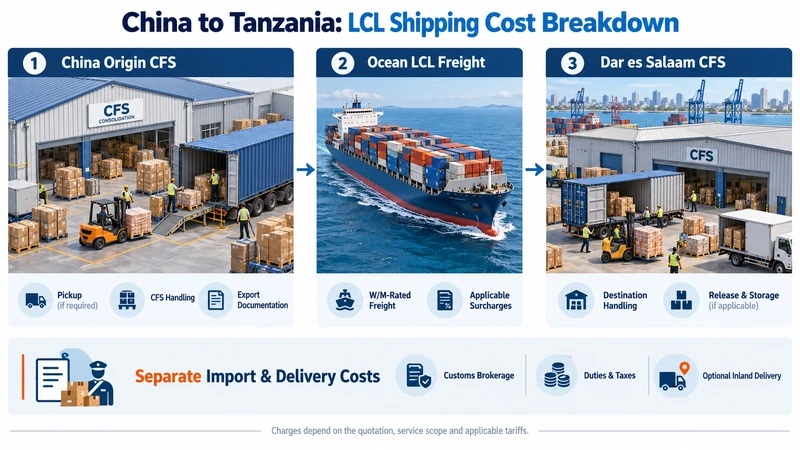
China–Tanzania LCL Cost Breakdown
| Charge Item | Billing Basis to Check | What to Verify |
|---|---|---|
| Supplier pickup in China | Per trip or agreed transport service | Pickup location and included distance |
| China CFS receiving and handling | Per W/M, shipment, or service | Handling and warehouse inclusions |
| Export documentation and clearance | Per declaration, document, or service | Which party arranges and pays |
| Ocean LCL freight | Per chargeable W/M, subject to minimums | Rate, minimum, rounding, validity |
| Freight surcharges | As stated in the quotation | Whether included in base freight |
| Dar es Salaam port/terminal services | Applicable published or contracted unit | Actual service and paying party |
| Destination CFS handling/release | W/M, shipment, or stated service | Named facility and collecting party |
| Customs brokerage | Agreed professional service fee | Licensed CFA and covered work |
| Duties, taxes, and inspections | Assessment or applicable regulatory basis | Commodity classification and requirements |
| Inland or final delivery | Per transport service | Destination address and delivery scope |
The table lists possible charge categories, not mandatory fees for every consignment.
Why a Lower Per-CBM Rate Can Produce a Higher Total Bill
Suppose two forwarders quote the same shipment.
Forwarder A provides a lower ocean freight rate but separately invoices China warehouse handling, origin documentation, destination CFS handling, and release services.
Forwarder B quotes a higher ocean freight rate but includes some of those activities.
The lowest ocean freight number may not be the lowest total amount payable.
A meaningful comparison requires both quotations to use the same cargo measurements, pickup and destination points, service boundaries, and tax assumptions. It also requires identifying which party will invoice each excluded charge.
Calculate the Effective Cost per Physical CBM
You can use the following formula after collecting the relevant invoices or complete quotations:
Effective Shipping Cost per Physical CBM = Total Included Shipping Charges ÷ Actual Cargo CBM
This figure is useful for budgeting and comparing similar shipments.
However, it is not the same as the ocean freight rate per W/M.
For a hypothetical 3 CBM shipment with a variable ocean freight rate R and fixed logistics fees F, assuming the shipment is rated by volume:
Effective Cost per CBM = (3 × R + F) ÷ 3
Which simplifies to:
R + (F ÷ 3)
If the same fixed fees apply to a smaller shipment, their contribution per physical CBM increases. That is one reason small LCL shipments can have a comparatively high effective unit cost.
When evaluating overall transport budgets, also consult our shipping cost from China to Tanzania guide, which covers costs beyond this specific LCL calculation.
Do Incoterms Change Who Pays These Charges?
Yes. The agreed Incoterms rule and named place help determine the allocation of costs and responsibilities between seller and buyer.
For instance, a buyer purchasing on EXW terms may need to arrange origin collection and additional export services. Different obligations apply under FCA, FOB, CIF, or DAP.
However, an Incoterms rule alone does not tell you whether a freight forwarder’s quoted service includes a particular warehouse or shipping-agent charge. You still need to read the quotation and transport contract.
Importantly, door-to-door shipping is not automatically DDP.
Under Incoterms 2020, DDP places import clearance and applicable import duty and tax responsibilities on the seller. Such an arrangement requires the seller to be able to fulfill those obligations legally in the destination country.
If the buyer remains responsible for import clearance and taxes, calling the service door-to-door does not change that responsibility.
Our DDP shipping from China to Tanzania guide provides further context.
When Does FCL Become More Cost-Effective Than LCL?
LCL is designed for shipments that do not require a dedicated container. However, increasing LCL volume can eventually make a full container load quotation competitive.
There is no universally reliable CBM threshold at which LCL automatically becomes more expensive than FCL. The decision depends on the actual freight rates and local charges for the shipment.
Compare the Total Costs, Not Just the Ocean Rates
For an LCL shipment:
LCL Total = W/M-Rated Charges + Fixed LCL Fees + Other Applicable Costs
For a full container shipment:
FCL Total = Container Freight + Origin and Destination Charges + Other Applicable Costs
Both totals must cover equivalent pickup, destination, customs-service, and delivery boundaries.
If the LCL quote ends at a CFS in Dar es Salaam while the FCL quote includes delivery to your warehouse, the two totals are not directly comparable. Likewise, taxes and cargo insurance need consistent treatment.
LCL vs. FCL Cost Comparison Matrix
| Comparison Factor | LCL Shipment | 20ft FCL Shipment |
|---|---|---|
| International freight | Calculated from chargeable W/M | Quoted for a dedicated container |
| Minimum charges | Shipment minimums may apply | Container rate applies |
| China origin handling | CFS receiving and consolidation may apply | Container loading and origin services |
| Destination handling | Deconsolidation and CFS release arrangements | Container terminal and delivery arrangements |
| Handling exposure | Cargo may be handled at consolidation and stripping facilities | No routine shared-container deconsolidation |
| Delivery planning | Collection after individual cargo release | Container delivery and unloading arrangements |
| Best cost choice | Requires complete quotation | Requires complete quotation |
A 20ft FCL shipment must also fit the equipment’s usable dimensions and permitted weight limits.
When Should You Request Both Quotations?
Consider requesting both options when your planned shipment is large enough that the combined LCL W/M charges and local fees may approach a 20ft container quotation.
This is particularly relevant when:
- You are importing many cartons or palletized products.
- The shipment includes fragile or non-stackable cargo.
- Several suppliers can prepare their goods for one coordinated shipment.
- Destination CFS handling creates substantial additional costs.
- You want to compare cargo handling requirements as well as freight costs.
Do not rely on a published rule such as “FCL is always cheaper above 15 CBM.”
Instead, provide the same cargo data to the forwarder and request quotations for both methods with matching service scopes.
If you need to review how the two shipment methods work operationally, see our sea freight from China to Tanzania guide.
What Information Do You Need for an Accurate LCL Cost Breakdown?
The accuracy of your freight quotation depends heavily on the information available before booking.
A preliminary estimate based only on “5 CBM of goods from China” leaves many important questions unanswered.
Prepare a Complete Cargo Measurement Sheet
Use the following checklist before contacting a freight forwarder.
| Information Required | Why It Matters |
|---|---|
| Product description | Determines cargo suitability and handling requirements |
| HS code, if known | Supports preliminary customs and regulatory screening |
| Package quantity | Identifies the number of shipping units |
| Packed length, width, and height | Determines physical CBM |
| Gross weight | Determines the weight basis for W/M |
| Carton, pallet, or crate details | Identifies the actual export-packed dimensions |
| Stackability | Helps assess consolidation suitability and special handling |
| Supplier locations | Identifies collection and origin CFS arrangements |
| Cargo-ready date | Supports available consolidation and departure planning |
| Commercial value and currency | Supports insurance and customs-related assessment |
| Tanzania destination | Establishes the delivery endpoint and local arrangements |
If the shipment contains several different product groups, separate them by package type and dimensions.
For example, do not combine wooden crates and loose cartons into one estimated dimension unless they will actually be shipped as one measured unit.
Prepare the Import and Shipping Documents
Your freight forwarder and customs representative may need additional documentation depending on the shipment.
Relevant documents can include a commercial invoice, packing list, transport documentation, and any required product permits or conformity documents.
For regulated goods, confirm the relevant TBS requirements early enough to complete any applicable pre-shipment procedure.
For Mainland Tanzania imports, coordinate customs arrangements with a licensed CFA rather than assuming the ocean carrier or forwarder automatically assumes the legal importer’s obligations.
Ask These Questions Before You Confirm an LCL Booking
Before accepting an offer, obtain clear answers to the following:
- Is the freight charged by CBM, W/M, or another stated basis?
- What minimum chargeable quantity and rounding rules apply?
- What services are included at the China origin CFS?
- Which Dar es Salaam facility will receive the cargo?
- What local charges are expected at destination?
- Who issues the destination invoices and arranges release?
- Are customs brokerage, taxes, and inspections excluded?
- What is the quotation’s validity period, currency, and delivery endpoint?
For multi-supplier shipments, also ask whether the goods will move under one consolidated shipment arrangement and whether separate documentation or warehouse fees will still apply.
A Simple LCL Quotation Request
To help the forwarder prepare a comparable quotation, you can send a request in this format:
Please provide an itemized LCL shipping quotation from China to Tanzania based on the following cargo details:
Origin: [Supplier city or pickup address]
Destination: [Dar es Salaam CFS or final delivery address]
Commodity: [Product description]
Packages: [Quantity and packaging type]
Dimensions: [Length × Width × Height per package group]
Total gross weight: [kg]
Cargo-ready date: [Date]
Required service: [CFS-to-CFS, port-to-port, or specified door-to-door scope]Please confirm the chargeable W/M, shipment minimum, China origin fees, ocean freight, destination CFS charges, shipping-agent fees, excluded customs and tax costs, rate validity, and any storage conditions.
If the delivery destination is outside Dar es Salaam, specify the exact city and receiving address.
For Zanzibar, indicate whether the intended routing is direct or via Dar es Salaam and request confirmation of the applicable destination procedures.
Get an LCL Cost Breakdown from Winsail Logistics
Understanding your chargeable CBM is the first step. The next is knowing what the complete shipping quotation actually covers.
Contact Winsail Logistics for an LCL Cost Breakdown and provide your cargo measurements, gross weight, supplier locations, destination, and requested service scope.
An itemized quotation gives you a clearer basis for comparing forwarding options, identifying additional charges, and deciding whether LCL or FCL better suits your shipment.
FAQ
If My Cargo Is Only 0.8 CBM, Will I Automatically Be Charged for 1 CBM?
Not necessarily. If your cargo measures 0.8 CBM and weighs 200 kg, its rated quantity under the common W/M comparison is 0.8. A quotation with a 1 W/M minimum would charge at least 1 W/M, but other contracts may have different minimums. Confirm the actual minimum and rounding rules.
Can Cargo Weighing 1,500 kg Cost More Than Its Measured CBM Suggests?
Yes. Under the common 1 CBM/1,000 kg W/M convention, cargo weighing 1,500 kg has a weight basis of 1.5 W/M. If its physical volume is only 0.9 CBM, the rated quantity is 1.5 W/M before any other contractual adjustments. Heavy packages may require additional handling checks.
Why Is the CBM on My Freight Invoice Different from My Supplier’s Packing List?
Differences may result from export packaging, pallets, crates, warehouse remeasurement, or contractual measurement rules. Request the final packed dimensions and the receiving warehouse's measurement record. Also distinguish physical CBM from chargeable W/M, which may be higher for dense cargo.
If Ocean Freight Is Prepaid in China, Can I Still Receive Charges in Dar es Salaam?
Yes. Freight prepaid does not necessarily cover destination CFS fees, shipping-agent documentation, customs brokerage, import duties, taxes, or onward delivery. Check the transport contract, the quotation's inclusions, and the destination invoice to identify what remains payable.
Can Two Chinese Suppliers’ Shipments Share One LCL Minimum Charge?
Possibly, if the goods are accepted and rated as one consolidated shipment. Separate HBLs, customs declarations, warehouse services, or pickup arrangements may still generate individual charges. Sharing a physical container does not guarantee a single minimum charge.
Who Pays CFS Storage Charges If Customs Release Is Delayed?
Responsibility depends on the CFS terms, transport contract, import arrangement, and collecting party. Customs delays do not automatically suspend storage charges. Ask the destination provider about free time, the charging basis, and applicable release conditions before arrival.
Does a Dar es Salaam Per-CBM Quotation Include Delivery to Zanzibar?
Not unless onward delivery is expressly included. A quotation ending at a Dar es Salaam CFS does not automatically cover transport to Zanzibar, additional handling, or Zanzibar-specific procedures. Verify the entire route, receiving facility, customs arrangements, and applicable Zanzibar Bureau of Standards requirements.
Final Takeaway
The shipping cost per CBM from China to Tanzania is best understood as a calculation and quotation-comparison problem, not a fixed price list.
Your actual physical volume is only the starting point. The payable amount can be affected by gross weight, W/M minimums, China consolidation, destination CFS arrangements, fixed documentation fees, and the scope of services you request.
For a reliable decision, calculate your packed cargo measurements, obtain the chargeable W/M and an itemized quotation, verify the Dar es Salaam destination charges, and compare LCL with FCL when appropriate.
That process gives you a stronger basis for controlling shipping expenses than choosing a forwarder based on the lowest advertised price per CBM alone.
Source and Rate Reference Note: This guide uses published information from Maersk LCL Terms, DHL Global Forwarding, the Tanzania Ports Authority January 2026 Sea Ports Tariff Book, Tanzania Revenue Authority, and relevant standards and Incoterms authorities, reviewed in October 2026. Tariff schedules, local charges, commercial freight rates, customs requirements, and cargo acceptance conditions may change. The worked calculations are hypothetical and should not be interpreted as actual shipment quotations. Final shipping charges and legal responsibilities must be established for the specific cargo, route, receiving facility, and contractual service scope.
