

Shipping from China to the UK can take a few business days by premium express courier or six to eight weeks or more for a complete ocean-freight movement from a Chinese supplier to a UK delivery address.
The important point is that transit time and total shipment lead time are not the same thing. A carrier may quote a port-to-port transit of around five to six weeks on a particular service, but your actual timeline also includes pickup in China, export handling, vessel cut-off, UK terminal processing, customs release and final delivery.
For importers managing stock replenishment, retail launches, manufacturing schedules or Amazon/3PL inventory, the more useful question is:
When must the cargo be ready in China for it to arrive at the required UK destination on time?
As a planning reference, the following ranges are more useful than looking only at flight or sailing time.
| Shipping method | Typical transit/service reference | Supplier-to-UK-door planning reference | What the number really means |
|---|---|---|---|
| Premium express courier | Often 1–3 business days on eligible premium services | Around 2–5 business days | Carrier service, postcode and customs status matter |
| Economy / expedited express | Roughly 2–5 to 5–12 business days depending on service | Service-specific | “Economy express” is not one standard product |
| Standard air freight | Current market examples may be around 5–8 days for the freight service | Around 7–12 calendar days | Includes more than aircraft flying time |
| FCL sea freight | Selected current carrier schedules may be around 35–44 days port-to-port | Around 40–52 days for planning | Add origin handling, UK release and inland delivery |
| LCL sea freight | Vessel leg may be similar to FCL | Around 45–60 days for planning | Consolidation and deconsolidation add time |
| Door-to-door shipping | Depends on the underlying air, express or sea service | No single universal figure | DAP/DDP describes responsibilities, not transport speed |
The supplier-to-door figures above are planning ranges rather than guarantees. Actual shipping time depends on the Chinese origin, cargo-ready date, carrier service, UK gateway, commodity, customs status and final delivery conditions.
For freight costs, shipping-method selection, ports, customs and broader route planning, see our Shipping from China to the UK guide.
Transit Time vs Total Lead Time: Make Sure You Are Comparing the Same Number
One of the biggest causes of unrealistic shipping plans is comparing quotations that measure different parts of the journey.
A supplier may say “air freight takes three days,” while a forwarder quotes seven days and a courier advertises a 1–3-business-day service. These figures can all describe different clocks.
Flight Time vs Airport-to-Airport Transit
A direct aircraft can travel between China and the UK in well under a day, but this does not mean commercial cargo moves from factory to warehouse in one day.
An air freight shipment may pass through:
supplier handover → pickup → export warehouse → cargo acceptance → security screening → airline cut-off → pallet build-up → uplift → flight or connection → UK cargo breakdown → customs release → collection → final delivery
That is why standard commercial air freight is normally planned in days rather than by the number of hours the aircraft spends in the air.
Current commercial lane examples can show several days of estimated air-freight service transit between major Chinese airports and London Heathrow. These should be treated as current market references rather than permanent route standards because airline schedules, connections and available products change.
Sailing Time vs Port-to-Port Transit
For ocean freight, the number shown in a carrier schedule usually relates to a specific port pair and service.
For example, a quoted transit such as:
Yantian → Felixstowe: approximately 35–40 days
does not normally include the time needed to:
- collect the cargo from the supplier;
- load the container or consolidate LCL cargo;
- meet the port cut-off;
- complete origin handling;
- discharge the container in the UK;
- complete customs formalities;
- secure terminal release;
- book a haulier;
- deliver to the consignee.
For purchasing and inventory planning, the supplier-ready-to-UK-door lead time is therefore more important than the sailing number alone.
Port Arrival Is Not the Same as Cargo Availability
ETA means the estimated vessel arrival time. It does not automatically mean the cargo is available for collection at that moment.
After arrival, the shipment may still require:
vessel discharge → terminal processing → customs release → shipping-line/terminal release → haulier booking → collection
For LCL freight, another stage is added because the consolidated container generally needs to be moved to a destination CFS or warehouse and unpacked before individual consignments can be released.
UK container terminals use operational booking and collection systems for hauliers, so inland collection should be treated as a separate lead-time stage rather than assumed to happen automatically at vessel arrival.
Pro Tip: When comparing freight quotations, ask exactly where the quoted transit time starts and stops. “35 days” means very little unless you know whether it is port-to-port, CFS-to-CFS or supplier-to-door.
China to UK Shipping Time by Method
The right shipping method depends partly on how much time remains between the cargo-ready date and the date the goods are actually required in the UK.
For the ocean leg specifically, the China-to-UK sea freight guide explains route patterns, FCL/LCL choices and port selection.
DHL, FedEx and UPS-Style Express
Premium courier is normally the fastest practical option for samples, replacement parts, documents and relatively small commercial shipments.
Major international courier networks publish service standards that can be very short. Some premium international express products fall into the 1–3-business-day service category, while expedited and economy products can take longer.
For China-to-UK planning, a cautious reference for eligible premium courier shipments is often:
around 2–5 business days from pickup to delivery.
However, an exact transit time should always be checked against:
- the Chinese pickup postcode;
- UK destination postcode;
- chosen carrier product;
- pickup cut-off;
- weekend or holiday dates;
- commodity restrictions;
- customs information.
A published “1–3 days” service standard should not automatically be treated as a guaranteed China-factory-to-UK-door commitment.
Economy and Deferred Express
“Economy express” can be misleading because it is not a single standardized service.
Different courier products may range from only a few business days to more than a week. If your shipment has a hard deadline, ask for the specific carrier product rather than accepting a quotation labelled only “economy courier.”
Standard Air Freight
For commercial cargo that is too large or expensive for courier but cannot wait for sea freight, air freight is often planned at approximately:
7–12 calendar days supplier-to-door, subject to routing and customs.
The actual airport-to-airport or freight-service component can be shorter.
Additional time can arise from:
- pickup from factories outside the airport region;
- export warehouse handling;
- airline space allocation;
- indirect flights;
- cargo screening;
- UK cargo terminal processing;
- customs queries;
- delivery scheduling.
For urgent production parts or replenishment stock, the main question should be whether the freight is booked on a service that meets the required delivery date—not simply whether “air freight is faster than sea freight.”
FCL Container Shipping
Current 2026 carrier schedules show why a single statement such as “sea freight from China to the UK takes 25–30 days” is unreliable.
Selected services from major Chinese ports to Felixstowe, London Gateway and Southampton may show mid-30s to low-40s days port-to-port, depending on the origin, carrier, port rotation and routing.
Actual bookings can use different services and schedules. For practical purchasing plans, around 40–52 days from supplier readiness to UK delivery may be a more useful initial FCL planning range than quoting only the port-to-port voyage.
LCL Sea Freight
LCL does not necessarily travel on a slower vessel than FCL.
The additional time normally comes from the processes around the voyage.
Before departure:
supplier pickup → China consolidation warehouse → cargo receiving → consolidation → CFS cut-off → container loading
After arrival:
container discharge → destination CFS → deconsolidation → individual shipment release → customs → final delivery
This means an LCL shipment can travel on the same ocean service as an FCL container but arrive at the consignee several days later.
For planning purposes, approximately 45–60 days supplier-to-door can be a useful initial range for many China–UK LCL shipments, but the actual consolidation schedule must be checked.
Door-to-Door Shipping
Door-to-door is a service scope, not a transport mode.
A door-to-door shipment may move by:
- express courier;
- air freight;
- FCL sea freight;
- LCL sea freight.
The total lead time therefore depends primarily on the underlying transportation and handling process.
The same applies to DAP and DDP.
DDP does not make a vessel or aircraft travel faster. DDP defines seller responsibilities under the agreed commercial arrangement. Whether a workable DDP structure can be arranged also depends on the importer setup, customs representation, commodity, VAT treatment and final-delivery scope.
Winsail can coordinate door-to-door arrangements where applicable, subject to shipment review and the agreed service scope. DDP feasibility should be confirmed shipment by shipment rather than treated as an automatic option.
The Real Supplier-to-UK-Door Timeline
A realistic shipping plan should begin with the Cargo Ready Date (CRD) and end with the date the consignee can actually receive the goods.
For one coordinated scope from China pickup to final UK delivery, review Winsail’s door-to-door shipping service against the required arrival date.
1. Supplier Readiness
The logistics lead time cannot begin while production is unfinished.
Before booking, confirm:
- final production completion;
- packing completion;
- number of packages;
- gross weight;
- CBM;
- pickup location;
- required export documents.
“Ready next week” is not as useful as a confirmed date and time when the cargo will be packed and available for pickup.
Pro Tip: Base freight planning on a confirmed CRD rather than the purchase-order date.
2. Pickup in China
Pickup time depends on the relationship between the supplier and the export gateway.
Cargo from factories near Shenzhen may reach Yantian quickly, while shipments from inland manufacturing cities may require longer domestic trucking.
Multiple-supplier consolidation can also add time because all suppliers must deliver their cargo before the consolidated shipment can move.
3. Export Handling and Cut-Off
Ocean bookings have operational cut-offs.
Depending on the booking, these can include:
- shipping instruction cut-off;
- VGM cut-off;
- CFS cut-off;
- container gate-in or CY cut-off.
A container can be physically close to the port and still miss its planned vessel if it does not meet the required cut-off.
For weekly ocean services, missing one departure can effectively move the shipment into the next sailing cycle.
4. Consolidation Where Required
This stage is especially important for LCL cargo.
The forwarder must receive individual shipments, prepare the consolidation and load the shared container according to the scheduled CFS program.
Cargo being “at the warehouse” does not necessarily mean it will sail the following day.
5. International Transit
Only at this point do the familiar air or ocean transit figures become relevant.
For air cargo, this is the airline movement and related airport handling.
For sea freight, this is the scheduled carrier route between the stated ports.
6. UK Arrival and Terminal Handling
After the vessel or aircraft arrives, cargo still needs to move through the destination facility.
For ocean FCL, this includes discharge and terminal availability.
For air freight, pallets or ULDs must be broken down and cargo made available by the ground-handling operation.
For LCL, the container generally requires deconsolidation before the individual shipment can be released.
7. Customs Release
Import paperwork should be prepared before the cargo arrives whenever possible.
Businesses importing into Great Britain will generally need the appropriate GB EORI, while Northern Ireland movements can involve different requirements and may require an XI EORI. The commodity code used on the import declaration helps determine duties and whether relevant import restrictions or licences apply.
Typical information required for clearance may include:
- importer/EORI details;
- commercial invoice;
- packing list;
- commodity code;
- customs value;
- country of origin;
- freight/Incoterm information;
- product licences or certificates where applicable.
Appointing a customs agent does not remove the importer’s responsibility for appropriate due diligence. The type of representation and liability depends on the arrangement.
VAT-registered UK businesses may be able to use Postponed VAT Accounting (PVA) to account for import VAT on their VAT Return when the applicable conditions are met. The arrangement needs to be correctly reflected in the import declaration.
8. Inland Delivery
The final stage can still affect the ETA.
Delivery planning may depend on:
- UK postcode;
- haulier availability;
- container collection slot;
- warehouse receiving hours;
- forklift or unloading arrangements;
- pallet requirements;
- Amazon or 3PL appointment;
- demurrage/free-time constraints.
For time-sensitive cargo, confirm the receiving conditions before the shipment reaches the UK.
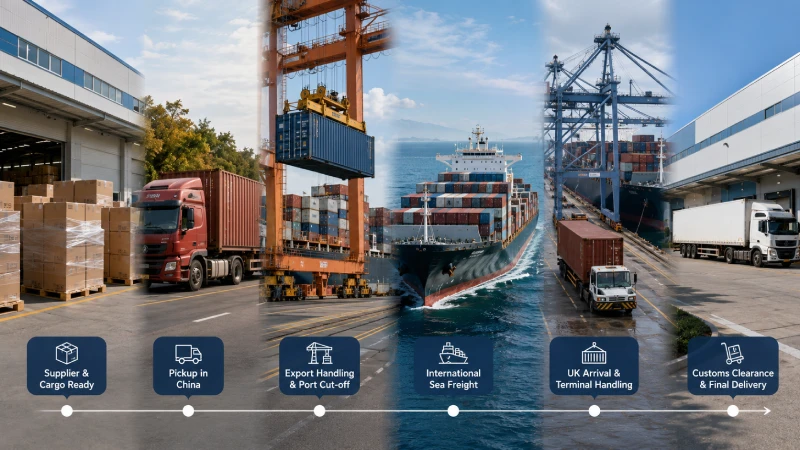
Current China Port to UK Port Transit-Time Examples
The table below shows why China-to-UK ocean transit should be based on the actual service and port pair, not a permanent generic average.
Carrier Schedule Snapshot — 2026
| China origin | UK port | Example service | Published transit |
|---|---|---|---|
| Yantian | Felixstowe | Selected FE3 service example | ~35–38 days |
| Ningbo | Felixstowe | Selected FE3 service example | ~41–43 days |
| Shanghai | Felixstowe | Selected North Europe service example | ~41 days |
| Yantian | Southampton | Selected FP2 service example | ~36 days |
| Ningbo | Southampton | Selected FP2 service example | ~40 days |
| Shanghai | Southampton | Selected FP2 service example | ~41 days |
| Yantian | London Gateway | Selected NE3 service example | ~35 days |
| Shanghai | London Gateway | Selected NE3 service example | ~41 days |
These numbers are carrier schedule references, not guaranteed delivery times.
Schedules may change due to:
- port rotation changes;
- omitted calls;
- vessel delays;
- weather;
- congestion;
- transshipment;
- geopolitical routing decisions.
Why the Same Origin Can Have Different Transit Times
Two containers leaving Shanghai for the UK do not automatically have the same ETA.
One service may:
- call the UK earlier in its North European rotation;
- include additional Asian ports;
- include transshipment;
- call continental Europe first;
- use a different routing.
This is why importers should ask for:
carrier + service + port pair + planned ETD + planned ETA
rather than relying only on “Shanghai to UK: approximately 35 days.”
Current Red Sea / Suez Routing Requires Extra Attention
Asia–Europe routings remain particularly important in 2026.
Carriers have adjusted selected East–West services between Suez Canal and Cape of Good Hope routings depending on operational and security conditions. The transition is not necessarily uniform across every carrier, service or voyage.
Therefore, importers should not assume either that:
- every China–UK service has returned to Suez; or
- every service is still routing around the Cape.
For a shipment with a fixed deadline, confirm the route at the time of booking.
Why LCL Usually Needs More Time Than FCL
FCL and LCL may share the same vessel, yet LCL frequently takes longer from supplier to consignee.
The difference is mainly operational.
| Stage | FCL | LCL |
|---|---|---|
| Supplier pickup | Required | Required |
| Origin consolidation | No | Yes |
| CFS handling | Usually no | Yes |
| International sailing | Yes | Yes |
| Destination deconsolidation | No | Yes |
| Customs/release | Required | Required |
| Final delivery | Required | Required |
With FCL, the container can normally move from terminal release toward the consignee after the necessary import and line/terminal requirements are satisfied.
With LCL, the shared container must first reach the deconsolidation facility. Individual shipments then need to be separated, processed and released.
This is why comparing only “vessel transit time” can make LCL appear faster than it really is.
Pro Tip: If two quotations show identical sea transit for FCL and LCL, ask for the expected cargo-available date, not only the vessel ETA.
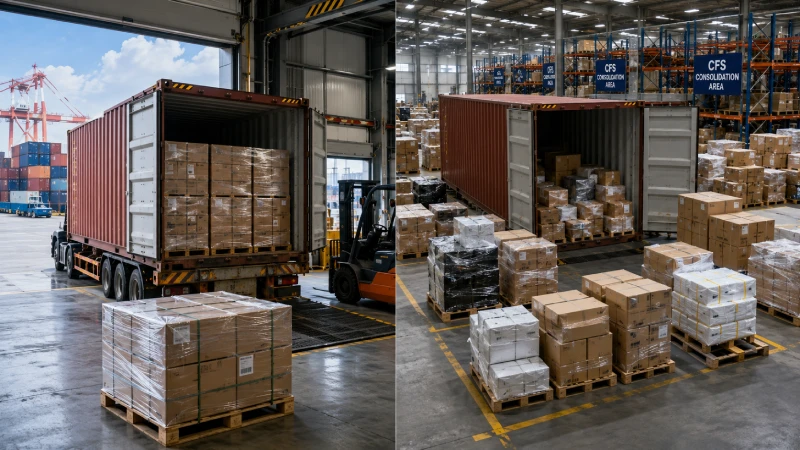
Why a Short Flight Can Still Mean a Week or More for Air Freight
The same misunderstanding appears in air freight.
The China-to-UK air freight guide separates flight time from pickup, export handling, airline capacity, customs and final delivery.
The aircraft itself is fast. The cargo process around it takes longer.
Before departure, freight may need:
- factory pickup;
- export warehouse receiving;
- document preparation;
- security screening;
- airline acceptance;
- flight allocation;
- build-up into pallets or ULDs.
After arrival:
- cargo is unloaded;
- ULDs are broken down;
- freight is processed by the handling agent;
- customs requirements are completed;
- cargo is released;
- delivery is arranged.
Direct uplift can shorten this process. Connecting flights or tight capacity can extend it.
This is why an airport-to-airport or service transit figure should never be confused with the total factory-to-warehouse lead time.
How UK Customs and Cargo Release Affect Delivery Time
There is no responsible universal answer to:
“UK customs always takes how many days?”
Many routine declarations can progress without a long delay, but the actual release time depends on the shipment.
Possible delay triggers include:
- missing or inconsistent invoice information;
- incorrect importer details;
- EORI problems;
- incorrect commodity classification;
- customs valuation queries;
- unpaid duties where applicable;
- missing licences or certificates;
- physical examination;
- controlled or regulated goods;
- requests for supporting documents.
This is why a fixed “customs takes 1–3 days” promise should not be built into every shipment plan.
GB vs Northern Ireland
A UK destination should also be identified correctly.
For imports into England, Scotland or Wales, Great Britain customs procedures apply.
Northern Ireland can involve different customs requirements. Businesses making certain movements or declarations in Northern Ireland may require an EORI beginning XI.
If the final destination is Belfast or elsewhere in Northern Ireland, do not assume that the same customs setup used for a Birmingham or London delivery automatically applies.
Customs Release Does Not Always Mean Immediate Delivery
Even after customs release, cargo may still need:
- terminal release;
- line release;
- CFS release;
- haulier allocation;
- collection appointment;
- consignee delivery booking.
For a hard delivery deadline, track both customs status and physical cargo availability.
What Can Delay a China-to-UK Shipment?
Shipping time is affected by more than distance.
Chinese New Year and Golden Week
Major Chinese holidays can affect:
- factory production;
- trucking;
- warehouse activity;
- booking demand;
- carrier capacity.
The impact also extends beyond the holiday dates themselves because factories and logistics networks can experience pre-holiday demand and post-holiday recovery.
Carriers may also adjust capacity or blank individual Asia–Europe sailings around major holiday periods.
Peak Season and Capacity Pressure
Ahead of retail peaks and major holidays, capacity can tighten.
A shipment may experience:
- limited airline allocation;
- vessel space shortages;
- earlier cut-offs;
- rollovers;
- higher likelihood of deferred departures.
If the shipment supports a fixed launch or replenishment deadline, book based on required arrival rather than waiting for the lowest possible freight rate.
Rollover
A rollover occurs when booked cargo does not load on the planned vessel.
On a weekly service, a rollover can effectively move cargo toward the next sailing cycle, although the exact delay depends on the carrier’s recovery option.
Transshipment
Direct services normally remove one connection risk.
With transshipment, the container is transferred between vessels at an intermediate hub. If the first vessel arrives late and misses the onward connection, the cargo can wait for another sailing.
Port Congestion
Congestion can influence:
- berth availability;
- vessel discharge;
- terminal processing;
- truck slots;
- container availability.
Current terminal conditions should be checked when booking rather than relying on an old congestion statement.
Customs Examination
A physical or documentary customs check can extend release time beyond a normal clean declaration.
The importer should therefore avoid planning a critical same-day delivery immediately after port ETA with no buffer.
Incomplete Importer Paperwork
A vessel delay is visible.
A documentation delay is often avoidable.
Before departure, confirm the party responsible for UK customs has the information needed to prepare the declaration.
LCL Deconsolidation
LCL cargo can wait for the full container to be transferred, unpacked and processed before individual consignments become available.
This stage should be included in the total lead time.
Delivery Booking Delays
Some warehouses, distribution centres, Amazon facilities and 3PLs operate appointment systems.
A container can be released but still not be deliverable on the importer’s preferred day if the receiving facility cannot provide a slot.
Work Backward from Your Required UK Delivery Date
For commercial importers, this is often the most useful way to plan.
Do not begin with:
“Sea freight is cheaper, so we will ship by sea.”
Begin with:
“The goods must be available at our UK warehouse by November 15.”
Then work backward.
Step 1 — Set the Real Required Date
Decide what the deadline actually means:
- arrival at UK port;
- cargo available for collection;
- delivery at your warehouse;
- Amazon/3PL check-in;
- stock available before a promotion;
- parts available before a production shutdown.
These are not the same milestone.
Step 2 — Allow Destination Time
Include reasonable time for:
- terminal/CFS handling;
- customs;
- haulier booking;
- inland delivery;
- receiving appointment.
Step 3 — Subtract the International Transit
Use the actual planned airline or ocean service rather than an average from a generic article.
Step 4 — Allow Origin Handling
Include:
- pickup;
- consolidation where applicable;
- export handling;
- port/airport cut-off.
Step 5 — Determine the Latest Acceptable CRD
You now have the latest date the supplier can realistically make the cargo available.
If the supplier cannot meet it, you have a logistics decision to make.
When a Split Air + Sea Shipment Makes Sense
Sometimes the correct answer is not “air or sea.”
For example, a business may need:
- 15% of stock urgently to prevent an inventory shortage;
- the remaining 85% at the lowest practical freight cost.
Subject to cargo suitability and commercial review, the urgent portion could move by air while the balance moves by ocean.
This can be more rational than air-freighting the full order or allowing all inventory to arrive too late.
Simple Deadline Decision Guide
| Time remaining before required UK delivery | Methods normally worth evaluating |
|---|---|
| Under 1 week | Premium express, if shipment qualifies |
| Around 1–2 weeks | Express or air freight |
| Several weeks | Compare air with available ocean schedules |
| Around 6–8+ weeks | FCL or LCL becomes more practical for many shipments |
This is only a planning framework. Shipment size, commodity, origin, service availability and customs conditions still determine what is workable.
How to Reduce Lead-Time Risk Before Booking
A reliable logistics plan is not only about choosing the fastest nominal transit.
Confirm the Actual Cargo-Ready Date
Ask the supplier whether the goods will be:
- manufactured;
- QC-completed;
- packed;
- labelled;
- export-ready
by the stated date.
Ask for the Actual Route
For ocean freight, request:
- carrier;
- service;
- origin port;
- destination port;
- ETD;
- ETA;
- direct/transshipment status.
For air freight, request:
- origin airport;
- destination airport;
- direct or connecting routing;
- estimated service transit;
- expected cargo cut-off.
Prepare UK Import Information Early
Before the cargo departs China, confirm where applicable:
- importer details;
- EORI;
- commodity code;
- invoice;
- packing list;
- customs value;
- licence/certificate requirements;
- customs representative;
- VAT/PVA instructions;
- destination postcode.
Book Earlier Around Known Disruptions
Allow additional planning margin around:
- Chinese New Year;
- Golden Week;
- peak retail periods;
- known capacity reductions;
- major geopolitical routing changes.
Coordinate the Receiving Window
For FCL, especially, confirm:
- unloading method;
- container access;
- warehouse opening time;
- maximum vehicle size;
- delivery appointment;
- whether live unloading or another arrangement is required.
A shipment plan is not complete until the consignee can physically receive the goods.
Pre-Booking Lead-Time Checklist
Before accepting a transit-time quotation, ask:
- Where does the quoted time start?
- Where does it end?
- What is the cargo cut-off?
- What is the planned ETD?
- What is the planned ETA?
- Which carrier and service are being used?
- Is the route direct or transshipped?
- Which UK port or airport will receive the cargo?
- What is the current ocean routing?
- For LCL, when should cargo become available after deconsolidation?
- Who is coordinating UK customs?
- Is inland delivery included?
- Does the consignee require an appointment?
If a supplier or forwarder cannot explain what the quoted number measures, do not build your inventory plan around that number.
Planning a China-to-UK Shipment Around a Real Deadline
The most useful shipping time is not the shortest number shown in a table.
It is the realistic interval between the date your supplier can release the cargo and the date your business needs to receive it.
As a practical starting point:
- premium express may deliver eligible shipments within a few business days;
- commercial air freight is often planned at approximately one to two weeks end-to-end;
- current major China–UK ocean services commonly show roughly the mid-30s to low-40s in days for selected direct port-to-port movements;
- FCL frequently needs several additional days around that sailing;
- LCL normally requires further time for consolidation and deconsolidation.
The exact answer should always be based on the shipment itself.
If you have a fixed UK delivery deadline, provide your supplier location, cargo-ready date, commodity, package dimensions, weight/CBM and UK delivery postcode. Winsail Logistics can review available routing options and coordinate a shipment plan based on the agreed service scope and current carrier schedules.
FAQ
How long does sea freight take from China to the UK?
Current 2026 carrier examples from major Chinese ports commonly show approximately 35–44 days port-to-port for selected services to Felixstowe, London Gateway or Southampton, although some services can be longer. Supplier-to-door FCL should be planned with additional time for China origin handling, UK terminal processing, customs and inland delivery.
How long does air freight take from China to the UK?
For commercial shipments, approximately 7–12 calendar days supplier-to-door can be a useful initial planning reference. The airport-to-airport or airline-service component may be shorter, depending on routing and capacity.
How long do DHL, FedEx or UPS take from China to the UK?
Premium international courier products may operate in the 1–3-business-day service category, while expedited and economy services can take longer. For practical planning, around 2–5 business days is often reasonable for eligible premium shipments, but the exact service should be checked for the China origin and UK postcode.
Why does LCL shipping take longer than FCL?
LCL normally requires extra processing before and after the ocean voyage. Cargo is consolidated at origin and the shared container must be deconsolidated in the UK before each shipment can be released. The vessel itself may travel at the same speed as an FCL shipment.
How long does UK customs clearance take for goods from China?
There is no reliable universal number for every import. A correctly prepared routine declaration may progress quickly, while document queries, classification issues, licences, customs examinations or other checks can extend the process.
How long does door-to-door shipping from China to the UK take?
It depends on the underlying transport mode. Express may take only several business days, commercial air freight may often be planned around one to two weeks, while FCL and LCL sea freight can require several weeks. Door-to-door describes the shipment scope rather than a specific transport speed.
Do Chinese New Year and Golden Week delay China-to-UK shipments?
They can. Factory shutdowns, pre-holiday demand, trucking availability, carrier capacity adjustments and blank sailings can all affect lead times, so additional planning buffer is advisable around major Chinese holiday periods.
Continue with related UK shipping guides
Use these focused guides for the next part of your China-to-UK shipping plan.
