
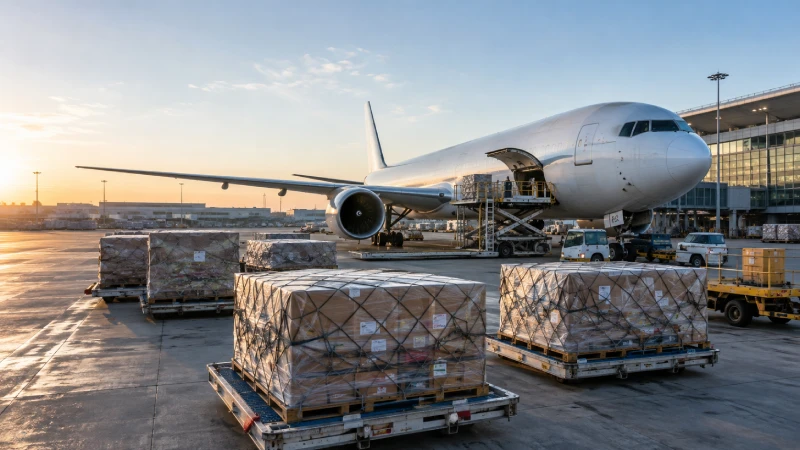
Air freight from China to the UK is often the practical choice when delivery speed matters more than achieving the lowest possible freight cost. It is commonly used for commercial electronics, spare parts, samples, industrial components, urgent stock replenishment and other relatively high-value or time-sensitive goods.
However, choosing air freight involves more than comparing a price per kilogram. Your final cost and delivery time can change significantly depending on the supplier’s location in China, departure airport, UK gateway, airline capacity, routing, carton dimensions, chargeable weight, cargo restrictions, customs readiness and final delivery postcode.
This guide explains how China–UK air cargo works in practice, including the main airports, realistic transit planning, chargeable weight, destination charges, special-cargo considerations and the information importers should prepare before requesting a quotation.
For a broader comparison of sea freight, air freight, DDP, customs and other route options, see our Shipping from China to the UK guide.
Last regulatory review: September 2026.
Quick Answer: Standard air freight is usually most suitable for commercial shipments that need to reach the UK faster than sea freight but do not require the fully integrated speed of an express courier. Published 2026 market references commonly show standard China–UK air freight taking roughly 5–10 days for many end-to-end shipments, while express services can often be around 3–6 days. Current public market references for ordinary general cargo vary widely, commonly around US$4–10/kg or more, depending on chargeable weight, routing, capacity and service scope. These are planning references rather than Winsail quotations, and actual rates should always be confirmed for the specific shipment.
| Shipping requirement | Practical starting option |
|---|---|
| Samples or very urgent small shipments | Express courier |
| Commercial stock requiring fast replenishment | Standard air freight |
| High-value spare parts or industrial components | Standard or priority air freight |
| Lightweight but bulky cartons | Check volumetric weight first |
| Large, non-urgent commercial shipment | Compare sea freight |
| Batteries, DG, liquids or unusual cargo | Cargo review before booking |
When Does Air Freight Make Sense from China to the UK?
The strongest reason to use air freight is usually not simply that the shipment is small. The better question is: what does a slower supply chain cost your business?
A shipment may justify air freight when delayed inventory could stop production, cause stockouts, postpone a product launch or leave a customer waiting for a critical replacement part.
Typical cargo profiles include:
- electronics and electronic components;
- machinery and automotive parts;
- urgent replacement components;
- industrial equipment parts;
- product samples and prototypes;
- high-value commercial goods;
- seasonal or promotional stock;
- e-commerce inventory replenishment;
- urgent stock for UK wholesalers and distributors.
For example, a 150 kg machine component may be expensive to move by air compared with sea freight, but the freight premium can be commercially reasonable if waiting several additional weeks would stop a production line.
The same logic applies to inventory. Instead of asking whether air freight is “expensive,” compare the additional air-freight cost with the financial effect of running out of stock.
When Express May Make More Sense
International express services can be more practical for smaller shipments where the importer values a highly integrated door-to-door network.
Samples, prototypes, documents and small quantities of replacement stock are common examples.
Express should not automatically be selected just because the shipment is below a particular weight. Courier pricing, dimensional weight, destination area, product restrictions and account rates can all change the calculation.
When Sea Freight Is Usually the Better Option
For bulky, heavy or non-urgent cargo, sea freight usually offers much lower unit transport costs.
If you are moving large quantities of ordinary commercial inventory and have sufficient lead time, compare both air and sea before booking. For some importers, the most effective solution is a split shipment: send the quantity required to prevent a stockout by air and move the remaining inventory by sea.
For a broader cost comparison across transport modes, see Shipping Cost from China to UK.
How China–UK Air Freight Actually Moves
A commercial air shipment involves considerably more than the flight itself.
A typical door-to-door movement may look like this:
China supplier → pickup → export warehouse → cargo screening → China customs/export processing → airline terminal → international flight → UK cargo terminal → import customs clearance → terminal release → UK delivery
Understanding this chain helps explain why a flight that takes less than a day does not result in same-day commercial air freight.
Airport-to-Airport Air Freight
An airport-to-airport rate generally focuses on moving cargo between the departure and arrival airports.
Depending on the quotation, it may exclude:
- supplier pickup;
- origin warehouse charges;
- export handling;
- customs services;
- destination terminal charges;
- customs brokerage;
- storage;
- Customs Duty;
- import VAT;
- final UK delivery.
IATA notes that airline transportation charges do not necessarily include services such as pickup, delivery, customs clearance, terminal handling, transshipment or storage unless they are stated in the quotation. See IATA’s air cargo tariffs and rules guidance.
For that reason, comparing two airport rates without comparing their inclusions can be misleading.
Airport-to-Door and Door-to-Door
For commercial importers, an airport-to-door or door-to-door arrangement is often easier to budget.
Depending on the agreed scope, a freight forwarder may coordinate:
- supplier collection;
- consolidation;
- export handling;
- international air freight;
- destination-agent handling;
- customs-clearance coordination where applicable;
- final trucking or courier delivery.
Customs duties, VAT and importer responsibilities should still be clearly identified rather than assumed to be included.
Direct vs Connecting Air Services
A direct or nonstop routing can reduce handling events and connection risk, but it is not automatically the best choice.
Connecting services may offer:
- better available capacity;
- a lower rate;
- more departure options;
- better acceptance for a particular shipment.
The trade-off is that another handling and flight connection is introduced.
A shipment can therefore be delayed even when the first flight leaves China on schedule if it misses its onward connection.
For cargo with a strict deadline, ask the forwarder whether the quoted schedule is:
- nonstop;
- direct with an intermediate stop;
- connecting through another hub.
Do not compare transit times based only on the advertised flight duration.
Standard Air Freight vs Express Courier
With express shipping, pickup, linehaul, customs processing and final delivery are normally operated through an integrated courier network.
Standard air freight typically involves a freight forwarder, airline, cargo terminal, customs arrangements and a separate delivery leg.
That additional flexibility can make standard air freight more suitable for larger commercial consignments, pallets and regular B2B replenishment, while express can remain attractive for smaller urgent shipments.
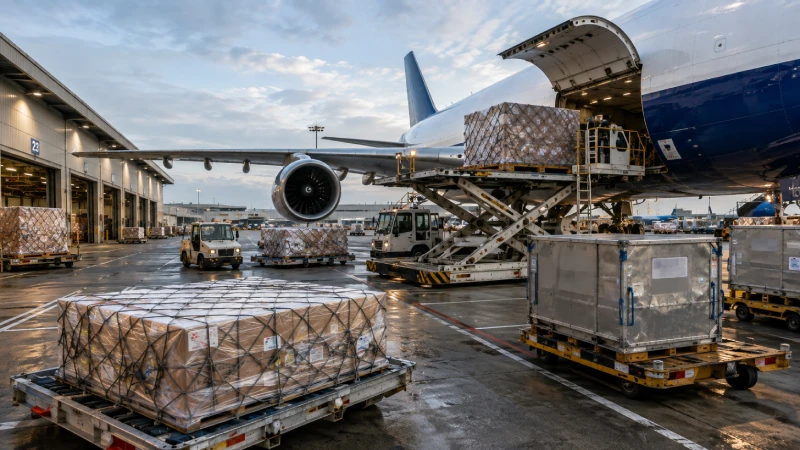
Which China Airport Should Your Cargo Depart From?
The lowest international air rate does not always come from the airport closest to your supplier, but neither should cargo automatically be trucked hundreds of kilometres to another airport simply because its airline rate is slightly lower.
The correct calculation is:
China pickup + origin handling + air freight + routing time + destination cost
Shanghai Pudong International Airport — PVG
PVG is a major option for cargo originating in:
- Shanghai;
- Jiangsu;
- Zhejiang;
- surrounding East China manufacturing regions.
Shanghai’s airport system handled approximately 4.5 million tonnes of cargo and mail during 2025, highlighting the scale of Shanghai as an international aviation and logistics hub. See the Shanghai Airport Authority.
For suppliers around Suzhou, Kunshan, Hangzhou, Ningbo and other East China manufacturing centres, the origin trucking cost and available uplift through PVG should be compared with alternative gateways.
Shenzhen Bao’an International Airport — SZX
SZX is particularly relevant for cargo from:
- Shenzhen;
- Dongguan;
- Huizhou;
- electronics and manufacturing clusters in the eastern Pearl River Delta.
Shenzhen Airport processed approximately 2.05 million tonnes of cargo and mail during 2025, including more than one million tonnes of international and regional cargo and mail. See the Shenzhen Government report.
This makes Shenzhen an important starting point for China–UK air freight, particularly for electronics, components and e-commerce-related cargo originating in the region.
Guangzhou Baiyun International Airport — CAN
CAN is often practical for suppliers in:
- Guangzhou;
- Foshan;
- Zhongshan;
- parts of the central and western Pearl River Delta.
Guangzhou Baiyun International Airport handled more than 2.4 million tonnes of cargo and mail in 2025. See the Guangzhou Government report.
For a shipment collected in Foshan, for example, comparing CAN with SZX should include both the international air rate and the additional trucking required to reach the airport.
Hong Kong International Airport — HKG
HKG can also be operationally relevant for South China cargo.
It should not, however, be treated simply as another Shenzhen departure airport. Moving mainland cargo through Hong Kong introduces a cross-boundary origin movement that needs to be justified by the available airline service, cargo acceptance, schedule or pricing.
Hong Kong International Airport handled approximately 5.07 million tonnes of cargo in 2025 and remains one of the world’s largest international air-cargo gateways. See Hong Kong International Airport’s cargo information.
HKG may be worth comparing when:
- the available airline schedule is stronger;
- capacity is easier to secure;
- a particular cargo type has a workable routing;
- the overall cost remains competitive after cross-border trucking and handling.
Beijing Capital and Beijing Daxing — PEK / PKX
PEK and PKX can be relevant for cargo originating around Beijing, Tianjin, Hebei and other parts of North China.
The choice should be based on the actual service available for the shipment rather than assuming that either airport always has the best UK route.
| China gateway | Particularly relevant origin area | Main planning consideration |
|---|---|---|
| PVG | Shanghai, Jiangsu, Zhejiang | Strong East China gateway; compare trucking from supplier |
| SZX | Shenzhen, Dongguan, Huizhou | Important for Pearl River Delta manufacturing and electronics |
| CAN | Guangzhou, Foshan and surrounding areas | Useful alternative for central/western Pearl River Delta |
| HKG | South China where routing supports it | Cross-border movement must be included in total cost |
| PEK / PKX | Beijing, Tianjin, Hebei, North China | Confirm current airline routing and cargo acceptance |
Pro Tip: Do not choose an airport from the air rate alone. A small per-kilogram saving can disappear quickly if it requires additional long-distance trucking, another warehouse transfer or an extra day of origin handling.
Heathrow, East Midlands or Manchester: Which UK Airport Should You Use?
The same principle applies at destination.
The airport with the cheapest international rate is not necessarily the airport that gives you the lowest delivered cost.
The better comparison is:
air freight + destination terminal charges + customs arrangement + inland trucking + UK postcode
London Heathrow — LHR
Heathrow is the UK’s dominant international air-cargo gateway by trade value.
The airport reported that £293 billion worth of goods moved through Heathrow during 2025 and describes itself as the UK’s largest port by value. Its network covers more than 230 destinations and includes extensive long-haul connectivity. See Heathrow Cargo.
LHR can be particularly practical when:
- the consignee is in London or South East England;
- airline capacity into Heathrow is competitive;
- the routing uses passenger belly capacity;
- the UK delivery cost works well from Heathrow.
But importers should still check destination handling and storage terms rather than assuming Heathrow will produce the lowest all-in cost.
East Midlands Airport — EMA
East Midlands has a substantially different cargo profile.
EMA describes itself as the UK’s foremost express air-freight hub. It handled 413,664 tonnes during the 2025/26 financial year and hosts major integrated logistics operators including DHL, UPS and FedEx. See East Midlands Airport’s cargo update.
Its central UK location can be valuable for time-critical distribution and express networks.
However, this does not mean that every standard air-freight consignment from China can or should be routed directly into EMA. Airline service, cargo type, available uplift and ground network still need to be checked.
Manchester Airport — MAN
Manchester is particularly relevant for consignees in:
- Greater Manchester;
- North West England;
- Yorkshire;
- northern distribution networks;
- other locations where trucking from southern airports would add unnecessary distance.
Manchester Airport operates a dedicated World Freight Terminal and identifies the Far East as one of its major cargo markets. See Manchester Airport Cargo.
For an importer with a warehouse near Manchester, Leeds or Liverpool, a slightly higher air rate into MAN could still produce a lower overall delivered cost than moving cargo through Heathrow and trucking it north.
| UK gateway | Main strength | Particularly worth checking for |
|---|---|---|
| Heathrow (LHR) | Large long-haul network and major UK international cargo gateway | London, South East and broad airline choice |
| East Midlands (EMA) | Strong express/freighter ecosystem and central location | Express, e-commerce and selected time-critical networks |
| Manchester (MAN) | Major northern gateway with dedicated cargo facilities | Northern England consignees and regional distribution |
Pro Tip: Always give your freight forwarder the real UK delivery postcode. “London,” “Manchester area” or “UK warehouse” is not enough information to optimise the arrival airport and final-mile cost.
How Long Does Air Freight from China to the UK Take?
For planning purposes, importers should distinguish between:
- flight time;
- airport-to-airport cargo time;
- total door-to-door transit time.
Published China–UK market data in 2026 commonly shows standard air freight in roughly the 5–10 day range, depending on the route and service definition, while express commonly falls around 3–6 days. These figures should be treated as planning references rather than guaranteed schedules.
| Service | Typical planning reference |
|---|---|
| Express courier | Around 3–6 days |
| Standard air freight | Roughly 5–10 days for many door-to-door movements |
| Airport-to-airport | Routing-specific |
| Sea freight | Considerably longer; compare through the UK route guide |
For a more detailed discussion of route timing across transport modes, see How Long Does It Take to Ship from China to UK?.
Where the Time Is Actually Spent
A commercial shipment may require time for:
- pickup from the supplier;
- delivery into the export warehouse;
- receiving and measurement;
- cargo security screening;
- export declaration;
- airline terminal acceptance;
- waiting for booked uplift;
- international flight;
- connection or transshipment where applicable;
- UK terminal breakdown;
- customs clearance and release;
- collection from the terminal;
- final delivery.
This is why a flight of several hours does not mean the freight can be delivered in the UK the same day.
Common Causes of Air Freight Delays
Typical operational issues include:
- limited airline capacity;
- peak-season demand;
- cargo missing a planned connection;
- incorrect invoice or packing-list information;
- customs queries;
- cargo inspection;
- undisclosed batteries or dangerous goods;
- special-cargo acceptance;
- destination terminal congestion;
- storage or release problems;
- consignee/importer documentation not being ready.
When a delivery deadline is critical, communicate the required delivery date, not just the preferred departure date.
How Is Air Freight Cost from China to the UK Calculated?
The headline per-kilogram rate is only one part of air-freight pricing.
For worked weight breaks and chargeable-weight examples, use the air freight cost per kilogram guide.
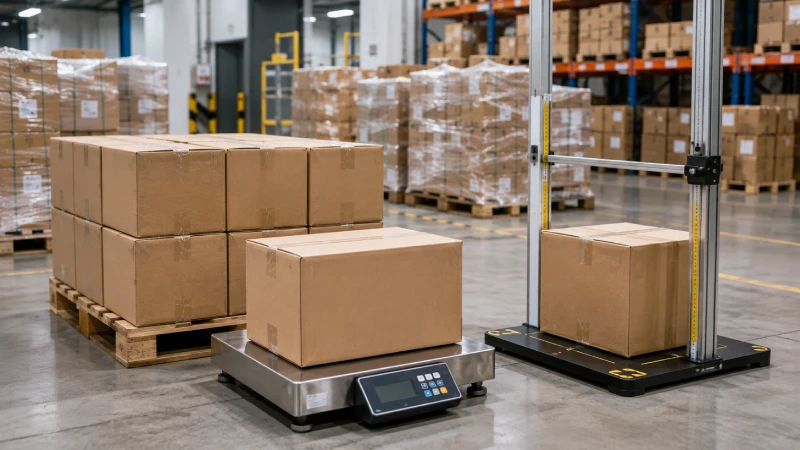
The starting point is usually chargeable weight.
Actual Weight vs Volumetric Weight
Airlines consider both:
- actual gross weight;
- volumetric weight.
The chargeable weight is normally whichever is higher.
IATA states that the general volumetric calculation for air cargo is:
Length × Width × Height in centimetres ÷ 6,000
See IATA’s air cargo tariffs and rules guidance.
Chargeable Weight Example
Suppose you are importing:
- 10 cartons;
- each carton measures 60 × 50 × 40 cm;
- total gross weight is 150 kg.
Volumetric weight per carton:
60 × 50 × 40 ÷ 6,000 = 20 kg
For 10 cartons:
20 × 10 = 200 kg volumetric weight
Your shipment therefore has:
- actual gross weight: 150 kg;
- volumetric weight: 200 kg;
- chargeable weight: 200 kg.
The air-freight rate would normally be applied to 200 kg rather than 150 kg.
This is why carton dimensions are essential when requesting an air-freight quotation.
Pro Tip: “500 kg cargo” is not enough information for a reliable quote. A forwarder needs carton dimensions because 500 kg of dense machinery parts and 500 kg of lightweight bulky products can produce very different chargeable weights.
Air Freight Weight Breaks
Commercial air-freight quotations commonly use weight breaks such as:
- +45 kg;
- +100 kg;
- +300 kg;
- +500 kg;
- +1,000 kg.
A higher weight break may have a lower rate per kg, but the total shipment cost still increases. Do not deliberately add unnecessary weight merely to reach another rate bracket without calculating the complete cost.
Typical 2026 Air Freight Rate Planning Range
Publicly available China–UK market references vary significantly.
Current 2026 market pages reviewed for this guide show standard general-cargo references ranging from roughly US$4/kg to US$10/kg or more, depending on weight, origin, destination and service scope. Individual route quotations can fall outside that range.
Treat this only as a budgeting reference, not as a live Winsail quotation.
Actual rates depend on:
- departure airport;
- arrival airport;
- chargeable weight;
- cargo dimensions;
- airline capacity;
- direct or connecting service;
- season and market demand;
- general or special cargo status;
- pickup location;
- UK delivery postcode;
- customs and delivery scope.
Air cargo pricing is dynamic. IATA notes that spot and ad hoc rates can depend on available capacity and market conditions.
What Is Included in an Air Freight Quote?
A complete China–UK cost can include several separate components.
| Cost component | What it covers |
|---|---|
| China pickup | Supplier to warehouse/airport movement |
| Origin handling | Receiving, warehouse and terminal processes |
| Export customs | Export declaration and related services |
| Security screening | Required cargo security processes |
| Air freight | International airline transport |
| Fuel/security surcharges | Airline or handling-related surcharges |
| UK terminal handling | Destination cargo terminal charges |
| Customs brokerage | Import declaration services where agreed |
| Customs Duty | Based on the goods and tariff classification |
| Import VAT | Based on applicable UK VAT treatment |
| Storage | May arise if cargo cannot be released promptly |
| UK final delivery | Airport to consignee postcode |
IATA lists handling, screening, dangerous-goods fees, fuel surcharges, security charges and terminal handling among possible air-freight accessorial charges.
Do Not Compare Quotes by £/kg or US$/kg Alone
When comparing two quotations, ask:
- Is China pickup included?
- Is export handling included?
- Is the service direct or connecting?
- Are destination terminal charges included?
- Is customs brokerage included?
- Are Duty and VAT excluded?
- Is final delivery included?
- Are storage charges excluded?
- Is the rate based on confirmed dimensions?
A cheaper airline rate can result in a more expensive door-to-door shipment.
Air Freight vs Express vs Sea Freight
The right method depends on the commercial objective, not simply the cargo weight.
| Factor | Express | Standard Air Freight | Sea Freight |
|---|---|---|---|
| Speed | Usually fastest | Fast | Slowest |
| Typical cargo | Samples, parcels, urgent small stock | Commercial replenishment, parts, pallets | Bulk and planned inventory |
| Pricing | Courier tariff / chargeable weight | Chargeable weight | CBM or container |
| Door delivery | Usually integrated | Can be coordinated | Can be coordinated |
| Cargo process | Courier network | Forwarder + airline + handlers | Forwarder + shipping line/terminal |
| Best question | Is convenience worth the premium? | Is the time saved worth the air cost? | Can the inventory wait? |
A Simple Decision Rule
Need a few cartons of samples immediately?
Start by checking express.
Need several hundred kilograms of commercial stock quickly?
Compare standard air freight.
Shipping bulky inventory without an urgent deadline?
Run a sea-freight comparison.
Only part of the shipment is urgent?
Consider splitting the order between air and sea.
There is no universal weight at which one method automatically becomes cheaper than another because density, origin, destination and minimum charges matter.
For broader route planning across air and ocean options, return to Shipping from China to the UK.
What Cargo Can Be Shipped by Air—and What Needs Extra Review?
Air freight can handle many commercial products, but not every cargo can be booked as ordinary general cargo.
Cargo containing cells or batteries should also be checked against the lithium-battery shipping guide before a route is selected.
General Cargo
Common air-freight candidates include:
- ordinary machinery parts;
- industrial components;
- samples;
- textiles;
- consumer products;
- certain electronics;
- urgent replacement inventory.
Even apparently ordinary products should be described accurately during quotation.
“Accessories,” “parts” or “electronics” may not provide enough information for cargo acceptance or customs classification.
Electronics and Battery-Powered Products
Always tell your forwarder whether the product:
- contains a battery;
- is packed with a battery;
- includes separate or spare batteries;
- contains lithium-ion, lithium-metal or another battery chemistry.
Do not remove battery information from a commercial description to try to obtain a general-cargo rate.
Lithium Batteries and Dangerous Goods
Lithium batteries are not automatically prohibited from air transport, but they are also not automatically accepted as ordinary cargo.
IATA states that lithium batteries can be carried by air depending on factors such as their configuration, Watt-hour rating for rechargeable batteries and lithium content for non-rechargeable batteries. See IATA’s lithium battery guidance.
Dangerous-goods transport is subject to classification, packaging, marking, documentation, operator acceptance and other requirements. The UK Civil Aviation Authority notes that dangerous goods can be carried safely when applicable requirements are met and that parties involved in preparing and transporting them have legal responsibilities. See the UK CAA dangerous-goods guidance.
For battery or DG shipments, the forwarder may need information or documents such as:
- battery specification;
- UN38.3 documentation where applicable;
- SDS or other product information where applicable;
- packaging details;
- battery configuration;
- quantity and rating.
The precise requirements should be checked shipment by shipment against current regulations and airline acceptance rules.
Magnetic Goods, Liquids and Powders
These goods are not automatically “air prohibited,” but they may require additional review.
Depending on the product and airline, the forwarder may request:
- SDS;
- composition information;
- transport-condition information;
- magnetic inspection or testing where relevant;
- confirmation that the goods are non-dangerous.
Always disclose the actual product before cargo reaches the export warehouse.
Oversized and Heavy Air Cargo
Heavy cargo can move by air, but aircraft and ground-handling restrictions matter.
A shipment may become difficult because of:
- individual-piece dimensions;
- individual-piece weight;
- aircraft door size;
- ULD compatibility;
- available freighter capacity;
- airport handling equipment.
For unusual machinery or oversized industrial parts, send dimensions, weight and photographs before expecting a firm rate.
UK Customs, VAT and Importer Responsibilities
Air transport does not change the basic UK customs obligations that apply to imported goods.
Importers should determine the customs and compliance position before cargo arrives rather than waiting until it is sitting at a UK airport.
EORI
For commercial imports into England, Scotland or Wales from China, businesses generally need an EORI number starting with GB.
For movements involving Northern Ireland, an XI EORI may also be required depending on the circumstances. GOV.UK distinguishes the requirements for Great Britain and Northern Ireland. See GOV.UK EORI guidance.
An EORI problem can lead to customs delays and potentially additional storage costs.
Commodity Codes and Customs Duty
There is no single Customs Duty rate for “goods from China.”
The correct commodity code is important because it helps determine:
- Customs Duty;
- import VAT treatment;
- licences;
- restrictions;
- possible trade measures.
HMRC’s UK Trade Tariff should be used to identify the correct commodity code and applicable measures.
Do not choose a commodity code based only on another supplier’s previous invoice. Product materials, function, construction and use can affect classification.
Import VAT and PVA
The UK’s standard VAT rate is 20% for many goods and services, but reduced, zero-rated or other VAT treatment can apply to particular goods. The correct treatment should therefore be checked rather than assuming every import has identical VAT treatment. See GOV.UK VAT guidance.
UK VAT-registered businesses may be able to use Postponed VAT Accounting (PVA) to account for import VAT through their VAT Return rather than paying it upfront at import.
HMRC states that when another party imports goods on a business’s behalf and PVA is to be used, written instructions may be needed so the correct information is entered on the import declaration. See HMRC’s PVA guidance.
This article is operational guidance rather than tax advice; importers should confirm their VAT treatment with the appropriate adviser or HMRC guidance.
Great Britain vs Northern Ireland
Do not treat Great Britain and Northern Ireland as identical import destinations.
Great Britain covers:
- England;
- Scotland;
- Wales.
Northern Ireland can involve different customs and product-regulatory procedures. HMRC’s tariff guidance distinguishes between the tariff systems used for GB and NI declarations.
If the delivery postcode is in Northern Ireland, make that clear before the shipment is quoted.
UKCA, CE and Product Compliance
A common outdated claim is that every commercial product entering Great Britain must now have UKCA marking.
That is incorrect.
Current GOV.UK guidance states that conformity marking is required only where relevant sector-specific legislation requires it, and not all products require a conformity mark. Current Great Britain guidance also covers both UKCA and CE routes depending on the applicable product legislation. Northern Ireland has a separate framework. See GOV.UK guidance on placing UKCA or CE marked products on the Great Britain market.
Before shipping a regulated product, check:
- which UK market it will be placed on;
- which product legislation applies;
- conformity-assessment requirements;
- marking requirements;
- technical documentation;
- importer or manufacturer responsibilities;
- labelling or traceability requirements.
A freight forwarder can coordinate transportation but should not be treated as the authority certifying whether a product is legally compliant for sale in the UK.
Can Air Freight Be Shipped DDP to the UK?
A DDP or similar door-to-door arrangement may be workable for some shipments, but it should never be assumed automatically.
The following must be clear:
- who is the importer;
- customs-representation structure;
- EORI position;
- who accounts for VAT;
- who pays Customs Duty;
- commodity classification;
- product compliance;
- final delivery arrangement.
HMRC distinguishes direct and indirect customs representation. Under direct representation, the importer remains responsible for matters including declaration information and Customs Duty/import VAT. GOV.UK also states that a business not established in the UK importing goods into Great Britain can only ask someone to act indirectly on its behalf. See GOV.UK customs representation guidance.
For that reason, Winsail should confirm UK DDP feasibility only after reviewing the specific shipment and importer structure.
Documents and Information Required Before Booking
For ordinary commercial air freight, commonly required shipping documentation includes:
- commercial invoice;
- packing list;
- air waybill;
- shipper and consignee details;
- accurate product description;
- customs classification information where available;
- licences or certificates where applicable.
HMRC requires commodity-code information for import declarations, and the UK Trade Tariff can also indicate whether specific licences or other measures apply.
Special cargo may require additional technical or dangerous-goods documentation.
Information Needed for an Accurate Air Freight Quotation
For an initial China–UK air-freight quotation, prepare:
- Number of cartons
- Dimensions of each carton
- Total gross weight
- Exact product description
- Battery status
- Supplier location in China
- UK delivery postcode
It is also useful to provide:
- cargo-ready date;
- supplier Incoterm;
- required UK delivery date;
- whether the cargo is palletised;
- photos for unusual goods;
- SDS or battery documents where relevant;
- Amazon FBA or 3PL warehouse requirements where applicable.
For Amazon or third-party fulfilment centres, also confirm that the destination’s inbound booking, labelling, pallet or carton requirements are being handled separately from the international air-freight booking.
For more information about Winsail’s air cargo capabilities, see Air Freight Services.
How to Reduce Air Freight Cost Without Increasing Delay Risk
Air-freight optimisation should focus on the factors that genuinely change cost rather than simply searching for the lowest advertised rate.
1. Reduce Volumetric Weight
If volumetric weight exceeds actual weight, packaging can become a major cost driver.
Review whether suppliers can:
- reduce empty carton space;
- use more suitable export cartons;
- remove unnecessary retail packaging before international transport;
- combine products more efficiently without increasing damage risk.
A small reduction in carton dimensions across dozens of cartons can materially reduce chargeable weight.
2. Consolidate Multiple Suppliers
If you purchase from several factories in China, consolidation may reduce:
- repeated origin pickup charges;
- multiple minimum handling charges;
- separate international bookings.
Cargo can potentially be collected into one warehouse and prepared as a consolidated shipment.
However, consolidation is not always the right solution. Waiting several days for one late supplier can undermine the reason for using air freight in the first place.
3. Compare SZX, CAN and HKG for South China Cargo
For Pearl River Delta sourcing, ask whether more than one airport provides a workable route.
Then compare:
pickup + airport transfer + handling + air freight + schedule
rather than the international rate alone.
4. Compare UK Gateways by Delivered Cost
Do the same at destination.
For cargo ultimately going to Manchester, Leeds or another northern distribution point, compare the total cost through MAN against alternatives through LHR or another suitable gateway.
5. Split Urgent and Routine Inventory
One of the most effective supply-chain strategies is often to stop treating the entire purchase order as equally urgent.
For example:
- urgent stockout quantity → air freight;
- remaining replenishment quantity → sea freight.
This preserves sales or production continuity without paying air-freight rates for inventory that does not need to arrive quickly.
6. Prepare Customs Information Before Arrival
Destination storage can turn a reasonable air-freight shipment into an expensive one.
Before the aircraft arrives, make sure the relevant parties have the necessary:
- commercial invoice;
- packing list;
- importer details;
- EORI;
- product description;
- commodity information;
- licences or certificates where applicable;
- clearance instructions.
Pro Tip: One of the easiest ways to waste the speed advantage of air freight is to fly the cargo across the world quickly and then leave it sitting at the destination terminal while paperwork is corrected.
Planning an Air Freight Shipment from China to the UK
Air freight works best when the routing is designed around the commercial requirement rather than simply choosing the lowest per-kilogram rate.
Before booking, answer six questions:
- When does the cargo actually need to arrive?
- What is the chargeable weight?
- Which China airport gives the best total origin solution?
- Which UK gateway gives the best delivered cost to the final postcode?
- Does the product require special air-cargo acceptance or UK import compliance?
- Exactly what is included in the quotation?
For ordinary cargo, Winsail Logistics can coordinate China pickup, consolidation, export handling, air-freight booking and UK delivery arrangements depending on the agreed service scope and shipment requirements.
Customs-clearance arrangements, special-cargo acceptance and DDP feasibility remain subject to shipment-specific review.
For a useful quotation, prepare:
carton quantity + carton dimensions + gross weight + exact product + battery status + supplier location + UK postcode.
That information allows the shipment to be evaluated by chargeable weight, origin airport, available routing and final delivery requirement, rather than relying on an inaccurate generic “price per kg.”
How much does air freight from China to the UK cost per kg?
There is no fixed China–UK air-freight rate. Public 2026 market references for ordinary commercial cargo commonly show broad ranges of roughly US$4–10/kg or more, but actual pricing can fall outside this range depending on chargeable weight, origin, destination, airline capacity, cargo type and service scope. Always confirm what the quotation includes.
How long does air freight from China to the UK take?
A reasonable planning range for many standard air-freight shipments is approximately 5–10 days, while express services can often be around 3–6 days. Routing, pickup location, connections, customs and final delivery can change the total transit time.
How is chargeable weight calculated for air freight?
Air cargo is normally charged using the higher of actual gross weight or volumetric weight. A commonly used volumetric calculation is Length × Width × Height in centimetres ÷ 6,000.
Which China airport is best for air freight to the UK?
There is no single best airport. PVG is important for East China, SZX and CAN are major options for the Pearl River Delta, HKG can be relevant for selected South China shipments, and PEK/PKX can be considered for North China cargo. The best choice depends on supplier location, cargo type, capacity, routing and required delivery time.
Is Heathrow or Manchester better for China air cargo?
It depends on the available airline routing and the final UK delivery address. Heathrow offers extensive international connectivity, while Manchester can reduce inland transport for many northern destinations. Compare the complete delivered cost rather than the airport rate alone.
Can lithium batteries be shipped by air from China to the UK?
Some lithium batteries and battery-powered products can be transported by air, but acceptance depends on battery type, configuration, rating, packaging, documentation and airline requirements. The shipment should be reviewed before booking.
Do I need an EORI number for air freight from China to the UK?
For commercial imports into England, Scotland or Wales, businesses generally need a GB EORI. Movements involving Northern Ireland may also require an XI EORI depending on the movement. The importer and customs-representation structure should be confirmed before the goods arrive.
Continue with related UK shipping guides
Use these focused guides for the next part of your China-to-UK shipping plan.
