

Air freight from China to Tanzania is one of the fastest and most reliable shipping solutions for importers dealing with time-sensitive cargo, high-value goods, or urgent replenishment needs. Compared to sea freight, which can take several weeks, air cargo typically delivers within a few days, making it a preferred option for electronics, spare parts, fashion items, and medical supplies.
For Tanzania-bound shipments, the main entry point is Julius Nyerere International Airport (DAR) in Dar es Salaam, with additional cargo handled through Kilimanjaro International Airport (JRO) for northern regions. On the China side, major export hubs include Guangzhou, Shenzhen, Shanghai, and Hong Kong—each offering frequent cargo flights to East Africa.
This guide breaks down when to use air freight, how long it takes, how pricing works, and what to expect during customs clearance—so you can make informed shipping decisions.
When to Use Air Freight
Air freight is not always the cheapest option, but it becomes the most practical choice in specific business scenarios.
The most common use case is urgent shipments. If your goods are needed within days rather than weeks, air freight is the only viable option. This applies to stock replenishment, production delays, or seasonal demand spikes.
Another key scenario is high-value or low-volume cargo. Products such as electronics, medical devices, or precision components benefit from air freight due to reduced transit time and lower risk exposure. Even though the cost per kilogram is higher, the total shipment cost remains manageable when volume is limited.
Air freight is also widely used when supply chain reliability matters more than cost. Unlike sea freight, which is affected by port congestion and schedule variability, air cargo operates on tighter and more predictable schedules.
Additionally, if your shipment is not large enough to justify a full container load but too urgent for sea LCL, air freight offers a clean and efficient middle-ground solution.
However, for bulky, low-value goods (such as furniture or raw materials), air freight is usually not cost-effective. In such cases, sea freight remains the preferred option.
Transit Time
Air freight from China to Tanzania is significantly faster than other shipping methods, but actual transit time depends on several operational factors.
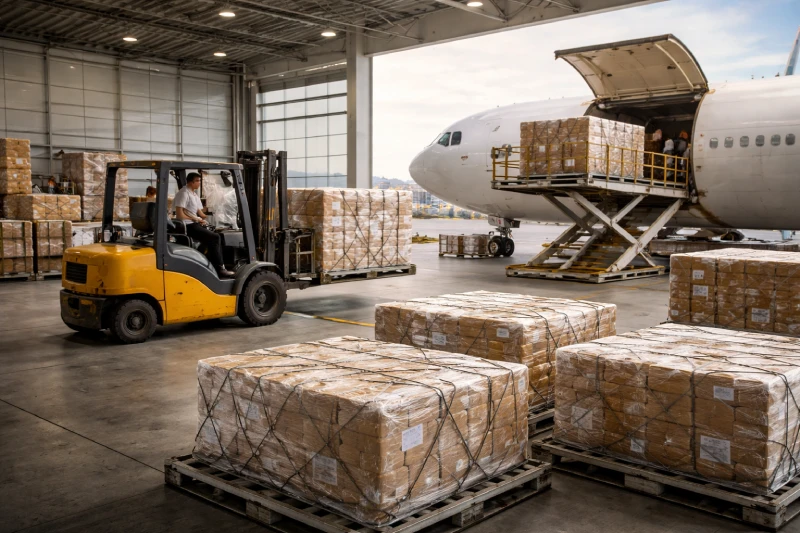
On average, airport-to-airport transit time ranges from 3 to 7 days. Direct or well-connected flights from Guangzhou, Shenzhen, or Hong Kong to Dar es Salaam typically fall within the shorter end of this range.
However, total door-to-door transit time usually extends to 5–10 days, considering the following stages:
- Export handling and customs clearance in China (1–2 days)
- Flight time and possible transshipment (1–3 days)
- Import customs clearance in Tanzania (1–3 days)
- Final delivery to consignee (1–2 days)
Indirect routes—especially those transiting through Middle Eastern hubs like Doha, Dubai, or Addis Ababa—may add 1–2 days depending on connection schedules.
Peak seasons (e.g., pre-holiday periods) can also impact transit time due to cargo space shortages.
For a more detailed breakdown of timelines across different shipping methods, refer to the Shipping Time page, where sea, air, and express options are compared side by side.
Cost Structure
Air freight pricing from China to Tanzania is primarily calculated based on chargeable weight, which considers both actual weight and volumetric weight.
The formula for volumetric weight is:
Length (cm) × Width (cm) × Height (cm) ÷ 6000
Whichever is higher—actual weight or volumetric weight—will be used for billing.
Key Cost Components
- Air Freight Rate (per kg)
This is the base transportation cost and varies depending on:- Origin airport (e.g., Guangzhou vs Shanghai)
- Airline and route
- Season (peak vs off-peak)
- Cargo type (general vs special goods)
- Fuel and Security Surcharges
These fluctuate with global fuel prices and airline policies. - Origin Charges (China)
Including:- Warehouse handling
- Export customs clearance
- Documentation fees
- Destination Charges (Tanzania)
Including:- Terminal handling
- Import clearance fees
- Delivery or local transport
Typical Price Range
- General cargo: $4.5 – $8.5 per kg
- Urgent shipments or peak season: $7 – $12 per kg
Prices vary significantly depending on volume. Larger shipments (e.g., 300kg+) typically qualify for better rates.
For a deeper understanding of pricing logic and how to estimate your shipment cost, refer to the Shipping Cost guide.
Airlines & Routes
Air freight from China to Tanzania is mainly operated through a mix of direct and transit routes, with airlines leveraging major international hubs.
Common Airlines Serving This Route
- Ethiopian Airlines (via Addis Ababa)
- Qatar Airways (via Doha)
- Emirates SkyCargo (via Dubai)
- Turkish Airlines (via Istanbul)
- China Southern Airlines (regional connections)
Among these, Ethiopian Airlines is often the most competitive option for East Africa due to its strong regional network.
Typical Routing Structure
There are very few direct flights from China to Tanzania. Most shipments follow this pattern:
China (Guangzhou / Shenzhen / Shanghai) → Transit Hub → Dar es Salaam (DAR)
Transit hubs play a critical role in:
- Consolidating cargo
- Optimizing flight schedules
- Reducing overall cost
Hong Kong is also a major consolidation hub, especially for international cargo.
Choosing the right route depends on your priority:
- Fastest delivery → fewer transshipments
- Lower cost → flexible routing via hubs
An experienced freight forwarder will balance these factors based on your shipment requirements.
Customs Handling
Customs clearance is a critical stage in air freight shipping to Tanzania, and delays often occur here rather than during transit.
Export Customs (China)
In China, the exporter or freight forwarder handles:
- Commercial invoice and packing list
- Export declaration
- HS code classification
This process is typically efficient and completed within 1–2 days.
Import Customs (Tanzania)
Upon arrival, Tanzanian customs requires:
- Commercial invoice
- Packing list
- Bill of airway bill (AWB)
- Import permits (if applicable)
- Tax and duty payment
Tanzania applies import duties and VAT depending on product classification. Incorrect documentation or undervaluation can lead to delays or penalties.
Common Challenges
- Incorrect HS codes
- Missing import permits
- Under-declared cargo value
- Lack of consignee tax registration
To avoid these issues, many importers choose DDP (Delivered Duty Paid), where the freight forwarder manages customs clearance and tax payment.
For a complete breakdown of procedures and required documents, refer to the Customs Clearance guide.
Air vs Express
Air freight and express shipping (couriers like DHL, FedEx, UPS) are often confused, but they serve different purposes.
Air Freight
- Suitable for: 100kg+ shipments
- Cost: Lower per kg than express
- Transit time: 5–10 days door-to-door
- Requires: Customs handling and coordination
Express Shipping
- Suitable for: small parcels (typically <100kg)
- Cost: Higher per kg
- Transit time: 3–5 days door-to-door
- Advantage: Fully integrated service (pickup + delivery + customs)
Key Differences
| Factor | Air Freight | Express Shipping |
|---|---|---|
| Cost per kg | Lower | Higher |
| Speed | Fast | Very fast |
| Volume | Medium–large | Small parcels |
| Process | More complex | Fully handled |
If your shipment is small and urgent, express is more convenient. But for larger cargo, air freight offers better cost efficiency.
For a detailed comparison of courier services and scenarios, refer to the Express shipping page.
FAQs
1. How long does air freight from China to Tanzania take?
Typically 5–10 days door-to-door, depending on routing and customs clearance.
2. What is the cost per kg for air freight?
Around $4.5 to $8.5 per kg for general cargo, with higher rates during peak seasons.
3. Which airport is used in Tanzania?
Most shipments arrive at Dar es Salaam (DAR), the main cargo hub.
4. Is air freight cheaper than express shipping?
Yes, especially for shipments above 100kg, air freight is significantly more cost-effective.
5. Do I need to handle customs myself?
Not necessarily. Many freight forwarders offer DDP services, handling customs and taxes on your behalf.
If you’re importing from China to Tanzania and need a balance between speed and cost, air freight remains one of the most practical and scalable solutions—especially when managed by an experienced logistics partner.
