

On CMA CGM’s published Kilima Xpress rotation, the scheduled sea voyage to Dar es Salaam is 30 days from Nansha, 34 days from Ningbo, and 35 days from Shanghai. These are port-to-port examples, not factory-to-door delivery promises. FCL and LCL may share the same vessel, but LCL requires additional consolidation and unpacking. Air freight and express services are generally faster, although their actual delivery dates depend on the booked service, cargo handling, customs clearance, and final destination.
Data Note — October 21, 2026: The sea transit times in this guide are calculated from CMA CGM’s published Kilima Xpress schedule. They describe one carrier’s scheduled port-to-port movement, not guaranteed transit times for every shipment. Air and courier delivery estimates require shipment-specific confirmation. Customs release and inland delivery are not included in the published ocean transit figures.
For Tanzanian importers, knowing when a vessel reaches Dar es Salaam is only part of the planning process. What matters to a procurement manager is when the goods can actually be collected, transported to a warehouse, and made available for distribution or production.
A supplier may report that goods are ready in China, but they still need to meet a vessel or flight cut-off. Similarly, cargo may arrive in Tanzania while customs formalities, terminal handling, or delivery arrangements remain incomplete.
This guide explains how to calculate a practical receiving date for FCL, LCL, air freight, and express shipments. For a broader introduction to transportation options, visit our shipping from China to Tanzania guide.
1. Shipping Times from China to Tanzania at a Glance
The time required to ship goods from China to Tanzania depends on the transport mode, departure availability, routing, cargo handling requirements, and final delivery location.
Sea freight is usually the practical choice for larger, less time-sensitive shipments. Air freight is more suitable when an earlier receiving date justifies the additional transport expense. Express courier services are commonly considered for documents, samples, and smaller urgent consignments.
However, the international transportation time is not the same as the total logistics lead time.
FCL vs. LCL vs. Air Freight vs. Express Delivery
The following comparison separates the international transport segment from the additional activities needed before and after it.
| Shipping Method | International Transport Time | Origin Preparation and Departure Waiting | Tanzania Clearance and Delivery | Main Uncertainty |
|---|---|---|---|---|
| FCL Sea Freight | 30–35 days on the specified CMA CGM Kilima Xpress origin-port examples | Container loading, export documentation, terminal cut-off, and sailing availability | Customs release, shipping-line and port formalities, container collection, and inland transport | Missed sailing, schedule changes, and destination release |
| LCL Sea Freight | Depends on the booked vessel; may share the same ocean transit as FCL | Cargo consolidation, CFS acceptance, and container loading | Deconsolidation, consignment-level release, and collection or final delivery | Consolidation schedules and CFS availability |
| Standard Air Freight | Depends on confirmed cargo flight and connection arrangements | Airline booking, export handling, security screening, and cargo acceptance | Airport handling, import customs clearance, and local transport | Available cargo space, flight connections, and customs processing |
| Express Courier | Depends on the courier service and origin/destination addresses | Courier pickup, shipment acceptance, and export processing | Courier-managed import procedures and last-mile delivery | Service coverage, customs holds, and shipment eligibility |
The 30–35-day sea figure applies only to the three named origin ports on the referenced carrier rotation. It is not a market-wide FCL average. The remaining stages require shipment-specific estimates.
Why the Fastest Transit Time Is Not Always the Earliest Delivery Date
Consider two hypothetical sea-freight options.
Service A has a shorter published voyage, but its cargo cut-off has already passed. Service B has a slightly longer voyage but accepts the cargo for an earlier departure.
Service B may still deliver the goods to Dar es Salaam first.
The same principle applies to air freight. A short flight itinerary is not particularly useful if the cargo cannot be accepted for that departure or must wait for an onward connection.
For import planning, compare the earliest feasible complete itinerary, not just the shortest published transport segment.
The date you need should also match your business objective:
- Port arrival: Suitable for monitoring the international movement.
- Cargo available for collection: Suitable for planning clearance completion and pickup.
- Warehouse receiving date: Suitable for inventory replenishment, customer commitments, and production planning.
For procurement decisions, the third date is usually the most important.
2. When Does the Shipping Clock Start and Stop?
One of the most common sources of confusion is the meaning of a quoted shipping time.
A freight forwarder may quote a vessel’s port-to-port transit time, while a buyer interprets the same number as the time between supplier pickup and warehouse delivery.
Those are different measurements.
From Cargo Ready Date to Vessel or Flight Departure
The cargo ready date is when the supplier expects the goods to be packed and available for the agreed export handover.
It does not necessarily mean that the cargo has been accepted by the carrier.
For sea freight, the goods may still need to be loaded into a container, transported to the terminal, processed for export, and delivered before the applicable cut-off.
For LCL, individual consignments must reach the consolidator’s designated facility in time to join the intended container.
For air freight, the airline or cargo-handling agent must accept the shipment in accordance with its booking and documentation requirements.
Key milestones include:
| Milestone | Meaning |
|---|---|
| Cargo Ready Date | Supplier has made the goods available for the agreed handover |
| Cargo Acceptance / CY or CFS Cut-off | Latest relevant deadline for the booked departure |
| Scheduled ETD | Planned vessel or aircraft departure |
| Actual Departure | Confirmed departure of the transport carrying the cargo |
| Scheduled ETA | Planned arrival at the destination port or airport |
| Actual Arrival | Confirmed arrival at the relevant destination |
A shipment that becomes ready after the cut-off may need to move on another departure.
Port-to-Port and Airport-to-Airport Transit Time
Port-to-port transit time measures the international sea movement between the specified loading and discharge ports, using the carrier’s published or actual event definitions.
It does not normally include the time required to prepare cargo at the supplier’s warehouse or complete the destination’s customs and delivery processes.
Likewise, airport-to-airport transit does not automatically include:
- Pickup from a Chinese supplier
- Export cargo handling
- Import customs clearance
- Destination warehouse release
- Delivery to the consignee
When comparing quotations, confirm whether the quoted period starts at cargo pickup, carrier acceptance, scheduled departure, or actual departure.
Customs Released, Cargo Available, and Delivered
These are three separate operational milestones.
Customs released means the applicable customs-release requirements have been satisfied. Other carrier, terminal, warehouse, or collection requirements may remain.
Available for collection means the cargo can be physically handed over once the relevant release and pickup conditions are satisfied.
Delivered means the goods have reached the agreed destination and the applicable delivery handover has been completed.
The complete sequence is:
Cargo Ready → Origin Handover → Vessel/Flight Departure → Destination Arrival → Import Release → Cargo Collection → Final Delivery
A carrier tracking page may confirm that a vessel has arrived without confirming that the importer can collect the goods.
This distinction becomes especially important when planning factory production, retail launches, or time-sensitive inventory replenishment.
3. Sea Freight Transit Times from Major Chinese Ports to Dar es Salaam
Dar es Salaam is a major gateway for China–Tanzania container shipments. However, the sailing duration varies according to the loading port, carrier, routing, and booked voyage.
Rather than treating a broad market average as a guarantee, importers should first examine an identifiable shipping service.
Verified Carrier Schedule Example: CMA CGM Kilima Xpress
CMA CGM publishes a weekly service rotation for its Kilima Xpress (KILIMA) service.
The published rotation identifies Shanghai as service day 0, Ningbo as day 1, Nansha as day 5, and Dar es Salaam as day 35.
Subtracting the origin service-day value from the Dar es Salaam value gives the following scheduled port-to-port transit figures.
| China Origin Port | Destination Port | Published Service Days | Scheduled Port-to-Port Transit |
|---|---|---|---|
| Shanghai | Dar es Salaam | Day 0 → Day 35 | 35 days |
| Ningbo | Dar es Salaam | Day 1 → Day 35 | 34 days |
| Nansha, Guangzhou | Dar es Salaam | Day 5 → Day 35 | 30 days |
Source: CMA CGM — Kilima Xpress (KILIMA), schedule checked October 21, 2026.
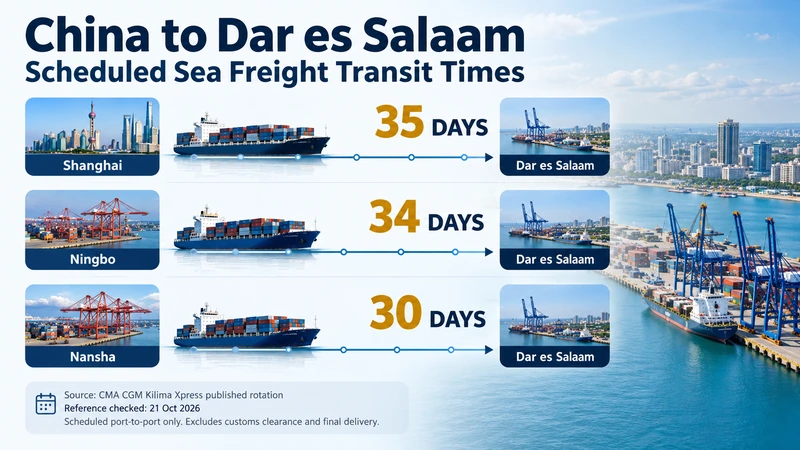
These figures demonstrate that even within one carrier’s service rotation, the origin port changes the scheduled voyage duration.
They do not prove that every Shanghai–Dar es Salaam shipment takes 35 days or that Nansha will always be the fastest option.
A different carrier, vessel connection, operational schedule, or booking date may produce a different ETA.
The published service also includes intermediate port calls. Its overall rotation duration is not the same as the transit time from China to Dar es Salaam.
Before booking, verify the specific vessel, voyage, loading terminal, intended routing, and estimated arrival date.
What About Shenzhen, Qingdao, Tianjin, and Other Chinese Ports?
Importers also frequently ship goods from Shenzhen, Qingdao, Tianjin, and other manufacturing regions.
However, an estimate should not be copied from a nearby port simply because the two locations are geographically close.
For example, Shenzhen’s Yantian and Shekou terminals are not interchangeable with Guangzhou’s Nansha terminal when checking a specific carrier schedule.
Similarly, a shipment originating in Qingdao may use a different service or connection arrangement from one departing Shanghai.
For these origins, request a routing that identifies:
- The actual loading port and terminal
- Carrier and service name
- Vessel and voyage number, where available
- Direct-vessel or connecting-service arrangement
- Scheduled departure and arrival
- Cargo acceptance cut-off
- Any planned transshipment
No universal Shenzhen-, Qingdao-, or Tianjin-to-Dar es Salaam transit figure is assumed in this guide. A current carrier itinerary is needed before selecting a specific number for procurement planning.
Direct Sailing vs. Transshipment: What Changes the Timeline?
The term direct service can be misunderstood.
A vessel may call at Singapore, Colombo, or other ports while the container remains on the same vessel. Such intermediate stops do not necessarily mean the container is transshipped.
An actual transshipment involves moving the container from one vessel to another.
Three common routing arrangements are:
Same-vessel service with intermediate calls: The container stays on its planned vessel through the intermediate ports. The additional port calls are already part of the published voyage rotation.
Transshipment service: The container is discharged from one vessel and loaded onto a connecting vessel. Its arrival date depends partly on that connection.
Feeder connection: A connecting vessel transports cargo between a regional port and a mainline service.
A connection can create additional uncertainty if the first vessel arrives late or the onward sailing changes.
However, it is not correct to assign every transshipment a fixed number of extra days. The effect depends on the actual connection schedule.
How Sailing Frequency and Cargo Cut-offs Affect Delivery
A weekly service does not mean every shipment will depart within seven days of the supplier reporting that the goods are ready.
The cargo must meet the cut-off for an available and accepted booking.
For an FCL shipment, container positioning, loading, sealing, export documentation, and terminal gate-in arrangements must align with the intended departure.
For LCL, the consolidator may close cargo acceptance before the ocean carrier’s terminal cut-off to allow time for stuffing and documentation.
If the intended departure is missed, the forwarder must identify another feasible sailing and update the arrival calculation.
Pro Tip 1 — Verify the Sailing, Not Just the Route
Before approving an inventory date, request the vessel name, voyage number, cargo cut-off, scheduled ETD, scheduled ETA, and confirmation of any planned vessel transfer. A generic “35-day sailing” is not sufficient for a time-sensitive purchase order.
Check a Tanzania Shipping Schedule
Share your cargo-ready date, Chinese loading port, and destination in Tanzania to request a sailing-specific schedule check and an indicative collection timeline.
For more information on container selection and consolidation arrangements, see our sea freight from China to Tanzania guide.
4. How Long Do Air Freight and Express Shipments Take?
Air transport can substantially shorten the international movement compared with a multi-week sea voyage. However, the required delivery time depends on more than the scheduled aircraft journey.
Buyers should distinguish standard air cargo from express courier services.
Standard Air Cargo to Dar es Salaam (DAR)
Air freight may be arranged through Chinese export airports such as Guangzhou Baiyun (CAN), Shanghai Pudong (PVG), or other suitable cargo gateways, with Tanzania’s Julius Nyerere International Airport (DAR) as the intended arrival airport.
The actual routing must be checked with the cargo provider.
A typical planning sequence includes:
Cargo Booking → Origin Acceptance → Export Handling → Confirmed Uplift → Flight / Connection → Airport Arrival → Import Release → Collection or Delivery
Not every shipment travels on a nonstop aircraft. Depending on the available service, cargo may move through an intermediate international hub.
A connecting itinerary may involve waiting for an onward flight, cargo transfer, handling checks, or rescheduling if space becomes unavailable.
Importantly, a published passenger flight schedule does not guarantee that commercial freight can travel on that flight.
For example, an airline may display a Guangzhou–Dar es Salaam passenger itinerary, but cargo acceptance, space availability, handling restrictions, and uplift confirmation require a separate cargo-service check.
For urgent air shipments, request:
- Confirmed cargo acceptance date
- Operating airline and route
- Planned flight or connection details
- Estimated arrival at DAR
- Cargo-handling and document-release arrangements
- Import clearance responsibility
- Estimated final delivery date
Without those details, a fixed airport-to-door estimate should be treated as provisional rather than a confirmed commitment.
Further guidance on choosing air cargo services is available in our air freight from China to Tanzania guide.
Express Courier for Samples and Small Shipments
Express services are commonly considered for commercial samples, documents, replacement components, and smaller parcels.
Unlike traditional airport-to-airport air cargo, an express courier typically offers an integrated parcel movement and tracking process.
However, the estimated delivery period is still service-specific.
FedEx, for example, provides origin- and destination-dependent transit-time tools and states that transit times and delivery commitments vary by shipment location and service.
See the FedEx Tanzania shipping services page for available service information.
Before relying on an express delivery estimate, confirm:
- The exact Chinese collection location and Tanzanian delivery address.
- The selected courier product and collection date.
- Shipment dimensions, weight, declared value, and contents.
- Import document and commodity restrictions.
- Whether the quoted date accounts for weekends or applicable non-working days.
- Any conditions or exclusions relating to customs clearance.
A courier’s Arrived in Destination Country tracking event should not be interpreted as proof that customs clearance and final delivery are complete.
When Should You Use Air Instead of Sea?
The decision should begin with the required receiving date and the consequences of missing it.
| Situation | Practical Scheduling Approach |
|---|---|
| Large replenishment order with flexible lead time | Compare confirmed FCL/LCL departures against the stock replenishment deadline |
| Production-critical replacement component | Obtain a confirmed air-cargo or express delivery estimate |
| Small supplier sample for product approval | Check express eligibility and the destination delivery date |
| Mixed shipment with urgent and non-urgent products | Consider separating critical items for air while moving the remainder by sea |
| Cargo requiring special handling or regulatory approval | Confirm transport eligibility and documentation before choosing the departure |
Splitting a shipment can be appropriate when the receiving date of a small quantity is more important than the arrival of the entire order.
The method should be selected against the actual deadline, shipment characteristics, and confirmed service—not simply the label “express” or “air freight.”
5. After Arrival in Tanzania: When Can You Actually Collect the Cargo?
A vessel arriving at Dar es Salaam does not mean its containers are immediately available to importers.
The goods still need to pass through the applicable import, carrier-release, terminal, and collection processes.
This is often the most important distinction between a published sea-freight ETA and a realistic warehouse receiving date.
FCL Container Release at Dar es Salaam Port
The Tanzania Ports Authority (TPA) import process identifies several steps between cargo arrival and physical release.
The importer normally engages a registered or appropriately licensed clearing and forwarding agent (CFA) to manage the applicable local clearance formalities.
Depending on the consignment and procedures, the process involves:
1. Import documentation and customs formalities
The importer provides the required commercial and shipping documents to the clearing agent. The agent handles the applicable customs declaration, assessment, payment, and release procedures.
2. Shipping-line release documentation
Relevant shipping documents and carrier release requirements must be satisfied. TPA describes the use of documents including the Bill of Lading, Release Order, and Delivery Order.
3. Port charges and administrative processing
Applicable documents and payments are processed through the relevant port systems. TPA identifies its Electronic Payment Portal (TePP) as part of the port charges procedure.
4. Truck and driver announcement
The collecting transport must be arranged and submitted through the relevant system to obtain the required entry permission.
5. Physical collection and gate release
Following the required checks, the cargo may be released to the authorized collecting party and moved out of the port.
These are process milestones, not a promise that clearance takes a fixed number of hours or days.
Some documentation work can begin before vessel arrival. Other steps depend on actual discharge, system status, customs decisions, and the relevant facility’s procedures.
Why LCL Cargo Can Be Available Later Than the Vessel Arrival
LCL cargo involves an additional physical handling stage.
Multiple importers’ shipments may travel inside the same consolidated container. On arrival, the container must be made available for the appropriate deconsolidation and consignment-release process.
The consignee may have to wait for:
- Container discharge and transfer or availability at the designated facility
- Deconsolidation or unstuffing
- House Bill of Lading documentation and release arrangements
- Relevant CFS handling and customs requirements
- Scheduling of the individual cargo collection
The Tanzania Trade Portal documents CFS-related and customs-release procedures for relevant import categories.
This means an LCL shipment can share the same vessel arrival date as an FCL container but have a different collection-ready date.
It would be misleading to state that LCL always takes a fixed number of days longer. The difference depends on the consolidator, facility, import process, and individual shipment.
Cargo Arrival vs. Cargo Collection: Milestone Checklist
Use the following checklist when monitoring a shipment after it reaches Tanzania.
| Shipment Milestone | Evidence to Request | Can the Cargo Be Collected? |
|---|---|---|
| Vessel has arrived | Carrier tracking or actual arrival confirmation | No |
| Cargo discharged and available at facility | Terminal or CFS status | Not necessarily |
| Customs release obtained | Applicable customs-release confirmation | Not necessarily |
| Carrier and terminal release requirements completed | Delivery/release documents and applicable payment confirmation | Subject to remaining pickup conditions |
| Truck and collection arrangements accepted | Entry permit or relevant pickup authorization | Subject to gate and facility requirements |
| Cargo physically collected or gated out | Collection or gate-out confirmation | Yes, collected |
| Goods received at destination | Delivery acknowledgment or proof of delivery | Yes, delivered |
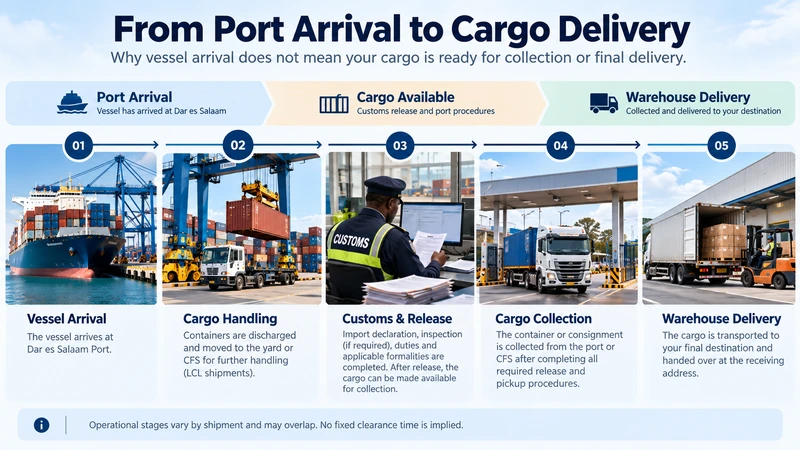
Customs release and physical gate-out are different events. A shipment may have cleared customs but still be awaiting a Delivery Order, applicable terminal formalities, or an available collecting truck.
Pro Tip 2 — Ask for the Release Milestone
When a vessel reaches Dar es Salaam, request both the expected customs-release date and the expected cargo collection or gate-out date. Ask which outstanding document, payment, inspection, or terminal activity could affect each milestone.
How Does Air-Cargo Clearance Affect Delivery?
Air cargo also requires destination handling and import release.
An aircraft may arrive at DAR before the cargo is available for collection from the relevant handling facility.
The consignee or appointed agent must confirm arrival documentation, customs status, any applicable regulatory checks, warehouse release, and transport arrangements.
For standard air freight, the earliest airport collection date should be requested separately from the flight’s arrival time.
Express courier services may integrate more of these activities into their own operational process, but customs exceptions and shipment restrictions can still affect delivery.
Delivery to Dar es Salaam vs. Inland Tanzania
Importers receiving goods outside Dar es Salaam must plan for additional inland movement.
For example, cargo discharged at Dar es Salaam Port may ultimately be destined for warehouses or businesses in Dodoma, Arusha, or Mwanza.
The final timeline depends on:
- Completion of the applicable import-release process
- Whether the cargo is collected as a full container or individual consignment
- Truck or other transport availability
- The precise final delivery address
- Road and operating conditions
- Receiver working hours and unloading arrangements
An ETA at Dar es Salaam should therefore never automatically become the delivery date for an inland consignee.
Zanzibar requires separate destination-specific checks. Mainland Tanzania import processes should not be assumed to cover all Zanzibar standards and administrative requirements. Where relevant, the Zanzibar Bureau of Standards publishes its own PVoC information.
For the documentation and release requirements affecting Mainland imports, see our Tanzania customs clearance guide.
6. What Causes Delays Between China and Tanzania?
Shipping delays are not always caused by slow vessels or congested ports.
They may originate before cargo leaves the Chinese supplier, during international transportation, or after arrival in Tanzania.
Identifying the affected milestone is more useful than assuming that every delay has the same cause.
Departure and Connection Delays
A supplier may finish production later than planned, or cargo may fail to meet the booked carrier’s cut-off.
Other potential disruptions include vessel schedule changes, lack of available cargo space or equipment, shipment rollover, port omissions, weather disruption, and missed connecting services.
The earlier the importer identifies the problem, the easier it is to evaluate alternative departures.
Documentation and Compliance Delays
Incomplete or inconsistent shipment information can prevent normal clearance progress.
Common matters requiring attention include discrepancies in the commercial invoice, packing list, transport document, importer details, commodity description, or declared classification.
Certain goods may also require specific licences, approvals, conformity documentation, or inspection procedures.
The Tanzania Bureau of Standards operates a Pre-Shipment Verification of Conformity (PVoC) framework for regulated products. Importers should establish whether their goods fall within the applicable requirements before shipment and arrange the appropriate conformity documentation where required.
See the TBS Notice to Importers.
Not every imported product has identical conformity requirements. The applicable rules should be checked by product type and current regulatory classification.
Port, Customs, and Final Delivery Delays
Even after the vessel arrives, the shipment may still depend on completion of inspections, release documentation, applicable payments, terminal handling, and transportation arrangements.
The following matrix helps identify warning signs.
| Potential Delay | Affected Milestone | Early Warning Sign | Preventive Action |
|---|---|---|---|
| Supplier production delay | Cargo-ready date | Goods not ready for loading or inspection | Confirm readiness before finalizing the intended departure |
| Missed export cut-off | Planned ETD | Container or cargo cannot be accepted for the booked sailing | Check terminal/CFS deadlines with the origin forwarder |
| Carrier schedule change | ETA | Revised vessel tracking or route announcement | Reconfirm the booked voyage and update the receiving plan |
| Missed transshipment connection | International transit | New connecting vessel or ETA | Request an updated itinerary |
| Missing regulated-product documentation | Import clearance | Agent cannot complete relevant compliance steps | Verify requirements before export |
| Inconsistent shipping documents | Customs or release | Document amendment or clarification request | Match commercial, packing, and transport details |
| Incomplete destination release | Cargo collection | Customs cleared but collection authorization outstanding | Track line, port, facility, and payment requirements separately |
| No collecting truck or delivery appointment | Inland transport | Cargo ready but no pickup slot confirmed | Arrange transport and receiving capacity in advance |
Do not assume that any of these events automatically adds a particular number of days. The actual impact depends on when the issue occurs, how quickly it is resolved, and which subsequent activities are affected.
Public holidays and facility working arrangements also matter. A shipment arriving shortly before a non-working period may require a different receiving plan from one arriving during normal operations.
7. How to Plan a Realistic Replenishment and Delivery Date
For procurement teams, the most useful question is not simply how long a ship takes to cross the ocean.
It is:
What is the latest date my supplier can have the cargo ready while still giving me a reasonable chance of receiving it before my business deadline?
A practical answer requires working backward from the destination receiving date.
Calculate Total Logistics Lead Time
A planning model is:
Total Logistics Lead Time = Origin Preparation + Departure Waiting + International Transport + Destination Release + Final Delivery + Planning Buffer
Each component should be defined carefully.
Origin preparation: Time from the agreed starting event to readiness for the intended carrier handover.
Departure waiting: Time between cargo readiness/acceptance and the actual departure of the booked international service.
International transport: The relevant carrier’s confirmed or published route time.
Destination release: Activities required after arrival before the goods are legally and physically available for pickup.
Final delivery: Movement from the collection facility to the named receiving address, including applicable receiving arrangements.
Planning buffer: An additional allowance chosen in line with the buyer’s tolerance for disruption and the shipment’s observed or assessed risks.
Some stages may overlap. For example, documentation preparation can occur before the vessel arrives. Do not automatically add every stage’s maximum duration if the underlying processes run in parallel.
If planning from the date the purchase order is placed rather than from the cargo-ready date, supplier production time must also be included.
Example: Why a 35-Day Sailing Is Not a 35-Day Receiving Time
Consider a simplified hypothetical FCL shipment from Shanghai to Dar es Salaam.
Assume the following conditions:
- Supplier cargo-ready date: November 1
- Hypothetical booked vessel departure: November 8
- Published port-to-port transit used for planning: 35 days
- Calculated scheduled Dar es Salaam arrival: December 13
The cargo has already spent 42 calendar days between supplier readiness and scheduled port arrival.
That includes seven days between the ready date and the hypothetical departure, plus the 35-day planned voyage.
It still does not include the actual destination-release and final-delivery stages.
Therefore, December 13 would be the calculated port ETA, not a confirmed warehouse receiving date.
This is an arithmetic illustration, not a published November vessel booking or a guaranteed transit forecast. A real shipment requires the corresponding vessel/voyage and the actual release and inland-delivery assumptions.
Work Backward from Your Required Receiving Date
Start with the date by which your warehouse needs the inventory.
Then identify:
- Required warehouse receiving date: The date goods must physically reach the agreed location.
- Latest acceptable cargo collection date: The date the goods must leave the port, CFS, or airport to meet the inland delivery plan.
- Target destination arrival date: An arrival date that leaves adequate time for the applicable release process.
- Feasible vessel or flight: A departure with a routing and ETA consistent with that target.
- Origin cargo cut-off: The latest handover deadline for that departure.
- Supplier readiness deadline: The date the supplier must have goods and required export-related preparations ready.
This approach converts an uncertain shipping estimate into a sequence of decisions that can be verified.
For high-impact shipments, ask the relevant parties to identify which milestones are confirmed and which remain provisional.
Plan Three Dates Instead of One
A useful procurement plan should distinguish an optimistic result from a delivery date suitable for business commitments.
| Planning Date | Meaning | Appropriate Use |
|---|---|---|
| Earliest Feasible Receipt | The earliest workable receiving date under favorable handling and release conditions | Opportunity planning |
| Working Delivery Estimate | Expected receiving date based on the proposed route and documented handling assumptions | Internal purchasing and warehouse coordination |
| Protected Inventory Date | A receiving date incorporating an agreed contingency allowance | Customer commitments, safety-stock planning, and production continuity |
The contingency allowance should reflect the business impact of late delivery, the reliability of the selected route, and available historical performance data.
It should not be presented as a universal number of extra days for Tanzania.
A business with limited safety stock may need a more conservative commitment date than one holding adequate replacement inventory.
Likewise, cargo requiring product-specific inspections may need a different scheduling approach from ordinary general merchandise.
What Information Is Needed to Check a Shipment Schedule?
Before requesting a shipping schedule, prepare the following information:
- Cargo-ready date: When the supplier expects the shipment to be ready for handover.
- Origin: Supplier pickup city or preferred Chinese loading port/airport.
- Goods description: Product name, relevant technical characteristics, and HS code if known.
- Shipment details: Number of packages, dimensions, gross weight, CBM, and FCL/LCL requirement.
- Destination: Dar es Salaam or another destination, including the final receiving city/address.
- Required receiving date: The business deadline, not merely a preferred departure date.
- Incoterm and agreed service scope: Who arranges transport, import formalities, and final delivery.
- Compliance requirements: Known permits, conformity certificates, inspections, or special-handling conditions.
These details allow a logistics provider to compare feasible departures against the required receiving date.
Does Door-to-Door Shipping Mean DDP?
No.
Door-to-door describes the physical transportation scope, while DDP (Delivered Duty Paid) is an Incoterms® rule allocating responsibilities between seller and buyer.
Under DDP, the seller is responsible for the required import-clearance formalities and associated import duties and taxes, subject to the legal ability to perform those obligations.
Under DAP (Delivered at Place), the seller arranges transport to the named destination, but the buyer is generally responsible for import clearance and its related charges.
The International Chamber of Commerce’s explanation of DAP and DDP highlights these distinctions.
DDP should not be promised where the seller cannot lawfully fulfill the required importer obligations. A qualified Tanzanian clearing agent may still be needed for the applicable formalities.
Neither DAP nor DDP is inherently a faster transport method.
If comparing air-freight arrangements, note that CIF is a sea/inland-waterway Incoterm, not a synonym for airport-to-airport air freight.
For a shipment timeline, always confirm the named delivery point, actual logistics services included, and which party must complete each import step.
Check a Tanzania Shipping Schedule
A reliable receiving-date plan begins with the cargo-ready date, the available sailing or flight, the anticipated destination-release process, and the actual delivery address.
Winsail Logistics can review your shipment information and help you evaluate suitable China–Tanzania transportation arrangements and scheduling assumptions.
Check a Tanzania Shipping Schedule
Provide your origin, cargo details, ready date, required delivery date, and final destination. The objective is to establish a practical shipment-specific plan rather than rely on a general transit-time average.
If your decision also depends on the overall transport budget, consult our separate shipping cost from China to Tanzania guide.
FAQ
My supplier missed the container cut-off. Can the shipment still arrive on the originally quoted date?
Possibly, but it should not be assumed. If the original sailing is no longer available, the forwarder must check whether another departure can achieve the required ETA. Request an updated booking itinerary with the new ETD, ETA, and any change in routing before confirming the receiving date.
Does a direct sailing mean the vessel makes no stops before Dar es Salaam?
Not necessarily. A service may call at several intermediate ports while the container remains on the same vessel. That is different from transshipment, where the container transfers to another vessel. Ask whether the container stays on the same vessel until Dar es Salaam.
Can LCL cargo be collected as soon as the vessel arrives at Dar es Salaam?
Usually not immediately. The consolidated container must be discharged and made available for handling. Deconsolidation, consignment documentation, customs release, and CFS collection arrangements may be required. Ask for the consignment-ready date, not only the vessel ETA.
Can my clearing agent prepare the Tanzania import declaration before the ship arrives?
Relevant documents and preparatory work may be completed before arrival, subject to current customs procedures. The importer should provide accurate commercial and transport documents to an appropriately licensed clearing agent, who can confirm which filings are permitted before arrival. Preparation does not mean the cargo has received final customs release.
Does an express tracking status of “Arrived in Destination Country” mean delivery is imminent?
Not necessarily. Import processing, local sorting, or final delivery arrangements may still be outstanding. Check the courier's tracking-event definitions and obtain its latest shipment-specific delivery estimate.
Which date should I use for inventory planning if my cargo is going to Arusha instead of Dar es Salaam?
Use the expected Arusha warehouse receiving date, not the vessel ETA at Dar es Salaam. Include import release, cargo collection, inland transportation, and receiving arrangements at the final address. Request separate estimated collection and delivery dates.
What if my shipment is scheduled to arrive near a weekend or Tanzanian public holiday?
Check the relevant customs, terminal, CFS, transport-provider, and receiving-warehouse arrangements. Identify which milestone may be affected by operating hours or non-working days, then request a revised release or collection estimate rather than assuming a standard holiday delay.
Sources and Schedule Reference
The following official and carrier sources support the route-specific information and process explanations used in this guide:
- CMA CGM — Kilima Xpress (KILIMA): Published service rotation and transit-time information. Schedule referenced October 21, 2026.
- Tanzania Ports Authority (TPA): Official Import Process.
- Tanzania Trade Portal: Official trade and import procedure information.
- Tanzania Bureau of Standards (TBS): Notice to Importers — PVoC-regulated products.
- International Chamber of Commerce: DAP and DDP under Incoterms® 2020.
- FedEx Tanzania: Shipping services and shipment-specific transit-time information.
- Zanzibar Bureau of Standards: Pre-Export Verification of Conformity information.
Important Shipping-Time Disclaimer: Published transit times are indicative and may change according to the carrier, vessel or flight, departure availability, routing, weather, cargo characteristics, customs procedures, and destination operations. The sea figures in this article describe one published carrier rotation, not all China–Tanzania shipments. Importers should verify current schedules, product-specific requirements, local clearing arrangements, and final delivery responsibilities before making time-sensitive commercial commitments.
