
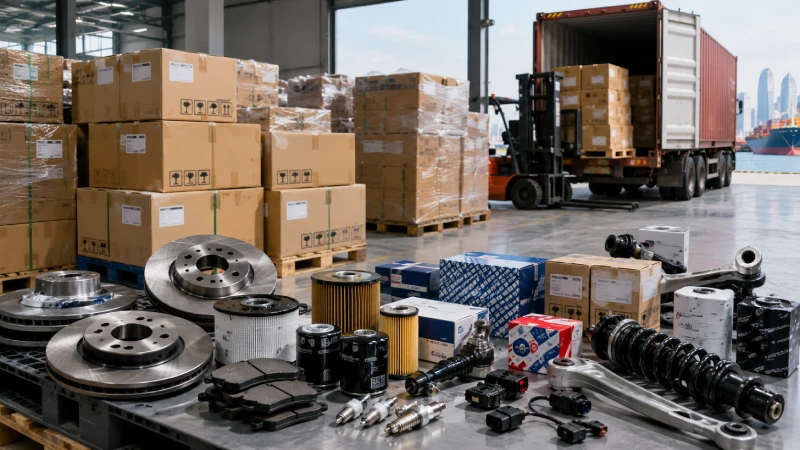
For Qatar importers who regularly purchase vehicle spare parts, Shipping from China to Qatar is not only about choosing sea freight or air freight. Auto parts distributors need a shipping plan that protects stock availability, controls logistics costs, and prevents urgent shortages from damaging customer relationships. Unlike one-time cargo shipments, auto parts supply requires repeated replenishment, SKU-level planning, supplier coordination, and a clear emergency shipment strategy.
The real challenge is simple: customers expect the right part to be available when a vehicle needs repair. If a distributor runs out of fast-moving parts, sales are lost immediately. If too much stock is imported too early, cash flow and warehouse space are locked up. A successful China-to-Qatar auto parts shipping strategy must balance inventory speed, freight cost, supplier lead time, and demand forecasting.
Why Auto Parts Shipping Requires Inventory Planning
Auto parts are more complex than many other cargo types because one shipment may include hundreds of different SKUs. A single order can include filters, sensors, brake pads, body parts, belts, suspension components, electronic modules, and accessories. Each product has a different sales speed, margin, packaging requirement, and urgency level.
For example, brake pads and filters may sell every week, while specialized engine components may only move when a repair shop has a specific demand. If both categories are shipped with the same replenishment logic, the distributor may overstock slow-moving parts while still running out of fast-moving items.
This is why auto parts importers should not start by asking only, “What is the cheapest freight option?” A better question is, “Which parts must always be available, which parts can wait, and which parts justify emergency shipping?” The answer determines whether LCL, FCL, air freight, or a hybrid model is the right choice.
Segment Auto Parts by Replenishment Priority
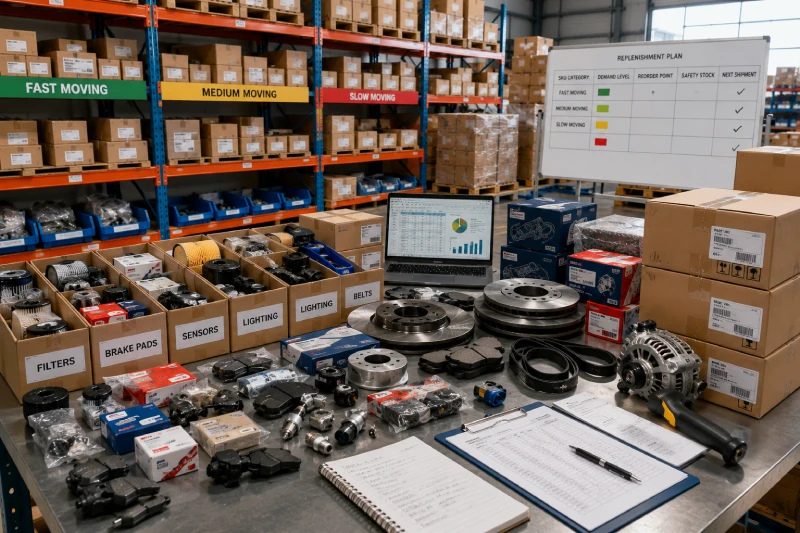
Before arranging shipments from China, distributors should divide auto parts into replenishment categories. This makes shipping decisions more accurate and reduces unnecessary freight spending.
| SKU Type | Examples | Best Shipping Strategy | Main Risk |
|---|---|---|---|
| Fast-moving parts | Filters, brake pads, belts, plugs, lighting parts | Regular sea freight replenishment | Stockouts |
| Medium-moving parts | Suspension parts, cooling parts, body accessories | Planned LCL or FCL batches | Overstock or delayed supply |
| Slow-moving parts | Engine parts, gearbox parts, rare model parts | Forecast-based ordering | Cash tied in inventory |
| Urgent parts | Customer-specific repair parts, backorders | Air freight or courier | High logistics cost |
| High-value compact parts | Sensors, ECUs, electronic modules | Air freight when needed | Damage, loss, urgent demand |
Fast-moving SKUs should be included in a fixed replenishment cycle. These are the parts that generate repeat sales and require safety stock. Medium-moving parts can be grouped with other items in scheduled shipments. Slow-moving and expensive parts should be ordered more carefully because importing too many units may increase storage cost and reduce cash flow flexibility.
Urgent parts should be treated separately. They are not part of the normal replenishment plan. They are used to protect a confirmed order, solve a repair delay, or support an important customer. If emergency shipments happen too often, the distributor should review its reorder points and demand forecast.
Build Regular Replenishment Cycles Instead of Random Orders
Many auto parts distributors lose money because they import reactively. They wait until stock becomes low, ask several suppliers to ship separately, and then pay extra charges for fragmented logistics. This creates repeated pickup costs, scattered documentation, poor consolidation, and more urgent air freight.
A better approach is to create a replenishment calendar. For example, a small distributor may arrange one LCL shipment every month. A larger wholesaler may schedule one 40ft container every 45 to 60 days. A distributor with strong demand may combine monthly sea freight with occasional air freight for urgent compact parts.
| Replenishment Cycle | Best For | Freight Method | Benefit |
|---|---|---|---|
| Monthly | Small mixed SKU replenishment | LCL or small air backup | Better stock stability |
| Every 45–60 days | Stable demand parts | LCL or FCL | Lower unit logistics cost |
| Quarterly | Large-volume wholesalers | FCL | Strong container cost efficiency |
| As needed | Urgent customer orders | Air freight | Fast stock recovery |
Planned cycles also help suppliers. If Chinese suppliers know the next cargo cut-off date, they can prepare goods together. This allows the freight forwarder to consolidate cargo in China, check cartons, organize packing lists, and reduce shipment fragmentation.
Sea Freight as the Base Inventory Channel
For most auto parts distributors, sea freight should be the foundation of the replenishment system. It offers better cost control for regular inventory, especially when the shipment includes heavy, bulky, or mixed cartonized parts.
Sea freight is suitable for brake discs, filters, suspension components, rubber parts, body panels, accessories, and other items that are not urgently needed. When demand is predictable, sea freight allows distributors to replenish stock at a lower landed cost per unit.
LCL is useful when the shipment volume is not enough for a full container. It allows importers to ship mixed cartons from different suppliers without waiting too long to build a full load. However, Qatar importers should carefully review destination charges, consolidation handling, and carton labeling. For smaller replenishment batches, LCL Shipping from China to Qatar can be a practical option, especially when the importer is testing new product lines or managing multiple suppliers.
FCL becomes more attractive when the distributor has stable demand and enough volume. A full container provides better control over loading, reduces cargo mixing with unrelated goods, and can lower the cost per carton. For larger distributors, FCL Shipping from China to Qatar is often the better choice once monthly or bi-monthly shipment volume becomes predictable.
Air Freight Should Be Used as a Stock Recovery Tool
Air freight is not the cheapest way to replenish auto parts inventory, but it can be the most profitable option in certain situations. If a small electronic part is needed to complete an urgent repair, losing the customer order may cost more than the air freight charge.
Air freight is best used for compact, high-value, urgent, or customer-confirmed parts. Examples include sensors, ECUs, electronic modules, specialty components, and small replacement parts with strong margins. These products can often absorb higher freight costs because the shipment size is small and the commercial urgency is high.
The mistake is using air freight too often because of poor planning. Every emergency shipment should be reviewed. If the same SKU repeatedly requires urgent shipping, it means the reorder point is too low or the demand forecast is inaccurate. Air freight should protect service levels, not cover repeated planning errors.
Use SKU-Level Forecasting to Avoid Stockouts
Inventory forecasting does not need to be complicated, but it must be disciplined. Qatar auto parts distributors should review sales data by SKU, not only by total monthly revenue. A product that sells 100 units per month needs a very different replenishment plan from a product that sells 3 units per month.
Key forecasting inputs include monthly sales quantity, current stock, supplier production time, China pickup time, sea or air transit time, customs and delivery buffer, and minimum safety stock. The reorder decision should consider the full lead time, not only the shipping time.
For example, if a supplier needs 10 days to prepare goods, China consolidation takes 5 days, sea freight and destination handling take several weeks, and the distributor wants two weeks of safety stock, the reorder should happen long before the warehouse reaches zero. Waiting until inventory is almost finished usually leads to expensive emergency shipments.
| Forecasting Input | Why It Matters |
|---|---|
| Monthly sales by SKU | Identifies fast and slow movers |
| Current stock level | Shows when replenishment is needed |
| Supplier lead time | Prevents late production surprises |
| Shipping lead time | Determines reorder timing |
| Safety stock | Protects against demand spikes |
| Emergency order history | Reveals forecasting weaknesses |
Consolidate Multiple Chinese Suppliers Before Export
Auto parts distributors often source from several factories or trading companies in China. One supplier may provide filters, another supplier may provide brake components, and another may supply lighting or accessories. If each supplier ships separately, the importer may pay more and receive inventory in a disorganized way.
China warehouse consolidation can solve this problem. Goods from different suppliers can be collected into one warehouse, checked against the purchase order, labeled by SKU, and shipped together. This is especially useful for Qatar distributors managing large product catalogs.
A well-prepared consolidated shipment should include supplier names, SKU codes, part numbers, carton quantities, gross weight, net weight, CBM, product descriptions, and photos if needed. This improves receiving accuracy when the shipment arrives in Qatar.
For importers who buy from multiple factories, China Warehouse Consolidation Services can reduce repeated origin costs and help keep the shipment organized before export.
Packaging and Labeling Affect Inventory Efficiency
Packaging is not only about cargo protection. For auto parts distributors, packaging also affects warehouse receiving speed and picking accuracy. If cartons arrive without clear SKU labels, warehouse teams may spend extra time identifying products, matching cartons, and updating inventory.
Fast-moving parts should be packed and labeled for quick receiving. Fragile parts such as lamps, mirrors, sensors, and electronic components need inner protection. Heavy metal parts should be packed in strong cartons or wooden cases where necessary. Body panels require careful protection to avoid bending, scratching, or corner damage.
Labels should be consistent with the distributor’s warehouse system. Ideally, each carton should show SKU code, part number, quantity, supplier name, and carton number. This helps the Qatar warehouse receive goods faster and reduces the risk of inventory mismatch.
Track Landed Cost by SKU, Not Only Shipment Cost
A shipment may look cheap at the freight invoice level but still create poor profitability if the cost is not allocated correctly across SKUs. Heavy brake parts, bulky body panels, lightweight filters, and compact electronic parts should not be evaluated in the same way.
Distributors should review landed cost by SKU or product group. This includes product cost, China inland charges, export handling, sea or air freight, destination charges, customs-related costs, local delivery, and handling fees. For bulky parts, Shipping Cost per CBM from China to Qatar is especially important. For dense or heavy parts, Shipping Cost per KG from China to Qatar can provide a better cost-control angle.
Once landed cost is clear, the distributor can make better pricing decisions. Some products may need minimum order quantities, some may need higher selling prices, and some may not be profitable if shipped too frequently in small batches.
Documentation Errors Can Disrupt Replenishment
For auto parts distributors, customs and documentation problems are not only compliance issues. They directly affect inventory availability. If a shipment is delayed because product descriptions, HS codes, invoices, or packing lists are unclear, the distributor may face stockouts even if the goods were ready on time.
Documents should match the actual cargo. Product descriptions should be specific enough to avoid confusion. Packing lists should show carton quantities, SKU details, weights, and CBM. Regulated or sensitive products such as tires, batteries, lubricants, safety-related parts, and certain electronic components may require additional checks before shipping.
The safest approach is to review documentation before export, not after the cargo arrives. This reduces the risk of delays and helps the importer maintain a stable replenishment schedule.
Recommended Shipping Model for Qatar Auto Parts Distributors
A practical replenishment model should combine sea freight, supplier consolidation, inventory forecasting, and emergency air freight control.
For new distributors, LCL shipping is often suitable because order volume may still be uncertain. For growing sellers, monthly or 45-day replenishment cycles can improve stock stability. For established wholesalers, FCL shipping usually provides better cost control and stronger schedule discipline. For repair chains or specialist parts sellers, a hybrid model may work best: sea freight for base inventory and air freight for urgent customer-specific parts.
| Distributor Type | Recommended Model |
|---|---|
| New auto parts seller | LCL shipments with controlled SKU testing |
| Growing distributor | Monthly mixed SKU replenishment |
| Established wholesaler | Regular FCL shipments |
| Repair network supplier | Sea freight base stock plus air freight backup |
| High-value parts importer | Limited inventory plus urgent air freight when justified |
The key is consistency. When replenishment is planned, emergency freight becomes the exception instead of the normal operating method.
How Winsail Logistics Supports Auto Parts Replenishment
Winsail Logistics helps Qatar importers coordinate auto parts shipments from multiple Chinese suppliers, including pickup, warehouse consolidation, carton checking, LCL shipping, FCL shipping, air freight, documentation review, and delivery coordination. For distributors that import regularly, the goal is not simply to move cargo once. The goal is to build a repeatable replenishment system that supports sales continuity.
By organizing supplier cargo in China, planning shipment cycles, and separating routine stock from urgent orders, Winsail Logistics can help auto parts distributors reduce stockouts, control freight costs, and improve warehouse receiving efficiency.
FAQs
What is the best shipping method for auto parts from China to Qatar?
For regular replenishment, sea freight is usually the best option. LCL works well for smaller mixed SKU shipments, while FCL is better for larger and more predictable volumes. Air freight is best for urgent, compact, or high-value parts.
Should auto parts distributors use LCL or FCL?
LCL is suitable when shipment volume is small or when the importer is consolidating mixed products from several suppliers. FCL is better when volume is stable, SKUs are moving quickly, and the distributor wants better control over loading and delivery timing.
When should I use air freight for auto parts?
Air freight should be used for urgent parts, confirmed customer orders, high-value compact items, or stockout recovery. It should not replace normal sea freight replenishment unless the product margin and urgency justify the cost.
How often should I replenish auto parts inventory from China?
Many distributors use monthly, 45-day, or 60-day replenishment cycles depending on sales speed, supplier lead time, and warehouse capacity. Fast-moving parts should be reviewed more frequently than slow-moving parts.
Can multiple suppliers in China be consolidated into one shipment?
Yes. Supplier consolidation is common for auto parts shipments. Cargo from different factories can be collected into one warehouse, checked, labeled, and shipped together to Qatar.
How can I reduce emergency shipments?
Track which SKUs repeatedly run out of stock, increase safety stock for fast-moving items, plan earlier reorder points, and use regular sea freight cycles. Emergency air freight should be reviewed every month.
What documents are needed for auto parts shipping?
Typical documents include commercial invoice, packing list, product descriptions, HS codes, and any required conformity or product-specific documents. Documentation should be checked before export to reduce the risk of delays.
How can I calculate landed cost for auto parts?
Landed cost should include product cost, China local charges, freight, destination charges, customs-related costs, Qatar delivery, and handling fees. Distributors should calculate landed cost by SKU or product category, not only by total shipment cost.
Final CTA
Shipping auto parts from China to Qatar is not just a freight decision. For distributors, it is an inventory replenishment strategy. The right plan keeps fast-moving parts available, reduces emergency shipments, improves warehouse control, and protects sales continuity. Contact Winsail Logistics to plan your next auto parts replenishment shipment from China to Qatar.
