

When sourcing products from China, many Qatar importers start with a simple question:
“What is the shipping cost per kilogram?”
At first glance, the answer seems straightforward. If the air freight rate is $5 per kilogram and your cargo weighs 100kg, then shipping should cost $500.
In reality, air cargo pricing is rarely that simple.
Airlines do not charge solely based on physical weight. Instead, they calculate what is known as chargeable weight, a pricing method that considers both weight and volume. As a result, a shipment weighing only 100kg may be billed as 150kg, 200kg, or even more.
This misunderstanding is one of the most common reasons importers underestimate logistics expenses and discover unexpected freight costs after production is completed.
If you are evaluating suppliers, comparing product options, or calculating expected profit margins, understanding air freight pricing is essential. This guide explains how airlines calculate shipping costs, why 1kg does not always equal 1kg, and how Qatar buyers can forecast logistics expenses before placing orders.
Why “Shipping Cost Per KG” Is Often Misleading
Many suppliers provide product weight information when issuing quotations. Unfortunately, that number alone is rarely enough to estimate freight costs accurately.
Airlines Sell Space, Not Just Weight
Aircraft cargo capacity is limited by two factors:
- Maximum weight
- Available cargo space
A shipment that occupies a large amount of space prevents airlines from loading additional cargo, even if it is relatively lightweight.
Consider these two examples:
| Cargo Type | Actual Weight |
|---|---|
| Metal Fasteners | 100kg |
| Decorative Pillows | 100kg |
Both shipments weigh the same.
However, the pillows occupy significantly more space inside the aircraft. Because they consume more cargo capacity, the airline charges more for transporting them.
This is why air freight pricing is based on economic value of space rather than physical weight alone.
Why 1kg Does Not Always Equal 1kg
In air freight, airlines compare two measurements:
- Actual Weight
- Volumetric Weight
The higher number becomes the chargeable weight.
In simple terms:
Understanding this concept is the foundation of accurate logistics budgeting.
Understanding Chargeable Weight: The Number That Determines Your Freight Cost
Many importers focus on product weight.
Professional freight forwarders focus on chargeable weight.
The difference between the two can significantly affect total transportation costs.
Actual Weight
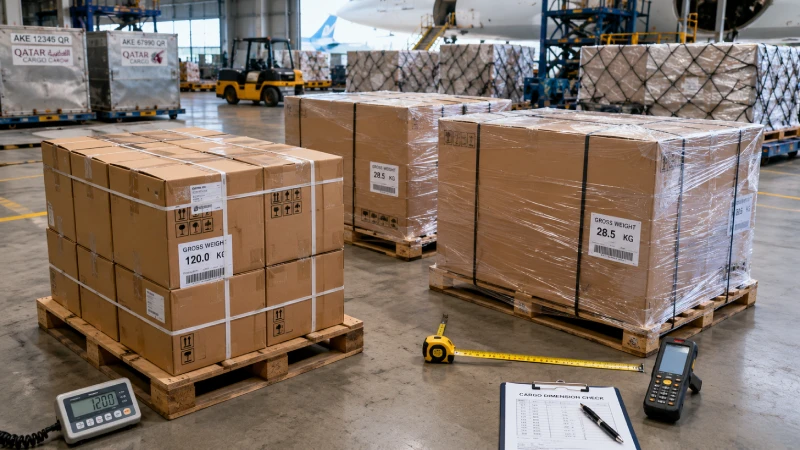
Actual weight refers to the physical gross weight of the shipment.
Examples include:
- Automotive components
- Industrial machinery parts
- Hardware products
- Metal fittings
Because these products are dense and compact, their actual weight is usually higher than their volumetric weight.
In such cases, airlines charge based on actual weight.
Volumetric Weight
Volumetric weight measures the amount of space cargo occupies inside an aircraft.
The standard formula used by most airlines is:
Dimensions are measured in centimeters.
Example Calculation
Imagine your supplier provides the following carton specifications:
- Length: 60cm
- Width: 50cm
- Height: 40cm
- Actual Weight: 12kg
The volumetric weight becomes:
Although the carton physically weighs only 12kg, the airline will charge for 20kg because the shipment occupies space equivalent to 20kg of dense cargo.
Your freight quote is therefore based on 20kg rather than 12kg.
For many first-time importers, this is where budget calculations begin to deviate from reality.
Which Products Usually Have High Volumetric Weight?
Some product categories are particularly vulnerable to volumetric pricing.
Products Often Penalized by Volume
Examples include:
- LED lighting products
- Plastic containers
- Toys
- Packaging materials
- Promotional displays
- Cushions and pillows
These products contain a large amount of air relative to their weight.
Even when physical weight appears low, shipping costs may be surprisingly high because airlines charge for occupied space.
Products Typically Charged by Actual Weight
Dense products perform much better under air freight economics.
Examples include:
- Metal hardware
- Industrial components
- Bearings
- Automotive parts
- Machine accessories
Because these products are compact and heavy, actual weight usually exceeds volumetric weight.
As a result, freight costs are more predictable.
The Sample Shipment Trap
Many Qatar buyers make budget decisions based on sample shipments.
This can be misleading.
A single sample box often has:
- Different packaging
- Different dimensions
- Different airline pricing brackets
A sample costing $100 to ship does not necessarily mean production orders will scale proportionally.
Always calculate freight costs using production packaging specifications rather than sample shipments.
How Airlines Build Freight Rates to Qatar
Once chargeable weight is determined, airlines apply freight rates.
Basic Air Freight Formula
The most common calculation is:
For example:
- Chargeable Weight: 200kg
- Freight Rate: $5/kg
Estimated Freight Cost:
While simple in principle, freight rates constantly fluctuate.
Why Rates Change Every Week
Air freight pricing depends on market conditions such as:
- Airline capacity
- Fuel costs
- Holiday demand
- E-commerce volumes
- Seasonal import activity in Qatar
Rates during peak seasons can be substantially higher than off-season periods.
This is why freight quotations should always be considered time-sensitive.
Why Larger Shipments Often Receive Lower Rates
Airlines typically offer pricing breaks at certain weight levels.
Common thresholds include:
- 45kg+
- 100kg+
- 300kg+
- 500kg+
A shipment weighing 120kg may receive a lower per-kilogram rate than a shipment weighing 30kg.
Understanding these brackets can help buyers consolidate orders and reduce logistics costs.
A Practical Method to Estimate Freight Costs Before Ordering
Instead of waiting for a freight quote after production, importers can estimate costs during supplier negotiations.
Step 1: Request Packaging Information
Ask suppliers for:
- Carton dimensions
- Number of cartons
- Gross carton weight
Without packaging information, freight forecasting is almost impossible.
Step 2: Calculate Chargeable Weight
Use the following process:
Supplier Packaging Data
↓
Actual Weight
↓
Volumetric Weight
↓
Compare Both Values
↓
Determine Chargeable Weight
This single step dramatically improves budgeting accuracy.
Step 3: Apply Current Market Rates
Suppose your calculations show:
- Chargeable Weight: 250kg
- Market Rate: $4.80/kg
Estimated Freight Cost:
You now have a realistic transportation budget before placing the order.
Step 4: Calculate Cost Per Product
Assume:
- Freight Cost: $1,200
- Quantity: 1,000 Units
Freight Cost Per Unit:
This number is far more useful than simply knowing the freight cost per kilogram.
It allows buyers to evaluate product profitability directly.
Landed Cost Forecasting for Qatar Importers
Freight cost should never be viewed in isolation.
The real objective is understanding how logistics impacts overall product economics.
Freight Cost as a Percentage of Product Value
Consider three products:
| Product Value | Freight Impact |
|---|---|
| $2 Item | Very High |
| $50 Item | Moderate |
| $500 Item | Low |
A $1 freight cost may destroy profitability for a low-value product but have little impact on premium goods.
This is why sourcing decisions should always include logistics analysis.
When Freight Makes a Product Uncompetitive
Many products appear profitable at factory price but become difficult to sell after transportation costs are added.
Before committing to suppliers, calculate:
- Factory cost
- Freight cost
- Customs charges
- Local delivery expenses
Only then can you accurately evaluate profitability.
Three Numbers Every Importer Should Know
Before placing an order, calculate:
- Freight Cost Per Unit
- Estimated Landed Cost Per Unit
- Expected Selling Margin
These three metrics determine whether a sourcing project is commercially viable.
Common Cost Estimation Mistakes Made by Qatar Buyers
Using Product Weight Instead of Carton Weight
Product weight often excludes packaging.
Airlines charge based on shipped cargo, not the product alone.
Ignoring Volumetric Weight
This is the most common budgeting mistake.
A lightweight shipment may end up costing significantly more than expected due to large carton dimensions.
Using Sample Freight as a Benchmark
Production orders often have completely different packaging configurations.
Sample freight should never be used as the primary basis for forecasting future costs.
Forgetting Destination Expenses
Air freight charges are only part of total logistics costs.
Importers should also budget for:
- Customs clearance
- Handling fees
- Local transportation
Ignoring these expenses can distort landed cost calculations.
How to Reduce Air Freight Cost Per KG
Improve Packaging Density
Reducing empty space inside cartons lowers volumetric weight and improves freight efficiency.
Small packaging improvements often generate substantial savings.
Consolidate Shipments
Larger consolidated shipments may qualify for better airline pricing brackets.
Combining multiple orders can reduce average freight cost per kilogram.
Optimize Packaging During Product Development
Packaging decisions made before production often have a larger impact on freight costs than buyers realize.
A more compact carton design can reduce logistics expenses for every future shipment.
Compare Different Departure Airports
Freight rates may vary depending on departure airport.
Major Chinese cargo hubs such as:
- Air Freight from China to Qatar
- Door to Door Shipping from China to Qatar
often provide alternative routing options that influence final pricing.
Discussing airport options with your freight forwarder can uncover additional savings opportunities.
Conclusion
When importing from China to Qatar, the most important number is not the freight rate itself—it is the chargeable weight.
Many buyers focus on product weight and overlook the role of volumetric calculations, leading to inaccurate budgets and unexpected shipping costs.
Before placing an order, always calculate:
- Actual Weight
- Volumetric Weight
- Chargeable Weight
- Freight Cost Per Unit
By understanding how airlines price cargo and forecasting logistics expenses early, importers can evaluate sourcing opportunities more accurately, protect profit margins, and make smarter purchasing decisions.
For a complete logistics strategy, buyers should also review Shipping from China to Qatar, LCL Shipping from China to Qatar, and FCL Shipping from China to Qatar to determine the most cost-effective transportation solution for their business.
