
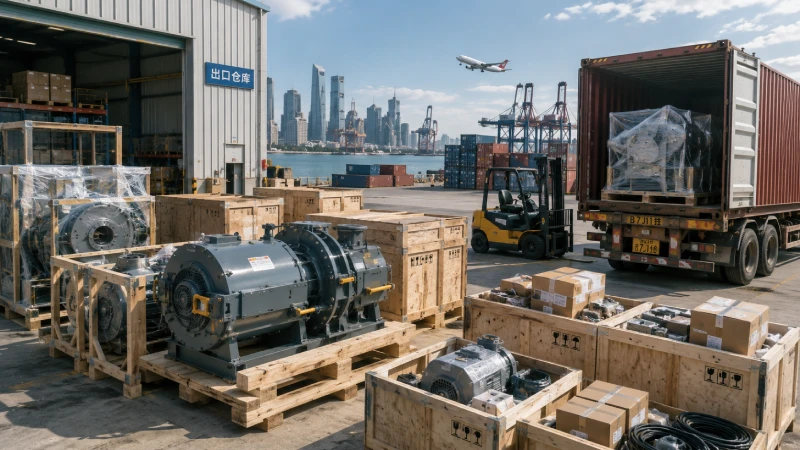
For Qatar businesses sourcing machines, production systems, workshop equipment, or replacement units through Shipping from China to Qatar, the biggest risk is not always the freight cost. In many industrial operations, delayed equipment means stopped production, idle workers, missed installation windows, or expensive emergency repairs. A machine may be shipped only once, but its availability can affect daily output for months or years. That is why shipping industrial equipment from China to Qatar should be planned as a production continuity decision, not just a transportation task.
Industrial equipment logistics is different from shipping ordinary commercial goods. A delayed container of consumer products may affect sales. A delayed machine, missing motor, damaged control panel, or unavailable spare part can stop an entire line. For manufacturers, contractors, maintenance teams, and industrial service providers in Qatar, the real question is not only “How much does shipping cost?” The more important question is: “How can we make sure the equipment is available when production needs it?”
Why Industrial Equipment Shipping Is a Production Continuity Decision
When a company imports industrial equipment from China, the shipment often supports a wider operational plan. The equipment may be required for a new production line, a plant upgrade, a repair project, or replacement of an aging machine. If the shipment arrives late, the impact can spread across purchasing, production, installation, maintenance, and customer delivery schedules.
This is why industrial equipment logistics should be evaluated by availability risk. A lower freight rate may look attractive at the quotation stage, but if the route is unreliable, documentation is incomplete, or spare parts are missing, the final cost can be much higher than the shipping charge itself. Downtime can include labor waiting time, delayed project handover, lost production capacity, urgent air freight for missing parts, and additional coordination with suppliers.
For Qatar importers, the goal should be simple: the equipment, accessories, documents, and spare parts should all be ready before they are needed on site.
Classify Equipment by Operational Importance Before Shipping
Not every piece of industrial equipment requires the same shipping strategy. Before choosing sea freight, air freight, FCL, LCL, or split shipment, importers should first identify how important the equipment is to daily operations.
A production-critical machine requires a more controlled shipping plan than auxiliary workshop equipment. A replacement motor that keeps an existing line running may justify air freight, while non-urgent tools can be consolidated with larger shipments. The logistics plan should match the business risk.
| Equipment Type | Operational Risk | Recommended Logistics Priority |
|---|---|---|
| Production-critical machine | Very high | Fastest reliable route with full tracking |
| Replacement equipment | High | Controlled schedule and early documentation |
| Expansion equipment | Medium | Balance cost, timing, and installation plan |
| Auxiliary equipment | Medium to low | Consolidation may be acceptable |
| Spare parts | High if urgent | Air freight or separate priority shipment |
This classification helps importers avoid overpaying for non-urgent cargo while still protecting the items that can stop production.
Plan Around the Full Equipment Availability Timeline
Many importers make the mistake of planning only around vessel transit time. For industrial equipment, this is too narrow. The real timeline starts before the cargo leaves the Chinese supplier and ends only when the equipment is ready for use in Qatar.
A practical equipment timeline should include supplier production time, factory testing, export packaging, inland trucking in China, customs documents, freight transit, Qatar customs clearance, final delivery, unloading, and installation preparation. If any step is delayed, the equipment may not be available when the operation needs it.
For example, a machine may have a 25-day sea freight transit time, but the total availability timeline could be 50–70 days when supplier lead time, packing, booking, export handling, clearance, and site delivery are included. Importers should also build buffer time for inspection, crating, documentation review, and delivery coordination.
A simple planning model is:
Total Equipment Availability Timeline = Supplier Lead Time + Testing + Packaging + Export Handling + Freight Transit + Customs Clearance + Site Delivery
This approach helps Qatar buyers plan based on operational readiness rather than only shipping duration.
Choose the Shipping Method Based on Downtime Risk
The best shipping method depends on cargo size, urgency, budget, and downtime risk. For planned equipment purchases, sea freight is usually the most economical option. Large machines, production systems, heavy equipment, and crated industrial cargo are commonly shipped by container or as special cargo depending on dimensions and weight.
For equipment that fits into a full container, FCL shipping from China to Qatar is often preferred because it provides better control over loading, fewer handling points, and more predictable coordination. FCL is especially useful when the equipment includes multiple crates, accessories, spare parts, and tools that should move together.
LCL can be suitable for smaller industrial components, replacement parts, tools, or accessories that do not justify a full container. However, for sensitive or urgent equipment, LCL shipping from China to Qatar should be used carefully because cargo may pass through more consolidation and handling points.
Air freight is usually not practical for very large equipment, but it can be valuable for urgent spare parts, control boards, sensors, motors, belts, or replacement components. If a small part can stop a large machine, the air freight cost may be far lower than the cost of downtime.
In many cases, the best solution is a split shipment strategy. The main equipment can move by sea, while urgent components, installation tools, or critical spare parts move by air. This allows the importer to control cost while reducing the risk of production delay.
Manage Spare Parts Before the Main Equipment Arrives
Spare parts logistics is one of the most important parts of industrial equipment shipping. A machine can arrive safely, but if one sensor, control board, belt, motor, blade, or connector is missing, installation or production may still be delayed.
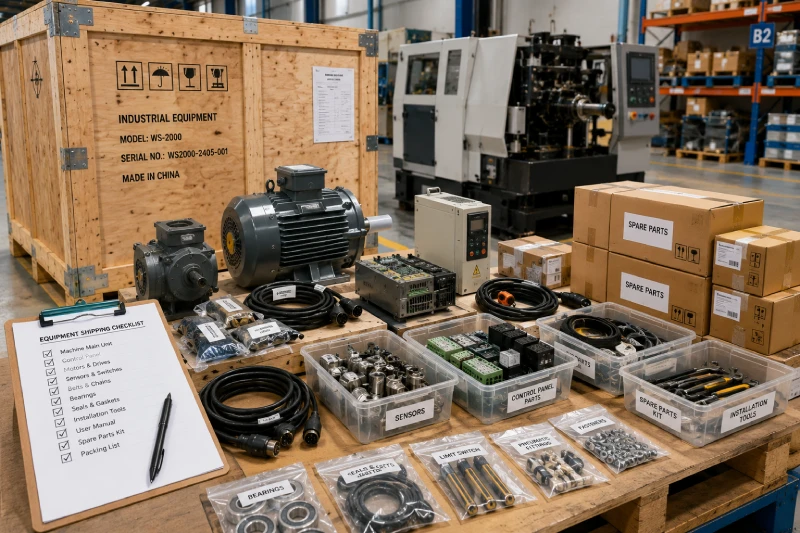
Before shipping, Qatar importers should request a critical spare parts list from the Chinese supplier. This list should identify the components most likely to wear out, fail during operation, or be needed during installation. It should also show part numbers, model compatibility, recommended stock levels, and replacement frequency.
Some spare parts should be shipped with the main equipment, while others may need separate priority shipping. For example, heavy accessories can move with the container, but small production-critical items may be better shipped by air, especially when installation deadlines are tight.
| Spare Part Type | Shipping Recommendation | Reason |
|---|---|---|
| Sensors and switches | Air freight if urgent | Small but production-critical |
| Motors and drives | Sea or air depending on urgency | Can stop machine operation |
| Belts, blades, seals | Consolidated or air freight | Common wear parts |
| Control boards | Air freight with protective packing | High value and fragile |
| Installation tools | Ship with equipment or separately | Needed before commissioning |
Spare parts should also be clearly labeled. Each box should include the part number, equipment model, quantity, and usage description. If multiple machines are shipped together, spare parts should be matched to the correct machine to avoid confusion after arrival.
Avoid Production Delays Caused by Documentation Problems
Documentation is often treated as a customs issue, but for industrial equipment it is also a production continuity issue. If documents are incomplete or inconsistent, the cargo may be delayed during clearance, even if the equipment has already arrived in Qatar.
Important documents may include the commercial invoice, packing list, bill of lading or air waybill, product description, HS code reference, model number, serial number, brand information, technical specifications, country of origin details, and end-use description.
For industrial equipment, vague descriptions can create problems. A document that only says “machine” or “equipment” may not provide enough clarity. It is better to describe the equipment accurately, including what it does, how it is used, and whether accessories or spare parts are included.
The packing list should also match the actual shipment. If there are wooden crates, accessory boxes, spare parts cartons, and tools, each package should be listed clearly. This reduces confusion during customs clearance, warehouse handling, and site receiving.
The goal is not only to pass customs. The goal is to prevent paperwork from delaying equipment availability.
Packaging and Loading Should Support Fast Installation
Industrial equipment packaging should protect the cargo during international transport, but it should also make unloading and installation easier after arrival. Poor packaging can lead to damaged components, missing accessories, extra inspection time, and delayed commissioning.
For heavy or sensitive equipment, exporters may use wooden crates, steel frames, anti-rust protection, moisture barriers, shock-resistant materials, or reinforced pallets. Cargo should also be marked with lifting points, center of gravity, forklift positions, and handling instructions.
If the equipment is expensive or sensitive, importers may also need photos before loading. These can show packaging condition, crate markings, accessory boxes, and container loading. For higher-value machinery, the risk-control methods discussed in shipping machinery from China to Qatar can also support better cargo protection.
Accessories should never be packed randomly. Installation tools, cables, spare parts, manuals, and control components should be grouped logically and labeled by machine. This helps the Qatar receiving team find the right parts quickly and avoid wasting time after delivery.
Use Maintenance Data to Plan Future Reorders
Industrial equipment shipping should not end after the first delivery. If the equipment is important to production, the importer should also plan future spare parts replenishment.
Maintenance records, supplier recommendations, and usage frequency can help determine which parts should be kept in Qatar and which parts can be ordered only when needed. If a component takes 30–45 days to produce and ship from China, keeping only one unit in stock may be risky if failure can stop production.
A simple spare parts planning method is:
Reorder Point = Average Usage During Lead Time + Safety Stock
For example, if a factory uses certain belts, blades, seals, or sensors regularly, those items should not be reordered only after the last unit is used. Importers should consider supplier lead time, freight time, customs clearance, and internal approval time.
For urgent small parts, buyers may compare air freight costs using shipping cost per KG from China to Qatar. For larger crated parts or bulky accessories, shipping cost per CBM from China to Qatar may be more useful for estimating sea freight or LCL costs.
Build a Continuity-Based Shipping Timeline
A strong shipping plan should start weeks before the equipment is needed. The following timeline can help Qatar importers reduce last-minute pressure.
Six to eight weeks before the required date, confirm the equipment specifications, supplier production schedule, testing plan, spare parts list, packing method, and import documentation requirements.
Four to six weeks before the required date, review the freight method, container requirement, loading plan, commercial invoice, packing list, and cargo dimensions. If the shipment includes heavy crates or oversized cargo, confirm lifting and inland trucking arrangements early.
Two to four weeks before arrival, prepare Qatar-side customs documents, site delivery access, unloading equipment, forklift or crane support, and installation team availability.
During arrival week, track customs clearance, inspect packaging before unloading, match accessories and spare parts against the packing list, and confirm whether any urgent components need follow-up shipping.
This timeline helps prevent a common problem: the equipment arrives, but the site is not ready to receive, unload, inspect, or install it.
How to Reduce Emergency Shipments
Emergency air freight is sometimes necessary. If a machine breaks down and production has already stopped, a small replacement part may need to move as quickly as possible. However, frequent emergency shipments usually indicate weak planning.
Qatar importers can reduce emergency shipments by keeping critical spare parts locally, forecasting maintenance needs, consolidating planned parts with larger equipment shipments, and preparing standard shipping information in advance. HS code references, product descriptions, supplier contacts, part numbers, and packing details should be ready before a breakdown happens.
The best emergency strategy is prevention. When spare parts are planned properly, air freight becomes a backup option rather than a regular operating cost.
Working With a Freight Partner for Industrial Equipment Continuity
A freight partner for industrial equipment should do more than provide a shipping price. For production-critical cargo, the forwarder should help coordinate with suppliers, review cargo information, compare shipping options, check documents, plan pickup, arrange container loading, monitor the shipment, and support Qatar delivery coordination.
Winsail Logistics can help Qatar importers plan equipment and spare parts shipments from China based on urgency, cargo size, operational importance, and delivery requirements. Whether the shipment involves a full container, urgent spare parts by air, LCL accessories, or a split shipment plan, the main objective is the same: reduce disruption and keep operations running.
Industrial Equipment Shipping Checklist for Qatar Importers
Before shipping industrial equipment from China to Qatar, importers should ask:
- Is the equipment production date confirmed?
- Is the equipment needed for active production?
- Are critical spare parts identified?
- Should any parts be shipped separately by air?
- Are accessories packed and labeled by machine?
- Are model numbers and serial numbers listed correctly?
- Is the shipping method based on downtime risk?
- Is the Qatar site ready for unloading?
- Are forklifts, cranes, or special handling tools required?
- Is there enough buffer time before installation or production start?
If the answer to any of these questions is unclear, the shipment may carry hidden production risk.
FAQs
What is the best shipping method for industrial equipment from China to Qatar?
For planned equipment imports, sea freight is usually the most cost-effective choice. FCL is preferred when the equipment can fit into a container and the importer wants better control. Air freight is mainly used for urgent spare parts or smaller production-critical components.
How can I avoid downtime when importing equipment from China?
Start planning early, confirm supplier lead time, prepare documents before shipment, identify critical spare parts, and choose the shipping method based on operational risk. If certain parts are needed urgently, consider split shipment by air and sea.
Should spare parts be shipped with the main equipment?
Some spare parts should be shipped with the equipment, especially installation parts, accessories, and maintenance items. However, urgent or production-critical spare parts may need separate air shipment if the main equipment is moving by sea.
Is FCL better than LCL for industrial equipment?
FCL is often better for larger or sensitive industrial equipment because it reduces handling and improves container control. LCL can work for smaller parts, accessories, or non-urgent industrial components.
Why is documentation important for industrial equipment shipping?
Incorrect or incomplete documents can delay customs clearance and postpone equipment availability. Industrial equipment documents should include accurate descriptions, model numbers, serial numbers, packing details, and technical information when needed.
Can Winsail Logistics help with spare parts and equipment shipments?
Yes. Winsail Logistics can support industrial equipment shipping from China to Qatar, including sea freight, air freight, FCL, LCL, split shipments, spare parts logistics, document checking, and Qatar delivery coordination.
