

For importers already planning regular Shipping from China to Qatar, battery cargo needs a different level of preparation from ordinary commercial goods. Batteries are not only evaluated by weight, volume, transit time, or freight rate. They must also be checked for dangerous goods classification, documentation, packing method, carrier acceptance, and destination handling. Whether you are importing lithium batteries, power banks, solar storage batteries, automotive batteries, UPS batteries, or electronic products with built-in batteries, the safest shipping plan starts before cargo pickup in China.
Battery shipments can move from China to Qatar, but not every battery can move by every route or every carrier. The key question is not simply “How much does it cost?” The better question is: “Is this battery cargo correctly classified, documented, packed, declared, and accepted by the carrier?” If the answer is unclear, the shipment may be rejected at the warehouse, delayed before departure, or held for additional review.
This guide explains how Qatar importers can manage battery shipments safely and compliantly, with a practical focus on DG classification, required documents, air and sea freight options, carrier restrictions, and shipment risk control.
Can Batteries Be Shipped from China to Qatar?
Yes, batteries can be shipped from China to Qatar, but the shipping method depends on the battery type, chemistry, capacity, packing method, and dangerous goods classification. A small electronic product with a battery installed inside may be handled differently from a carton of standalone lithium-ion batteries. A solar storage battery system will not be managed the same way as button cells or automotive batteries.
For this reason, importers should avoid treating battery cargo as general electronics. Many shipment problems happen because the product description is too vague. For example, “electronic accessories” may not be enough if the cargo contains lithium batteries. The forwarder and carrier need to know whether the batteries are shipped alone, packed with equipment, or contained in equipment.
Before requesting a freight quote, importers should prepare basic cargo information: battery type, UN number if available, MSDS, UN38.3 test summary for lithium batteries, invoice, packing list, carton dimensions, gross weight, product photos, and delivery address in Qatar. With this information, a freight forwarder can check whether air freight, sea freight, LCL, FCL, or DDP is realistic.
Why Battery Cargo Requires Dangerous Goods Management
Battery cargo creates transport risks if it is not packed, labeled, and declared correctly. The main risks include short circuit, overheating, fire, leakage, swelling, carton damage, and incorrect handling. These risks are especially important in air cargo because airline safety requirements are strict and carrier acceptance may be limited.
For Qatar importers, dangerous goods management is also a business risk control issue. Poor preparation can lead to booking cancellation, export warehouse rejection, additional re-packing costs, missed delivery deadlines, or delayed customs clearance. If the cargo is for a retail launch, construction project, solar installation, maintenance operation, or urgent replacement order, even a short delay can become expensive.
That is why battery shipments should be reviewed before cargo leaves the supplier’s factory. A reliable forwarder should not wait until the goods arrive at the airport or seaport to discover missing documents or incorrect packaging.
| Importer Risk | Possible Result |
|---|---|
| Battery type is unclear | Wrong DG classification or booking rejection |
| Supplier provides generic MSDS | Document review delay |
| UN38.3 test summary is missing | Lithium battery shipment may not be accepted |
| Cargo is booked as ordinary goods | Compliance risk and possible rejection |
| Packaging is weak | Short circuit, damage, or repacking cost |
| Carrier approval is not checked | Shipment may be refused before departure |
Identify the Battery Type First
The first step is to identify what kind of battery is being shipped. Battery chemistry and packing method affect the shipping plan.
Lithium-ion batteries are common in rechargeable products such as power banks, laptops, mobile devices, e-bike batteries, solar energy storage products, portable tools, and many consumer electronics. These shipments usually require careful review of watt-hour rating, packaging, battery condition, and whether the battery is standalone or installed in a product.
Lithium metal batteries are often used in button cells, sensors, meters, medical devices, tracking devices, and some industrial products. They are not handled exactly the same way as lithium-ion batteries, so importers should not assume the same document or packing rules apply.
Lead-acid batteries are common in automotive, UPS, backup power, and industrial applications. These may involve different concerns such as leakage prevention, spillable or non-spillable classification, corrosion risk, pallet stability, and heavy cargo handling.
Battery-powered equipment can also require review. Even if the battery is not shipped separately, the equipment may still need correct declaration and packaging. This is common for machinery, testing devices, scooters, power tools, and solar equipment.
For related electronic products, importers can also review Shipping Electronics from China to Qatar, but battery cargo should always be treated as a higher-risk category.
DG Classification and UN Numbers
Dangerous goods classification is the foundation of the shipment plan. The UN number helps carriers understand what type of battery cargo is being transported and what handling requirements may apply.
| Cargo Situation | Common UN Number | Importer Meaning |
|---|---|---|
| Lithium-ion batteries shipped alone | UN3480 | Usually stricter approval and packaging control |
| Lithium-ion batteries packed with equipment | UN3481 | Battery and equipment move together |
| Lithium-ion batteries contained in equipment | UN3481 | Battery is installed inside the product |
| Lithium metal batteries shipped alone | UN3090 | Requires strict document and packing review |
| Lithium metal batteries packed with equipment | UN3091 | Must be declared correctly |
| Lithium metal batteries contained in equipment | UN3091 | Still needs classification review |
| Battery-powered vehicles or equipment | UN3171 or other applicable entry | Classification depends on product design |
The forwarder should verify classification based on the actual product, not only the supplier’s product name. For example, “battery pack,” “energy storage unit,” and “portable power station” may sound similar in commercial language, but the shipping requirements can be different.
Documents Required for Battery Shipping
Documentation is one of the most common reasons battery shipments are delayed. A normal shipment may only need invoice, packing list, and consignee details. Battery cargo usually needs additional dangerous goods documents.
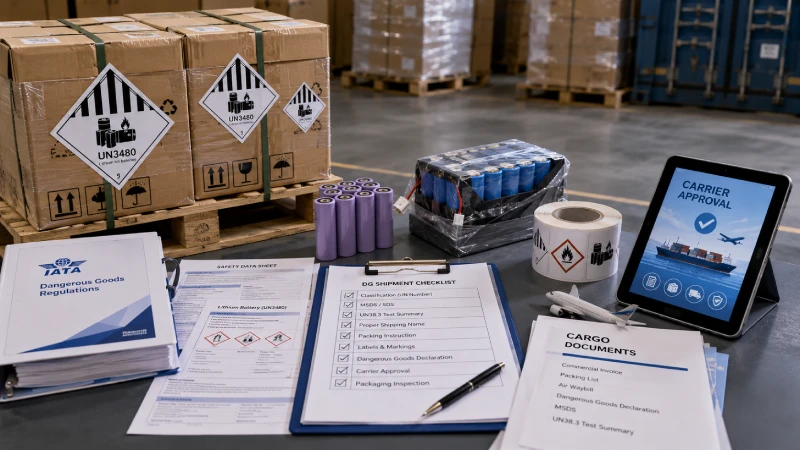
Core commercial documents include the commercial invoice, packing list, HS code, product description, consignee details in Qatar, and delivery address. The product description should clearly mention the battery or battery-powered nature of the goods where applicable.
Dangerous goods documents may include MSDS or SDS, UN38.3 test summary for lithium batteries, battery specification sheet, Dangerous Goods Declaration when required, product photos, label photos, packing certificate if required, and emergency contact details.
Importers should ask the Chinese supplier for these documents before final payment or pickup arrangement. If the supplier cannot provide product-specific documents, the shipment should be reviewed carefully before booking.
A practical pre-check should include:
- Is the battery chemistry clearly stated?
- Is the battery shipped alone, packed with equipment, or contained in equipment?
- Is the MSDS product-specific?
- Is the UN38.3 test summary available for lithium batteries?
- Do the invoice and packing list match the actual cargo?
- Are carton dimensions and gross weight confirmed?
- Are battery labels and package marks clear?
- Has the carrier accepted this cargo type before booking?
Air Freight Batteries from China to Qatar
Air freight is useful when the shipment is urgent, small, high-value, or needed for immediate replacement. For example, a Qatar importer may use air freight for battery-powered electronics, urgent spare battery modules, testing samples, or small batches of commercial products.
However, air freight is also more restrictive. Not every airline accepts every type of battery cargo. Standalone lithium batteries may require prior approval, stricter documentation, and specific packing controls. Some cargo may need cargo-aircraft-only routing depending on classification and packing rules.
For this reason, importers should not compare air freight only by price and transit time. The real decision is whether the airline can accept the cargo safely and whether documents are ready before cutoff.
| Air Freight Factor | Why It Matters |
|---|---|
| Airline acceptance | Some battery types need prior approval |
| DG documents | Missing documents can stop the booking |
| Packing method | Must prevent short circuit and movement |
| Cargo description | Vague descriptions increase inspection risk |
| Warehouse review | DG cargo may need earlier receiving time |
| Transit planning | Routing may be limited by carrier rules |
For urgent cargo, Winsail can help evaluate whether Air Freight from China to Qatar is suitable before the shipment is picked up from the supplier.
Sea Freight Batteries from China to Qatar
Sea freight is often more practical for larger battery shipments, regular inventory, solar storage products, automotive battery products, and industrial power systems. It may provide more flexibility than air freight, especially when the shipment is heavy, bulky, or not extremely urgent.
LCL can be possible for some battery cargo, but it depends on DG compatibility, co-loader rules, and carrier acceptance. Because LCL cargo is consolidated with other shipments, dangerous goods review is important. The forwarder must confirm whether the cargo can be accepted before delivery to the CFS warehouse.
FCL is usually better for larger battery shipments because the container is controlled by one shipper. This can reduce consolidation complexity and provide better packaging, labeling, loading, and risk control. For solar batteries, storage systems, or regular commercial battery inventory, FCL Shipping from China to Qatar may be more stable than LCL.
For smaller battery-related shipments, importers can still compare LCL Shipping from China to Qatar, but they should confirm DG acceptance before assuming LCL is available.
Carrier Restrictions Must Be Checked Before Pickup
Battery shipments are not accepted automatically. Even if the cargo is legally shippable, a specific airline, shipping line, co-loader, warehouse, or terminal may still refuse it based on internal rules.
Carrier approval should happen before cargo pickup. The forwarder should review documents, confirm the UN number, check packing details, and submit the shipment to the carrier or airline for approval when required. If approval is requested after the cargo reaches the warehouse, the importer may face storage charges, re-delivery costs, or booking delays.
A safer workflow is:
- Confirm battery type and packing method
- Collect MSDS, UN38.3, invoice, packing list, and photos
- Review DG classification
- Check air or sea carrier acceptance
- Confirm booking and DG surcharge
- Arrange pickup in China
- Verify labels, marks, and package condition
- Ship to Qatar under the approved plan
This is why battery importers should choose a forwarder experienced in Dangerous Goods Shipping from China rather than only looking for the lowest freight rate.
Packaging and Risk Control
Packaging is not only a supplier responsibility. It directly affects whether the shipment can be accepted and transported safely.
Battery packaging should prevent short circuits, protect terminals, reduce movement inside cartons, and keep products stable during handling. Cartons should be strong enough for stacking, and pallets should be wrapped and labeled properly. Heavy battery cartons should not be loaded in a way that causes compression damage or imbalance.
Importers should be especially careful with damaged, swollen, leaking, used, returned, prototype, or recalled batteries. These may require special review and may not be accepted under standard shipping arrangements.
For battery-powered products, the device should be protected against accidental activation. For standalone batteries, terminals should be insulated or otherwise protected. For heavy battery modules, pallet stability and forklift handling should be planned in advance.
Qatar Import and Delivery Considerations
Once the shipment arrives in Qatar, documentation must remain consistent. The invoice, packing list, airway bill or bill of lading, DG documents, and product description should not conflict with each other. Vague descriptions such as “parts,” “accessories,” or “electronics” can create problems when the cargo contains batteries.
Qatar importers should also confirm whether the product category requires additional compliance documents beyond freight documents. Battery-powered consumer products, automotive parts, industrial equipment, and solar energy systems may have different import considerations.
For broader cost planning, importers can review Shipping Cost from China to Qatar, but battery shipments should include DG review time, possible DG surcharge, special handling cost, and carrier approval time in the budget.
Air, Sea, or DDP: Which Option Is Better?
The best method depends on urgency, battery type, shipment size, documents, and carrier acceptance.
| Shipping Option | Best For | Main Limitation |
|---|---|---|
| Air Freight | Urgent samples, small high-value shipments | Strict approval and DG limits |
| Sea Freight LCL | Small non-urgent cargo if accepted | DG consolidation restrictions |
| Sea Freight FCL | Larger battery orders and regular inventory | Longer transit time |
| DDP Shipping | Importers needing delivery coordination | DG compliance still required |
| Project Cargo | Large energy storage or industrial battery systems | Requires early planning |
Some importers ask whether DDP Shipping from China to Qatar can simplify battery shipments. DDP may be possible for certain battery cargo, but it should never be treated as a shortcut around dangerous goods rules. The cargo still needs correct classification, documents, packing, carrier acceptance, and compliant handling.
Common Mistakes When Shipping Batteries
The most common mistake is declaring battery cargo as ordinary electronics. This may look easier at the beginning, but it creates a much higher risk of rejection later.
Another mistake is booking air freight before checking airline acceptance. Some importers only discover restrictions after cargo has already arrived at the airport warehouse. This causes delays and extra costs.
Suppliers may also provide generic MSDS files that do not match the actual product. This can create problems during document review. Importers should request product-specific documents and check whether the model number, battery type, and technical details match the shipment.
Other common mistakes include missing UN38.3 test summaries, weak export cartons, unclear product descriptions, mixed cargo without DG review, and choosing LCL without confirming consolidation acceptance.
How Winsail Logistics Helps
Winsail Logistics helps Qatar importers manage battery shipments from the preparation stage, not only after cargo is ready. Our team can review battery type, cargo details, MSDS, UN38.3 documents, packing list, invoice, carton dimensions, and delivery requirements before recommending a shipping solution.
Depending on the shipment, we can help compare air freight, sea freight, LCL, FCL, or DDP options. We also coordinate with carriers to check DG acceptance, advise on packaging and labeling, arrange pickup in China, manage export handling, and support delivery planning in Qatar.
If you need to ship batteries from China to Qatar, send us your MSDS, UN38.3 test summary, invoice, packing list, product photos, carton size, gross weight, and Qatar delivery address. Winsail Logistics will help review the cargo and recommend a safer shipping plan based on your battery type and timeline.
FAQs
Can lithium batteries be shipped from China to Qatar?
Yes, lithium batteries can often be shipped from China to Qatar, but they must be classified, documented, packed, and accepted by the carrier correctly.
Can I ship batteries by air freight to Qatar?
Air freight may be available for some battery shipments, especially urgent or high-value cargo, but airline approval and dangerous goods documents may be required.
Is sea freight better for battery shipments?
Sea freight is often better for larger battery shipments, solar storage products, automotive batteries, and non-urgent inventory because it can offer more flexibility and better cargo control.
What documents are needed for battery shipping?
Common documents include invoice, packing list, MSDS, UN38.3 test summary for lithium batteries, battery specification sheet, product photos, and Dangerous Goods Declaration when required.
Can batteries be shipped by DDP to Qatar?
DDP may be possible for certain battery cargo, but DG requirements still apply. The shipment must still be classified, packed, declared, and accepted properly.
Why are battery shipments rejected?
Battery shipments are commonly rejected because of missing documents, incorrect UN numbers, weak packaging, unclear cargo descriptions, or lack of carrier approval.
What information should I provide for a battery freight quote?
Provide battery type, MSDS, UN38.3 report, invoice, packing list, carton dimensions, gross weight, product photos, shipping address in China, and delivery address in Qatar.
