
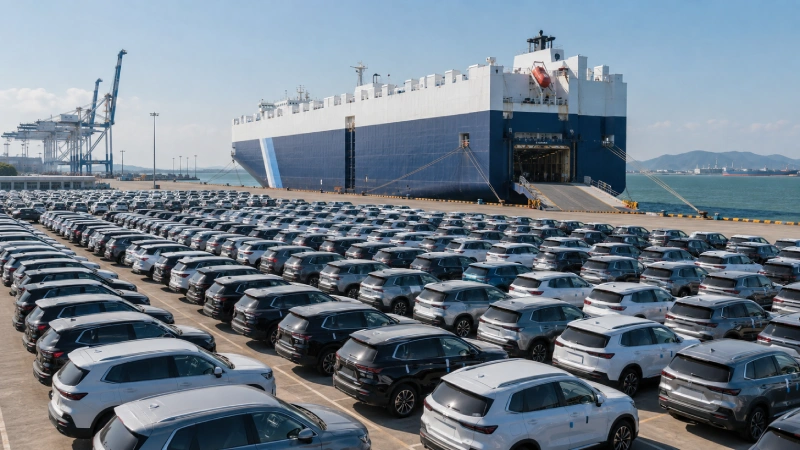
Vehicles can be shipped from China by RoRo, container, rail, road, air freight or specialized project transport. The correct method depends on vehicle type, condition, propulsion system, dimensions, route and destination-country rules.
Before booking, confirm four separate issues: China export eligibility, carrier and terminal acceptance, destination import permission, and local clearance and registration. Approval at one stage does not guarantee approval at the next.
What Does Vehicle Shipping from China Include?
Vehicle purchase, export and transport are different services. The seller supplies the vehicle. An eligible exporter handles the applicable export procedure. A freight forwarder coordinates pickup, storage, booking, loading, customs and transport documents. The importer and destination agent handle local clearance, taxes, inspection, registration and delivery.
| Approval layer | Question to answer |
|---|---|
| China export eligibility | Can this vehicle and exporter complete the required procedure? |
| Carrier and terminal acceptance | Will the selected line, vessel and ports accept it? |
| Destination import eligibility | Is the vehicle legally importable? |
| Local clearance and registration | Can it be cleared, inspected and registered? |
A vehicle that can leave China may still be refused registration at destination.
What Types of Vehicles Can Be Shipped from China?
China vehicle export logistics can cover new and used cars, SUVs, pickups, vans, motorcycles, ATVs, golf carts, trucks, buses, construction equipment, agricultural machinery and special-purpose vehicles. Petrol, diesel, battery-electric, hybrid, plug-in hybrid and fuel-cell vehicles may require different booking information and safety reviews.
| Vehicle condition | First logistics question |
|---|---|
| New | Are exporter eligibility and model documents complete? |
| Used | Do ownership, registration and inspection records match? |
| EV | What battery classification and carrier approval apply? |
| Non-running | Can the terminal tow or lift it safely? |
| Damaged | Could accident, fire, flood or battery damage cause rejection? |
| Oversized | Is RoRo, flat rack, breakbulk or project transport required? |
All abnormal conditions must be disclosed before quotation.
Check Destination Import Eligibility Before Buying
The costliest mistake is buying a vehicle before confirming that it can be imported and registered. Ask a licensed destination broker or authority to verify:
- Vehicle age or manufacturing-date limits
- Left-hand-drive or right-hand-drive rules
- Emissions, safety and roadworthiness standards
- Restrictions on used, damaged or salvage vehicles
- Importer licences, permits and type approval
- Duties, VAT, excise tax and registration charges
China-specification vehicles also require practical checks: charging connector and voltage, infotainment language, navigation and connected services, radio compatibility, warranty validity, diagnostic tools, software support and spare-parts availability.
This guide does not publish fixed country tax rates or age limits because they change and belong in regularly updated destination guides. “Exportable from China” does not mean “road-legal at destination.”
China Vehicle Export Requirements and 2026 Rules
New Vehicle Export Licensing
China may require vehicle exports to be handled through an enterprise meeting the applicable automobile export-licensing conditions.
From January 1, 2026, export-licence management applies to a specific category described as passenger vehicles with a VIN and powered only by a drive motor, with reference customs code 8703801090. This applies to the specified pure-electric passenger-vehicle category, not every new-energy vehicle. See official Announcement No. 54.
Under the 2026 catalogue, new automobiles use a multiple-clearance licence within its validity period, for up to 12 customs declarations; used automobiles follow a one-batch-one-licence system. A forwarder can coordinate documents and logistics but cannot issue the licence or replace an eligible exporter.
Used Vehicle Export Requirements
Used-vehicle records for VIN, model, owner, registration date and transfer-for-export date must remain consistent across the application documents. Inspection, export licensing and later deregistration also follow the applicable procedure.
See How to Export Used Cars from China and Used Car Export Documents from China.
The 180-Day Rule
A vehicle registered for 180 days or less is not automatically banned.
For export applications from January 1, 2026, the exporter must additionally submit an After-sales Repair Service Confirmation issued and stamped by the manufacturer. It must identify the destination, vehicle and after-sales network. Without it, the export licence will not be issued.
See the official used-vehicle export management notice.
Modified vehicles require separate authenticity and product-compliance evidence and should not be processed as standard vehicles.
Vehicle Shipping Methods from China
RoRo Shipping
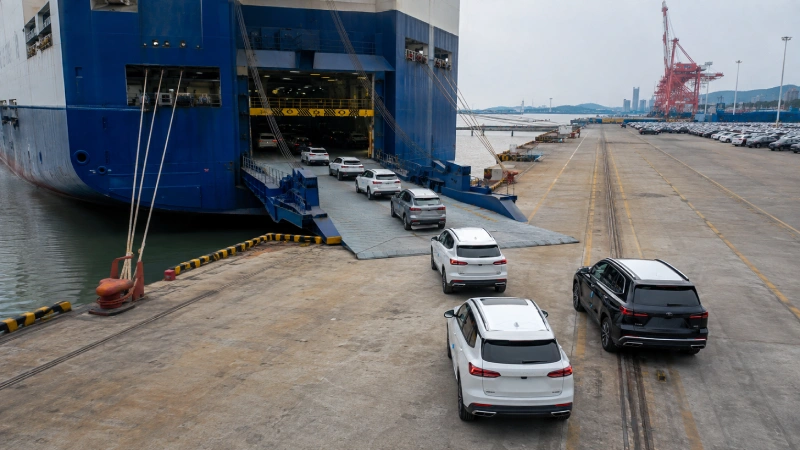
Roll-on/roll-off shipping is often suitable for running or towable cars, fleets, trucks, buses and wheeled equipment when a suitable route serves the destination.
Restrictions may cover vehicle condition, keys, fuel level, alarms, brakes, steering and loose items. Sailing frequency and port coverage may be lower than container services. High-value vehicles may need additional protection review.
See Winsail’s RoRo ocean freight guide for a more detailed explanation of this shipping method.
Container Shipping
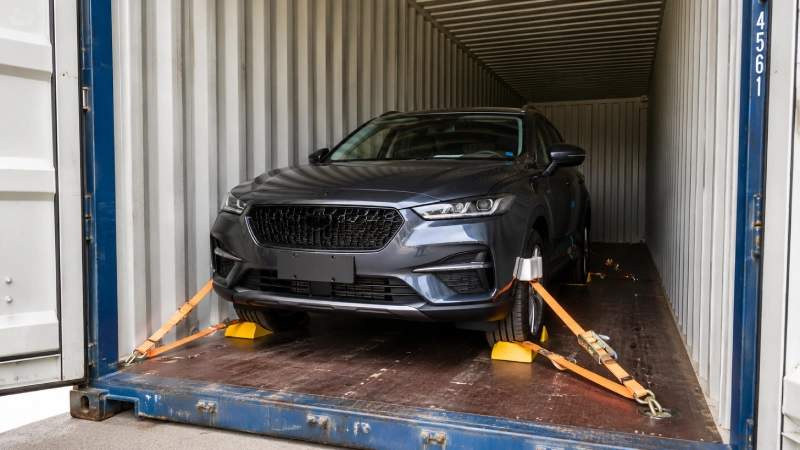
Containers provide enclosed handling and may suit high-value vehicles, small batches, multi-vehicle loading or approved vehicle-and-parts combinations.
Capacity cannot be determined from model names alone. Check exact dimensions, weight, container door height, ground clearance, loading angle and lashing plan.
See How Many Cars Fit in a Shipping Container.
Other Shipping Methods
Rail and multimodal services may serve Central Asia, Europe and selected inland markets, subject to route and terminal acceptance.
Flat rack, breakbulk and project transport suit oversized buses, special trucks and machinery. Air freight is normally reserved for urgent or exceptional high-value vehicles.
| Method | Best suited to | Main review |
|---|---|---|
| RoRo | Running vehicles and fleets | Route and terminal acceptance |
| Container | Protected or combined shipments | Dimensions and securing plan |
| Rail or multimodal | Selected inland corridors | Route and border conditions |
| Flat rack or breakbulk | Oversized units | Lifting and project approval |
| Air freight | Urgent exceptional cargo | Aircraft and DG approval |
How to Choose the Chinese Export Port
Ports commonly reviewed include Shanghai/Nangang, Taicang, Guangzhou Nansha or Xinsha, Tianjin, Qingdao, Ningbo, Xiamen and Lianyungang. No port is automatically best.
Compare the vehicle location, inland collection cost, RoRo or container schedule, carrier acceptance, dimensions, condition, terminal capability, destination, transshipment route, space and gate-in date.
A more distant port with a direct sailing may be better than a nearby port requiring expensive transshipment.
Step-by-Step Vehicle Shipping Process
- Confirm destination import and registration eligibility.
- Verify the seller, eligible exporter and vehicle identity.
- Collect VIN, specifications, dimensions, condition, propulsion and registration data.
- Confirm the applicable new-, used- or modified-vehicle export procedure.
- Compare RoRo, container and alternative routes.
- Obtain carrier and terminal acceptance.
- Arrange pickup, yard receiving, photographs and condition inspection.
- Complete container loading and lashing, or RoRo terminal delivery.
- Submit customs and shipping documents.
- Check the Bill of Lading.
- Track departure, transshipment and arrival.
- Complete destination clearance, inspection, registration and delivery.
| Party | Typical responsibility |
|---|---|
| Seller or exporter | Sale, vehicle identity and export-eligibility documents |
| Winsail or forwarder | Pickup, route review, booking, loading, customs coordination and tracking |
| Carrier or terminal | Formal acceptance, gate-in, handling and carriage |
| Destination agent | Arrival handling and customs coordination |
| Importer | Import permission, taxes, registration and local compliance |
Documents Required to Ship a Vehicle from China
Vehicle and Export Documents
These may include:
- VIN or chassis list
- Registration and ownership records where applicable
- Vehicle certificate or technical data
- Export licence where required
- Inspection or conformity records
- Supporting documents for used or modified vehicles
Commercial and Customs Documents
These usually include:
- Sales contract
- Commercial invoice
- Packing list
- Customs declaration
- Certificate of origin where required
Transport Documents
Depending on the shipment, these may include:
- Booking confirmation
- Bill of Lading
- Loading record
- Vehicle condition report
- Inspection photographs
- Insurance certificate
- Dangerous-goods documents when applicable
The exact names and scope depend on new or used status, propulsion type, shipping method, exporter, carrier and destination.
Special Requirements for Electric and Hybrid Vehicles
First distinguish BEV, PHEV, HEV, fuel-cell and conventional fuel vehicles.
The IMDG Code 2024 Edition, Amendment 42-24, became mandatory on January 1, 2026. A lithium-ion battery-powered vehicle may fall under UN3556; lithium-metal and sodium-ion vehicles use UN3557 and UN3558. Updated carrier guidance no longer permits the generic UN3171 entry for lithium- or sodium-ion-powered vehicles.
See the IMO IMDG Code page.
PHEVs and HEVs should not automatically be declared as UN3556. Classification depends on the actual propulsion system, battery and applicable provisions.
Shippers must disclose accidents, repairs, flood exposure, warning faults and suspected battery damage. A quotation is not formal carrier acceptance, and the origin, transshipment and destination ports may impose additional checks. Damaged or unstable batteries may be rejected.
For detailed requirements, read How to Ship Electric Cars from China by Sea.
How Much Does Vehicle Shipping from China Cost?
There is no reliable worldwide average price per vehicle. An accurate quotation should use this structure:
Total logistics cost = China pickup + export handling + inspection and document costs + loading and terminal charges + ocean or rail freight + insurance + destination charges
Pricing depends on:
- Make, model and year
- Quantity
- Dimensions and weight
- New or used status
- Propulsion system
- Running condition
- Accident damage or modifications
- Vehicle location in China
- Destination country and port
- RoRo, container or alternative method
- Cargo-ready date
- Required destination service
Confirm whether a quote covers port-to-port freight, origin charges, CIF, DAP or DDP service. Destination taxes, registration, storage and demurrage may remain outside the freight amount.
Transit Time and Schedule Planning
Total lead time includes vehicle preparation, document review, export licensing or used-vehicle processing, carrier approval, pickup, port delivery, waiting for departure, transit, transshipment, destination clearance and delivery.
Sailing time is not complete delivery time. RoRo departures may be less frequent than container sailings. EV pre-approval, document problems, congestion and transshipment can extend the schedule.
An estimated time of arrival is a planning estimate, not a guaranteed arrival date.
Inspection, Loading and Risk Control
Before handover, record the VIN, odometer, exterior and interior condition, dashboard warnings, keys, accessories, loose items, tyres, glass, underbody and battery enclosure. Keep dated photographs and receiving records.
For containers, check:
- Container door clearance
- Vehicle ground clearance
- Wheel restraints
- Approved lashing points
- Weight distribution
- Verified Gross Mass
For RoRo shipments, confirm driving or towing capability, brakes, steering, alarms, key handling and the terminal gate-in report.
Marine insurance should be reviewed according to the insured value, covered risks, exclusions, deductible and claims procedure. Insurance does not guarantee full payment for every type of loss.
Common Vehicle Shipping Mistakes
Avoid these common mistakes:
- Paying before destination eligibility is confirmed
- Using an unqualified vehicle exporter
- Treating a freight quote as carrier approval
- Allowing VIN inconsistencies between documents
- Hiding accident, flood or battery damage
- Assuming RoRo is always cheaper
- Assuming every 40HQ fits more vehicles
- Leaving unapproved items inside the vehicle
- Confusing China export clearance with destination registration
- Ignoring warranty, software or spare-parts compatibility
What Winsail Can—and Cannot—Coordinate
Winsail can coordinate China pickup, receiving, warehousing, photographs, route comparison, carrier and terminal enquiries, RoRo booking, container loading and lashing, export customs support, insurance arrangements, shipping documents, tracking and destination-agent communication where available.
Winsail cannot:
- Issue documents that must come from the vehicle manufacturer
- Replace an eligible automobile exporter
- Guarantee carrier acceptance of an abnormal vehicle
- Guarantee destination import approval or registration
- Guarantee overseas warranty or spare-parts supply
Clear responsibility boundaries help buyers identify risks before vehicle payment and freight booking.
FAQ About Vehicle Shipping from China
Can an individual ship a vehicle from China?
An individual may buy a vehicle, but qualified companies, licences or customs brokers may be required for export and import. Confirm both sides before payment.
Is RoRo or container shipping cheaper for cars?
It depends on the route, vehicle size, quantity, schedule and local charges. RoRo is not automatically cheaper on every shipping lane.
Can used cars be exported and shipped from China?
Yes, when exporter, registration, inspection and licence requirements are satisfied. Vehicles registered for 180 days or less need the additional manufacturer confirmation.
Can electric vehicles be shipped from China by sea?
Yes, subject to correct classification, complete condition disclosure, carrier approval and port requirements. Damaged or suspected defective batteries require separate review.
What documents are required to ship a car from China?
Typical records include vehicle and export documents, commercial invoice, packing list, customs declaration, Bill of Lading and any required inspection or dangerous-goods documents.
How many cars fit in a 20ft or 40ft container?
Capacity depends on exact dimensions, weight, container door height, ground clearance and the approved loading system. It cannot be confirmed from vehicle category alone.
Can non-running or accident-damaged vehicles be shipped?
Sometimes, but towing, lifting, terminal and safety conditions must be reviewed. Accident, flood, fire and battery damage must be disclosed before booking.
How long does vehicle shipping from China take?
It depends on document preparation, carrier approval, route, departure frequency, transit, transshipment and destination clearance, not only the sailing time.
